
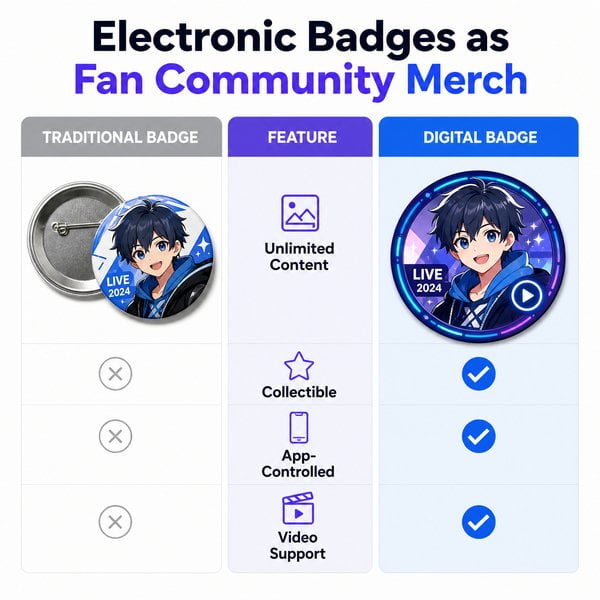
Why electronic badges are the ultimate merch for fan communities
Electronic Anime Badges (电子吧唧) — also sold as Digital Round Badges — are rapidly becoming the go-to merchandise for anime clubs, convention sellers, and fandom-driven retail because they combine emotional design, interactivity, and collectability. For buyers sourcing merch for fan communities, they offer a compelling mix of engagement, repeat-purchase potential, and margin-friendly manufacturing. This guide covers the concerns buyers raise most often: customization, costs, manufacturing specs, safety/compliance, logistics, and commercialization strategies.
Why choose electronic badges over traditional pins?
- Higher perceived value: LEDs, motion effects, sound, or NFC give fans a memorable experience that justifies premium pricing.
- Repeatability and drops: Electronic badges work well for limited drops, event exclusives, and seasonal releases — boosting urgency and secondary market trade.
- Branding and storytelling: Programmable features let you embed animations, short audio cues, or NFC links to exclusive content, increasing fan engagement beyond a static collectible.
- Differentiation at conventions: In crowded vendor halls, interactive merch stands out and draws crowds.
Market context — demand and growth
Buyers should evaluate electronic badges within the broader promotional and fandom merchandise markets. According to Grand View Research, the global promotional products market was valued at roughly USD 24 billion in 2021 and is expected to grow at a mid-single-digit CAGR through the decade — a sign that branded, novelty, and fan-oriented items remain a resilient segment. Statista and industry analyses also show that licensed and fandom-related merchandise has seen steady expansion as streaming and global fandoms scale, supporting higher demand for collectible and tech-enabled items.
Common buyer concerns — answered
1. Customization & artwork
Electronic badges support full-color printed faces (UV / digital print), domed epoxy, and clear acrylic lenses. Animated effects are handled by a small onboard controller; artwork is sent as flat art plus separated layers for LED regions. We recommend providing vector art (AI, EPS, or high-res PNG) and noting which areas should backlight or flash.
2. Minimum Order Quantities (MOQ) & pricing
MOQs depend on complexity. Simple single-LED badges commonly start at 500–1,000 pcs; multi-color programmable badges usually start at 1,000–3,000 pcs due to component costs and programming setup. Per-unit price varies widely by feature: basic light-only units can be under USD 2.50 in large runs; multi-effect or Bluetooth-enabled badges typically range USD 4–12+ depending on battery choice, casing materials, and software development.
3. Batteries, lifetime & shipping
Common power options:
- Non-replaceable coin cell (CR2032 / AG13): low cost, 100–200 hours of use.
- Replaceable coin cell: fan-friendly but adds a battery door and slightly higher cost.
- Rechargeable LiPo with micro-USB/USB-C: higher upfront cost, perceived premium.
Proper labeling and testing are required for lithium batteries; many customers choose replaceable coin cells where air-shipping restrictions are a concern. For rechargeable options, confirm UN38.3 and airline shipping limits with your supplier.
4. Quality control & certifications
Insist on RoHS and CE compliance for electronic components. For export to North America, check FCC/EMC if devices include radio modules (Bluetooth). Work with factories that allow third‑party QC inspections (pre-shipment, inline) and provide sample testing for LED lifetime and switch durability.
5. Intellectual property & licensing
Fan merch often uses copyrighted characters. Buyers are responsible for securing licenses from rights-holders. Factories can treat designs as confidential, but they cannot legally manufacture trademarked content without documented licensing — include this requirement in your purchase order and IP agreements.
Specifications comparison table
| Feature | Electronic Anime Badge (Basic) | Electronic Badge (Advanced) | Traditional Enamel Pin |
|---|---|---|---|
| Typical size | 50–75 mm round | 50–100 mm round | 20–50 mm |
| Power source | CR2032 coin cell (replaceable/non) | Rechargeable LiPo or coin cell | None |
| Lighting & effects | Single/multi LEDs, simple blink | RGB LEDs, animations, sound, NFC/Bluetooth | None |
| MOQ (typical) | 500–1,000 pcs | 1,000–3,000+ pcs | 100–500 pcs |
| Lead time (production) | 25–35 days | 35–60 days (assembly/programming) | 20–35 days |
| Compliance considerations | RoHS, CE | RoHS, CE, UN38.3 (if LiPo), FCC (wireless) | RoHS, metal plating certifications |
| Per-unit price (indicative) | USD 2.5–5 | USD 5–12+ | USD 0.8–3 |
Sourcing checklist for buyers
- Confirm IP/license rights in writing before prototyping.
- Ask for BOM and safety documentation (RoHS, CE, UN38.3 where applicable).
- Request samples with final electronics, not mock-ups.
- Plan tiered MOQ: test with a limited run, then scale to seasonal drops.
- Negotiate packaging that aligns with fandom presentation (window box, blister, or collector pouch).
- Arrange third‑party QC and factory audits if buying at scale.
Why source from Shenzhen / Toyvao
Shenzhen remains a global electronics manufacturing hub with fast prototyping, accessible component supply, and factories experienced in small-batch electronics and novelty items. Toyvao combines in-house tooling and electronics assembly, enabling tighter lead-times and integrated QC for interactive merch like electronic anime badges. This single-source approach reduces coordination overhead, shortens timelines for event-driven releases, and improves margins through optimized BOM and component sourcing.
FAQ
Q: What is the typical lead time for a first production run?
A: For a basic light-up badge, expect 25–35 days after artwork approval. Complex or Bluetooth-enabled units typically require 35–60 days to account for programming and additional testing.
Q: Can I get small sample units before committing to MOQ?
A: Yes. Factories can provide prototypes or small pre-production samples (often at higher unit cost) so you can test materials, electronics, and user experience before volume production.
Q: Are there restrictions on shipping electronic badges internationally?
A: Yes. Batteries, especially lithium rechargeable, are subject to air transport restrictions and may increase shipping costs. Many customers opt for replaceable coin cells to simplify compliance for air freight.
Q: What artwork files do you need?
A: Vector files (AI, EPS) are best. For printed photos, provide high-resolution PNG/TIFF at 300 dpi and include separate layers for LED-active areas and any cut lines.
Q: How do you handle IP/licensing for fan designs?
A: Buyers must provide documented proof of licenses or rights. Factories will require a written authorization and may refuse production for unlicensed content to avoid legal risk.
If you are ready to discuss specifications, request samples, or get a quote for electronic anime badges (电子吧唧), contact our sourcing team:
Email: sales@toyvao.com
WhatsApp: +86 186 8106 4480
