
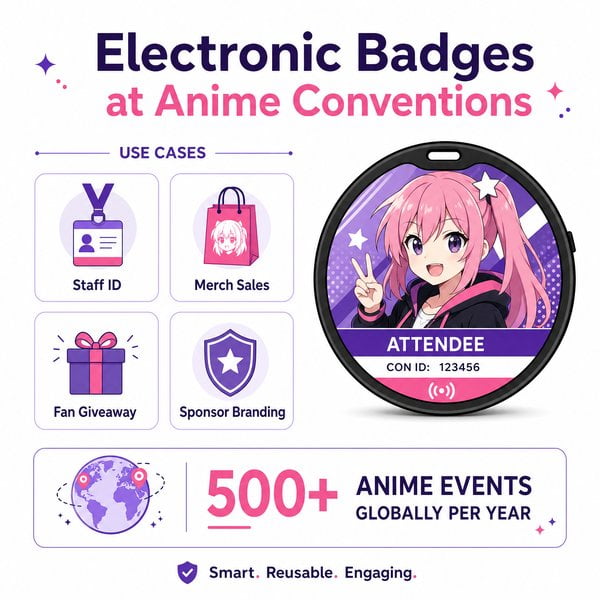
Why electronic anime badges matter for conventions
Electronic Anime Badges (电子吧唧) — also marketed as Digital Round Badges — are becoming a staple for anime conventions that want to improve attendee experience, increase sponsor value, and capture measurable marketing ROI. These small, wearable devices combine high-impact visuals (LED or LCD), interactive features (NFC/Bluetooth), and on-device data collection to turn a simple badge into a promotional channel, merch opportunity, and engagement tool.
Key buyer concerns and how to address them
1. Cost vs ROI
Buyers often worry about unit cost, especially for large attendee counts. Consider the badge as a multi-functional asset: sold as premium merch, used for sponsored exclusives, or rented for the event. Case studies across events show electronic badges can be monetized through limited-edition designs, sponsor placements, and integrated gamification to offset purchase costs.
2. Customization and branding
Conventions require different levels of customization: full-color artwork, animated sequences, sponsor logos, and attendee names. Ask suppliers for proof-of-concept tooling, on-device UI templates, and sample runs. Toyvao offers ODM/OEM packages allowing screen animations, custom backplates, and laser-engraved metal elements for premium feel.
3. Connectivity and features
- NFC for contactless check-in, exclusive content unlocks, and micro-payments.
- Bluetooth Low Energy (BLE) for proximity campaigns, real-time interaction tracking, and push notifications.
- Standalone LED/LCD animation only — lower cost but limited interactivity.
Choose the feature set that matches your event objectives: e.g., use NFC+BLE for interactive sponsor zones; LED-only badges are good for visual branding and collectible value.
4. Battery life and charging logistics
Battery life varies by display type and connectivity. Typical specs:
- LED animated badges: 8–24 hours depending on brightness and animation loop.
- LCD/OLED with intermittent BLE: 12–48 hours with optimized firmware.
Plan on in-hall charging hubs, swap stations, or removable batteries for multi-day events. Confirm supplier-provided battery certifications and safe transport documentation for air freight.
5. Durability, safety, and compliance
Buyers should require CE, RoHS, and UN38.3 (for lithium batteries) documentation. Also look for IP ratings if badges will be worn outdoors or at crowded events where moisture or spills are possible.
6. Minimum Order Quantity (MOQ), lead times and production
MOQs vary by supplier and complexity. Typical ranges from specialty manufacturers:
- Standard LED badge (single-color shell, simple animation): MOQ 500–1,000 units.
- Custom screen + NFC/BLE: MOQ 1,000–5,000 units.
Production lead times are 6–12 weeks for custom tooling; faster timelines possible for repeat SKUs. Negotiate sample and pilot runs to validate design before full production.
Marketing use cases at anime conventions
- Limited-edition collectible badges as paid merchandise — scarcity drives demand.
- Sponsor-branded interactive badges that unlock vendor discounts or in-hall AR experiences.
- Gamified attendee journeys: badge-triggered quests, scavenger hunts, leaderboard displays.
- On-site data capture: opt-in analytics for booth visits, session attendance, and content engagement.
- VIP/rental tiers: premium battery life, enamel backings, or integrated displays for influencer promotion.
Industry context and data
Understanding market trends helps justify investment. Two relevant data points:
- Wearable technology growth: Grand View Research estimated the global wearable technology market at approximately USD 116.2 billion in 2021, with projected double-digit CAGR over the next decade. This growth signals broad familiarity and acceptance of wearable devices as marketing platforms.
- Convention attendance scale: Major anime and pop-culture events attract six-figure audiences. For example, Statista reports that Anime Expo (Los Angeles), one of the largest anime conventions in North America, exceeded 110,000 attendees in pre-pandemic years — demonstrating the reach available to badge-based campaigns.
These data points highlight both the technical market momentum for wearables and the audience scale you can reach with badge-based marketing at major conventions.
Supplier checklist for sourcing electronic badges
When evaluating factories and partners, ask for:
- Sample units and firmware demo (NFC/BLE functionality).
- Certifications: CE, RoHS, UN38.3, FCC (if using BLE in North America).
- Production capacity and MOQ flexibility (pilot runs, staggered delivery).
- Customization options: artwork, animations, enclosure materials, packaging.
- On-site support or fulfillment services (pre-programming, attendee stuffing).
- Data security and privacy measures for any attendee data collected.
Specification comparison table (example)
| Feature | LED Collectible Badge | Interactive NFC Badge | Digital Round Badge (Full) |
|---|---|---|---|
| Display | LED matrix (color) | Single-color LED + NFC | 1.3″ round TFT LCD (full color) |
| Connectivity | None | NFC (ISO14443) | NFC + BLE |
| Battery life | 8–24 hours | 12–24 hours | 12–48 hours (power-saving firmware) |
| Typical MOQ | 500 units | 1,000 units | 1,000–5,000 units |
| Approx. unit cost (OEM est.) | Low | Medium | Medium–High |
| Use case | Collectible merch | Quick-ticket unlocks / freebies | Full marketing + data platform |
Best practices for deployment
- Run a pilot with 1–5% of attendees to validate user flows and battery performance.
- Provide clear opt-in language for data tracking and use transparent privacy policies.
- Design tiered offerings: free attendee badge, paid collectible, and VIP premium badge.
- Plan logistics: charging hubs, lost-badge policies, and staff training for field support.
- Measure KPIs: redemption rates, sponsor interactions, dwell time at booths, and merch sales.
Conclusion
Electronic Anime Badges/Digital Round Badges are powerful hybrid products: they function as merch, engagement tools, and data-gathering devices. For anime conventions seeking to elevate attendee experience and quantify marketing value, a well-specified badge program — backed by certification, pilot testing, and a supplier experienced in event hardware — delivers measurable returns.
FAQ
Q1: How long does it take to produce custom electronic badges?
A1: Typical lead time for a full custom run is 6–12 weeks after tooling approval. Pilot samples can be delivered in 2–4 weeks depending on component availability.
Q2: Can badges be reused across events?
A2: Yes — badges with durable shells and rechargeable batteries can be refurbished and reprogrammed. Consider rental or deposit-based models to encourage returns.
Q3: What data can badges collect and how is privacy managed?
A3: Badges can log opt-in proximity events, NFC taps, and session check-ins. All data collection should be opt-in and handled under GDPR/CCPA-compliant policies; anonymization and secure data transfer are recommended.
Q4: What are typical price ranges?
A4: Price depends on features: basic LED collectible badges are the least expensive; NFC/BLE-enabled full-color badges cost more. OEM pricing varies by MOQ; ask suppliers for detailed quotes based on specs.
Q5: Do you offer on-site support and pre-programming?
A5: Many manufacturers (including Toyvao) provide pre-programming, QA, and optional on-site technical support for large events. Confirm services during RFP.
Ready to source Digital Round Badges (电子吧唧) for your next convention? Contact Toyvao for product specs, MOQ, and a sample order:
Email: sales@toyvao.com
WhatsApp: +86 186 8106 4480
