
For global toy distributors, educational publishers, and B2B sourcing managers, China remains the undisputed global hub for manufacturing children’s electronic educational toys. Specifically, cities like Shenzhen and Dongguan in Guangdong Province house the world’s most advanced supply chains for intelligent early childhood hardware, including kids talking flashcard machines [1].
However, sourcing electronic educational devices from across the globe involves navigating a complex landscape of technical specifications, safety compliance, and manufacturing standards. Selecting the wrong factory or overlooking critical quality control checkpoints can result in costly product recalls, custom seizures, and damaged brand reputation.
To help B2B buyers establish a highly reliable, cost-effective, and fully compliant supply chain, this comprehensive sourcing guide outlines the essential technical, manufacturing, and regulatory factors to look for when sourcing kids’ flashcard machines from Chinese factories [1] [2].
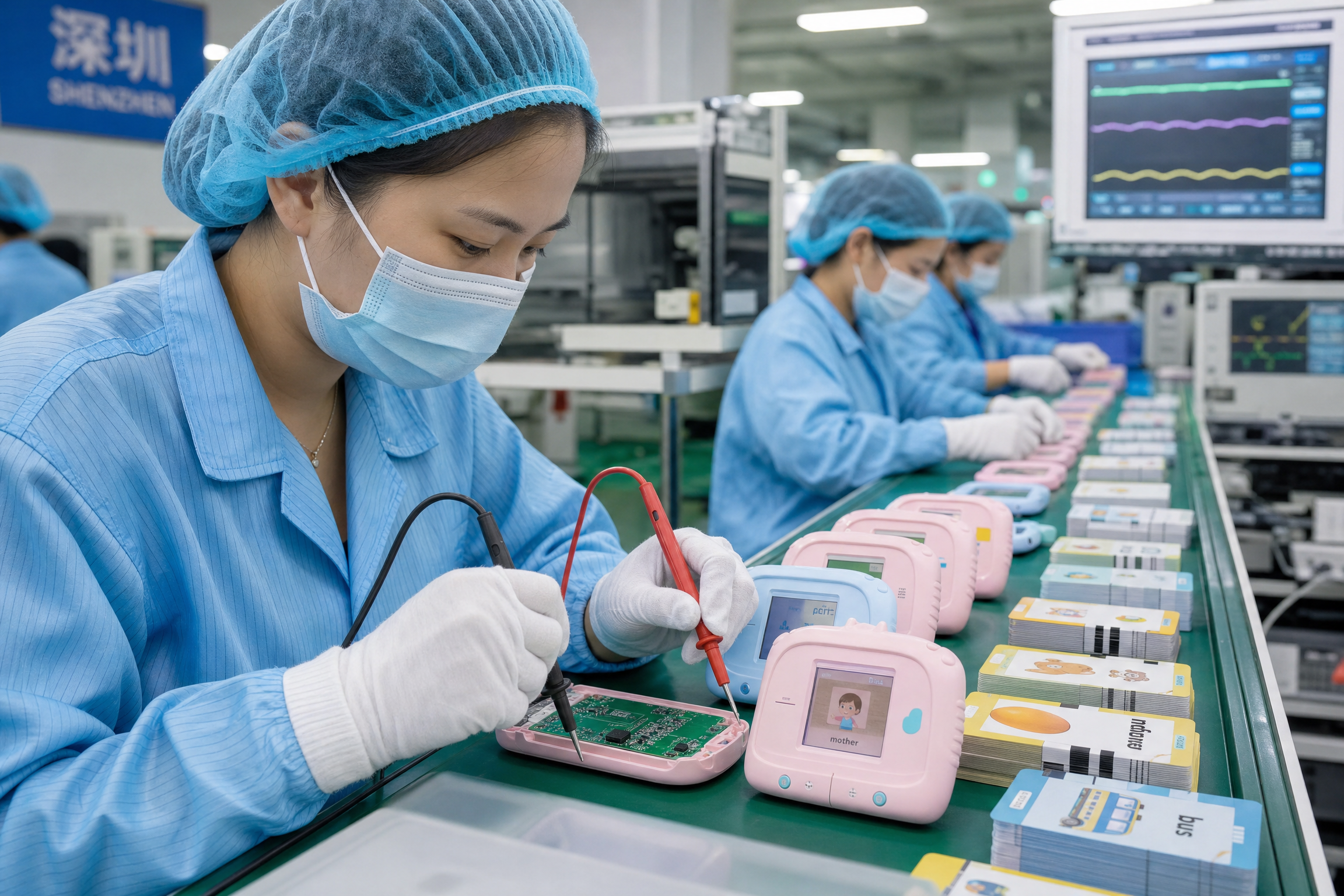
1. Sourcing Clusters: Why Shenzhen and Dongguan Lead the Industry
When sourcing electronic toys from China, geography matters. While other regions in China specialize in plastic toys (such as Chenghai in Shantou), Shenzhen and Dongguan are the global capitals for electronic educational hardware [1].
This region offers an unparalleled ecosystem where chip design houses, injection molding factories, high-speed SMT (Surface Mount Technology) assembly lines, and accredited testing laboratories operate within a 50-mile radius. This dense industrial cluster allows factories to rapidly prototype new designs, source high-grade electronic components at lower costs, and adapt to shifting regulatory requirements much faster than factories in other regions [1] [3].
For B2B importers, sourcing from a manufacturer located in the Shenzhen-Dongguan corridor ensures shorter lead times, superior hardware engineering, and easier factory audits [1].
2. Factory Audit Checklist: Identifying Genuine Manufacturers vs. Trading Companies
Many B2B buyers accidentally source from trading companies posing as factories on online directories. While trading companies have their place, sourcing directly from a genuine OEM/ODM manufacturer is critical for securing competitive pricing, direct quality control, and custom branding flexibility [1] [2].
Core Audit Verification Checkpoints:
- In-House SMT and Assembly Lines: A genuine manufacturer should own and operate their own SMT lines for PCB (Printed Circuit Board) assembly and dedicated, dust-free assembly lines for finished toys.
- ISO 9001 and BSCI Certifications: Verify that the factory is certified under ISO 9001 (Quality Management Systems) and has undergone a BSCI (Business Social Compliance Initiative) or ICTI (International Council of Toy Industries) social audit [2] [4].
- Dedicated R&D and Engineering Team: A professional factory must have in-house electronic, mechanical, and software engineers who can handle custom firmware programming, PCB layout design, and plastic mold modifications [1].
- Traceable Component Sourcing: Ensure the factory has established, audited relationships with certified battery cell suppliers, non-toxic ABS plastic suppliers, and FSC-certified paper mills [1] [5].
3. Technical Specifications: Sourcing High-Clarity and Kid-Proof Hardware
To protect your brand’s reputation on retail shelves and e-commerce platforms like Amazon, the hardware specifications must be thoroughly vetted. Cheap flashcard machines suffer from common technical failures that can be easily avoided by specifying the correct manufacturing standards.
Hardware Sourcing Checklist:
- Acoustic Fidelity (Audio IC): Demand a minimum of 16kHz sampling rate and 16-bit mono resolution using premium ADPCM or PCM audio chips. Muffled or robotic voices will lead to immediate customer returns [6].
- Reading Technology Accuracy: Ensure the reader utilizes a high-precision optical CIS (Contact Image Sensor) or an advanced barcode reader. Low-quality sensors will fail to read cards that are slightly bent or inserted at an angle [1].
- Type-C Rechargeable Battery Systems: Avoid dry battery systems (AAA) which increase long-term consumer costs. Specify built-in lithium-polymer (Li-Po) batteries (minimum 300mAh) equipped with a Type-C charging port and a certified Protection Circuit Module (PCM) to prevent overcharging [7].
- Casing Impact Resistance: The casing must be made of virgin, non-recycled ABS plastic with a wall thickness of at least 2.0mm to survive standard toy drop tests [1] [8].
4. B2B Reference Matrix: Evaluating Factory Capabilities
When requesting quotes (RFQs) from Chinese toy factories, use the following technical and operational matrix to evaluate and compare factory capabilities:
| Evaluation Dimension | Tier 3: Low-Cost Assembly Shop | Tier 2: Standard OEM Factory | Tier 1: Premium ODM Partner (Toyvao Standard) |
|---|---|---|---|
| Manufacturing Setup | Outsources SMT; basic manual assembly lines | In-house assembly; outsources PCB SMT | Fully integrated SMT, mold-making, and dust-free assembly |
| Quality Control (QC) | Basic visual inspection at end of line | IQC (incoming) and FQC (final) checks | IQC, IPQC (in-process), FQC, OQC, and in-house aging labs |
| Acoustic Standards | 8kHz audio, cheap paper speaker (<75dB) | 12kHz audio, standard speaker (75-80dB) | 16kHz high-fidelity, premium mylar speaker (80-85dB limit) |
| Battery Engineering | No PCM board; basic AAA battery setup | Basic Li-Po battery with single-IC protection | A-Grade certified Li-Po cell with Dual-IC Protection Board |
| Compliance & Lab Testing | No test reports; copies generic certificates | Basic CE/FCC reports from local labs | ASTM F963, EN71, CPSIA, CPC, RoHS from SGS/Intertek |
| ODM Customization | No custom design; stock molds only | Custom card printing; no hardware changes | Full custom molds, custom firmware, multi-language voiceover |
| MOQ & Lead Time | 3,000 units; 35-45 days | 2,000 units; 30-35 days | 1,000 units (Custom Logo); 20-25 days fast-turnaround |
5. Regulatory Compliance: The Ultimate Sourcing Gatekeeper
Importing electronic toys into premium markets without the proper, accredited test reports is a recipe for disaster. Customs authorities in the US and EU routinely seize non-compliant shipments, and platforms like Amazon will instantly suspend listings that lack verified safety documentation.
1. United States Market Requirements
All children’s toys imported into the US must have a Children’s Product Certificate (CPC) issued by the importer, based on passing test reports from a CPSC-accepted, third-party accredited laboratory [8]. The testing must cover:
* ASTM F963-23: Physical and mechanical hazards, flammability, and heavy metals in substrate materials [8].
* CPSIA Section 101: Lead content limits in accessible parts (under 100 ppm) [9].
* CPSIA Section 108: Phthalates limits (under 1,000 ppm for 8 specified phthalates) [9].
* FCC Part 15: Electromagnetic compatibility and radio frequency interference testing for electronic components [10].
2. European Union Market Requirements
To apply the CE Mark and legally sell toys in the EU, the product must comply with the Toy Safety Directive 2009/48/EC [11]. The required testing and documentation includes:
* EN 71 Parts 1, 2, and 3: Mechanical and physical properties, flammability, and migration of certain chemical elements [12].
* EN 62115: Safety standards specifically for electric toys [13].
* RoHS Directive 2011/65/EU: Restricts the use of lead, mercury, cadmium, and other hazardous substances in electronic components [14].
* REACH Regulation: Verifies the absence of Substances of Very High Concern (SVHC) in plastic and paper materials [15].
6. Sourcing Workflow: Toyvao’s 5-Step Risk-Free Sourcing Process
To ensure a seamless, high-quality sourcing experience for our global partners, Toyvao has engineered a highly structured, 5-step manufacturing and quality assurance workflow:
[Step 1: DFM & Prototyping] ──> [Step 2: SMT & PCB Testing] ──> [Step 3: Assembly & IPQC] ──> [Step 4: 100% Functional Test] ──> [Step 5: OQC & Shipping]
- Design for Manufacturing     - High-speed Yamaha SMT        - Dust-free assembly lines     - 100% sound & sensor test     - Outgoing Quality Control
- Custom voiceover recording   - Automated Optical Inspection - In-process quality checks    - 24-hour battery aging test   - Complete TCF/CPC assembly
- Step 1: Design for Manufacturing (DFM) & Voiceover: We review your custom branding requirements, perform a complete DFM analysis of the hardware, and record native voiceovers in our professional partner studios.
- Step 2: SMT & PCB Quality Control: We assemble the internal circuit boards using high-speed Yamaha SMT machines and perform AOI (Automated Optical Inspection) to ensure zero soldering defects.
- Step 3: Dust-Free Assembly & IPQC: The card readers are assembled in a dust-free environment, with IPQC (In-Process Quality Control) inspectors checking sensor alignment, speaker soldering, and casing fit at every stage.
- Step 4: 100% Functional & Battery Aging Tests: Every single completed device undergoes a 100% functional test (reading cards and checking volume) and is subjected to a 24-hour continuous battery charge-discharge aging test to guarantee cell stability.
- Step 5: OQC & Customs Documentation Assembly: Our OQC (Outgoing Quality Control) team performs final AQL (Acceptable Quality Level) sampling, packs the goods in heavy-duty export cartons, and compiles the complete CPC, MSDS, UN38.3, and CE compliance files for your shipment.
7. Partner with Toyvao: Your Trusted Shenzhen OEM/ODM Factory
Sourcing kids’ flashcard machines from China does not have to be a high-risk venture. By partnering with a professional, engineering-focused manufacturer like Toyvao, you secure direct access to top-tier hardware, strict international compliance, and a highly optimized supply chain.
Secure your supply chain with a premier Shenzhen manufacturer. Contact Toyvao’s B2B sourcing and engineering desk today to request factory audit reports, product samples, and a customized wholesale quotation.
- Inquiry & Sales: sales@toyvao.com
- Compliance & Engineering: engineering@toyvao.com
- Direct Line / WhatsApp: +86 186 8106 4480
- Factory Address: Toyvao Industrial Park, Bao’an District, Shenzhen, China
- Official Website: https://toyvao.com/
References
[1] Toyvao Manufacturing Group. (2026). B2B Toy Sourcing and Quality Control Engineering Manual. Toyvao Factory Internal Documentation.
[2] China Toy & Juvenile Products Association (CTJPA). (2024). White Paper on the Export and Sourcing of Chinese Educational Toys. http://www.tjpa-china.org/
[3] Shenzhen Electronic Chamber of Commerce (SECC). (2025). Annual Report on the Supply Chain Dynamics of Intelligent Educational Hardware in Shenzhen.
[4] Amfori. (2024). BSCI Code of Conduct and Auditing Guidelines for Consumer Goods Manufacturers. https://www.amfori.org/
[5] Forest Stewardship Council (FSC). (2023). FSC Principles and Criteria for Sustainable Paper Sourcing in Toy Manufacturing. https://fsc.org/
[6] Audio Engineering Society (AES). (2024). Acoustic Clarity and High-Fidelity Standards for Early Childhood Educational Devices. https://www.aes.org/
[7] International Electrotechnical Commission (IEC). (2023). IEC 62133-2: Safety Requirements for Portable Sealed Secondary Lithium Cells. https://www.iec.ch/
[8] U.S. Consumer Product Safety Commission (CPSC). (2024). Toy Safety Business Guidance: ASTM F963-23 and the Children’s Product Certificate (CPC). https://www.cpsc.gov/
[9] U.S. Consumer Product Safety Commission (CPSC). (2024). CPSIA Lead and Phthalates Limits for Children’s Products. https://www.cpsc.gov/
[10] Federal Communications Commission (FCC). (2024). Part 15 Radio Frequency Devices – Electromagnetic Compatibility Guidelines for Electronic Toys. https://www.fcc.gov/
[11] European Commission. (2024). Toy Safety Directive 2009/48/EC – Legislative Guidance for Importers. https://ec.europa.eu/
[12] European Committee for Standardization (CEN). (2025). EN 71: Safety of Toys – Parts 1, 2, and 3. https://www.cen.eu/
[13] European Committee for Electrotechnical Standardization (CENELEC). (2025). EN 62115: Electric Toys – Safety and Heating Specifications. https://www.cenelec.eu/
[14] European Commission. (2023). RoHS Directive in Electrical and Electronic Equipment – Toy Sourcing Compliance. https://ec.europa.eu/
[15] European Chemicals Agency (ECHA). (2024). REACH Candidate List of Substances of Very High Concern for Authorisation. https://echa.europa.eu/
