
For toy wholesalers, educational brand owners, and B2B sourcing managers, the toddler learning category represents one of the fastest-growing sectors in the global toy industry. Within this segment, talking flash card machines—also known as interactive card readers or audible sensory toys—have emerged as a dominant product line.
These devices bridge the gap between traditional flash cards and screen-free digital learning, making them a staple in early childhood classrooms and modern households alike. However, with hundreds of manufacturers offering varying levels of quality, choosing the right talking flash card machine to represent your brand or stock in your retail chain is a critical decision.
A poorly constructed device with low-fidelity audio, fragile card stock, or non-compliant battery systems can lead to high return rates, negative brand reviews, and customs clearance delays. This comprehensive B2B sourcing guide outlines the essential engineering, educational, and safety criteria required to select the best talking flash card machine for toddlers [1].
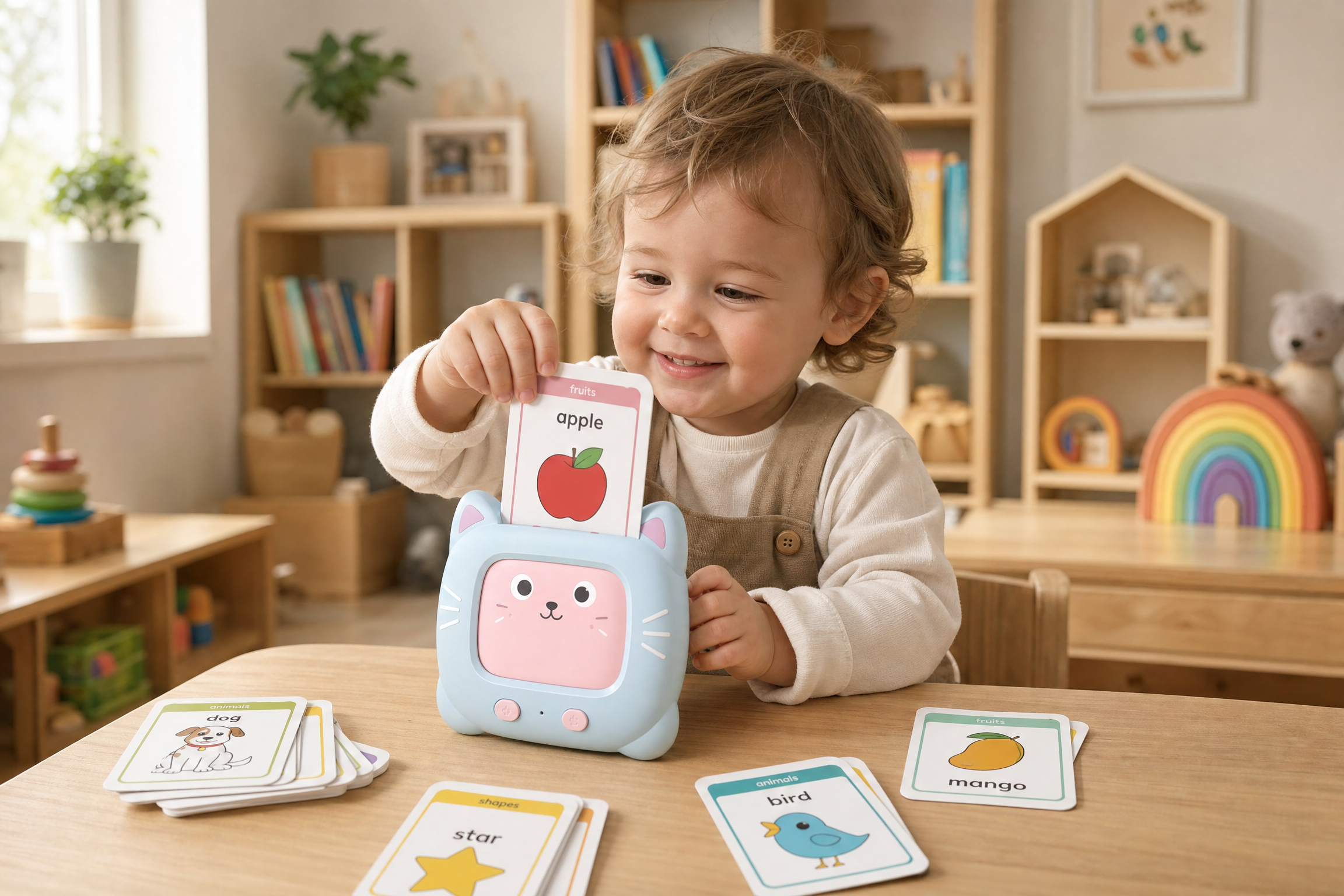
1. Why Are Talking Flash Cards the Ultimate Screen-Free Learning Tool?
Early childhood educators and pediatricians consistently warn against excessive screen time for children under the age of five. According to the World Health Organization (WHO), sedentary screen time should be limited to less than one hour per day for toddlers, with younger infants receiving zero screen exposure [2].
Talking flash card machines offer a highly interactive, sensory-rich alternative. By combining visual illustrations with auditory pronunciation and realistic sound effects (such as an animal’s roar or a vehicle’s horn), these devices stimulate multiple neural pathways simultaneously [3].
This multisensory approach accelerates vocabulary acquisition, cognitive association, and fine motor skills (as toddlers practice inserting cards into the slot). For B2B buyers, importing screen-free educational toys aligns perfectly with current global consumer trends prioritizing developmental health and digital detox for toddlers [1] [3].
2. Audio Quality: The Crucial Metric for Language Development
The primary function of a talking flash card machine is to teach toddlers correct pronunciation. If the audio chip delivers muffled, distorted, or low-bitrate sound, the device defeats its educational purpose and can actually hinder language development [4].
Key Audio Sourcing Specifications:
- High-Fidelity Audio Chips: Ensure the manufacturer uses audio ICs that support at least 16kHz sampling rate and 16-bit mono resolution. Cheap devices often utilize 8kHz, 8-bit compression, resulting in “scratchy” or robotic voices [4].
- Professional Voice Talents: The voiceover must be recorded by native speakers in a professional studio. For English-learning cards, standard American or British accents with clear, expressive, and slow enunciation are mandatory [1] [4].
- Premium Speaker Components: Sourcing devices with 8-ohm, 0.25W or 0.5W high-quality mylar speakers ensures crisp sound reproduction, especially for high-frequency consonants (such as “s,” “t,” and “p”) which are critical for early language learners [4].
- Safe Decibel Limits: Under ASTM F963 and EN 71-1, the sound pressure level of toys must be strictly controlled to protect sensitive toddler ears. The volume must not exceed 85dB when measured at a distance of 50 centimeters [5] [6].
3. Card Durability and Safety: Sourcing Kid-Proof Materials
Toddlers do not handle toys gently. They bend, chew, drool on, and tear paper products. Therefore, the quality of the flash cards is just as important as the electronic reader itself.
Core Card Manufacturing Standards:
- Heavyweight Card Stock: The cards should be made from at least 350gsm (grams per square meter) or 400gsm double-sided copper paper to prevent easy bending and creasing [1].
- Non-Toxic Matte Lamination: Every card must be coated with a double-sided, food-grade matte lamination. This provides water resistance (protecting against drool or spills) and eliminates harsh glare under room lights, protecting the child’s vision [1] [5].
- Rounded Corners: Sharp paper edges can cause painful paper cuts on delicate toddler skin. All cards must be die-cut with generously rounded corners (radius of at least 5mm) [5].
- Soy-Based Inks: The printing must utilize eco-friendly, non-toxic soy-based inks rather than traditional petroleum-based inks, ensuring the cards are completely safe if a toddler accidentally puts them in their mouth [5].
4. B2B Selection Matrix: Comparing Product Grades
When sourcing talking flash card machines from an OEM/ODM factory, you will encounter different tiers of product specifications. The table below serves as a reference matrix to help you select the appropriate product grade based on your target market, brand positioning, and budget:
| Feature / Specification | Standard Grade (Economy Market) | Toyvao Premium Grade (High-End Retail) | Pro Smart Grade (AI & Interactive) |
|---|---|---|---|
| Audio Resolution | 8kHz, 8-bit ADPCM (compressed) | 16kHz, 16-bit PCM (high-fidelity) | 22kHz, 16-bit Hi-Fi Stereo |
| Speaker Type | Cheap paper cone speaker | Premium mylar speaker (8Ω, 0.25W) | High-fidelity chamber speaker |
| Power Source | AAA dry batteries (not included) | Rechargeable Li-Po battery (300mAh) | Rechargeable Li-Po battery (500mAh) |
| Charging Interface | Micro-USB or none | Type-C (modern, fast-charging) | Type-C with fast charge |
| Card Materials | 300gsm paper, basic lamination | 350gsm copper paper, matte food-grade | 400gsm tear-resistant synthetic card |
| Reading Technology | Basic optical bar-code reader | Precision high-speed CIS sensor | Advanced RFID / NFC contactless |
| Safety Certification | Basic CE / FCC | ASTM F963, EN71, CPSIA, CPC, RoHS | ASTM, EN71, REACH, UL2054 |
| B2B Sourcing MOQ | 3,000 units | 1,000 units (Custom Logo) | 500 units |
| Ideal For | Dollar stores, budget promotional | Educational brands, Amazon, premium retail | High-tech educational institutions |
5. Technology Behind the Magic: Optical Sensors vs. RFID
How does the machine know what word is on the card? Understanding the underlying reading technology is essential for B2B buyers evaluating factory capabilities.
1. Optical Barcode / CIS Sensor Technology (Most Popular)
The vast majority of talking flash card readers use high-precision optical sensors. The cards are printed with a microscopic, invisible barcode or a specific pattern of carbon-ink lines on the insertion strip. When the card is inserted, the internal sensor reads the pattern and triggers the corresponding audio file stored on the chip.
* Pros: Extremely cost-effective, lightweight cards, highly reliable, and supports hundreds of cards without adding weight or cost to the package [1].
* Cons: The card’s insertion edge must remain clean and unbent; if the barcode is severely damaged or dirty, the sensor may misread the card.
2. RFID / NFC Contactless Technology (Next-Generation)
In high-end educational models, micro-RFID chips are embedded directly inside each card. The toddler simply taps or places the card near the reader to activate the sound.
* Pros: 100% dust-proof, works even if the card is completely crumpled or chewed, and allows for interactive multi-card matching games.
* Cons: Significantly higher manufacturing costs, thicker cards, and requires compliance with local wireless radio regulations (such as FCC ID or RED certification) [1] [7].
6. Sourcing Compliance Checklist for B2B Importers
Before placing a wholesale order for talking flash card machines, ensure your manufacturing partner can provide the following compliance documents to guarantee a smooth customs clearance process:
- Children’s Product Certificate (CPC): Mandatory for importing children’s toys into the United States, backed by an accredited third-party test report (CPSC-accepted lab) [5].
- EC Declaration of Conformity (DoC): Mandatory for European Union imports, certifying compliance with the Toy Safety Directive 2009/48/EC and EN 62115 [6].
- RoHS and REACH Reports: Verifies that all electronic components, plastic casings, and battery terminals are free from restricted hazardous chemicals, heavy metals, and phthalates [8].
- UN38.3 & MSDS (Material Safety Data Sheet): Absolutely required for shipping devices containing internal rechargeable lithium batteries by air or sea freight [9].
7. Partner with Toyvao: Your Premier Talking Flash Cards Manufacturer
As an engineering-first, CPSC-audited factory in Shenzhen, Toyvao specializes in manufacturing premium-grade, highly compliant talking flash card machines for leading global educational brands.
We offer complete OEM/ODM customization services, including custom plastic mold designs (such as cute animals or branded shapes), multi-language voice recording (English, Spanish, French, Arabic, German, Japanese, and more), custom-illustrated card decks, and retail packaging design [1].
Elevate your educational product line. Contact Toyvao’s sourcing and product development team today to receive a free catalog, custom samples, and a competitive wholesale quotation.
- Inquiry & Sales: sales@toyvao.com
- Compliance & Engineering: engineering@toyvao.com
- Direct Line / WhatsApp: +86 186 8106 4480
- Factory Address: Toyvao Industrial Park, Bao’an District, Shenzhen, China
- Official Website: https://toyvao.com/
References
[1] Toyvao Manufacturing Group. (2026). B2B Toy Sourcing and Quality Control Engineering Manual. Toyvao Factory Internal Documentation.
[2] World Health Organization (WHO). (2019). Guidelines on Physical Activity, Sedentary Behaviour and Sleep for Children Under 5 Years of Age. Geneva: World Health Organization. https://www.who.int/
[3] National Institute on Deafness and Other Communication Disorders (NIDCD). (2023). Speech and Language Developmental Milestones in Toddlers. U.S. Department of Health and Human Services. https://www.nidcd.nih.gov/
[4] Audio Engineering Society (AES). (2024). Standards for Digital Audio Sampling and Acoustic Clarity in Educational Hardware. https://www.aes.org/
[5] U.S. Consumer Product Safety Commission (CPSC). (2024). Toy Safety Business Guidance: ASTM F963-23 and CPSIA Compliance. https://www.cpsc.gov/
[6] European Committee for Standardization (CEN). (2025). EN 71-1: Safety of Toys – Part 1: Physical and Mechanical Properties. https://www.cen.eu/
[7] Federal Communications Commission (FCC). (2024). Equipment Authorization and RF Exposure Compliance for Low-Power Electronic Toys. https://www.fcc.gov/
[8] European Chemicals Agency (ECHA). (2023). REACH and RoHS Restrictions on Phthalates and Heavy Metals in Children’s Plastics. https://echa.europa.eu/
[9] International Air Transport Association (IATA). (2024). Lithium Battery Shipping Regulations (UN38.3 and MSDS Requirements). https://www.iata.org/
Related Articles:
Useful Resources:
