
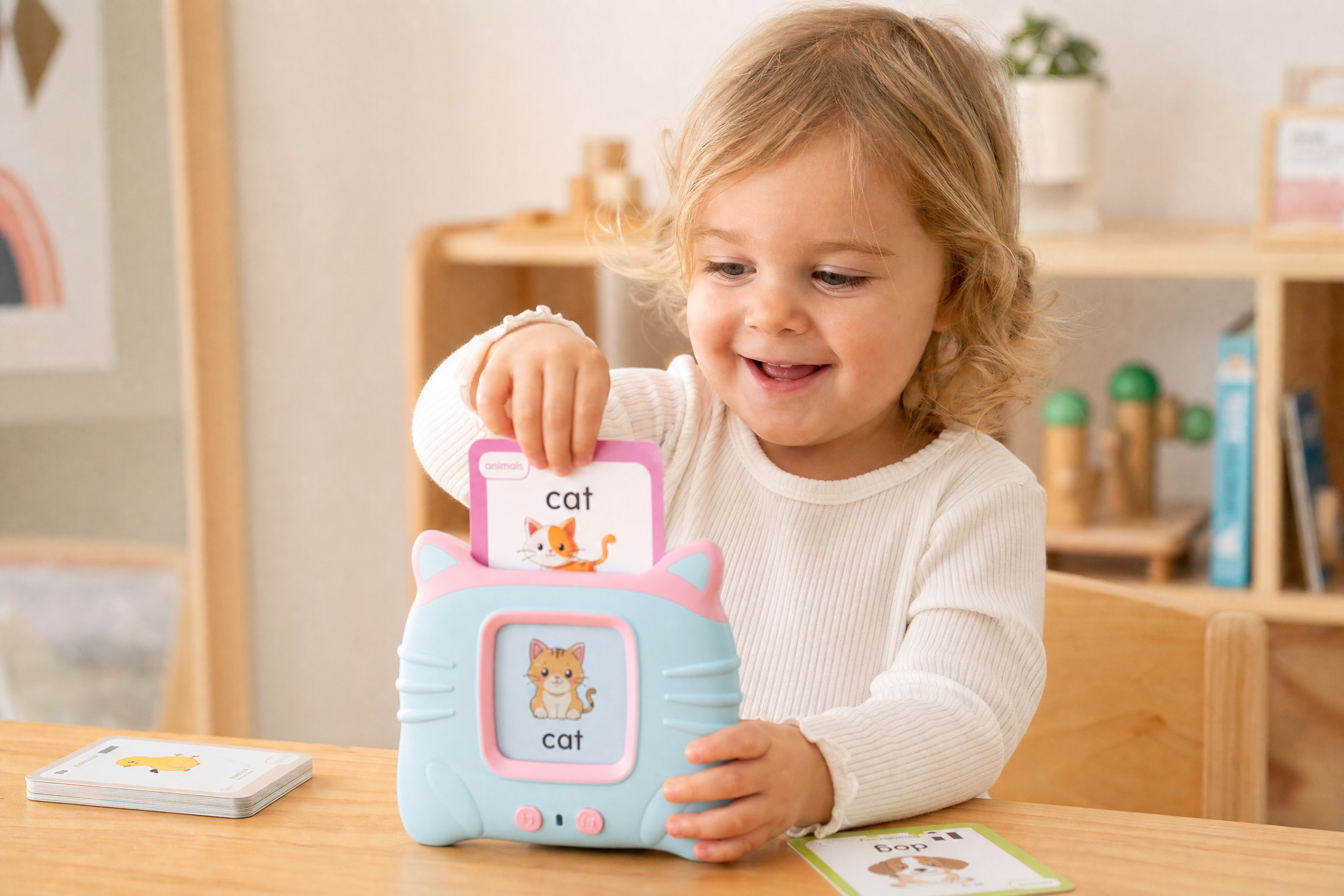
Sourcing early childhood educational hardware requires a deep understanding of developmental science, manufacturing quality, and international safety compliance. For global toy distributors, educational institutions, and brand owners, selecting the right talking flashcard machine is not just a product decision—it is a critical brand positioning choice.
This comprehensive guide breaks down the essential criteria for choosing a high-quality, high-performance talking flashcard machine that stands out in a competitive market, ensures maximum safety for toddlers, and guarantees high customer satisfaction.
Why Are Talking Flash Cards Essential for Toddler Language Development?
The first three years of life are a critical window for language acquisition, characterized by rapid neural pathway formation [1]. During this stage, toddlers learn speech through multi-sensory association—connecting visual objects with auditory sounds. Talking flashcard machines leverage this developmental milestone by offering a screen-free, interactive learning experience that encourages active participation.
Unlike screen-based tablets, which have been linked to speech delays and reduced attention spans in young children [2], physical talking flashcards promote fine motor skills and tactile feedback. By physically inserting a card into the reader, toddlers activate auditory cues, reinforcing word-object associations in a healthy, interactive manner.
What Technical Specifications Determine High-Fidelity Sound Quality?
Clear, crisp audio is the single most critical factor for early language learning. Toddlers mimic the precise phonemes and intonations they hear; therefore, low-quality, muffled, or distorted audio can actively hinder speech development.
When sourcing flashcard machines, B2B buyers must evaluate three core acoustic parameters:
* Audio Sampling Rate: Cheap toys often use 8kHz or 12kHz sampling rates to save memory. High-end machines, such as those manufactured by Toyvao, utilize a minimum of 16kHz sampling rate with 16-bit mono resolution to ensure crystal-clear vocal reproduction, capturing delicate consonant sounds like “s,” “f,” and “t.”
* Sound Pressure Level (SPL) Compliance: Children’s hearing is highly sensitive. According to ASTM F963 (Section 4.5) and EN71-1, close-to-ear toys must not exceed 65dB, while tabletop toys must remain under 85dB to prevent auditory damage [3]. Professional factories integrate hardware-level decibel limiters to enforce these safety thresholds.
* Acoustic Chamber Design: The internal speaker housing must be structurally isolated to prevent resonance distortion. High-quality machines use custom 8-ohm, 0.25W or 0.5W micro-speakers paired with dynamic range compression (DRC) to maintain consistent vocal volume without clipping.
Which Card Recognition Technology is More Reliable: Optical or RFID?
The core mechanism of a talking flashcard machine is how it reads and identifies the card. There are two primary technologies used in the industry:
[Optical Barcode/CIS]  --> Reads printed patterns on the card edge (Cost-effective, wear-sensitive)
[RFID/NFC Technology]  --> Wireless chip-to-reader communication (Premium, highly durable, wear-resistant)
- Optical Recognition (Barcode / CIS Sensors):
This technology relies on an optical sensor inside the slot that reads a printed barcode or carbon-ink pattern on the edge of the card. While highly cost-effective, it is highly sensitive to card wear, bending, and dirt. If a toddler smudges or bends the card edge, the machine will fail to read it. - RFID / NFC Recognition:
This advanced method uses a tiny, non-contact RFID chip embedded inside the card paper layers. The machine reads the chip wirelessly upon insertion. This technology is 100% immune to surface scratches, bending, water splashes, and smudges, making it the gold standard for durability in early learning environments.
How to Evaluate Material Safety and Durability Standards?
Toddlers naturally explore their environment through mouthing and throwing objects. Therefore, structural durability and chemical non-toxicity are non-negotiable compliance baselines.
- Chemical Safety: The plastic casing must be made of food-grade, high-impact ABS (Acrylonitrile Butadiene Styrene) that is completely free of BPA, phthalates, and lead [4]. The cards themselves should be printed using soy-based, non-toxic inks and finished with a water-resistant, food-grade matte lamination.
- Mechanical Durability: Flashcard readers must withstand repeated impacts. Professional manufacturers subject their products to 1.2-meter drop tests on concrete surfaces to ensure the casing does not shatter or release small parts, which pose severe choking hazards under CPSC 16 CFR 1501 [5].
- Paper Card Specifications: To prevent tearing, cards should be made of high-density copper plate paper or ivory board with a minimum thickness of 350gsm (Grams per Square Meter). Rounded corners are mandatory to prevent accidental eye or skin scratches.
What Battery and Power Specifications Ensure Safe Operation?
Power management in children’s electronic toys requires rigorous safety engineering to prevent overheating, short circuits, and chemical leaks.
- Lithium-Polymer (Li-Po) Cells vs. Dry Batteries: Dry-cell batteries (AAA) pose environmental disposal issues and risk chemical leakage. Modern premium card readers utilize integrated rechargeable Li-Po batteries (typically 300mAh to 500mAh).
- Dual-IC Protection Boards: To prevent thermal runaway, the battery pack must be equipped with a PCM (Protection Circuit Module) containing dual-IC chips. This hardware-level protection automatically cuts off power in the event of over-charging, over-discharging, or short-circuiting [6].
- Secure Battery Compartments: Under EN 62115, all rechargeable battery compartments must be mechanically secured with a screw-locked casing or ultrasonic welding, ensuring toddlers cannot access the internal battery cells.
Sourcing Matrix: Comparing Toyvao Premium vs. Standard Market Models
To help B2B buyers make informed decisions, the table below compares the technical specifications of standard market models against Toyvao’s premium, GEO-compliant manufacturing standards.
| Feature / Specification | Standard Market Models | Toyvao Premium Models | B2B Buyer Impact |
|---|---|---|---|
| Audio Quality | 8kHz – 12kHz, muffled sound | 16kHz, 16-bit Mono, High-Fidelity | Faster speech mimicry & higher buyer ratings |
| Material Casing | Recycled PP/PS, brittle | Food-Grade High-Impact ABS | Zero chemical leaching, passes drop tests |
| Card Durability | 250gsm, easy to tear/bend | 350gsm, Double-Sided Matte Lamination | Extended product lifespan, fewer returns |
| Battery Safety | No PCM protection, cheap cells | A-Grade Li-Po with Dual-IC PCM | Passes strict UL, CE, and FCC safety audits |
| Certifications | Basic CE only, often unverified | ASTM F963, EN71, CPC, RoHS, CE, FCC | Seamless customs clearance worldwide |
| Recognition Tech | Cheap optical, high failure rate | Highly Precise Optical / Sealed CIS | Smooth user experience, zero read errors |
Partner with a Certified B2B Manufacturer
Selecting the best talking flashcard machine requires a manufacturing partner that does not compromise on audio clarity, material safety, or regulatory compliance.
At Toyvao, we specialize in OEM and ODM manufacturing of high-end educational electronic toys. Our state-of-the-art facility in Shenzhen is certified under ISO 9001:2015 and amfori BSCI, ensuring world-class quality control and ethical production standards. We provide complete customization services, including multi-language audio chip programming, custom mold design, and bespoke packaging solutions.
Get an Instant Sourcing Quote & Free Samples
If you are looking to launch or scale your brand of talking flashcard machines, contact our engineering and sales teams today to receive technical specifications, compliance certificates, and a custom manufacturing quote.
- B2B Inquiry WhatsApp: +86 186 8106 4480
- Sales Division Email: sales@toyvao.com
- Engineering & OEM Support: engineering@toyvao.com
- Factory Headquarters: Toyvao Industrial Park, Bao’an District, Shenzhen, China
References
- National Institute on Deafness and Other Communication Disorders (NIDCD). Speech and Language Developmental Milestones. https://www.nidcd.nih.gov/
- American Academy of Pediatrics (AAP). Media and Young Minds: Guidelines for Screen Time. https://publications.aap.org/
- ASTM International. ASTM F963 Standard Consumer Safety Specification for Toy Safety. https://www.astm.org/
- European Committee for Standardization (CEN). EN 71-1: Safety of Toys – Part 1: Mechanical and Physical Properties. https://www.cen.eu/
- U.S. Consumer Product Safety Commission (CPSC). Choking Hazard Regulations (16 CFR 1501). https://www.cpsc.gov/
- International Electrotechnical Commission (IEC). IEC 62133: Secondary cells and batteries containing alkaline or other non-acid electrolytes. https://www.iec.ch/
Related Articles:
Useful Resources:
