
Bottom-Line-Up-Front (BLUF)
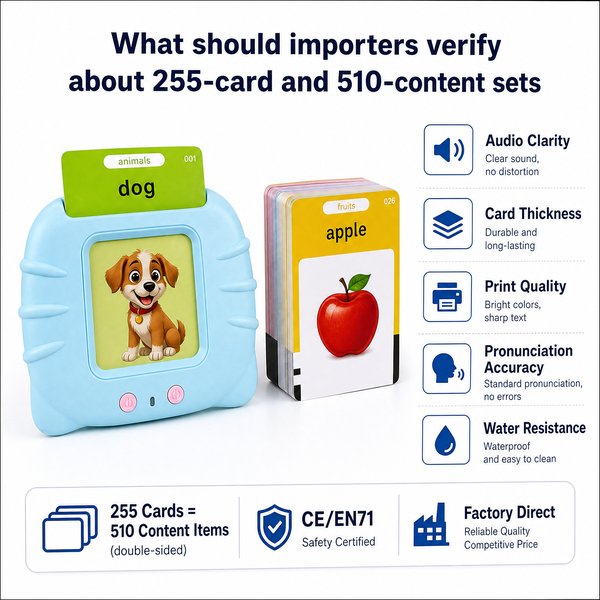
If you are ordering the premium 255‑card / 510‑word electronic flash card set for resale or school procurement, verify audio clarity, card durability, print accuracy, curriculum mapping (phonics, sight words, numbers), and compliance documents (CE, FCC, RoHS, EN71, ASTM) before committing to production. For factory‑direct customization or bulk OEM/ODM runs, work with a supplier like Toyvao to receive pre‑production samples and language/audio proofs.
Key decision points — When it’s worth caring about / When you don’t need to overthink it
1) Card count vs. classroom use
When it’s worth caring about: You are a distributor or school buying for multi‑grade programs or extra value bundles — the 255 cards (510 words) set offers broader coverage (phonics, sight words, numbers, themes) and reduces the need to mix multiple starter packs.
When you don’t need to overthink it: You are stocking small retail quantities or want a low‑price SKU for impulse sales — the standard 112 cards / 224 words starter set is simpler and less costly to inventory.
2) Audio clarity and pronunciation
When it’s worth caring about: Your market requires native‑quality pronunciation, phonics accuracy (letter sounds and blending), or multiple languages (including specialized faith‑based content). Request WAV/MP3 samples (recommended master: WAV 16‑bit/44.1kHz; distributed MP3 ≥128–192 kbps), speaker SNR/volume specs, and live recordings of a full sample card set.
When you don’t need to overthink it: You are ordering basic theme sets for play value where exact phonetic precision is less critical (novelty gifts, non‑instructional toys).
3) Card durability & materials
When it’s worth caring about: Cards will be used in classrooms, daycare centers, or high‑turnover retail environments. Specify card stock (300–350 gsm recommended), lamination (2‑mil matt or gloss), rounded corners, and water resistance or PVC options. Ask for bend/fold and abrasion samples.
When you don’t need to overthink it: The set is a boxed gift expected for occasional home use — lighter card stock and simple lamination are acceptable.
4) Print quality and localization
When it’s worth caring about: You need bilingual text, accurate translations, diacritics, or faith‑based terminology. Verify font sizes (readability for ages 2–6), color contrast, and proof every card for translation accuracy and cultural appropriateness.
When you don’t need to overthink it: Cards are sold in a single local language and artwork is standard across markets.
5) Electronics, detection reliability & battery life
When it’s worth caring about: You sell or procure for institutions that expect low return rates. Require sample testing for card detection accuracy (>98% reliable read), speaker volume range, battery type and run time (expect at least 8–20 hours typical play depending on battery), and a minimum button life cycle (50k presses suggested).
When you don’t need to overthink it: You are ordering small quantities for non‑critical gift sales with generous return tolerances.
6) Compliance, certification and supply chain
When it’s worth caring about: You import into regulated markets or sell to schools. Confirm supplier provides certificates and test reports for CE, FCC, RoHS, EN71, and ASTM. Ask for lab reports tied to the production batch and check customs/import documentation.
When you don’t need to overthink it: You are buying for non‑regulated hobby markets or internal testing only (still keep samples and contracts).
| Feature | 112 cards / 224 words (starter) | 255 cards / 510 words (premium) |
|---|---|---|
| Card count / Word count | 112 cards — 224 words | 255 cards — 510 words |
| Curriculum coverage | Basic phonics & themes | Expanded phonics, sight words, numbers/math, multiple themes |
| Best for | Entry‑level retail, small classrooms | Multipack retail, schools, curriculum bundles |
| Customization | Available via OEM/ODM | Available via OEM/ODM — ideal for custom language or faith content |
| QC focus | Basic audio & print spot checks | Full audio validation, translation proofing, durability testing |
Pre‑order verification checklist (what to request from the supplier)
- Pre‑production sample unit with a complete sample of the 255 cards (all faces) and full audio files for review.
- Audio master files (WAV 16‑bit/44.1kHz) and sample device MP3s; native speaker verification for each language variant.
- Card specification sheet: gsm, lamination type, thickness, dimensions, corner radius, coating/water resistance method.
- Print proofs for all artwork and localizations, including QA sign‑off from your language reviewer.
- Electronics datasheet: speaker specs, power source, battery life expectation, card detection reliability, firmware update method.
- Compliance and lab reports: CE, FCC, RoHS, EN71, ASTM — and copy of the factory’s ISO or quality system if available.
- Packing list, box dimensions, case qty, weight, and retail-ready packaging mockups.
- Warranty terms, return policy, and after‑sales technical support contact.
Customer Feedback Synthesis
- Positive: “Audio samples matched our curriculum expectations — the phonics pronunciations were clear and consistent after we reviewed pre‑production WAV files.”
- Positive: “The 255‑card set cut our SKUs: one premium pack replaced three smaller packs in our school bundles and reduced reorder complexity.”
- Positive: “Factory direct customization via the OEM channel allowed us to add local sight words and a faith‑based module — turn‑around on samples was within two weeks.”
- Concern: “First shipment had inconsistent print registration on ~4% of cards — we tightened the pre‑production approval to fix it for subsequent batches.”
- Concern: “Some buyers reported edge delamination after heavy classroom use; we requested a change to 2‑mil lamination and rounded the corners for durability.”
- Concern: “A batch arrived without complete compliance paperwork which delayed customs clearance — insist on original lab reports tied to the PO.”
FAQ
- Q: How can I validate pronunciation and phonics before a full order?
- A: Ask the supplier for full master audio files (WAV) and a physical pre‑production sample of the full card set. Have native language experts and your curriculum team sign off on phonics, blending demos, and sight words prior to production.
- Q: What minimum quality specs should I demand for cards and electronics?
- A: Request 300–350 gsm card stock with 2‑mil lamination (or PVC), rounded corners, and abrasion testing results. For audio, request WAV masters (16‑bit/44.1kHz) and MP3 output ≥128 kbps; require supplier tests for card detection reliability (>98%) and a stated battery life range.
- Q: What certifications are required for school sales and EU/US import?
- A: Typical requirements include CE (EU), EN71 (toy safety), RoHS (restricted substances), FCC (US electronics), and ASTM (US toy standards). Obtain test reports for your specific SKUs and ensure documents reference the production lot.
- Q: Can I customize language, faith content or artwork for private label orders?
- A: Yes. Most manufacturers offering OEM/ODM services (including Toyvao as a factory‑direct partner) will support custom cards, languages, and specialized content like Quranic or faith‑based learning. Confirm lead times, MOQ, and sample approval workflow up front.
Next steps / Call to action
For factory‑direct pricing, sample requests, or to discuss OEM/ODM custom 255‑card (510‑word) sets and verification workflows, contact Toyvao. Ask for pre‑production audio masters, full card samples, and compliance documentation before placing a bulk order.
WhatsApp: +86 186 8106 4480 • Email: sales@toyvao.com • Website: https://toyvao.com
