
As the demand for early educational toys surges globally, talking flash cards have emerged as a highly profitable product category for Amazon FBA sellers, educational brands, and global distributors. However, one of the most common questions we receive at Toyvao from B2B buyers is: What Minimum Order Quantity (MOQ) should we expect when sourcing custom talking flash cards?
Understanding the MOQ landscape is critical for supply chain planning and cash flow management. In this comprehensive guide, we will break down the factors that influence MOQ, the differences between OEM and ODM MOQs, and how to negotiate favorable terms with a Chinese factory.
Why Do Factories Enforce MOQs for Talking Flash Cards?
Minimum Order Quantities are not arbitrary numbers set by factories; they are driven by the underlying economics of electronics manufacturing in China. According to industry analysis, the fixed costs of production setup must be amortized over a sufficient number of units to maintain profitability [1].
1. Raw Material Sourcing
For talking flash cards, the core components include ABS plastic, PCB boards, speaker units, and lithium-polymer (Li-Po) batteries. Component suppliers often enforce their own MOQs. For example, a custom-colored ABS plastic batch typically requires at least 1,000 to 3,000 units to justify the machine setup and color mixing process.
2. SMT (Surface-Mount Technology) Setup
The PCB assembly process relies on automated SMT machines. Programming these machines and loading the component reels takes significant time. Running an SMT line for fewer than 1,000 units is highly inefficient and drives up the per-unit cost exponentially.
3. Custom Printing and Packaging
Custom flashcards require high-quality offset printing. Printing facilities usually require a minimum run of 1,000 to 2,000 sets to cover the cost of creating printing plates and calibrating the color presses.
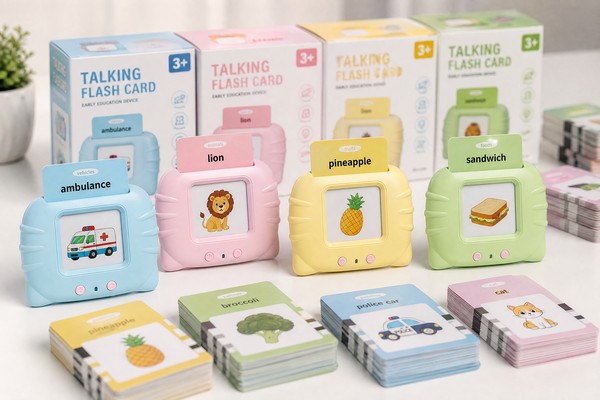
What Are the Typical MOQs for Different Customization Levels?
The MOQ you encounter will depend heavily on the level of customization you require. At Toyvao, we categorize customization into three distinct tiers, each with its own MOQ structure.
Tier 1: White-Labeling (Low Customization)
If you are purchasing our standard, pre-designed talking flash card machines and only require your logo printed on the device and standard packaging, the MOQ is relatively low.
* Typical MOQ: 500 – 1,000 units
* Best For: Amazon FBA beginners, small retailers testing the market.
Tier 2: OEM Customization (Medium Customization)
OEM (Original Equipment Manufacturer) involves modifying existing designs. This might include custom device colors, localized voice recordings (e.g., Spanish or French), and fully custom packaging.
* Typical MOQ: 2,000 – 3,000 units
* Best For: Established brands looking to differentiate their product line.
Tier 3: ODM Development (High Customization)
ODM (Original Design Manufacturer) means developing a completely new product from scratch. This involves new industrial design (ID), custom tooling (molds), and unique PCB engineering.
* Typical MOQ: 5,000 – 10,000+ units
* Best For: Large educational brands, enterprise-level distributors.
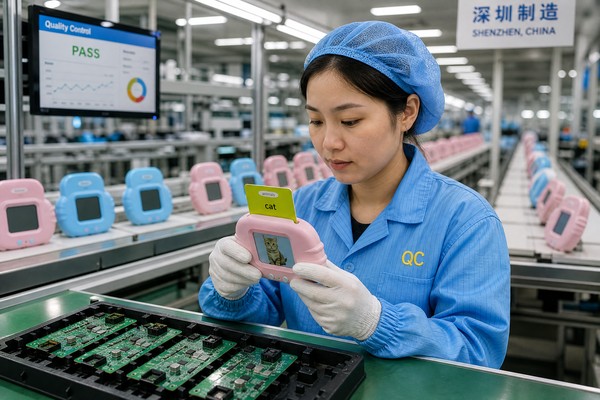
Cost Structure and MOQ Comparison Table
To help you visualize the relationship between customization, MOQ, and estimated costs, we have compiled the following comparison matrix based on current Shenzhen manufacturing standards.
| Customization Level | Typical MOQ | Custom Tooling Cost | Estimated Lead Time | Primary Cost Drivers |
|---|---|---|---|---|
| White-Label | 500 – 1,000 | $0 | 15 – 20 Days | Unit cost, logo printing |
| OEM (Custom Color/Voice) | 2,000 – 3,000 | $0 – $500 | 25 – 35 Days | Custom packaging, voice recording |
| ODM (New Mold/Design) | 5,000 – 10,000+ | $3,000 – $8,000 | 45 – 60 Days | R&D, plastic injection molds, PCB design |
How Can B2B Buyers Negotiate Lower MOQs?
While factories have strict cost baselines, there is often room for negotiation, especially if you can demonstrate long-term partnership potential. The Toy Association emphasizes that building strong supplier relationships is key to supply chain resilience [2].
Strategy 1: Pay a Higher Unit Price for a Trial Order
If you cannot meet the 2,000-unit MOQ for a custom color, offer to pay a 10-15% premium on the unit price for a 1,000-unit trial order. This compensates the factory for the setup inefficiencies while allowing you to test the market with lower risk.
Strategy 2: Standardize Internal Components
You can lower the MOQ for external customizations by agreeing to use standard internal components. For example, use Toyvao’s standard PCB and battery configuration, but customize the outer shell color and packaging. This reduces the factory’s engineering risk.
Strategy 3: Consolidate Orders
If you plan to launch multiple SKUs (e.g., a blue version and a pink version), ask the factory if they will accept a combined MOQ. For instance, instead of 2,000 units per color, negotiate 1,000 units of blue and 1,000 units of pink under a single 2,000-unit production run.
Why Choose Toyvao as Your Manufacturing Partner?
At Toyvao, we understand the challenges B2B buyers face when scaling their educational toy brands. We offer flexible MOQ structures designed to support both emerging sellers and established enterprises. Our Shenzhen-based facility maintains strict quality control, ensuring compliance with CPSC, ASTM, and EN71 standards [3].
Whether you need a quick 500-unit white-label order or a complex 10,000-unit ODM project, our engineering and sales teams are ready to support your vision.
Ready to start your custom talking flash card project? Contact us today for a detailed quotation and MOQ assessment.
- Email: info@toyvao.com
- WhatsApp: +86 138 2358 8945
- Website: https://toyvao.com
References
[1] Grand View Research. “Educational Toys Market Size, Share & Trends Analysis Report.” (2023).
[2] The Toy Association. “Supply Chain and Manufacturing Best Practices.” (2024).
[3] Consumer Product Safety Commission (CPSC). “Children’s Products Safety Standards.” (2024).
