
When sourcing talking flash cards in bulk from Chinese manufacturers, B2B buyers often focus primarily on unit cost and minimum order quantities (MOQs). However, neglecting warranty terms and after-sales support can lead to significant financial losses, brand damage, and regulatory compliance issues. This comprehensive guide explores why robust after-sales infrastructure is critical for B2B success and how to evaluate a factory’s warranty policies.
What Are the Hidden Costs of Poor After-Sales Support in Toy Sourcing?
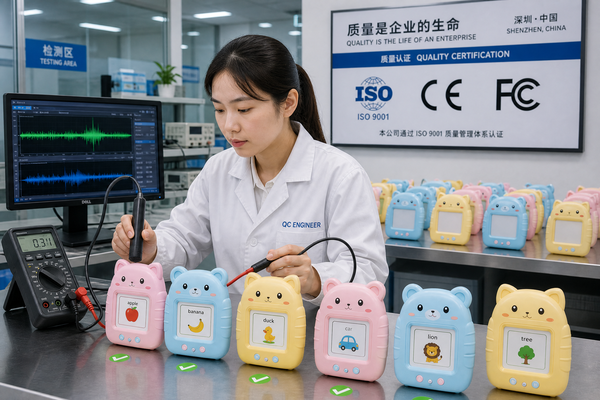
The true cost of a defective batch of talking flash cards extends far beyond the initial purchase price. For B2B distributors and brand owners, the financial impact of poor after-sales support can be devastating. According to the U.S. Consumer Product Safety Commission (CPSC), defective children’s products can lead to mandatory recalls, which cost companies an average of $8 million in direct and indirect expenses [1].
When a manufacturer lacks a comprehensive warranty policy, the burden of returns, repairs, and customer dissatisfaction falls entirely on the distributor. If an educational toy fails to meet acoustic standards (e.g., exceeding the 85dB limit set by EN71 or ASTM F963), the resulting negative reviews on platforms like Amazon can permanently damage a brand’s reputation [2]. Furthermore, without a clear defective replacement agreement, buyers may be forced to absorb the cost of unsellable inventory, significantly eroding profit margins.
How Does a Factory’s Warranty Policy Reflect Its Quality Control Standards?
A manufacturer’s willingness to offer a robust warranty is a direct reflection of its confidence in its quality control (QC) processes. Factories that implement stringent QC protocols—such as testing for 16kHz sampling rates, 16-bit mono audio clarity, and battery safety under UN38.3 standards—are far more likely to provide favorable warranty terms [3].
When evaluating a factory, B2B buyers should scrutinize the correlation between warranty length and manufacturing standards. A factory offering a standard 12-month warranty typically employs advanced testing equipment, including acoustic chambers and battery cycle testers. Conversely, a supplier offering only a 30-day return window may be cutting corners on internal components, such as using inferior PCM dual-IC protection boards or low-grade Li-Po cells.
Warranty vs. Defect Rate Matrix
| Warranty Duration | Typical Defect Rate | QC Infrastructure Indicators | Risk Level for B2B Buyers |
|---|---|---|---|
| < 30 Days | > 5% | Basic visual inspection only, lack of certified testing equipment | High Risk |
| 6 Months | 2% – 5% | Standard assembly line checks, basic audio testing | Moderate Risk |
| 12+ Months | < 1% | Comprehensive acoustic chambers, UN38.3 battery testing, ISO 9001 compliance | Low Risk |
What Should Be Included in a Comprehensive B2B Warranty Agreement?
A standard B2B warranty agreement for electronic educational toys must go beyond vague promises of “good quality.” To protect their investments, buyers must ensure that specific clauses are explicitly detailed in the manufacturing contract. The Toy Association emphasizes that clear communication regarding defect thresholds and replacement logistics is essential for maintaining a healthy supplier-buyer relationship [4].
Key elements of a robust warranty agreement include:
1. Acceptable Quality Limit (AQL): The agreement should specify the maximum acceptable defect rate (typically AQL 1.5 for major defects and 4.0 for minor defects).
2. Defective Replacement Policy: Clear terms outlining how defective units will be handled. Will the factory provide free replacements in the next shipment, or issue a credit note?
3. Component-Specific Warranties: Differentiated warranty periods for critical components, such as a longer warranty for the PCB and battery compared to the external plastic casing.
4. Logistics and Shipping Costs: A clear definition of who bears the shipping costs for returning defective units or sending replacement parts.
How Can Toyvao Support Your Long-Term Brand Growth?
Partnering with a reliable manufacturer like Toyvao ensures that your brand is protected by industry-leading quality control and comprehensive after-sales support. Toyvao understands that B2B success relies on consistent product quality and responsive service. By implementing rigorous testing protocols, including strict adherence to acoustic safety standards and battery certifications, Toyvao minimizes defect rates and maximizes buyer confidence.
Our commitment to transparency and long-term partnership means that we offer competitive warranty terms and clear replacement policies, ensuring that our B2B clients can scale their businesses without the fear of hidden liabilities.
References
[1] U.S. Consumer Product Safety Commission (CPSC). “Recall Guidance for Businesses.”
[2] ASTM International. “ASTM F963 – Standard Consumer Safety Specification for Toy Safety.”
[3] United Nations Economic Commission for Europe. “UN Manual of Tests and Criteria (UN38.3).”
[4] The Toy Association. “Quality Assurance and Safety Compliance in Toy Manufacturing.”
Ready to source premium talking flash cards with guaranteed quality and reliable after-sales support? Contact Toyvao today!
Email: sales@toyvao.com | WhatsApp: https://wa.me/8618681064480
Related Articles:
Useful Resources:
