
What Are the Safety Requirements for a Toddler’s Reading Pen?
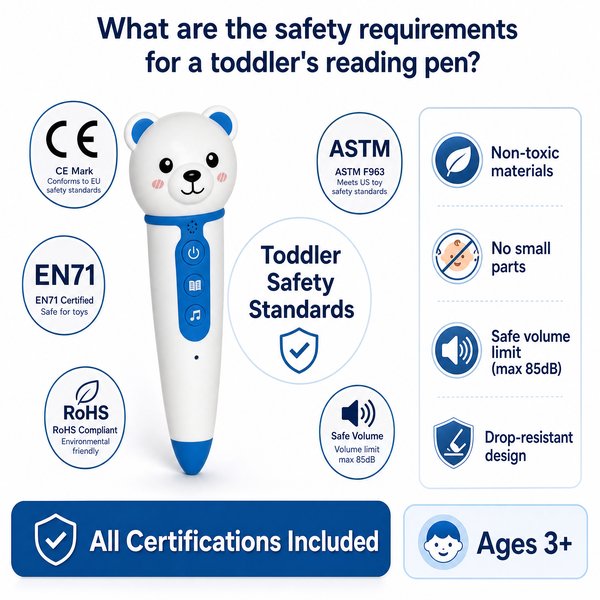
Bottom Line Up Front (BLUF): When selecting a reading pen for toddlers aged 3 and above, safety is paramount. Key safety requirements include compliance with toy-specific certifications such as EN71/CE for Europe and ASTM/CPSC for the US, use of non-toxic materials, absence of small or detachable parts that can pose choking hazards, volume limits capped at ≤85 dB to protect hearing, and robust battery safety standards like IEC 62133 with over-charge and short-circuit protections. Additionally, a durable, child-proof design combined with offline-only operation (no Wi-Fi or Bluetooth) minimizes physical, chemical, electrical, and data privacy risks. Toyvao’s children’s OID reading pens meet these stringent criteria, ensuring safe and engaging learning experiences for toddlers.
Why Safety Standards Matter for Toddler Reading Pens
According to Grand View Research, the global educational toy market is expected to reach $34.5 billion by 2028, driven by increasing awareness of early childhood development. Ensuring safety in educational products like reading pens is critical as it directly impacts children’s health and parents’ trust.
Key Safety Concerns Addressed by Standards
- Physical Safety: Prevent choking hazards by avoiding small detachable parts.
- Chemical Safety: Use non-toxic, BPA-free, and phthalate-free materials.
- Electrical Safety: Battery certifications ensure no overheating or leakage.
- Auditory Safety: Volume limits protect sensitive toddler hearing.
- Privacy and Security: Offline operation prevents unauthorized data collection.
Essential Safety Certifications and Compliance
When to Prioritize Certifications
If you are importing reading pens for resale, school procurement, or distribution in major markets such as the EU, UK, or US, it is essential that the products adhere to the following standards:
- EN71 Parts 1-3: Covers mechanical/physical properties, flammability, and chemical composition (EU).
- CE Marking: Required for products sold in the European Economic Area.
- ASTM F963 / CPSC / CPSIA: US toy safety standards including mechanical, chemical, and electrical safety.
- IEC 62133: International standard for rechargeable batteries ensuring protection against over-charge, short-circuit, and overheating.
When Less Rigorous Checks Are Acceptable
For prototype development, internal classroom use, or conceptual evaluation, basic lab reports and material safety data sheets (MSDS) may suffice temporarily. However, certified units must be used for any commercial sale or public distribution to ensure compliance and safety.
Material and Design Safety Considerations for Toddlers
Non-Toxic and Durable Materials
Toddlers often put toys in their mouths, so reading pens must be:
- Manufactured from FDA-approved, BPA-free, phthalate-free, and lead-free plastics.
- Finished with non-toxic paints and coatings.
- Durable and impact-resistant to withstand drops and rough handling.
Choking Hazard Prevention
Ensure no parts are small enough to be swallowed. The pen’s design should be robust with no detachable buttons, covers, or accessories that could be removed and put into a toddler’s mouth.
Hearing Protection Standards
According to the World Health Organization (WHO), noise levels above 85 decibels (dB) can damage hearing over prolonged exposure. Toddler reading pens should thus limit maximum volume to ≤85 dB to safeguard sensitive young ears.
Battery and Electrical Safety
Battery safety is critical to avoid fires, leaks, or burns:
- Use batteries compliant with IEC 62133 standards.
- Include over-charge, short-circuit, and over-discharge protection circuits.
- Employ child-proof battery compartments to prevent accidental ingestion or tampering.
- Use USB charging with protection against overheating and power surges.
Privacy and Data Security: Why Offline Operation Matters
Unlike student translation or OCR scanner pens, toddler reading pens like Toyvao’s children’s OID reading pen operate offline without Wi-Fi or Bluetooth connectivity. This approach:
- Eliminates risks of unauthorized data collection or hacking.
- Ensures uninterrupted usage without dependence on internet connectivity.
- Protects toddlers’ privacy in compliance with global data protection regulations.
Comparing Safety Features Across Popular Toddler Reading Pens
| Feature | Toyvao OID Reading Pen | Generic Student Translation Pen | Basic OCR Scanner Pen |
|---|---|---|---|
| Age Suitability | 3+ years | 7+ years | 6+ years |
| Safety Certifications | EN71, CE, ASTM, IEC 62133 | Varies, often none | Varies, often none |
| Materials | Non-toxic, BPA-free plastic | Mixed materials, some toxic risks | Mixed materials, some toxic risks |
| Volume Limit | ≤85 dB | Not guaranteed | Not guaranteed |
| Connectivity | Offline only (no Wi-Fi/Bluetooth) | Wi-Fi/Bluetooth enabled | Wi-Fi/Bluetooth enabled |
| Battery Safety | IEC 62133 certified, child-proof | Varies | Varies |
Additional Safety Tips When Using Toddler Reading Pens
- Supervise toddlers during use to prevent misuse.
- Regularly inspect the pen for damage or loose parts.
- Store pens away from water and extreme temperatures.
- Follow manufacturer instructions for charging and usage.
For more insights into child-safe educational products, explore our articles on Talking Flash Card Machine Safety Features and Water Doodle Mat Benefits for Toddlers.
