
Bottom-Line-Up-Front (BLUF)
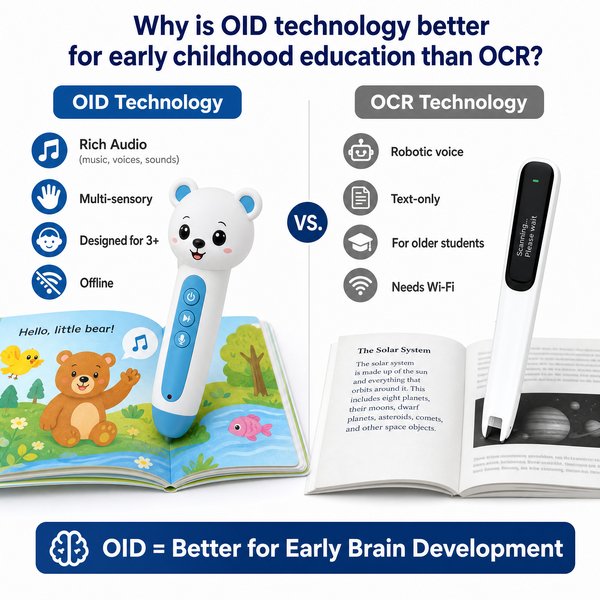
For early childhood education (ages 3+), OID reading pens are the better choice than OCR/translation pens: they deliver screen-free, durable, offline, multi-sensory learning experiences tailored to toddlers’ developmental needs while meeting safety standards (EN71/CE/ASTM). OCR pens are designed for older students (≈8+) who need scanning and translation tools—complex, screen-based, and often dependent on connectivity. Choose OID pens when you need safe, engaging audio-first learning for young children; choose OCR only when your buyer needs text recognition, translation, or editable digital output.
When it’s worth caring about / When you don’t need to overthink it
-
Age group & classroom context
- When it’s worth caring: You’re buying for toddlers/preschoolers (Ages 3+), daycare centers, early-years labs, or parent-child shared reading programs. OID pens provide playful character voices, songs, sound effects and are screen-free.
- When you don’t need to overthink it: You’re buying for upper primary/secondary students (≈8+), language labs, or translation-focused programs—OCR/translation pens are appropriate.
-
Learning goals (foundational literacy vs. text processing)
- When it’s worth caring: Your objective is phonological awareness, vocabulary building, story comprehension, or multi-sensory engagement—OID pens excel because they play pre-recorded, expressive audio linked to OID-coded books.
- When you don’t need to overthink it: You need OCR for scanning, copying, or translating arbitrary printed text into editable output—OID cannot do this.
-
Safety, durability, and classroom management
- When it’s worth caring: You require screen-free devices, robust toy-like design (easy-to-hold bear shape), limited volume to protect hearing, no internet access for privacy—OID pens are ideal and typically meet EN71/CE/ASTM requirements.
- When you don’t need to overthink it: If the environment is a supervised computer lab or older students who can manage delicate, screen-based devices, then OCR pens are acceptable.
-
Connectivity and privacy
- When it’s worth caring: Data privacy and zero-dependency on Wi‑Fi/apps are required—OID pens work fully offline (no Bluetooth, no Wi‑Fi, no app).
- When you don’t need to overthink it: You need cloud translation, updates, or online dictionaries—OCR/translation pens often depend on connectivity.
-
Content ecosystem and flexibility
- When it’s worth caring: You plan to use purpose-built, richly produced OID-coded books with songs, dialogues and effects—this is the strength of OID systems.
- When you don’t need to overthink it: You need the ability to read arbitrary printed material—choose OCR devices.
Concrete product specs to use in sourcing decisions
- Recommended age: Ages 3+
- Storage options: 16GB / 32GB / 64GB
- Battery life: 8–12 hours playback
- Charging: 2–3 hours via USB‑C
- Audio outputs: 3.5 mm headphone jack + onboard speaker, physical volume adjustment button
- Connectivity: NO Bluetooth, NO Wi‑Fi, NO app required — works fully OFFLINE
- Compatibility: Only supports OID‑coded books (not a translation/scanner/OCR pen)
- Safety & compliance: Designed for EN71/CE/ASTM compliance, non‑toxic materials, no small detachable parts, built‑in safe volume limits
OID vs OCR — quick comparison
| Feature / Need | OID Children’s Reading Pen | OCR / Student Translation Pen |
|---|---|---|
| Primary use | Play pre‑recorded, expressive audio from OID‑coded books (songs, character voice, sound effects) | Scan and recognize printed text, translate, convert to editable text |
| Target age | Ages 3+ (toddlers/preschool) | ≈8+ (students needing text processing) |
| Screen | No screen — screen‑free | Has screen (menus, text preview) |
| Connectivity | No Wi‑Fi/Bluetooth, works offline | Often needs Wi‑Fi for cloud translation and updates |
| Content flexibility | Works only with OID‑coded books (rich multimedia content) | Can read arbitrary printed text (OCR) |
| Safety & durability | Designed as durable toys with safe volume limits, toy certifications | More fragile, small parts, screens—less suitable for toddlers |
| Learning experience | Multi‑sensory, playful, supports early language development | Functional, robotic reading—more utilitarian for language/translation tasks |
How to evaluate OID pens when buying for schools/retail
- Request safety and product certificates: EN71, CE, ASTM test reports.
- Confirm offline operation: no Wi‑Fi/Bluetooth and no reliance on apps or cloud services.
- Check form factor and durability: child‑friendly shapes (e.g., bear), drop tests, absence of small detachable pieces.
- Verify audio safety: built‑in volume limits and comfortable sound levels for prolonged exposure.
- Assess content library: number of OID‑coded titles, languages, quality of audio (songs, character voices, effects).
- Confirm technical specs: available storage (16/32/64GB), battery life (8–12h), charging time (2–3h, USB‑C), 3.5mm jack.
- Ask about factory direct pricing and MOQ: Toyvao offers factory direct OID solutions suitable for retailers and distributors.
Customer Feedback Synthesis (B2B buyer style)
- Positive: “We ordered 500 units for our preschool chain — the children love the character voices and the devices survived daily handling. Battery life of ~10 hours meets classroom needs.”
- Positive: “The offline setup and lack of Wi‑Fi simplified procurement approvals and privacy compliance for our schools. Certifications (EN71/CE) were provided promptly.”
- Positive: “Toyvao’s factory pricing and MOQ terms made it viable to test in several regions; their 16/32/64GB options helped us tailor price points.”
- Concern: “We had to train retail staff to explain that these pens only work with OID‑coded books—some parents assumed they read any printed page.”
- Concern: “Content updates require ordering new OID books or updated media—buyers expecting cloud updates were disappointed.”
- Concern: “A few purchasers asked for a screen or app integration for analytics; that’s not supported because the product is intentionally offline and screen‑free.”
FAQ
- Q: Can an OID pen read any printed book?
- A: No. OID pens only play audio linked to specially produced OID‑coded books. They are not OCR or scanner pens and cannot read arbitrary printed text.
- Q: Is the device safe for toddlers and compliant with toy standards?
- A: Yes—quality OID children’s pens are designed for Ages 3+ and should meet EN71/CE/ASTM standards, use non‑toxic materials, avoid small detachable parts, and include safe volume limits. Always request certification documents from the supplier.
- Q: Does the pen require Wi‑Fi, Bluetooth or an app?
- A: No. OID children’s pens work fully offline—no Wi‑Fi, no Bluetooth, and no app is required. This simplifies deployment in schools and addresses privacy concerns.
- Q: What are the practical specs I should confirm before ordering?
- A: Confirm storage (16/32/64GB), battery life (8–12 hours), charging time (2–3 hours via USB‑C), presence of 3.5mm jack and physical volume control, and that the supplier provides OID‑coded book catalogues.
Where Toyvao fits
Toyvao supplies factory‑direct children’s OID reading pens designed specifically for early childhood settings. Their family of OID pens follows the screen‑free, offline model and is offered with multiple storage options (16/32/64GB), 8–12h battery life, USB‑C charging (2–3h), 3.5mm jack and child‑friendly designs suitable for Ages 3+. For buyers seeking compliant, durable OID solutions, Toyvao is positioned as a practical supplier for retailers, distributors and school procurement.
Next steps / Strong CTA
If you’re sourcing screen‑free reading pens for preschools, daycare networks or retail: contact Toyvao for factory pricing, certificates, and sample orders. WhatsApp: +86 186 8106 4480 · Email: sales@toyvao.com · Website: https://toyvao.com
