
Executive Summary
This guide explains what B2B buyers should require from suppliers of Picture Book Reading Pens (Story Pens, Talking Book Pens, OID Reading Pens) regarding warranty, after-sales service (AFS), and spare parts. It translates supply-chain realities into contract terms, service-level agreements (SLAs), inventory targets, technical requirements, and compliance checkpoints that minimize total cost of ownership and protect brand reputation in school, retail, and distributor channels.
Key recommendations
– Minimum warranty: 12 months for finished product; 6 months for consumables (stylus tips, foam, batteries) with extended options to 24 months for classroom deployments.
– RMA SLA: initial response ≤ 24 hours; RMA authorization ≤ 3 business days; repair or replacement turnaround ≤ 10 business days for in-region service; advance replacement shipment ≤ 72 hours where inventory exists.
– Spare-parts availability: supplier commits to keep spare parts available for at least 5 years after last shipment; formal parts list with OEM part numbers and prices; lead-time notification (PCN) ≥ 180 days for obsolescence.
– Minimum spare-parts stocking policy: buyer should hold spares equal to forecasted failures during supplier lead time + 25% buffer (example formula provided).
– Documentation and tools: complete BOM, exploded drawings, repair manuals, test jig specifications, firmware images, and authorized service center training required at purchase.
– Compliance and logistics: UN38.3 battery shipping certification, EN71/ASTM/IEC/CE/FCC test reports, WEEE and CPSIA declarations where applicable.
The rest of this guide breaks down technical items, contractual clauses, SLA templates, spare-parts math, and operational best practices to include in RFQs, purchase orders, and distributor agreements.
What Is Picture Book Reading Pen and Who Uses It
Product summary
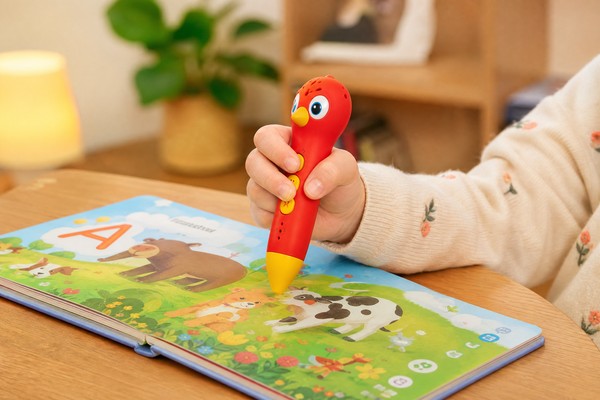
– Function: Handheld, stylus-like electronic pen that reads encoded pictures or printed OID codes on illustrated storybooks to play synchronized audio narration, music and sound effects on tap.
– Typical hardware: MCU (ARM Cortex-M/R series low-power), flash memory (NAND/SD), audio DAC/amplifier, micro speaker (8–16 mm, 0.5–1.5 W), microphone (optional), capacitive/resistive touch/stylus tip, Li-ion or LiPo rechargeable battery (200–1200 mAh), charging port (Micro-USB or USB-C), Bluetooth LE (optional), indicator LEDs.
– Typical software: audio playback engine, content mapping table (OID database), firmware with update capability (USB, SD, or OTA for Bluetooth variants), simple UI (play/pause, volume, page memory).
Primary users and channels
– Educational distributors and school systems (K–6), procuring devices for classroom usage and repeat student handling.
– Mass-market retailers and toy wholesalers, stocking consumer products with higher return volumes and warranty expectations.
– Licensing partners & publishers bundling pens with content libraries; these buyers require content lifecycle and rights assurances.
– Aftermarket service providers and refurbishers that repair and resell devices.
Operational environments
– High-touch classroom use: heavy daily handling, 1m drop exposures, multiple users.
– Home use: mixed conditions, lower usage intensity but higher returns for perceived faults.
– Library and rental programs: higher expected duty cycles and uptime requirements.
Implication for warranties and spares
– Heavy-use environments require longer warranty periods, faster RMA turnarounds, local spare-part inventories, and robust consumable support (tips, batteries, speakers).
– Licensing/content partners require integrity of audio content, version control, and guaranteed access to master files.
Why Demand Is Growing
Market drivers for robust AFS and spares
– Rising classroom deployments: Governments and NGOs increasingly adopt digital learning aids; devices must endure institutional wear.
– Higher expectations for uptime: Schools and libraries demand predictable service to avoid lesson disruption.
– Regulatory pressure: Child-safety and battery shipping rules increase complexity of returns and repairs; non-compliance risks recalls and fines.
– Brand protection: Fast replacement and warranty fulfillment protect retail margins and brand reputation; poor AFS drives chargebacks and negative reviews.
– Extended product lifecycles: Content licensing and curriculum alignment extend product relevance → buyers need guaranteed parts and firmware support beyond the product’s active selling lifecycle.
Economic impact
– Downtime cost: In institutional deployments, a single failed pen per classroom can disrupt multiple lessons per day. Operational cost of replacements and teacher time is substantial.
– Secondary market/resale value: Availability of spare parts supports refurbishment and resale—improving total lifecycle recovery.
– Warranty expenses: A structured warranty and spares program reduces ad-hoc warranty costs and return fraud when SLA and RMA protocols are enforced.
Key Technology Differences
Hardware variables that affect warranty and spares planning
– Battery chemistry and capacity
– Li-ion/LiPo (typical capacity 200–1200 mAh). Batteries are wear items; expect 300–800 charge cycles before capacity drop.
– Replaceable vs. embedded: Replaceable batteries reduce RMA costs; embedded batteries require approved repair centers and regulated shipping for returns.
– Shipping implications: Batteries shipped with goods must meet UN38.3; defective batteries require special handling.
– Audio subsystem
– Speaker size and power rating: 8–16 mm speakers, 0.5–1.5 W RMS; speaker failure common in high-volume usage and mishandling.
– Amplifier topology and thermal design influence reliability.
– Connectivity
– Wired-only (USB/SD): fewer obsolescence risks; spare ports, connectors (Micro-USB vs. USB-C) must be stocked.
– Bluetooth LE: firmware and compliance updates become required; spare antennas and RF certification traces must be managed.
– Storage and content delivery
– Internal flash vs. removable SD card: Removable cards simplify content replacement and reduce returns but add consumable failure modes (card contacts, loss).
– Mechanical design
– Stylus nib/tip materials (TPU, silicone) wear quickly—classified as consumables.
– Housing materials (ABS/PC) and assembly technique affect drop resistance and repairability.
– Serviceability
– Modular design with screws and replaceable subassemblies (battery door, speaker module, PCB) reduces repair time and spare-part complexity.
– Glued or ultrasonic-welded housings increase repair cost and turnaround; often lead to full-unit replacement.
Firmware and software differences
– Firmware update method: USB/SD (manual) vs. OTA (remote). OTA-capable units require ongoing support for security patches and BLE profile maintenance.
– Content management: Content licensing and DRM mechanisms require supplier to provide verified master files and version history for reloading during repair.
How these differences affect warranty and spare parts
– Modular, replaceable designs reduce average repair cost and recommended spare inventory.
– Devices with embedded batteries and glued housings should have stronger advance-replacement policies and shorter RMA turnarounds.
– BLE-enabled devices need a warranty clause covering RF compliance drift and firmware patches.
Key Features and Specifications to Evaluate
Mandated specifications for procurement documents (must-have items to include in RFQ/RFP)
Warranty and service terms
– Warranty Periods:
– Standard: 12 months for finished product.
– Recommended for institutional buyers: 24 months with service-level add-on.
– Consumables: 90–180 days (stylus tips, batteries). Negotiate extended consumable terms for education contracts.
– Coverage scope and exclusions:
– Coverage: manufacturing defects, component failure under normal use.
– Exclusions: physical abuse, water ingress (unless specified IP rating), unauthorized repairs, cosmetic wear, loss/theft.
– Remedy options: repair, advance replacement, or refund; specify preferred remedy order and timing.
RMA and SLA metrics
– Initial customer contact response time: ≤ 24 hours.
– RMA authorization time: ≤ 3 business days.
– Repair or replacement turnaround: ≤ 10 business days for in-region centers; ≤ 20 business days for return-to-factory.
– Advance replacement shipping: ≤ 48–72 hours where stock exists; supplier to maintain safety stock for advance replacements.
– RMA acceptance criteria and rejection report: supplier must provide detailed rejection reasons (with photos) for denied claims.
Spare parts and BOM requirements
– Supplier must provide:
– Full BOM with OEM part numbers.
– Exploded assembly drawing and SKU cross-reference.
– Spare parts price list (FOB or DDP), MOQ per spare SKU, typical lead times.
– Recommended spare-parts kit for field repair with pricing (battery, speaker, stylus tip, charging port, PCB).
– Minimum spare availability commitment: 5 years after last shipment.
– PCN/End-of-Life (EOL): supplier to provide written notice ≥ 180 days before part discontinuation.
Service and logistics
– Authorized Service Centers: list and locations; criteria for becoming an authorized center (training, test jig, certification).
– Consignment and local stocking options: supplier should offer consignment spares at buyer distribution centers.
– Shipping terms for warranty returns: specify prepaid return labels for cross-border warranty and responsibility for duties/taxes.
Technical and quality tests
– Factory testing requirements: 100% power-on test, burn-in (recommended 8–48 hours), acoustic test for speaker output, firmware health check, charge cycle test for batteries.
– Environmental and mechanical tests: drop test (1 m, 6 faces), vibration, thermal cycling (where buyer operates in extreme climates).
– Certs and reports required: EN71-1/2/3 (EU toy safety), EN62115 (electrical safety for toys), CE/RED or FCC (for RF units), RoHS, REACH, CPSIA (US), WEEE (EU), UN38.3 (batteries), EMC test reports.
Consumables and lifecycle items
– Expected MTBF and consumable life:
– Battery: useful life 300–800 full cycles; capacity degradation to 80% at ~300 cycles typical for low-cost Li-ion.
– Stylus tip: replace every 6–12 months under classroom usage.
– Speaker: useful life highly dependent on volume and drop; use MIL equipment for high-duty environments.
Documentation and tools
– Repair manual with step-by-step instructions and torque specs.
– Test jig specifications and software tools for QC/repair.
– Firmware images and secure distribution process (signed firmware).
– Content master files and mapping tables.
Procurement KPIs
– Acceptable DOA rate: < 2% (first 7 days).
– Annual failure rate target: < 3–5% field failure beyond DOA.
– RMA rejection rate target: < 10% of claims denied (with documented reasons).
– Repair yield target: > 95% first-pass repair success for authorized centers.
Pros and Cons
Pros of a comprehensive warranty and spares program
– Reduces downtime and service friction for institutional users.
– Protects brand reputation by ensuring fast replacements and consistent quality.
– Allows predictable budgeting for repairs and spare-parts inventories.
– Enables refurbishment programs and residual value recovery.
Cons and trade-offs
– Higher upfront supplier price for extended warranty and spare stock commitments.
– Increased administrative overhead to manage RMA workflows, local repair centers, and spare inventories.
– Complexity around cross-border returns and battery shipping compliance.
– Risk of overstocking low-turn spares if forecasts are inaccurate.
Operational compromises
– Buyers must decide between centralized (supplier-managed) vs. decentralized (buyer-managed) spares stock. Centralized reduces buyer working capital but increases lead time risk.
– Advance replacement programs minimize downtime but require higher supplier inventory or higher prices.
Step-by-Step Decision Guide
Pre-contract evaluation checklist
– Technical fit: Confirm pen hardware (battery type, speaker spec, connectivity) aligns with end-use.
– Compliance: Verify test reports (EN71, EN62115, CE/FCC, UN38.3). Request actual lab reports, not just certificates.
– Warranty baseline: Insist on written warranty with clear remedy hierarchy and SLA metrics.
– Spare parts: Obtain full BOM, exploded drawings, spare parts price list, MOQ, and lead times.
– Service capability: Evaluate supplier’s authorized service center footprint, average RMA turnaround historically, and sample RMA records.
Draft RFQ and contract clauses to include
– Warranty term and coverage: exact language about starting point (shipment date vs. invoice date), remedy.
– RMA SLA table: initial response, authorization time, repair/replacement time, advance replacement shipping times.
– Spare parts availability: minimum availability window (5 years), minimum stock levels, and PCN notice period (≥ 180 days).
– Pricing and credits: agreed spare-part pricing schedule, price stability clause for first 24 months, credit terms for warranty repairs.
– Documentation delivery: BOM, manuals, test jig specs, firmware images delivered within X days of first order.
– Obsolescence handling: supplier responsible for last-time buy offers and alternative part sourcing.
Operational implementation steps
– Pilot order: Place small production run (e.g., 500–2,000 units) with full AFS terms to validate RMA workflows and spare-parts consumption.
– Setup RMA process: Create ticketing portal, define diagnostic evidence requirements (photos, video), and standardize RMA numbering.
– Train support staff: supplier supplies training to buyer customer-service and repair teams; require certificate of completion.
– Stocking plan: Calculate required safety stock using the spare-parts formula (below) and implement consignment or DDP stocking as needed.
– Review cadence: Quarterly SLA reviews, failure mode trend analysis, and content/firmware patch schedule alignment.
Spare-parts stock calculation (recommended method)
– Inputs: monthly sold units (M), expected annual failure rate (%) (F_annual), supplier lead time in months (L), buffer factor (B, e.g., 25%).
– Convert F_annual to monthly failure rate: F_month = F_annual / 12.
– Required spare quantity per SKU = ceil((M × F_month × L) × (1 + B))
– Example: M = 1,000 pens/month, F_annual = 5% → F_month = 0.417%. L = 2 months, B = 25%:
– Required spares ≈ ceil((1000 × 0.00417 × 2) × 1.25) ≈ ceil(10.4) = 11 pieces of each critical spare.
Decision points for advanced buyers
– If selling into schools: require 24-month warranty and local advance replacement stock.
– If selling online retail: 12-month warranty sufficient, but require fast RMA turnaround and prepaid return labels.
– If doing long-term licensing: demand 5–7 years of parts availability and signed PCN obligations.
Pricing and Cost Analysis
Cost elements to include in supplier quotes
– Unit manufacturing cost (FOB/EXW).
– Extended warranty premiums (per-unit surcharge or percentage).
– Spare parts pricing and MOQ; list price and bulk tiers (e.g., 1–99, 100–499, 500+).
– Repair labor costs for out-of-warranty repairs (per-unit flat fee or hourly labor + parts).
– Shipping and logistics: inbound parts shipping, warranty return shipping responsibilities, duties & taxes.
– Test jig and tooling costs: initial one-time fees for repair/test equipment and calibration.
– Training and documentation fees (if supplier charges).
Representative example cost breakdown (illustrative)
– Example finished pen FOB price: $15–$35 depending on features (basic offline audio vs. BLE + SD + higher-capacity battery).
– Typical spare part pricing (example for $20 pen):
– Battery (embedded, 400 mAh): $0.80–$1.80 (4–9% of unit cost)
– Speaker (12 mm, 1 W): $0.50–$1.20 (2–6%)
– Main PCB assembly (including MCU and flash): $3.00–$7.00 (15–35%)
– Stylus tips (pack of 10): $0.50–$1.50 (consumable)
– Charging port/connector: $0.20–$0.80
– Full replacement pen (unit buy): $15–$35
Warranty cost models
– Inclusive warranty: supplier absorbs all warranty costs; typically priced into unit at ~2–6% premium depending on expected failure rate and RMA handling model.
– Pass-through warranty: buyer pays repair costs; supplier handles logistics but charges per repair. Lower unit price, higher operational risk for buyer.
– Service contract: fixed per-unit annual service fee covering advanced replacement and spare parts pool; recommended for institutional deployments.
Inventory carrying cost considerations
– Carrying spares increases working capital needs but reduces service downtime. Balance with consignment options.
– Use ABC classification: high-cost, low-failure parts (PCBs) should be managed with tighter reorder points and strategic consignment; low-cost consumables (tips) should be stocked widely.
Example ROI analysis for institutional deployment
– For a deployment of 1,000 pens to 100 classrooms:
– Expected annual field failure (5%): 50 units.
– Cost of classroom disruption per failure (teacher time, lost lesson): estimate $75 per incident.
– Avoiding disruption by advance replacement reduces intangible costs and justifies higher per-unit warranty premiums.
Competitive Landscape
Supplier tiers and typical AFS capabilities
– Tier A (OEMs with global service networks)
– Strengths: regional repair centers, consignment stocking, SLAs for advance exchange, full documentation.
– Typical warranty: 12–24 months; spare availability 5–7 years.
– Pricing: premium.
– Tier B (mid-size manufacturers/exporters)
– Strengths: competitive unit pricing, can provide BOM and spares, limited regional service.
– Limitations: longer RMA turnaround if returns to Asia required; may require MRAs for local repairs.
– Warranty: typically 12 months; spare availability 3–5 years.
– Tier C (small OEMs/ODM)
– Strengths: low unit cost, flexible MOQ.
– Limitations: limited after-sales infrastructure; spare parts limited or long lead times; frequent product revisions.
– Warranty: variable; often pass-through or limited.
What to watch for in supplier claims
– “Lifetime support” or “lifetime warranty” often undefined—require exact duration and terms.
– Quick RMA numbers without local service centers: confirm lead times and logistics for cross-border returns (duties, tax implications).
– Generic compliance claims (e.g., “CE”) without test reports—demand lab test numbers and dates.
Selecting a partner by use case
– Large school program: Tier A supplier with local service and 24-month warranty + consignment spares.
– Retail mass-market: Tier B supplier with clear RMA portal, advance replacement inventory in key markets.
– Low-cost private label: Tier C supplier only if buyer accepts shorter spares window and higher reverse-logistics costs.
What Buyers Say
Common buyer pain points (based on aggregated B2B service cases)
– Long RMA turnarounds: Buyers report 3–8 week turnarounds when returns are routed to overseas factories—disruptive for schools.
– Lack of spare parts visibility: Suppliers failing to provide BOM and lead times make forecasting impossible.
– Hidden costs: Buyers report unexpected duties and return shipping costs billed back for warranty returns.
– Obsolescence without notice: Customers forced into redesigns when supplier discontinues critical ICs without PCN.
– Content mismatch after repair: Repaired units returned without the correct audio content or language pack.
Common buyer demands that resolved issues
– Advance replacement pool with monthly inventory reports reduced classroom downtime by >80% in pilot programs.
– Local repair training and a simple test jig reduced return shipments by 40% and repair cost by 30%.
– Supplier commitment to a 5-year spare availability clause prevented mid-cycle product termination and preserved resale channels.
Case examples (anonymized)
– School district A: Insisted on 24-month advance-exchange warranty and local consignment spares. Upfront annual fee of $2 per unit for the service—reduced classroom disruptions to near zero.
– Retailer B: Negotiated a 12-month warranty with prepaid return labels and RMA portal. Achieved <3% RMA rate and cut refund abuse with photo evidence rules in the RMA flow.
What buyers successfully negotiated
– Free-of-charge return shipping and taxes for in-warranty units.
– Fixed spare-parts prices for first 24 months.
– Manufacturer liability cap for content licensing losses and patch commitments.
Safety, Maintenance and Compliance
Regulatory and safety items to require in contracts
– Child-safety standards:
– EU: EN71-1/2/3; EN62115 for electrical toys where applicable.
– US: CPSIA (phthalates and lead limits), ASTM F963 (toy safety).
– Batteries: UN38.3 transport test report for lithium batteries; IEC 62133 battery safety standard recommended.
– EMC and RF:
– FCC ID (US) for transmitters; EU RED/CE for RF; EMC test reports for conducted and radiated emissions.
– Chemical compliance:
– RoHS and REACH declarations; phthalates and heavy metal test results.
– Environmental / disposal:
– WEEE compliance for EU markets and take-back options for batteries and electronics.
Maintenance best practices to include in user guidance
– Battery handling:
– Provide clear instructions for charging cycles, storage, and safe disposal.
– Specify expected lifecycle (e.g., “Battery retains ≥80% capacity after 300 full cycles under normal use”).
– Consumable replacements:
– Recommend replacement intervals for stylus tips based on duty cycle (e.g., every 6–12 months for classrooms).
– Cleaning:
– Approved cleaning agents and procedures to avoid speaker port blockage or ingress into charging port.
– Repair safety:
– Authorized service centers must follow ESD precautions and battery-handling SOPs.
Logistics and legal constraints
– Cross-border returns require clarity on who handles duties, VAT refunds, and import permits for repaired units.
– Battery returns: require specialized carriers and packaging; contract should identify responsible party and cost-sharing.
Recall and incident handling
– Supplier must supply a recall plan and designated contact for safety incidents with defined response times (initial report within 24 hours and root-cause analysis within 10 business days).
– Liability clauses: define manufacturer vs. buyer responsibilities for consumer safety incidents, including legal defense and recall costs.
Frequently Asked Questions
What is an appropriate warranty length for picture book reading pens?
– Standard commercial practice is 12 months for finished goods. For institutional deployments (schools/libraries), buyers should require 24 months or a 12-month warranty plus a paid extended-service option. Consumables (tips, batteries) usually covered for 90–180 days.
Should batteries be covered under warranty?
– Batteries are consumables and often offered with limited warranty (90–180 days). For classroom deployments, negotiate longer battery coverage or supply replaceable battery assemblies.
How long should suppliers guarantee spare parts?
– Require minimum 5 years after last shipment; 7 years preferred for long-term education contracts. Also include a PCN process with minimum 180 days notice.
What are acceptable RMA turnaround times?
– Initial response ≤ 24 hours; RMA authorization ≤ 3 business days; in-region repair/replacement ≤ 10 business days; overseas repairs ≤ 20 business days. Advance replacement should ship within 48–72 hours when stock exists.
What spare parts should be stocked locally?
– Minimum local stock recommended:
– Batteries: 5–10% of active installed base.
– Speakers: 2–5% of active base.
– PCB assemblies: 1–3% (higher if known failure mode).
– Stylus tips: 10–20% of active base (fast-moving).
– Charging ports and connectors: 2–5% of active base.
How to calculate spare-parts quantities?
– Use the formula in the Step-by-Step Decision Guide: round up monthly expected failures multiplied by lead time (months), plus a buffer of 25%.
What documentation should suppliers provide?
– BOM with part numbers, exploded drawings, repair manual, test jig specs, firmware images, lab test reports (EN71/EN62115/CE/FCC/UN38.3), and PCN/EOL policy.
Who pays for return shipping under warranty?
– Best practice: supplier pays return shipping and duties for in-warranty repairs. If buyers opt to handle returns, stipulate clear reimbursement terms.
What is a reasonable DOA rate?
– Below 2% DOA in the first 7 days is a reasonable target. Higher DOA rates indicate quality control issues.
How to handle firmware and content updates post-sale?
– Require supplier to provide firmware images and signed updates; for BLE devices, require remote OTA procedures and an update schedule for security patches. For content, ensure licensed master audio files are delivered and version-controlled.
What if the supplier discontinues a critical IC?
– PCN clause with minimum 180 days notice; require alternate sourcing or last-time-buy options. Put an obligation to provide cross-reference parts and assist in qualification of replacements.
Contact Toyvao
For procurement assistance, supplier vetting, RFQ templates, or to request a detailed spare-parts costing worksheet and RMA SLA template, contact Toyvao procurement services:
– Email: sourcing@toyvao.com
– Web: https://toyvao.com/contact
Toyvao provides sourcing support for educational hardware, supplier audits, and contract drafting for Picture Book Reading Pens and adjacent educational electronics. Include your project scope (annual units, target markets, desired warranty and service levels) when contacting for a faster response.
