
Executive Summary
This guide defines practical, standards-aligned testing protocols a buyer should require when sourcing Picture Book Reading Pens (also called Story Pens, Talking Book Pens, or OID Reading Pens) for children. The three failure modes that cause the majority of field returns are mechanical shock (drops), liquid/dust ingress (water, saliva, dirt), and button/switch failure from repetitive tapping. This document synthesizes relevant standards (IEC/EN/MIL/ASTM/ISO), proposes repeatable lab and factory-level test procedures, lists acceptance criteria and failure definitions, estimates testing cost and lead time, and presents a decision framework for choosing test intensity based on target market and price tier.
Key takeaways:
– Drop robustness: simulate real-world child use with multi-orientation free-fall tests (1.0 m typical), extended random drop cycles, and pre-conditioning at temperature extremes. Acceptance: continuous operation, no hazardous fragmentation, batteries secured.
– Ingress protection: require at least IPX4/IP5X (splash + dust protection) for low-cost units; IPX7/IP6X (immersion + dust-tight) for toys marketed as washable/bath-safe. Follow IEC 60529 test methods and document speaker and port sealing strategy.
– Button durability: specify mechanical life cycles (100k–200k cycles) under realistic actuation force (1.5–3.5 N) and environmental aging; establish electrical/contact performance limits (contact resistance, bounce, stuck/travel change).
– Compliance: align tests with EN 71 series, EN 62115, IEC 60529, IEC 60068 family and IEC 62133 (battery), plus regional EMC/REACH/ROHS requirements.
– Cost and sampling: expect third-party lab test packages to cost $500–$3,000 per device model; factory QC sampling with AQL 1.5 for critical tests.
Use this guide to define contractual test plans, acceptance criteria, and supplier audit checklists before production sign-off.
What Is Picture Book Reading Pen and Who Uses It
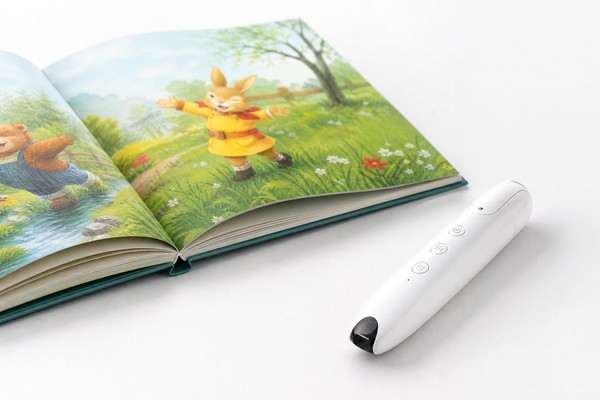
A Picture Book Reading Pen is a handheld electronic device that plays pre-recorded audio when its tip (or another sensor) is tapped on printed OID/QR-like hotspots or picture areas in educational storybooks. Common components:
– Housing: molded ABS/PC or TPU overmold.
– Tip/sensor: optical reader, capacitive/touch sensor, or IR/NFC element.
– Speaker: 8–32 mm dynamic driver with acoustic port.
– Buttons/switches: tactile push-buttons, membrane or PCB-mounted.
– Electronics: MCU, flash storage, audio codec, amplifier, battery (AA/AAA or rechargeable Li-ion).
– Interfaces: micro-USB/Type-C charging port, possible Bluetooth or Wi‑Fi.
End users:
– Children aged roughly 2–8 years old.
– Parents and educational institutions (preschools, kindergartens).
– Retailers and licensors who require durable, easy-to-clean, low-maintenance products.
Use cases:
– Repeated tapping and short taps (high-frequency, low-travel), accidental drops, spills and mouthed objects. Environments include homes, daycare centers, classrooms, travel.
Design trade-offs: light weight and small form factor improve ergonomics but increase vulnerability to impact and ingress. Speaker and acoustic port requirements conflict with full waterproofing unless specialized membranes or design concessions are applied.
Why Demand Is Growing
Demand drivers:
– Educational shift toward interactive learning tools for early literacy.
– Licensing of children’s IP (story brands) increases pressure to supply high-volume retail products.
– Increased caregiver expectation for durable, washable devices that can survive institutional use.
– Growth of digital audio content libraries and low-cost storage makes content localization simple and economical.
Supplier implications:
– Volume buyers and licensors demand reliable durability to reduce returns and service costs.
– Buyers need clear, measurable test criteria to protect brand reputation and ensure compliance across jurisdictions (EU Toy Safety Directive vs. US CPSIA).
Failure cost:
– Typical RMA/field-failure costs for non-compliant pens: return shipping, repair/replacement, reputation loss, loss of license agreements. Preventive investment in testing is typically an order of magnitude cheaper than post-release recalls.
Key Technology Differences
Materials and mechanical design:
– Rigid ABS/PC housings: lower material cost, higher crack risk under impact.
– TPU overmolding or multi-shot designs: better impact absorption, higher tooling cost.
– Internal ribbing and foam inserts: low-cost way to protect PCB and battery from impact.
Speaker sealing options:
– Open ports (no sealing): best audio, worst ingress protection.
– Hydrophobic fabric/ePTFE membranes: allow sound transmission while blocking liquids; add $0.10–$0.60 per unit and require careful acoustic tuning.
– Sealed coaxial drivers (waterproof): higher cost, reduced sensitivity.
Buttons and switches:
– Metal-dome tactile switches on PCB: low profile, long life (50k–200k cycles) depending on spec.
– Rubber dome/silicone membrane: softer feel, longer dust resistance, variable lifecycle.
– Mechanical push-button with actuator and O-ring: more complex sealing, better life if well designed.
Power:
– Replaceable AA/AAA: easier field service, low cost, but battery compartment security (screw or tamper-proof) required by EN 62115.
– Internal Li-ion with Type-C charging: better sealing (no battery hatch), but requires compliance with IEC 62133 and proper charging ICs.
Connectivity:
– Passive devices (audio-only) avoid RF regulatory overhead.
– Bluetooth/2.4 GHz options require FCC/CE/TELEC/ETSI certifications, increasing cost and test matrix but add features (streaming, updates).
Supplier capability matters: some OEMs specialize in sealed, washable pens and have validated processes for membranes, IP-rated assembly, and acoustic compensation. Others build low-cost, low-risk designs without water resistance.
Key Features and Specifications to Evaluate
Mechanical robustness
– Drop height: target 1.0 m for handheld child usage; commercial/educational devices should be validated to 1.2–1.5 m for rougher handling.
– Drop orientations: faces, edges, corners. Typical protocol: 3–6 drops per orientation for initial verification; 18–30 drops for certification-level tests.
– Surface types: rigid concrete/ceramic tile, wood over concrete (12 mm plywood), and carpet/dense foam to simulate different real-world impacts.
Ingress protection (IEC 60529)
– Dust: IP5X (limited ingress), IP6X (dust tight). For classroom and outdoor use, aim for IP6X.
– Water: IPX4 (splash), IPX6 (powerful water jets), IPX7 (immersion 1 m/30 min), IPX8 (immersion deeper/longer per manufacturer). For washable/bath-safe pens choose IPX7/IPX8 or ensure the battery is sealed.
Button/switch durability
– Mechanical life: recommend minimum 100,000 actuations for retail pens; 200,000+ for institutional/classroom-grade products.
– Actuation force: specify design target (e.g., 1.5–3.5 N) to ensure usability by young children but prevent accidental presses.
– Speed: typical tapping rate for children is 1–3 Hz; tests should run at 2 Hz to simulate sustained tapping.
– Electrical reliability: contact resistance drift <100 mΩ, no contact loss; debounce/bounce within design thresholds.
Acoustic performance (post-sealing)
– Frequency response and SPL: verify output remains intelligible; specify min SPL at 0.2 m (e.g., 70–80 dB) after any waterproofing membranes.
– Distortion: THD below 5% at normal playback for voice clarity.
Battery and power safety
– Battery retention and leakage: battery cover torque test, retention force ≥3 N; verify safe operation after drops.
– Recharging: Type-C port sealing strategy if internal Li-ion; charging IC compliance and over-current/over-voltage protection required.
Environmental and aging
– Temperature: operate -10°C to +40°C typical; test from -20°C to +60°C for storage.
– Humidity: soak at 95% RH / 40°C for 48–96 hours then functional test.
Regulatory and safety
– Toy safety: EN 71-1 (mechanical), EN 71-2 (flame), EN 71-3 (migration of elements). For electrical toys, EN 62115.
– EMC: EN 55032/55035 or FCC Part 15 if RF present.
– Batteries: IEC 62133 for Li-ion.
Documentation & traceability
– BOM with material specifications for housings and membranes.
– Serial numbers and date codes for batch traceability.
– Production-run test records for mechanical and IP sampling.
Pros and Cons
Pros
– Specifying and enforcing robust test protocols lowers field failures and RMAs.
– Clear test acceptance criteria protect brand value and reduce liability.
– Investing in improved sealing and button durability results in longer in-service life in institutional settings.
Cons
– Higher level of testing and design for IP67 and 200k button cycles increases BOM and tooling cost (typically +10–30%).
– Waterproofing complicates acoustic design; expect extra engineering time for voice clarity.
– Extensive lab testing increases time-to-market (add 2–6 weeks for full verification by third-party labs).
Risk trade-offs
– Minimal testing (basic drop + visual) reduces upfront cost but increases risk and downstream support costs.
– Over-engineering (MIL-STD-810G tumble-rated, IP68, 1M mechanical cycles) may be unnecessary for low-cost retail pen sold for limited home use.
Step-by-Step Decision Guide
Step 1 — Define market and use case
– Home retail single-user: target tests = basic drop (1.0 m, 12 drops), IPX4 splash, button life 100k cycles.
– School/daycare/institutional: target tests = elevated drop (1.2–1.5 m, 18–30 drops + random drop cycles), IP6X + IPX7, button life 200k cycles, battery security.
– Washable/bath product: target tests = IPX7/IPX8, acoustic membrane qualification, full immersion cycles.
Step 2 — Choose standards to follow
– Mandatory: IEC 60529 (IP), EN 71-1/2/3, EN 62115 (electrical toy safety), IEC 62133 (battery).
– Recommended mechanical: IEC 60068 series (drop/shock/vibration), MIL-STD-810G Method 516.6 for shock if high ruggedness required.
– Sampling and QC: ISO 2859-1 (AQL) or equivalent.
Step 3 — Define test matrix and acceptance criteria
– Drop: 1.0 m free-fall onto three surfaces; orientations: face, edge, corner; acceptance: device functional, no battery ejection, no sharp fragments.
– Random drop cycle: 500–2,000 cycles on drop tower simulating handling; accept ≤1% functional failure in lot, no hazardous fragments.
– IP: IEC 60529 test for IPX7 (immersion 1 m/30 min) and IP6X dust chamber 8 hours; acceptance: no ingress that impairs function or creates safety risk.
– Button: 100k–200k cycles at 2 Hz; actuation force set to spec; acceptance: no stuck button, travel change <20%, contact resistance <100 mΩ increase.
Step 4 — Decide lab vs factory test split
– Pre-production: full lab verification (third-party) on engineering prototypes.
– Pilot production: repeat full tests on 5–10 samples.
– Mass production: factory sampling per AQL; critical tests (drop/IP/button) run on samples per batch or representative spc.
Step 5 — Require documentation and warranty terms
– Supplier must provide detailed test reports (raw data), material certificates, and corrective action plans for failures.
– Define warranty RMA thresholds and replacement policy in commercial contract.
Step 6 — Post-production verification and field monitoring
– Implement early-life failure (burn-in) monitoring and collect RMA data monthly for first 3 production lots.
– If failure rate >1% for critical items within 6 months, trigger 100% inspection or redesign.
Pricing and Cost Analysis
Testing cost estimates (third-party labs, typical 2024 rates)
– Single-model IP and basic drop package: $500–$1,200.
– Full lab verification (drop, extended shock, IPX7, IP6X, button life bench): $1,500–$3,500.
– Accelerated life-cycle/button durability standalone bench test: $300–$800.
– Custom acoustic tuning post-sealing: $500–$2,000 depending on cycles.
Manufacturing cost impacts (approximate)
– Acoustic hydrophobic membrane: $0.10–$0.60 per unit.
– Higher-rated tactile switch (200k cycles): additional $0.05–$0.40 per unit.
– Sealed Type-C port with gasket vs open micro-USB: $0.25–$1.00 per unit.
– Overmolded TPU housing vs plain ABS: tooling +$1,000–$5,000; unit cost +$0.30–$1.20.
– Improved internal shock mounts/foam inserts: $0.05–$0.30 per unit.
Total product price impact:
– Upgrading a basic pen to institutional grade (IP67 + 200k switch + sealing + enhanced housing) commonly increases FOB unit cost by 10–25% depending on volume. For example, a $10 pen may rise to $11–$12.50 FOB.
Sampling strategy and cost control
– Use targeted third-party testing on representative models; perform factory-level sampling using AQL. For high-volume SKUs, invest in full-lot testing for first runs then periodic audits.
Return-on-investment
– Preventing a recall or large-scale RMA often justifies testing costs. Example: a single recall for a licensed product can cost tens to hundreds of thousands of dollars versus a few thousand in testing.
Competitive Landscape
Supplier categories
– Low-cost OEMs: produce basic pens with minimal sealing, limited mechanical reinforcement. Attractive price points but high field failure risk in institutional use.
– Mid-tier ODMs: offer IP54–IP65 options, improved switches, basic sound membranes, often serve retail licensors.
– High-end specialist manufacturers: focus on fully washable/immersible pens, robust internal mounting, long-life switches and documented life-cycle testing for education markets.
Where buyers find suppliers
– Chinese manufacturing clusters (Guangdong, Zhejiang) dominate supply. Factories range from small electronics houses to vertically integrated toy manufacturers with in-house testing capability.
– Specialized test houses: SGS, Intertek, TÜV, UL for third-party certification and verification.
Competitive differentiators
– Proven test documentation: suppliers with prior EN 62115/EN 71/IEC 60529 test reports reduce risk.
– Acoustic engineering capabilities: ability to tune speaker output after adding hydrophobic membranes.
– Battery expertise: integration of IEC 62133-compliant li-ion solutions with safe charging circuits.
Contract levers
– Require pre-shipment test reports as commercial condition.
– Stage payments tied to passing defined batch verification.
– Ask for improvement plans and timelines for any non-conformances discovered.
What Buyers Say
Common buyer feedback patterns from retailers, licensors and institutional purchasers:
– Button failure is the most frequent early-life complaint: stuck or non-responsive buttons after heavy tapping within 3–6 months.
– Water damage is a significant source of returns when packaging or marketing suggests “washable” but product lacks proper sealing.
– Battery compartment screws back out or become loose after drops, leading to rattling and battery contact loss.
– Acoustic quality often suffers after waterproofing; buyers expect intelligible speech post-seal but don’t always receive it.
– Buyers that invest in stronger tests report lower RMA rates and better license renewals.
Observed performance thresholds buyers report as acceptable:
– Less than 0.5% RMA due to mechanical or ingress failure in first 6 months for retail consumer units.
– Less than 0.1% for institutional-grade deployments (schools/daycare) when IP67/200k tests are specified.
Best practices buyers recommend:
– Validate button life on the exact production tooling and switch component; change of switch sub-vendor requires re-validation.
– Require hydrophobic membranes be specified by material and source; field failures often trace to inconsistent membrane quality.
– Include battery-in-device drop tests during verification.
Safety, Maintenance and Compliance
Safety standards to require
– EN 71 series (EU Toy Safety Directive) — mechanical/physical, flammability, chemical migration. Mandated for toys sold in EU.
– EN 62115 — safety of electric toys (applies to electrically powered toys).
– IEC 60529 — IP code for ingress protection. Use for ingress test definitions.
– IEC 60068 family (drop/shock/vibration) — use for mechanical robustness validation.
– IEC 62133 — safety requirements for batteries (Li-ion) if internal rechargeable batteries used.
– FCC/IC/ETSI — for RF modules (Bluetooth/Wi‑Fi).
– REACH/ROHS compliance for materials and inks.
Battery and battery compartment requirements
– Child-resistant battery cover per EN 62115: screw-secured or requiring tool to open for button cell/AA/AAA compartments.
– For integrated Li-ion, require manufacturer documentation of IEC 62133 compliance and battery protection (thermal, overcharge).
Packaging and labeling
– Required warnings and age labels per market (e.g., choking hazard, small parts).
– Maintenance instructions indicating cleaning methods, non-submersible vs washable claims.
Maintenance and cleaning
– Recommended cleaning: wipe with damp cloth and mild detergent; disinfect with up to 70% isopropyl alcohol on non-porous surfaces, avoiding speaker membranes and electronics ports.
– Do not autoclave, do not submerge unless product is certified IPX7/IPX8 and document cleaning protocol.
– For battery replacement guidance: remove batteries before long-term storage; tighten battery compartment screws to specified torque.
End-of-life and hazardous materials
– Comply with WEEE for waste electronic equipment in EU markets.
– Ensure no use of banned phthalates or heavy metal migration beyond EN 71-3 thresholds.
Factory maintenance and calibration
– Factory test fixtures for button cycles and drop towers should be calibrated annually and test logs maintained for traceability.
– Use incoming inspection for switches/membranes with batch-level sample testing.
Frequently Asked Questions
What drop height should I require?
– For handheld child devices, require verification at 1.0 m. Institutional units should be validated to 1.2–1.5 m and subjected to extended random-drop cycles (500–2,000 cycles) to simulate repeated handling.
Which IP rating is necessary?
– Minimum recommended for daily use is IPX4 (splash-resistant) + IP5X/6X dust protection. If the product is marketed as washable or bath-safe, require IPX7 (1 m / 30 min) or IPX8 as defined for your use-case.
How many button cycles are enough?
– Retail pens: minimum 100,000 cycles at 2 Hz and spec’d actuation force. Institutional/classroom: 200,000+ cycles. Adjust based on expected daily usage: 100 taps/day × 5-year life = ~182,500 taps.
How many samples should I test?
– Pre-production and pilot: full testing on 5–10 units. For mass production, use ISO 2859-1 sampling plans with AQL 1.5 for critical features. For high-risk items or high-volume SKUs, increase sampling frequency or run destructive tests on a periodic basis.
Can I rely on supplier test reports?
– Verify reports via a reputable third-party (SGS, Intertek, TÜV). Ask for raw data, not only pass/fail certificates, and for test equipment calibration records.
What happens to audio quality after waterproofing?
– Expect some SPL loss and frequency changes. Require acoustic validation after sealing; specify minimum intelligibility and SPL at a fixed distance (e.g., >70 dB at 20 cm) and limit THD.
How much will these tests add to my timeline?
– Budget 2–6 weeks for full third-party verification depending on test queue, complexity, and whether iterative redesign is required after failures.
What are common failure modes to watch for?
– Buttons becoming non-responsive (mechanical wear, contact corrosion).
– Water ingress at seams or charging port, causing speaker failure.
– Battery cover screws loosening after repeated drops.
– Acoustic muffling from incorrect membrane selection.
Contact Toyvao
For sourcing assistance, test-plan templates, or supplier validation support, contact Toyvao:
– Website: https://toyvao.com
– Sourcing inquiries: sourcing@toyvao.com
– Product and technical inquiries: tech@toyvao.com
– Request: provide model brief (drawings, BOM, target markets), required performance tier (retail vs institutional), and projected annual volume to receive a tailored test matrix and cost estimate.
Toyvao offers templates for contract test plans, suggested AQL sampling tables, and introductions to accredited test labs able to run IEC 60529, EN 62115, EN 71 series, and long-cycle tactile switch testing.
