
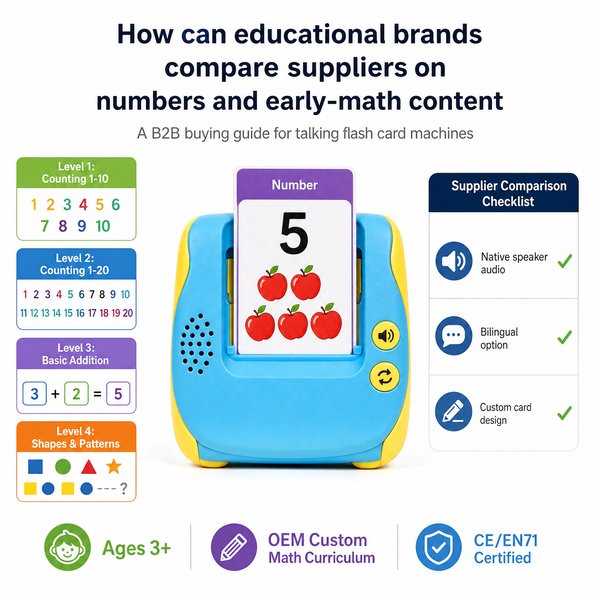
BLUF: To compare suppliers on numbers and early‑math content, evaluate (1) explicit curriculum scope and learning progression, (2) audio accuracy and multilingual/localization capabilities, (3) physical card durability and print quality, and (4) certifications, MOQ/lead time and OEM/ODM flexibility. Prioritize vendors who can deliver curriculum-mapped sets (e.g., 112 cards / 224 words starter or 255 cards / 510 words premium), clear audio, and CE/EN71/FCC/RoHS compliance — factory-direct options like Toyvao can combine OEM/ODM customization with those assurances.
Key decision points — When it’s worth caring about / When you don’t need to overthink it
1) Content depth and scope (numbers & early math)
When it’s worth caring about:
- Your customers require staged learning (counting → number recognition → basic addition), aligned to a curriculum or grade level. You need precise scope (how many numbers, presence of concepts like more/less, counting by 2s/5s, simple equations) and measurable learning objectives.
- You sell into schools or learning centers where assessment or lesson plans will reference the card content directly.
When you don’t need to overthink it:
- You are stocking general-purpose preschool toys for open-market retail where simple number naming and counting (1–20) is acceptable.
2) Curriculum alignment & pedagogy (phonics + numbers integration)
When it’s worth caring about:
- You require explicit pedagogy (e.g., scaffolding from numeral recognition to one-to-one correspondence to addition) or alignment to national/early-learning standards.
- You need integrated content across phonics, sight words and numbers so cross-curricular lessons are possible.
When you don’t need to overthink it:
- Customers want standalone toys for home use and aren’t matching to formal lesson plans.
3) Audio accuracy, languages & localization
When it’s worth caring about:
- You sell in multilingual markets or require high-quality, native-speaker pronunciation for numbers and math vocabulary (e.g., “subtract,” “equals”).
- You need specialized content such as Quranic/faith-based counting examples or language dialect variants — requires OEM/ODM support.
When you don’t need to overthink it:
- Only basic single-language pronunciation is required (e.g., simple English number names) and buyers accept generic TTS-style audio.
4) Audio hardware & clarity
When it’s worth caring about:
- Use in noisy classrooms or group activities where volume and clarity (no distortion) matter. Verify sample recordings; check bit-rate and speaker quality.
When you don’t need to overthink it:
- Device is for quiet home use and short listening sessions.
5) Card durability, print quality & safety
When it’s worth caring about:
- Products will circulate in schools/daycares — require thicker cards, rounded corners, scratch/water resistance, and non-toxic inks. Ask for card thickness (in gsm or mm) and water-resistance treatment.
When you don’t need to overthink it:
- Low-cost impulse retail where occasional replacements are acceptable.
6) Compliance & certifications
When it’s worth caring about:
- Selling into regulated markets (EU/US) — insist on CE, EN71, ASTM, FCC, RoHS test reports and ability to supply test certificates per shipment.
When you don’t need to overthink it:
- Private demos or small pilot buys for internal testing in non-regulated contexts.
7) Customization, MOQ & logistics
When it’s worth caring about:
- You require OEM/ODM customization (custom cards, languages, branding), private-label packaging, or specific pack sizes. Then MOQ, tooling costs and lead time become decisive factors.
When you don’t need to overthink it:
- You buy off-the-shelf SKUs and prioritize lowest landed cost over customization.
Concrete comparison table — how suppliers typically stack up
| Attribute | Minimal Supplier | Standard Supplier | Premium Supplier | Toyvao (factory-direct example) |
|---|---|---|---|---|
| Typical card set | ~50 cards (50 words) | 112 cards / 224 words (starter) | 255 cards / 510 words (premium) | 112 cards (224 words) & 255 cards (510 words) options |
| Curriculum (numbers & math) | Number naming only (1–10) | Counting, number recognition, simple addition | Sequenced math concepts, problem cards, flash equation prompts | Phonics, Sight Words, Numbers & Math, Themes; OEM math content available |
| Audio quality | Low-cost TTS; variable clarity | Pre-recorded native voices; decent clarity | Studio-recorded, multi-language, high bitrate | Native pronunciation options and custom language recording via OEM/ODM |
| Card durability | Thin board, limited resistance | Thicker board, laminated options | Waterproof, high GSM, rounded safety corners | Custom thickness/lamination options; sample verification recommended |
| Certifications | Often none | CE / RoHS | CE / EN71 / ASTM / FCC / RoHS with test reports | CE / FCC / RoHS / EN71 / ASTM (can supply certificates) |
| Customization & OEM/ODM | Not available | Limited (logo, packaging) | Full OEM/ODM (cards, content, languages) | Full OEM/ODM support including faith-based/Quranic content |
| MOQ & lead time | Very low MOQ, short lead time | Moderate MOQ (1k+), 4–8 weeks | Higher MOQ, custom lead times 8–12+ weeks | Factory-direct MOQ and lead times configurable — contact for quotes |
Verification checklist — what to inspect before ordering
- Audio samples: verify clarity, recording bit-rate, native speaker pronunciation for numbers/math terms, and multi-language samples if required.
- Card samples: check thickness (gsm or mm), lamination, edge finishing, water resistance and print fidelity (fonts, numerals legibility).
- Curriculum mapping: request a content matrix showing which math skills each card targets (counting, one-to-one correspondence, addition, symbols like +, -).
- Translations/pronunciations: confirm accurate translations for localized number words and any math-specific vocabulary.
- Certs & tests: obtain CE/EN71/FCC/RoHS/ASTM test reports and check they match the SKU and production batch.
- Piloting: run a small pilot (50–200 units) in classrooms to measure engagement and teacher feedback before large buys.
Customer feedback synthesis
Positive quotes:
- “Clear audio and sequence progression — teachers used the 112-card starter set to support counting lessons across three classes with predictable results.”
- “Factory-direct pricing from a vendor with OEM capability made it easy to localize number names into two dialects — lead time was reasonable.”
- “Certifications and sample test reports arrived with the first shipment, which sped up our procurement sign‑off for district deployment.”
Negative / concern quotes:
- “One batch had inconsistent pronunciations for ‘thirteen’ — we needed audio rework, which delayed rollout.”
- “Cards delaminated after heavy classroom use; supplier corrected material grade on reorder but we took returns from three centers.”
- “MOQ and tooling costs were higher than expected for a small pilot, making the initial buy risky for our regional stores.”
FAQ — quick answers for procurement teams
-
Q: What card set sizes should we offer for K–2 markets?
A: Offer both a standard starter (112 cards / 224 words) for preschool and early-K and a premium set (255 cards / 510 words) for K–2 and accelerated programs. The starter covers number naming and basic addition; the premium includes extended math concepts and thematic reinforcement. -
Q: How do we verify audio pronunciation and translations before mass production?
A: Request voice sample files (MP3/WAV), ask for native-speaker vetting, and approve a signed-off audio master. For localized content, require a small pre-production run and classroom pilot. -
Q: What certifications are essential when selling in EU/US school channels?
A: At minimum CE/EN71 for Europe and ASTM/FCC for the US, plus RoHS for material safety and FCC for any wireless/audio-emitting electronics. Ask suppliers for up-to-date test reports matching your SKU. -
Q: Can suppliers produce faith-based or specialized early-math content?
A: Yes — choose suppliers offering OEM/ODM. Toyvao, for example, supports custom languages and specialized content such as Quranic/faith-based learning alongside numbers and math modules.
Next steps / procurement checklist
- Request 2–3 sample kits (112-card and 255-card) with audio files and lab reports.
- Map content to your curriculum requirements and run a 30-day classroom pilot.
- Confirm customization options (languages, branding, faith-based content) and negotiate MOQ/lead time.
- Ensure all certifications are on file before approving bulk shipments.
Ready to compare supplier quotes and get OEM/ODM options? Contact Toyvao for factory-direct pricing, samples and customization: WhatsApp +86 186 8106 4480, Email sales@toyvao.com, Website https://toyvao.com
