
Executive Summary
This guide provides an engineering-focused specification and decision framework for OEMs developing Picture Book Reading Pens (also known as Story Pens, Talking Book Pens or OID Reading Pens). It focuses on four key PCB-level subsystems that determine product performance, cost, and manufacturability: microcontroller (MCU), digital-to-analog converter / audio codec (DAC/codec), power amplifier, and non-volatile memory.
Recommendations are practical and vendor-agnostic where possible, and include specific part-class suggestions and representative IC examples used in production. You will find:
– Capability thresholds for MCUs depending on file format, latency and features (Cortex-M0/M4/M7, ESP32 class, or hardware decoder).
– When to use integrated MCU DAC vs external codec vs PWM.
– Amplifier class trade-offs for single-cell Li-ion powered pens (Class D recommended for battery life).
– Memory options (QSPI NOR, SPI NAND, eMMC, microSD) with guidance on capacity, access pattern, random-access latency and cost.
– BOM cost ranges, supply considerations, compliance and testing checkpoints.
Use this guide to define component specs, price targets, development effort and risk before committing to prototypes or volume orders.
What Is Picture Book Reading Pen and Who Uses It
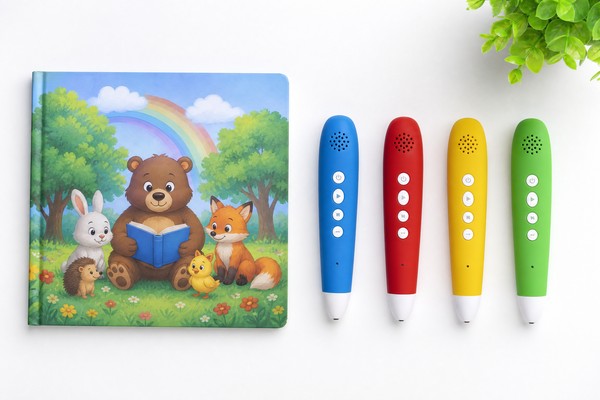
A Picture Book Reading Pen is a handheld consumer electronics device for children that reads aloud page-specific narration, prompts and sound effects when the pen tip is tapped on special printed page targets (optical patterns) or QR-like tags. Core user and buyer groups:
– Children’s book publishers and licensors who embed audio into print runs.
– Educational product OEMs and ODMs that supply interactive reading kits to schools and retail channels.
– Distributors and private-label brands targeting early literacy and multilingual markets.
– Contract manufacturers developing low-cost, battery-powered interactive devices.
Functional constraints typical to this product class:
– Battery-operated (single-cell Li-ion or 2 × AA/NiMH) with 4–12 hour active life target.
– Fast audio start/seek latency (typical expectation <100 ms; ideal <30 ms) when a tag is tapped.
– Small speaker (28–40 mm) with limited acoustic output; priority on speech intelligibility rather than hi-fi fidelity.
– Limited PCB footprint (board area 25–50 cm²), low BOM cost, and strong expectations for reliability, child safety and regulatory compliance.
Design decisions at MCU, DAC/codec, amplifier and memory layers define responsiveness, battery life, audio quality and manufacturability.
Why Demand Is Growing
Market drivers behind continued demand and frequent new SKUs:
– Ongoing investment in early literacy and bilingual education products in APAC, LATAM, and MEA.
– Publishers seeking differentiated physical products vs. pure-digital apps; pen-based UX is tactile and intuitive for pre-readers.
– Component cost decline and higher integration in MCUs and audio ICs enabling richer features at lower BOM cost.
– Increased print-on-demand and short-run publishing models where a standardized pen module can be paired with many books.
– Parent preference for offline, screen-free learning tools for young children.
From a sourcing perspective, growth means competitive pressure on unit cost, but also opportunities for modular upgrades (e.g., add BLE or voice recognition) using the same core audio/data architecture.
Key Technology Differences
Design choices cluster into a few architecture patterns. Each has distinct impact on BOM, development complexity and runtime behavior.
Software-decoding MCU (single-chip)
– MCU implements decoding (ADPCM, MP3/AAC) in software.
– Requires MCU with DSP instructions or high clock rate (Cortex-M4/M7 or ESP32).
– Advantage: fewer external chips, lower BOM and board area.
– Downsides: higher power draw during decoding, more complex firmware, may need more RAM/flash.
Hardware codec / dedicated MP3 decoder
– External codec/decoder IC (e.g., VS10xx series) performs compressed audio decoding.
– MCU handles control and OID mapping only.
– Advantage: lower MCU requirement, deterministic decode latency, well-tested decoder stacks.
– Downsides: extra BOM cost, more pins and board routing.
I2S DAC + Digital Amp (I2S-to-Class-D)
– MCU or codec produces I2S stream; external DAC or I2S-input class-D amplifier handles digital-to-analog and drive.
– Advantage: higher audio quality, cleaner analog domain, small PCB footprint if using integrated digital amp (e.g., MAX98357A).
– Downsides: requires I2S-capable MCU or codec; careful power/EMC layout.
MCU internal DAC or PWM DAC
– For ultra-low-cost pens, use MCU’s internal DAC or PWM output filtered by RC/LC into amplifier.
– Advantage: cheapest and simplest.
– Downsides: limited SNR and THD, audible artifacts on speech and increased filtering needs.
Memory and access behavior differences
– QSPI NOR flash: low-latency random reads, good for indexing and short clips, but capacity tops out (commonly ≤128 Mbit / 16 MB or 256 Mbit / 32 MB in commodity parts).
– SPI NAND / eMMC / microSD: much higher capacities (hundreds of MB to multiple GB) at lower cost per MB but with higher random-access latency and higher firmware complexity (ECC, wear leveling).
– microSD: universal, easy to update content, but physical card adds mechanical failure risk and slower seek times.
Power supply topology
– Single-cell Li-ion (3.7 V nominal) with boost or direct-drive for amplifier is common; the choice of amplifier affects whether a boost converter is required.
– For AA/NiMH designs, boost converter is mandatory to maintain amplifier supply over battery discharge curve.
Key Features and Specifications to Evaluate
This section lists the concrete parameters to specify and target when selecting parts and architecting the PCB.
Microcontroller (MCU)
– Core: Cortex-M0/M0+/M3/M4/M7, ESP32 (Tensilica Xtensa), or RISC-V. Choose M4/M7 for DSP-heavy decoding (MP3/AAC) or advanced features (voice recognition).
– Clock: 48–200+ MHz depending on codec and DSP needs.
– RAM: 32–512 KB minimum; 256 KB recommended for MP3 decoding and buffering. 1 MB+ for more complex features.
– Internal flash vs external: On-chip flash sufficient for bootloader/firmware; large audio should be elsewhere.
– Interfaces: I2S or SAI for audio, QSPI for execute-in-place (XIP) flash, SDIO for microSD, SPI, I2C, UART.
– DMA: mandatory for low-CPU audio streaming and low-power operation.
– ADC: if supporting microphone for voice notes; resolution 12-bit typical.
– GPIO count: enough for pen tip detection, OID sensor control, LEDs, buttons.
– Power modes: deep sleep with RTC for standby hours, wake-on-IO or external interrupt.
DAC / Audio Codec
– Interface: I2S/TDM recommended; MCU internal DAC or PWM acceptable for speech-only low-cost devices.
– Resolution & sample rate: 16-bit, up to 48 kHz is adequate; speech can be 8–22 kHz sampling.
– SNR/THD+N: target >90 dB SNR for clean audio; 70–80 dB can be acceptable for low-cost mono speech.
– Integrated microphone ADC: useful if recording voice notes; 12–16 bit ADC recommended.
– Mono vs stereo: mono is common; stereo needed only if music or binaural playback is required.
– Features: EQ, volume control, microphone bias, headphone amp, mute/shutdown.
Class of amplifier
– Class D (step-up or bridged) recommended for battery life. Choose mono class D 1–3 W for small speakers.
– Class AB simpler but less efficient; acceptable for short playback but drains battery faster.
– Power supply compatibility: select amplifier rated for battery voltage (e.g., 2.5–5.5 V) to avoid extra boosters.
– Output power: match to speaker (4–8 Ω). For 3.7 V battery, expect ~1–3 W into 4–8 Ω.
– EMI considerations: include output LC filter and layout best practices.
Memory
– Capacity planning: estimate storage using chosen codec and expected total runtime.
– Example: speech encoded at 32 kbps mono (ADPCM/low-bitrate MP3) consumes ~240 KB per minute. 1 hour ≈ 14.4 MB.
– Type and interface:
– QSPI NOR (Winbond W25Q256 = 256 Mbit / 32 MB) for moderate-sized content with low-latency random reads.
– SPI NAND or eMMC for >32–128 MB capacity; requires ECC and more complex drivers.
– microSD for very large or user-updatable content; worst-case latency but easiest field updates.
– Random access latency: critical for tap-to-play UX. QSPI NOR and XIP-capable flashes give the lowest latency and simplest firmware model.
– Endurance and retention: flash endurance for read-only content is less critical; use eMMC/SPI NAND with known-good parts for long lifetimes.
Real-time performance and latency
– Seek/response time goal: <30 ms optimal, <100 ms acceptable.
– Buffering: small circular buffers (16–64 KB) with DMA reduce CPU load and support instant starts.
– Indexing: maintain a mapping table (tag ID → audio offset + length) in fast SRAM or on-chip flash for immediate lookup.
EMC, board layout and analog design
– Analog ground plane and star ground around codec and amplifier.
– Dedicated analog supply decoupling and ferrite bead isolation between digital and analog domains.
– Speaker routing and placement to minimize PCB-induced vibration and EMI.
– Class D switching node must be kept short and with recommended filtering per datasheet.
Pros and Cons
MCU Software Decode (Cortex-M4/M7 or ESP32)
– Pros: Lower chip count, lower BOM, flexible firmware, compact PCB.
– Cons: Higher power during decode, requires sufficient RAM and CPU headroom, longer firmware development and optimization for DSP.
Hardware Decoder / External Codec
– Pros: Deterministic decode, lower MCU spec required, offloads CPU, sometimes includes built-in amplifiers or microphone ADCs.
– Cons: Additional IC cost, more complex BOM and layout, potential obsolescence of decoder chips.
MCU Internal DAC / PWM
– Pros: Lowest cost and smallest BOM footprint.
– Cons: Lower audio fidelity, more filtering, PWM switching noise can affect OID sensor if poorly routed.
I2S DAC + Class D Amp (Digital Path)
– Pros: Clean signal chain, better SNR, digital domain until the final stage, easier to implement volume control and EQ.
– Cons: Slightly higher BOM cost, need for careful clocking and jitter control.
QSPI NOR vs SPI NAND vs eMMC vs microSD
– QSPI NOR: low latency, limited capacity and higher $/MB.
– SPI NAND/eMMC: large capacity, lower $/MB, requires ECC/wear-leveling/drivers and can add latency.
– microSD: flexible, removable content, easy updates; potential reliability and mechanical issues; slower random access.
Step-by-Step Decision Guide
Follow this pragmatic path when specifying the PCB and components for a new pen project.
Define product targets
– Audio length and format: total hours per device, target bitrates, speech vs music.
– UX latency target: 30 ms vs 100 ms.
– Battery target: runtime under typical use (hours), charging system, battery type.
– Cost target: desired BOM cost per unit at target volume.
Choose audio format strategy
– If main content is speech-only and you want minimum CPU load: choose ADPCM (4:1 compression) or low-bitrate MP3 (32–64 kbps). ADPCM is simpler to decode and often sufficient.
– If you need music or higher fidelity: use MP3/AAC and choose a hardware decoder or MCU with DSP (Cortex-M4/M7 or ESP32-class) and sufficient RAM/flash.
Select memory architecture based on capacity and latency
– <32 MB audio content and strict latency: QSPI NOR (XIP).
– 32 MB–1 GB with acceptable latency and more complex firmware: SPI NAND or parallel NAND with ECC or eMMC.
– >1 GB, user update capability or frequent content changes: microSD or eMMC.
– Build an index table of tag→offset in fast-access memory for instant lookup.
Pick MCU class
– Ultra-low-cost, speech-only, MIDI-like features: Cortex-M0+/M3 with QSPI NOR if using easily-decodable formats (ADPCM/WAV).
– Balanced: Cortex-M4 (e.g., STM32F4-class) with 256 KB+ RAM for MP3 decoding in software.
– High-feature or Wi‑Fi/BLE integration: ESP32 family or Cortex-M7 with 1 MB+ RAM.
– If using hardware decoder: MCU requirements drop to control and peripheral handling—Cortex-M0+ is often sufficient.
Decide on DAC/codec and amplifier topology
– If using MCU internal DAC for mono speech: combine with small class D or AB amplifier, add LC filtering for PWM if used.
– For best audio quality and cleaner layout: choose an I2S DAC + class D amp or single-chip I2S-to-amplifier IC (MAX98357A family).
– Select class D amplifier with auto-shutdown and thermal protection; ensure chip supports battery voltage without external boost.
Prototype and test
– Prototype with dev boards: MCU dev kit + evaluation board for DAC/amp + representative memory medium (QSPI or microSD).
– Measure real response times (tap to audio) under real OID sensor workloads.
– Test battery life using automated tap sequences and sleep/wake cycles.
Plan firmware and production
– Implement index lookups and DMA-driven audio pipelines early.
– Include bootloader capability and OTA (if using BLE/Wi-Fi).
– Put in debug/diagnostic connectors and production test points for flash programming and QC.
Mitigate supply risk
– Select second-source parts for MCU, memory and amplifier where possible.
– Use commodity and long-life parts when available (avoid niche decoders with limited lifespan).
Pricing and Cost Analysis
Below are representative cost ranges for single-unit BOM items in common volume bands (10k–100k units). Prices are indicative and depend on exact part, contract, and market conditions.
Component class — low-end / mid-range / high-end (unit price estimates USD)
– MCU (Cortex-M0+/M3 class): $0.60 – $2.50 — Cortex-M4/M7: $2.50 – $7.00 — ESP32-class (Wi‑Fi/BLE): $1.50 – $3.50
– QSPI NOR flash (16–32 MB): $0.35 – $1.20 — (64 MB – 128 MB): $1.00 – $2.50
– SPI NAND / eMMC (128 MB – 8 GB): $0.80 – $6.00 depending on capacity
– microSD (industrial SLC/MIC): $0.80 – $3.00 (for 2–8 GB)
– DAC / codec IC: $0.30 – $2.50 — premium codecs up to $4.00
– Class D amplifier: $0.20 – $1.20 (PAM-series low-cost) — higher performance TI parts $1.50 – $3.50
– Speaker (custom molded 28–40 mm): $0.25 – $1.50
– Power management (charger, protection, regulator): $0.50 – $2.50
– Sensors (optical OID sensor): $0.30 – $1.80
– PCB assembly and materials (2-layer, populated): $1.50 – $4.00 (depending on component density and labor geography)
Typical BOM scenarios
– Ultra-low-cost pen (short audio, simple features): target BOM $6–12 per unit.
– MCU M0+, QSPI NOR 8–16 MB, MCU DAC or PWM, cheap class D amp, speaker, basic charger.
– Mainstream pen (1–3 hours, MP3 support, better audio): target BOM $12–22 per unit.
– MCU M4 or ESP32, QSPI NOR 32 MB or SPI NAND 64–128 MB, I2S DAC or codec, class D amp, Li-ion charger.
– Feature-rich pen (BLE, voice notes, extended memory 1–4 GB): BOM $25–45 per unit.
– ESP32/advanced MCU, eMMC or microSD, high-quality codec, integrated mic ADC, smart PMIC.
Additional cost buckets
– Tooling and NRE: keypad molds, case tooling, battery-certified fixtures — $5k–$50k depending on complexity.
– Firmware development and testing: estimate 3–6 person-months for a basic product; more for advanced features.
– Certification and compliance (CE, FCC, RoHS, battery safety, EMC): $3k–$10k per region for test and lab; accelerated manufacturers may include pretesting.
Licensing
– Check codec patent status and required licenses. MP3 patents have largely expired globally (as of 2017), but AAC and other codecs may carry fees. Verifying with legal is required for commercial distribution.
Competitive Landscape
Component suppliers
– MCUs: STMicroelectronics (STM32 family), NXP (Kinetis/i.MX RT), Microchip/Atmel (SAM series), Espressif (ESP32), Nordic Semiconductor (nRF52 for BLE-only).
– Memory: Winbond, GigaDevice, Micron, Samsung (eMMC), Kingston/SanDisk for microSDs.
– Audio CODECs/DACs: Texas Instruments (TLV320 family), Cirrus Logic, Maxim Integrated (MAX98357), ESS, Wolfson (now Cirrus Logic).
– Decoders: VS10xx/VS1053 series (VLSI Solution) historically used for offloading MP3 decoding.
– Amplifiers: PAM series (Diodes Inc.), TI TPA family, Maxim, Analog Devices.
System integrators and ODMs
– Multiple China-based OEMs supply complete pen modules (MCU + OID sensor + audio subsystem) and will customize firmware for large orders.
– ODMs are often the fastest path to market if you accept a standard hardware baseline and need rapid volume.
Value-added suppliers
– Speaker fabricators offering tuned drivers for speech.
– Battery partners with pre-certified cells and protection boards.
– Case houses experienced in child-safe plastics and assembly.
Supply-chain risks
– Memory and MCU shortages have historically been major schedule risks—specify second sources and maintain rolling purchase contracts.
– Obsolescence: use broadly adopted families (e.g., STM32, ESP32) rather than niche decoders.
What Buyers Say
Common priorities and pain points reported by purchasers and product managers:
– Responsiveness: poor tap-to-sound latency is the single most common customer complaint. Buyers insist on <100 ms; top-of-line products target <30 ms.
– Audio quality vs battery life: buyers want clear speech and long battery life. Opting for class D amps and efficient codecs is a common compromise.
– Content update strategy: buyers prefer devices that allow content updates by microSD or over-the-air via BLE/Wi‑Fi in premium tiers.
– Cost sensitivity: a 10–20% reduction in BOM price materially affects competitiveness; buyers often ask for alternate BOM options to trade features for cost.
– Supply reliability: buyers prioritize long-life parts and multiple sourcing options for memory and MCU to avoid mid-run redesigns.
– Ease of certification and child-safety compliance: buyers expect suppliers to handle EU/US regulatory requirements and testing.
Common technical complaints post-production:
– Audible pops/clicks during sample rate changes — usually layout or power sequencing issues with codec/amplifier.
– EMI/pickup affecting OID sensor performance due to poor PCB grounding around class D switching nodes.
– Flash corruption on cheap SPI NAND when power loss occurs during writes — requires robust power-fail-safe firmware.
Safety, Maintenance and Compliance
Regulatory and safety requirements that apply to consumer devices for children:
– RoHS and REACH: mandatory restrictions on hazardous substances in EU and many markets.
– CE and FCC: EMC and Radio/EMC testing for European and US markets. Class D amplifiers raise EMC concerns; pre-certify with production-level PCB layout and shielding as needed.
– Battery safety: UN38.3 transit tests, IEC62133 for batteries containing lithium cells. Chargers must comply with relevant regional standards (UL, EN).
– Acoustic safety: maximum SPL should be limited to safe levels for children (many buyers target <85 dB SPL at 0.5 m; check regional guidance). Implement software volume limits and physical attenuation.
– Choking/ingestion: product enclosures must meet mechanical strength and small-parts tests for the intended age group (e.g., ISO/ASTM standards for toys).
– Chemical labeling: batteries and materials must meet labeling and disposal guidance.
Manufacturing and maintenance best practices
– Production test: include programming and audio-playback test steps, battery charge/discharge QC, speaker impedance checks and OID recognition validation.
– Firmware update path: include a secure bootloader and recovery for field firmware updates or fixing content indexing issues.
– Conformal coating or potting: consider for devices that may be handled roughly, but be mindful of repairability and voice/mic performance.
– Maintenance: provide clear instructions for battery replacement if non-rechargeable, or service centers for battery replacement in sealed models.
Frequently Asked Questions
Q: Can I decode MP3 on a low-cost MCU like Cortex-M0?
A: Decoding MP3 in real time on Cortex-M0 is generally not feasible at acceptable CPU utilization. For MP3/AAC, choose a Cortex-M4/M7 or ESP32, or use a hardware decoder IC. For speech-only content, ADPCM or u-law PCM with Cortex-M0 is viable.
Q: What memory size do I need for 2 hours of narrated content?
A: It depends on codec. Example:
– ADPCM (~32 kbps): 2 hours ≈ 28.8 MB.
– MP3 @64 kbps: 2 hours ≈ 57.6 MB.
Therefore plan 64–128 MB usable storage for 2 hours with some headroom and indexing.
Q: Is an external DAC necessary?
A: Not always. For speech-only low-cost pens, MCU internal DAC or PWM + LC filter into an amplifier can be acceptable. Use external I2S DAC for higher SNR, stereo, or if analog performance is a priority.
Q: Should I choose class D or class AB amplifier?
A: Class D provides much better battery efficiency for battery-powered pens and is recommended for typical use. Class AB is simpler and may be used in low-duration playback designs, but battery life will suffer.
Q: How do I achieve low tap-to-sound latency?
A: Use low-latency memory (QSPI NOR with XIP or a preloaded SRAM index), maintain an audio offset table in fast memory, and design the firmware to DMA a minimal initial buffer and start playback immediately while rest of data streams.
Q: What are common causes of audio clicks and pops?
A: Power sequencing issues, abrupt codec power-down without mute, sample-rate changes, inadequate decoupling, and poor ground separation between digital and analog sections. Implement soft-mute sequences and follow datasheet power sequencing.
Contact Toyvao
For BOM review, supplier recommendations, prototyping services, or RFQ assistance for Picture Book Reading Pens and module-level solutions, contact Toyvao:
– Website: https://toyvao.com
– Email: info@toyvao.com
Provide your target unit volumes, preferred battery type, expected audio hours per unit, latency target and any regulatory markets (EU/US/China) to receive a tailored component and cost breakdown.
