
Executive Summary
Small retailers buying Picture Book Reading Pens (also called Story Pens, Talking Book Pens, OID Reading Pens) face two interlinked procurement levers: minimum order quantity (MOQ) requirements and tiered pricing models. Properly structured MOQs and pricing tiers determine landed cost, cash flow, inventory risk, and gross margin. This guide applies practical, specific sourcing strategies—MOQ consolidation, staged production, split shipments, group buys, and tiered discount negotiation—backed by technical variables that materially affect unit cost (memory size, speaker, battery, certifications, packaging). It provides step-by-step decision rules, example landed-cost calculations, negotiation levers, supply-chain operational controls, and compliance requirements (EN71, ASTM F963, CPSIA, UN38.3, FCC, RoHS). Use it to convert manufacturer price tables into reliable buying decisions that protect margins while keeping SKU breadth appropriate for small retail footprints.
What Is Picture Book Reading Pen and Who Uses It
Product definition
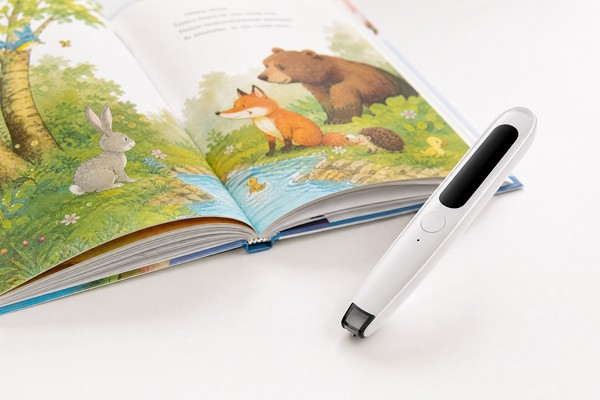
– A Picture Book Reading Pen is a handheld electronic device that plays pre-recorded audio when its tip touches printed targets on a picture or storybook. Technologies used include optical identification (printed dot patterns read by an onboard camera or IR sensor), resistive touch points, or embedded NFC/RFID hotspots. Typical functions: word/sentence playback, sound effects, multi-language audio, recording, volume control, and simple interactive games.
– Typical hardware components: microcontroller (ARM Cortex-M0/M3 or 8051 class), flash memory (8 MB–512 MB), speaker (8 mm–28 mm; 0.5–3 W), microphone (for recording), battery (single-cell LiPo 3.7 V 300–1500 mAh or AA/NiMH in low-cost models), OID sensor (camera or IR photodiode with lens), audio codec (MP3/ADPCM), charging interface (micro-USB or USB-C), optional Bluetooth/Wi‑Fi module for updates.
Who buys for resale
– Small independent toy/book retailers, early learning centers, specialty bookstores, online niche sellers (Amazon, Etsy reselling), and educational product distributors.
– Buyers need low initial inventory risk, easy re-order options, localized content (language-specific audio), and compliance documentation for regional toy regulations.
Common manufacturer types
– Low-cost OEM factories (China, Dongguan/Shenzhen), mid-range ODMs offering design customization, and brand manufacturers offering higher margins with full certification and warranty services.
Why Demand Is Growing
Market drivers
– Parents and educators prioritize early literacy tools combining print and audio; interactive pens address phonics, vocabulary, and listening skills.
– E-commerce growth and small retailers’ need for differentiated SKUs (localized language packs, private-label branding) drive demand for small-volume, configurable production.
Economic factors favoring pens
– Unit retail prices range widely: mass-market pens $10–25, branded systems $30–80. For small retailers, these price points match impulse and gift purchases with 40–70% gross margin potential.
– Manufacturing maturity: many component costs have stabilized (microcontrollers, flash memory, MEMS microphones), enabling competitive per-unit pricing even at modest volumes if MOQ strategy is optimized.
Operational needs of small retailers
– Low MOQ is critical to test market response to private-label or localized audio content without capital lock-up.
– Faster time-to-shelf: small retailers often need 4–12 week lead times; supply partners who offer sampling, small pilot runs, and split shipments provide advantages.
Key Technology Differences
Optical vs RFID vs touch
– Optical Identification (OID): uses a camera or optical sensor to read micro-patterns printed on pages. Advantages: precise mapping to content, supports complex interactions. Hardware cost: higher due to camera/lens and processing. Typical sensor: low-resolution CMOS camera + onboard MCU image recognition. Power: modest increase; chip and processing add $1.00–$3.00 to BOM.
– RFID/NFC: requires tags embedded in pages; low-cost reader but requires tag production and embedding; best for durable board books. Less precise for continuous text mapping.
– Resistive touch/printed hotspots: cheapest; direct contact points printed as conductive ink. Low cost but less durable and limited content complexity.
Audio processing and quality
– Codec and sampling: MP3 at 32–128 kbps, 22 kHz mono is common; CD-quality unnecessary and wastes flash. ADPCM is a lower-cost codec sometimes used in ultra-low-end pens.
– Speaker and output power: 8 mm speakers produce acceptable voice at 0.5–1 W; 16–28 mm speakers produce fuller sound and are preferred for premium products. Speaker selection affects BOM by $0.20–$2.50.
Memory and storage
– Flash memory options: 8 MB (few minutes of audio) → 32 MB → 128 MB → 512 MB (multiple hours and multi-language).
– Cost impact: moving from 32 MB to 128 MB typically increases BOM by $0.80–$2.00 depending on supplier and contract volume.
Connectivity and updates
– USB-C or micro-USB for file transfer is standard. Bluetooth Low Energy or Wi‑Fi enables OTA updates and easier localization but adds $1.50–$4.00 BOM and additional certification (FCC, CE).
– SD card slot increases flexibility but adds mechanical complexity and cost (~$0.50–$1.20).
Power choices
– Single-cell LiPo (300–1500 mAh): compact, rechargeable; requires charging circuit and UN38.3 testing for transport; typical cost addition: $0.80–$3.00.
– AA/NiMH: higher user-replaceable convenience; bulkier; slightly higher ongoing user cost. Battery choice affects weight, packaging, and certification complexity.
Durability and form factor
– Impact-resistant ABS (2–3 mm thickness) or TPE overmolding on handles. Enclosure tooling costs (injection molds) are significant: $3,000–$25,000 depending on complexity. Amortization per unit decreases with volume.
Key Features and Specifications to Evaluate
Mandatory technical specs to request from suppliers
– Audio: codec (MP3/ADPCM), sample rate (≥22 kHz recommended), mono output, max playback power (dB SPL at 0.5 m).
– Memory: flash capacity and whether expandable (8–512 MB); specify preloaded content format and file structure.
– Sensor type: OID camera resolution and recognition rate, or NFC/RFID protocol, or conductive touch technology.
– MCU: part number or class (e.g., ARM Cortex-M0 32-bit), clock frequency, RAM size—used as a proxy for future firmware flexibility.
– Speaker: diameter (8–28 mm), impedance (4–8 Ω), rated power (0.5–3 W), SPL @1W.
– Power: battery chemistry, capacity (mAh), built-in charger IC type, expected runtime (hours of continuous playback).
– Interfaces: USB type, Bluetooth version (if any), SD slot presence.
– Physical: weight (g), dimensions (mm), material (ABS/TPE), IP rating if applicable.
– Environmental: operating temperature range, storage temperature.
Operational and service specs
– Lead time: prototype/sample 2–4 weeks; production 6–12 weeks after PP sample approval.
– MOQ for each SKU, and MOQ for combined production.
– Defect tolerance / acceptance quality limits (AQL), e.g., AQL 0.65 for critical defects common for electronics.
– Warranty (months) and RMA procedure.
Supply-chain and customization specs
– Tooling costs and amortization schedule, including per-unit amortization at target order sizes.
– Packaging options and costs (retail box vs polybag; printed manual languages).
– Audio localization: per-language recording costs (studio vs supplier-sourced VO), per-minute cost for localization. Typical cost: $50–$250 per minute for professional studio recording depending on language and actor rates; cheaper in bulk or using supplied files.
Quality checkpoints to require
– Pre-Production Prototype (PP sample) and Production Part Approval Process (PPAP) equivalents.
– First Article Inspection (FAI) and production run inspection reports (IQC, OQC).
– Burn-in test duration (72 hours recommended for electronics).
– Drop tests and mechanical stress testing for toy-grade durability.
Pros and Cons
Pros (for small retailers buying these pens)
– Differentiation: private-label and language-localized content can create unique SKUs.
– Margins: potential 40–70% gross margin if purchased and priced correctly.
– Low unit packaging and weight reduce per-unit shipping and return costs.
– Educational value drives repeat and gift purchases.
Cons and risks
– MOQ constraints: many manufacturers set MOQs of 500–1,000 units per SKU for customized pens; OEMs may require 3,000–5,000 units for full tooling amortization to reach low per-unit prices.
– Certification costs: arranging EN71/ASTM/FCC and battery testing can add $2,000–$10,000 per SKU upfront.
– Technical variability: recognition errors, audio quality issues, and battery performance can create returns and reputational risk.
– Inventory risk: unsold SKUs tie up capital; shelf life of interactive content might be variable.
Acceptance levels and common thresholds
– Acceptable production defect rate targeted by reputable suppliers: <1% total defects, <0.5% critical defects.
– Minimum profitable order size for a private-label pen typically 300–1,000 units, depending on the supplier and packaging complexity.
Step-by-Step Decision Guide
Step 1 — Define the SKU scope (3–5 days)
– Decide whether to buy a white-label, semi-custom, or fully custom pen. White-label: lowest MOQ (100–500), fewer customization options. Fully custom: higher MOQ (1,000+) and higher tooling.
– Confirm localization needs (languages, accents, content variations) and packaging.
Step 2 — Establish target landed cost and margin (1–2 days)
– Set target retail price and desired gross margin. Example: target retail $29.99, desired margin 55% → target landed cost ≤ $13.50.
– Determine acceptable lead time and inventory turnover.
Step 3 — Collect supplier quotes and technical proposals (1–2 weeks)
– Request detailed BOM, per-part costs, MOQ for each SKU, tooling costs, sample pricing, lead time, payment terms, incoterms (FOB/CIF/DDP), and certification status.
– Ask for PP sample and factory photos.
Step 4 — Use MOQ strategies to reduce risk
– Consolidate SKUs: print multiple language tracks onto one hardware model to reach MOQ while varying packaging.
– Staged production: negotiate small pilot run (100–300 units) with higher unit price, and a guaranteed follow-on order at reduced price within 3–6 months.
– Group buying/cooperative purchasing: coordinate with other small retailers to meet MOQ collectively.
– Consignment or vendor-managed inventory (VMI) where feasible.
Step 5 — Negotiate tiered pricing and terms
– Aim for a clear tier structure: e.g., 1–99 units = $12.00, 100–499 = $9.50 (20% discount), 500–999 = $8.00 (16% discount), 1000+ = $6.50 (19% discount). Negotiate payment terms: 30% deposit, 70% on B/L or Net30 for trusted partners.
– Ask for rebates for hitting cumulative annual volumes (e.g., $0.25–$1.00/unit credit when annual purchases exceed thresholds).
Step 6 — Validate compliance and testing (2–6 weeks parallel)
– Verify supplier provides test reports: EN71, ASTM F963, CPSIA (for US), FCC/CE if wireless present, RoHS. If not, budget for third-party testing ($2,000–$6,000).
– Confirm battery transport compliance (UN38.3) and IEC 62133 on battery.
Step 7 — Finalize PP sample, pre-production sign-off and inspection (1–2 weeks)
– Approve PP sample and request production start. Specify FAI, in-process inspections, final OQC, and AQL levels in contract.
Step 8 — Manage logistics and after-sales (ongoing)
– Choose incoterm (FOB if using preferred freight forwarder; DDP if you want landed cost certainty but higher per-unit). Budget freight: air freight for samples $50–200; sea freight FCL/LCL per-container economics apply.
– Define RMA, spare parts, and firmware update paths.
Pricing and Cost Analysis
Typical supplier pricing tiers (illustrative, FOB Shenzhen)
– Sample/prototype: $25–$60 each (includes setup and priority build).
– Low volume (100–299 units): $9.00–$12.00/unit.
– Mid volume (300–999 units): $6.50–$9.00/unit.
– High volume (1,000–5,000+ units): $4.50–$7.50/unit.
Cost components and impact on unit price
– BOM (electronics, speaker, battery, PCB): 40–60% of FOB unit price.
– Enclosure/tooling amortization: upfront $3,000–$25,000; at 1,000 units, $3–$25 per unit; at 5,000 units, $0.60–$5.00 per unit.
– Assembly and test labor: 15–25% of FOB.
– Packaging, manual, and barcodes: $0.30–$2.00.
– QC and certifications amortized per unit: depends on number of SKUs; for a single SKU, testing can add $2.00–$8.00 per unit when amortized over initial small batch.
Example landed-cost calculation (scenario)
– Order: 500 units customized pen (single language), FOB Shenzhen unit price = $8.50.
– Factory charges: tooling amortization included in price.
– Freight (sea LCL to US East Coast): $0.60/unit (estimate $300 total).
– Customs duty (toy HS 9503): assume 0–5% depending on tariff schedule; use 3% for calculation = 0.03 × ($8.50 + $0.60) = $0.27/unit.
– Import broker, insurance, inland freight to warehouse: $1.20/unit.
– VAT/GST not included (depends on destination).
– Landed cost per unit ≈ $8.50 + $0.60 + $0.27 + $1.20 = $10.57.
– If retail price $29.99, gross margin = (29.99 − 10.57) / 29.99 = 64.8%.
Sensitivity to MOQ and tier pricing
– If order drops to 100 units with unit price $11.00 and proportional freight per unit increases to $2.50 (air or small sea LCL), landed cost = $11.00 + $2.50 + $0.33 (duty) + $1.20 = $15.03 → margin at $29.99 retail = 49.9%.
– Conclusion: each MOQ bracket changes margin materially; hitting mid-volume tiers (300–1,000) often brings per-unit savings of 10–35%.
Negotiation levers with cost impact estimates
– Increase order size to hit next tier: may reduce unit price 10–30%.
– Reduce flash memory (e.g., 128 MB → 32 MB): saves $0.80–$2.00/unit.
– Speaker downgrade (16 mm → 8 mm): saves $0.30–$1.50/unit.
– Eliminate Bluetooth: saves $1.50–$4.00/unit + reduces certification.
– Simplify packaging to polybag: saves $0.30–$1.50/unit.
– Move audio to supplier-provided VO rather than client-supplied studio: may increase or decrease cost depending on language and volume; estimate $50–$200/minute.
Payment terms and working capital
– Typical terms: 30% deposit, 70% balance against B/L. Net30 or Net60 sometimes available for established customers but rare for small retailers. Negotiating extended terms reduces cash tied to inventory.
Competitive Landscape
Supplier segments
– Low-cost China OEMs: price-driven; MOQs 500–2,000 for customization; faster lead times; variable quality control.
– ODMs and contract manufacturers (China, Taiwan): higher technical capability, support for firmware and electronics, MOQ often 1,000+.
– Brand manufacturers (global): offer finished certified products with marketing support but at higher unit price and minimum reselling agreements.
– Niche local suppliers and importers who hold stock (dropshipping/consignment) for small retailers: allow single-unit purchases but with lower margin opportunity.
Channel platforms and sourcing options
– Alibaba and Global Sources: primary platforms for MOQ-based sourcing; useful for initial supplier discovery and RFQs.
– Trade shows: Canton Fair, Hong Kong Toys & Games Fair—opportunities to compare suppliers and negotiate face-to-face.
– Sourcing agents: recommended for quality control and factory audits; fees 3–8% of order value.
– Third-party fulfillment & private-label services: aggregate MOQ across retailers; monthly subscription or margin share.
Price tiers in the market (retail)
– Economy mass-market pens: retail $9–18; low-cost hardware and limited features.
– Mid-tier interactive pens: retail $18–35; better audio, more durable housing, optional Bluetooth.
– Branded premium systems (LeapFrog/Branded reading systems): retail $35–80; heavy investment in content, certifications, and brand recognition.
Key competitor strategies
– Branded players invest in exclusive content bundles and long-term licensing (schools and libraries).
– OEM suppliers compete on price, small-batch flexibility, or bundled service (assembly + content localization).
– Some suppliers offer “pilot programs”: low initial MOQ at higher price, converted to lower price after buyer commits to a larger follow-up order.
What Buyers Say
Common feedback from small retailers
– “MOQ is the biggest blocker.” Many buyers report that 500–1,000 unit minimums for customized pens are too large for a single SKU test.
– “Samples can be misleading.” Discrepancies between sample and mass production are common; require PP sample and clear acceptance criteria.
– “Certification surprises.” Buyers are surprised by the time and cost of certifications if not included in seller quotes—plan $2,000–$8,000.
– “Localization is expensive.” Voice-over, multiple languages, and culturally appropriate sound effects increase per-minute content costs.
– “Warranty and spare parts matter.” Small retailers need clear RMA processes and spare stylus tips or replacement batteries to reduce returns.
Performance and fault patterns
– Recurring issues: recognition accuracy drops with poor printing quality on books; audio clipping due to inadequate power management; brittle mechanical switches in low-cost pens.
– Supplier responsiveness: fast communication correlates with lower defect rates and smoother post-order support.
Negotiation stories from peers
– Group buy success: several regional bookstores pooled orders to reach 2,000 units and secured an additional 15% discount and split-tooling cost coverage.
– Staged order success: retailer negotiated 200-unit pilot at $11/unit and 1,000-unit follow-up at $6.75/unit if follow-up placed within six months—reduced risk and accelerated launch.
Satisfaction metrics
– Expected acceptable defect rate reported by experienced retailers: <2% overall defects, <1% critical. Anything higher triggers renegotiation or supplier change.
Safety, Maintenance and Compliance
Applicable safety standards and tests
– EU Toy Safety (EN71 series): EN71-1 (mechanical/physical), EN71-2 (flammability), EN71-3 (migration of specific elements). Required for toys sold in the EU.
– US: ASTM F963 and CPSIA regulations (lead, phthalates); CE marking may be required for EU compliance too.
– FCC Part 15: required for devices with Bluetooth or Wi‑Fi in the US.
– RoHS 2011/65/EU: restricts hazardous substances in electronics.
– REACH: restricted substances of very high concern (SVHC) monitoring for chemicals in plastic parts.
– Battery safety: UN38.3 (transport of lithium batteries), IEC 62133 (battery safety testing), and airline/sea transport regulations.
– EMC/EMI: for devices with wireless modules or high-speed switching.
Documentation and certification practices
– Require copies of test reports (laboratory name, test standard, date, sample ID).
– Confirm third-party lab accreditation (ISO/IEC 17025 preferred).
– Ask for supplier’s Declaration of Conformity (DoC) and supply chain traceability for critical components (battery batch, wireless module).
Maintenance best practices for resellers
– Provide clear User Manual with battery handling, charging instructions, and warnings (choking hazards for small parts).
– Offer spare parts (stylus tips, replacement speakers, charging cables) as SKUs or through supplier.
– Firmware updates: specify update path (USB transfer, Bluetooth OTA) and who provides OTA server or PC tools.
– Warranty policy: standard 12-month warranty; define warranty return flow and cost sharing with supplier for defective batches.
Risk mitigation
– Pre-ship inspection (third-party QC) with AQL defined.
– Retain 5–10% buffer stock for replacements until supplier proven reliable.
– Stagger production into multiple batches to detect issues early.
Recall and liability
– Maintain documentation for any recall; ensure supplier insurance and indemnity clauses in contracts for product liability related to manufacturing defects and non-compliance.
Frequently Asked Questions
What is a realistic MOQ for small retailers?
– For off-the-shelf, non-customized pens expect MOQs of 100–300. For any customization (printed logo, unique mold, localized audio) typical MOQs are 500–1,000. Full tooling and unique mold often requires 1,000–5,000 to achieve competitive per-unit pricing.
Can I negotiate tiered pricing with small initial orders?
– Yes. Common approaches: pay higher pilot price for 100–300 units, then secure reduced price on a commitment to reorder a larger quantity within a defined period. Request clear tiered price tables and cumulative annual purchase rebates.
How much do certifications cost and who pays?
– Testing typically costs $2,000–$8,000 per SKU depending on standards and labs. Battery and wireless certification can add another $2,000–$10,000. Certificates are usually paid by the buyer if the buyer requests them for private label; negotiate cost sharing or higher unit price including certification.
What payment terms should I expect?
– Typical supplier terms: 30% deposit, 70% balance against copy of B/L. Net30/Net60 available to established buyers. Escrow or Alibaba Trade Assurance can be alternatives for trust-building.
How do I lower my unit cost without increasing MOQ?
– Consolidate SKUs, reduce optional features (Bluetooth, large memory), simplify packaging, accept longer lead times (allow factory to batch with other orders), or use group-buy arrangements.
What is acceptable defect rate?
– Aim for <2% total defect; <1% critical. Define AQL in contract and require third-party inspection reports.
How long are lead times?
– Samples: 2–4 weeks. Mass production: 6–12 weeks after PP approval for many factories; custom tooling adds 2–6 weeks for mold making.
What are the common hidden costs?
– Certification and testing, tooling amortization, freight and customs, inspection fees, and returns/logistics for defective products.
Contact Toyvao
For supplier matching, MOQ negotiation support, and landing-cost modelling tailored to your SKU and target market, contact Toyvao procurement services:
- Email: sales@toyvao.com
- Business orders: orders@toyvao.com
- Website: https://www.toyvao.com
- Note: Provide product specification sheet, target retail price, preferred markets (country/region), and estimated pilot order quantity when you contact us to enable a rapid, specific assessment and supplier shortlist.
