
Bottom-Line-Up-Front (BLUF)
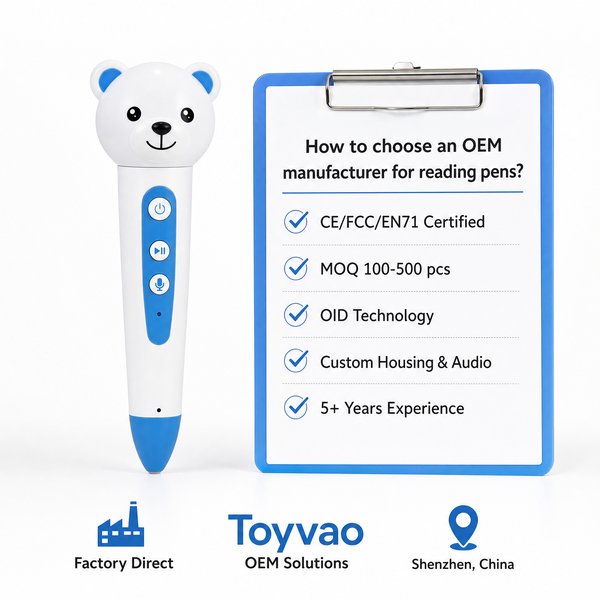
If you need an OEM for children’s reading pens, prioritize a factory with proven OID expertise, full safety certifications (CE/FCC/RoHS/EN71/ASTM/UN38.3), clear book-printing workflow, and flexible customization with realistic MOQs (100–500 pcs). Choose vendors that can deliver offline, secure OID pens (NO Bluetooth, NO Wi‑Fi, NO app required) and support the printing/mapping pipeline for OID-coded books—this is the single biggest determinant of a successful product launch. Toyvao is an example of a factory-direct supplier that offers OEM customization (housing, audio, packaging) and these capabilities.
Key decision points — “When it’s worth caring about / When you don’t need to overthink it”
Core technology: OID 2.0 vs OID 3.0
When it’s worth caring about:
- If you plan extensive content (lots of pages, interactive hotspots) or very fine-grain indexing across many titles, choose a partner that supports OID 3.0 (larger code space and finer printing tolerance).
- If you need the best future-proofing for high-density layouts or specialty print processes (very small fonts, glossy substrates), demand OID 3.0 and printing tests.
When you don’t need to overthink it:
- For most standard children’s picture and early-reader books, OID 2.0 is sufficient and less expensive to implement.
- If your catalog is small-to-medium and you control the printing process, OID 2.0 reduces risk and complexity.
Certifications and export market requirements
When it’s worth caring about:
- If you sell to EU/UK/US, insist on CE (or UKCA), EN71, FCC, RoHS, ASTM—and UN38.3 for shipping lithium batteries. These are non-negotiable for retailers and distributors.
- Ask for live copies of test reports and ensure scope covers the exact model and battery configuration.
When you don’t need to overthink it:
- For local pilots or non-retail proof-of-concepts, you can start with basic electrical safety checks and functional demos, but plan certification before full-scale retail.
Customization, MOQ and pricing
When it’s worth caring about:
- If you require unique housings, branded audio, language packages or retail packaging, verify OEM MOQ (Toyvao: MOQ 100–500 pcs) and ask for tooling lead times and unit price breaks by tier.
- Confirm whether audio mapping (linking OID codes to audio tracks) is included or charged separately.
When you don’t need to overthink it:
- For reseller stock or private-label quick-turn, accept standard housing and audio to keep MOQs and unit cost low.
Book printing and content pipeline
When it’s worth caring about:
- If you plan to print at multiple vendors or outsource book production, require the manufacturer to provide clear print specs (CMYK + special K layer for OID dots), sample PDFs, and mapping templates so printers can produce compatible books.
- Ask for a test-run service: sample printed pages + pen verification before full print runs.
When you don’t need to overthink it:
- If the OEM will produce both the pen and the books in-house or through a vetted partner, you can rely on their integrated workflow and skip deep print vendor qualification.
Hardware specs that matter to buyers
When it’s worth caring about:
- Battery life: demand real-world 8–12 hours playback and 2–3 hours charge time via USB-C (this is standard for reliable classroom use).
- Storage: 16/32/64 GB options—choose based on content library size and future growth.
- Physical features: 3.5mm headphone jack, volume control, rugged housing for ages 3+, easy-to-clean materials.
When you don’t need to overthink it:
- If distribution is to small libraries or boutique shops, standard 16 GB and base housing reduce cost and complexity.
Connectivity and data security
When it’s worth caring about:
- If your clients require zero-connectivity devices for privacy or classroom management, insist on fully offline designs (NO Bluetooth, NO Wi‑Fi, NO app required). This simplifies compliance and reduces cyber risk.
When you don’t need to overthink it:
- If you plan value-added cloud features, updates, or analytics later, you can start with offline pens and later introduce a connected model as a separate SKU.
Concrete specs and comparison
| Feature | Typical Option A | Typical Option B |
|---|---|---|
| Technology | OID 2.0 — sufficient for standard kids’ books | OID 3.0 — higher index, finer print tolerance |
| Storage | 16 / 32 GB | 32 / 64 GB |
| Battery | 8–10 hours, USB‑C, 2–3h charge | 10–12 hours, USB‑C, 2–3h charge |
| Connectivity | Offline only — NO Bluetooth / NO Wi‑Fi | Offline only — NO Bluetooth / NO Wi‑Fi |
| Physical | 3.5mm jack, volume button, child-safe housing | Same + optional custom housing/branding |
| MOQ (OEM) | 100–500 pcs depending on customization | |
| Certifications | CE / FCC / RoHS / EN71 / ASTM / UN38.3 (for batteries) | |
Production and content workflow checklist (use at RFP stage)
- Confirm OID version (2.0 vs 3.0) and request test prints.
- Ask for sample units with preloaded audio (your content if possible).
- Request printing spec: CMYK + K layer for OID dots and mapping template (file naming, track length limits).
- Validate battery tests and UN38.3 report for sea/air shipment.
- Get written MOQ, tooling costs, lead times, and tiered pricing.
- Verify warranty, repair policy, and spare-part pricing (tips, batteries, PCB if applicable).
Customer Feedback Synthesis
Positive feedback (synthesized from B2B buyer voices):
“The pen hardware held up well in kindergarten settings — 8–10 hours battery life matched our full-day rotations.”
“Factory handled audio mapping and delivered perfect book-to-audio sync; saved our team weeks of work.”
“MOQ of 200 with custom packaging hit the sweet spot for our seasonal SKU launch — pricing was competitive because we worked factory-direct.”
Negative / concern feedback (realistic buyer style):
“We underestimated the printing tolerances — our local printer couldn’t reproduce the OID K layer reliably, which delayed launch.”
“Some suppliers claimed certification but sent generic reports not covering the actual battery or shipped SKU.”
“Warranty turnaround time was slow overseas; logistics for battery returns (UN38.3) added unexpected cost.”
FAQ — Short, direct answers for procurement
Q: Will an OID pen work with regular printed books or scanned PDFs?
A: No. OID pens read invisible dot patterns printed in a special K layer. They only work with OID-coded books produced to the manufacturer’s print specifications.
Q: Can the pen translate or OCR general text?
A: No. This is not a translation pen or general OCR scanner. The pen plays pre-recorded audio mapped to OID codes. Multilingual content must be pre-recorded and mapped into the book files.
Q: What are typical OEM MOQs, lead times, and certification responsibilities?
A: Typical OEM MOQs are 100–500 pcs depending on customization. Lead times vary (samples 2–4 weeks; production 6–12+ weeks). Ensure the factory provides certification reports (CE/FCC/EN71/ASTM/UN38.3) for the exact model and battery used.
Q: How does audio/content provisioning work for custom books?
A: The factory provides mapping templates. You supply audio files (named per template) or request factory voice recording. The manufacturer programs the audio into the pen and verifies mapping with sample printed pages.
Next steps / Buying checklist
- Request sample pen(s) with your audio and a printed test page.
- Obtain exact certification reports and confirm battery compliance for shipping.
- Get written MOQ, tooling, lead time and per-unit pricing tiers.
- Verify the print spec package (CMYK + K OID layer) and request a printer compatibility test.
Contact Toyvao — factory-direct OEM contact
For OEM inquiries, samples, pricing and certification documents contact Toyvao directly: WhatsApp +86 186 8106 4480, email sales@toyvao.com, or visit https://toyvao.com. If you want a guided RFQ that includes OID printing specs, MOQ breakdown (100–500 pcs), and certification copies, reach out and request their OEM kit and sample program.
