
Executive Summary
Language versioning and localization for picture book reading pens (story pens, talking book pens, OID reading pens) is a core commercial and technical decision that impacts device cost, product-market fit, user experience, and after-sales operations. Buyers must choose between prerecorded human narration, on-device text-to-speech (TTS), and cloud TTS or hybrid approaches. Each approach has clear trade-offs in audio quality, storage footprint, latency, cost structure (one-time vs recurring), IP/licensing, update complexity, and regulatory risk when devices target children.
This guide provides a concrete framework for sourcing teams and product managers evaluating multilingual audio strategies for story pens. It covers technical differences, measurable specifications (sample rates, codecs, storage math, processor requirements), localization workflows (voice casting vs TTS tuning), cost benchmarks and pricing models, compliance points for children’s products, QA checklists, and a step-by-step decision guide that connects market requirements (target languages, dialects, offline capability) to implementation choices. Use this guide to make objective procurement decisions, estimate BOM and OPEX impacts, and set acceptance criteria for suppliers.
What Is Picture Book Reading Pen and Who Uses It
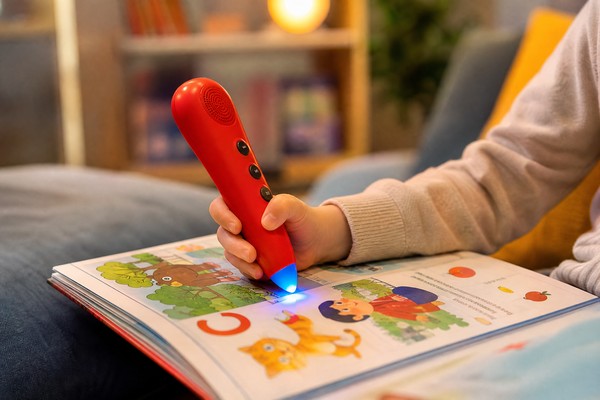
A Picture Book Reading Pen (also called Story Pen, Talking Book Pen, OID Reading Pen) is a handheld electronic reader that plays audio when its tip taps printed materials (books, cards). The pen contains an audio decoder, speaker (and often headphone output), a microcontroller or application processor, flash memory (or microSD), and interfaces (USB, Wi‑Fi, Bluetooth, NFC/IR/optical reading for OID tags). Some models pair with companion apps for content management.
Primary users and buyers:
– Toy and educational-product OEMs and brands (mass-market children’s products)
– Publishers of children’s books expanding into interactive formats
– Distributors and private-label importers sourcing from contract manufacturers
– Early-childhood education centers and institutional buyers
– Export buyers targeting multilingual regions (e.g., Europe, India, Southeast Asia)
Commercial constraints for buyers:
– Target age: typically 0–8 years; audio clarity and warmth of voice are critical
– Offline expectation: many markets expect full offline audio capability
– Multilingual demands: single device may need 2–6 languages; some markets demand 10+ (classroom or tourist markets)
– Price sensitivity: BOM targets for mass-market pens commonly range from USD 7–30 retail; audio and localization choices must fit that pricing
Why Demand Is Growing
Demand for story pens with advanced language and localization features is accelerating for several measurable reasons:
– Globalization of children’s content: Publishers seek incremental revenue by localizing catalogs into Spanish, Mandarin, Arabic, Portuguese, Hindi, etc. Multilingual pens allow reuse of hardware across markets.
– Parental demand for bilingual/multilingual learning tools: Market research across multiple geographies shows stronger uptake where pens support native and second-language modes.
– Declining cost of digital audio storage and TTS quality improvements: Flash memory prices have fallen—e.g., a 1GB eMMC module that was costly five years ago is now inexpensive at scale—enabling more on-device audio. Neural TTS advances expanded acceptable synthetic voice quality for children’s products.
– Supply chain realities: Offline-first devices avoid data costs and parental privacy issues, increasing preference for on-device audio or hybrid caching strategies.
– Education policy and classroom deployment: Schools require devices that support local dialects and curriculum alignment—driving kits with multiple language packs.
Market consequence: Suppliers who can offer modular localization (easy language pack deployment, OTA updates, multiple voice variants) and predictable BOM impacts are more competitive.
Key Technology Differences
This section provides the technical distinctions you must evaluate and quantify.
Audio Source: Prerecorded Human Narration vs On-device TTS vs Cloud TTS
– Prerecorded human narration: Highest naturalness. Requires storage of finished audio files. Example: 1 hour of finished 16 kHz, 16-bit mono WAV = ~7.2 MB/min × 60 = 432 MB (uncompressed); using MP3 at 64 kbps, ~0.48 MB/min × 60 = ~29 MB. Human voice quality preferred for story engagement; localization cost is per-minute/per-language.
– On-device TTS: Synthesizes speech locally. Storage footprint includes TTS engine binary and voice model(s). Suitable when offline operation is mandatory. Neural TTS models for acceptable quality typically require tens to hundreds of MB per voice unless using highly optimized models. Embedded lightweight engines (eSpeak, Pico, Flite) have minimal storage (<1–5 MB) with lower naturalness.
– Cloud TTS: Highest flexibility and voice options; minimal device storage. Requires reliable connectivity; introduces latency and recurring API costs and data privacy considerations.
Audio Format and Compression
– Sampling rate: 16 kHz mono is industry standard for speech with good intelligibility and reasonable size; 22.05 kHz or 32 kHz for higher fidelity and music. Use 44.1 kHz if music fidelity is required.
– Bit depth: 16-bit PCM is standard.
– Codecs: MP3 (common, low CPU), AAC (better efficiency), Ogg/Opus (superior bandwidth efficiency, lower CPU in modern decoders). Choose codec balancing audio size vs decoding CPU. Example: MP3 at 64 kbps is acceptable for speech; Opus at 24–40 kbps gives comparable quality at lower size.
– File size math (example): MP3 64 kbps = 8 KB/s ≈ 0.48 MB/min; WAV 16 kHz, 16-bit = 31.25 KB/s ≈ 1.875 MB/min.
Processing and Memory
– MCU vs Application Processor: Simple players use Cortex‑M4/M7 MCUs for playback. On-device TTS neural engines necessitate Cortex‑A series application processors or SoCs with NN accelerators/NPU. Example: a Cortex‑A53 with 512–1024 MB RAM can host lightweight neural TTS; standard MCU with 256–512 KB RAM cannot.
– Persistent storage: Flash vs microSD. Typical product tiers:
– Budget: 8–32 MB flash + microSD up to 32 GB
– Mid: 128–512 MB flash or microSD up to 64 GB
– Premium: 1–32 GB eMMC or microSD up to 128 GB
– Battery and power: Continuous audio playback at average 70–85 dB SPL has measurable current draw. Example: a 600 mAh Li‑po delivering 3–4 hours playback; higher quality speakers and higher volumes reduce runtime.
Connectivity and Update Mechanisms
– Offline-only: All audio and UI assets stored on device/microSD; updates via USB or physical card.
– Hybrid: Critical voices stored on device; additional languages downloaded via Wi‑Fi or app.
– OTA: Requires secure firmware and content update mechanism; ensure signed packages and rollback support.
Language and Script Support
– Non‑Latin scripts require font rendering and UI support:
– RTL (Arabic, Hebrew): UI must support bidirectional rendering and layout changes.
– Complex scripts (Devanagari, Thai): Engine must support shaping and rendering.
– Chinese: Distinguish Simplified vs Traditional; may need Pinyin and Bopomofo for pedagogy.
– Phonetic and pronunciation dictionaries: Necessary for TTS customization and foreign names; can be stored as lexicons (CSV, JSON) with phonetic mappings.
Voice Technology and Quality
– Human narration: natural cadence, intonation, expressiveness. Requires studio recording, mastering, noise floor <–60 dB.
– Neural TTS: state-of-the-art gives human-like voices; quality depends on model size and training on child-directed speech. Models vary: concatenative (older), parametric, neural WaveNet/Tacotron/Transformer-based.
– SSML: Speech Synthesis Markup Language support enables prosody control, pauses, voice changes, pitch, speaking rate.
Security and Privacy
– Cloud TTS introduces PII transfer; must consider COPPA (US), GDPR (EU) and local regulations.
– Voice models and audiobooks are IP assets—must include DRM/content protection for licensed materials.
Key Features and Specifications to Evaluate
When specifying or sourcing, demand clear supplier data for each item below and include acceptance criteria in RFPs.
Supported Languages and Dialects
– Exact languages and locale tags (e.g., en-US, en-GB, es-ES, es-MX, pt-BR, zh-CN, zh-TW, hi-IN)
– Dialects within languages (e.g., Brazilian Portuguese vs European Portuguese; Latin American Spanish vs Iberian Spanish)
– Support for regional pronunciations for names, place names and cultural references
Voice Options and Counts
– Number of voice variants per language (male/female/child/neutral). Example acceptance: minimum 2 voices per language for major locales; 1 voice for secondary locales.
– Human vs synthetic voice inventory: list per language.
Audio Quality and File Specs
– Default sampling rate (recommend 16 kHz for speech, 22.05 kHz if mixed music), codec supported (MP3/AAC/Opus), target bitrate per language pack (e.g., 32–64 kbps for speech).
– Speaker SPL and frequency response: Example acceptance: 85 dB @ 0.5 m (typical), 300–12,000 Hz frequency response for clear speech.
Storage and Memory
– Minimum device flash and recommended microSD capacity per localization package. Provide storage estimates per language pack. Example: 30 minutes of compressed audio (MP3 64 kbps) ~14.4 MB; 10 books × 30 min = 144 MB per language.
– Support for microSD up to specific sizes (e.g., 64 GB).
Processing and TTS Engine
– On-device TTS engine name/version; memory footprint (MB); CPU requirements (e.g., requires ARM Cortex‑A53 with 512 MB RAM).
– SSML and lexicon support; ability to load pronunciation dictionary (format and API behavior).
Connectivity and Update Methods
– Wi‑Fi/Bluetooth versions, USB protocol, app integration (iOS/Android), ability to download language packs and verify signatures.
– OTA security: signed packages, TLS, rollback.
Latency and Performance
– TTS synthesis latency target (on-device: <1000 ms per sentence; cloud: typical 200–800 ms roundtrip depending on connectivity).
– Playback startup time after tap (target <200 ms for seamless UX).
Power and Battery
– Playback runtime (hours) at specified volume and battery capacity. Example: 800 mAh battery yields ~10 hours at medium volume; require measured test result.
Regulatory and Safety
– Compliance list: CE (EMC, LVD), FCC Part 15 (US), RoHS, EN71 toy safety, ASTM F963, UN38.3 shipping for Li‑ion cells, COPPA/GDPR-related privacy statements.
Content Management and Rights
– Content licensing model (OEM-supplied, publisher direct, or aggregator)
– DRM or watermarking options for licensed content
– Metadata format (ID3, JSON catalog), content indexing method (OID tags, QR, image recognition)
Localization Workflow and Turnaround
– Typical lead times for human narration per language (studio booking, recording, editing), and for TTS pack generation and validation. Provide SLA examples: human narration 2–6 weeks per 1–3 hour finished audio; TTS pack generation 1–3 days per language for templated story sets.
Quality Assurance
– Audio quality metrics (SNR, clipping rate), intelligibility tests, linguistic QA by native speakers, child-testing protocols.
Pros and Cons
Evaluate alternatives using these pros/cons, tailored to your market and product roadmap.
Prerecorded Human Narration
– Pros: Best naturalness and engagement; preferred for storytelling; easier to control emotion and emphasis; stable offline operation.
– Cons: High one-time cost per language; storage-heavy; slow to update; requires rights clearance and re-records for minor text changes; logistics for voice casting and studio time.
On-device TTS
– Pros: Offline operation; flexible (instant changes); smaller content storage; can personalize voice or accents; no per-request cloud cost.
– Cons: Requires more capable SoC and memory, increasing BOM; best neural quality requires large models or NPU; voice naturalness can be inferior to human narration unless heavy engineering is applied.
Cloud TTS
– Pros: Highest voice quality options, easy to add voices and languages, lowest device storage needs, fast iteration for localization.
– Cons: Requires reliable internet; recurring per-character or per-request costs; privacy/regulatory exposure; latency and user experience degradation under poor networks.
Hybrid (Prerecorded + TTS)
– Pros: Store core stories as human recordings while using TTS for menus, prompts, and dynamic text; reduces storage relative to full human narration and maintains high engagement for primary content.
– Cons: Complexity in content management and syncing; still requires dual pipelines.
Simple Embedded TTS (e.g., Flite, Pico)
– Pros: Very small footprint (<5–10 MB), works on MCU-class processors, no internet.
– Cons: Robotic voice quality; may not be acceptable for storytelling to children.
Cost and Time Trade-offs
– Human narration: expensive per language but high engagement; plan for 2–6 weeks per language for a catalog.
– TTS: lower marginal cost and faster deployment, but potential OPEX (cloud) and engineering investment (on‑device models).
Step-by-Step Decision Guide
Use this practical checklist to map business needs to technical choices and procurement actions.
Define Market Requirements
– List target countries and languages with exact locale tags. Prioritize by addressable market size and willingness to pay.
– Decide offline requirement: must work offline in all uses, or is online acceptable?
– Determine voice quality target: native human narration or acceptable synthetic voice? Include user age (younger children require higher narrator quality).
Estimate Content Volume and Storage
– Inventory number of books, average length per book (minutes), and update cadence.
– Calculate storage per language pack using codec and bitrate. Example: 20 books × 20 min = 400 min; at MP3 64 kbps ≈ 400 × 0.48 MB = 192 MB per language.
Select Audio Strategy
– If offline + premium experience: prerecorded human narration for core titles and TTS for ancillary UI.
– If many languages with limited budget: on-device TTS if hardware budget allows, or cloud TTS with caching for intermittent online use.
– For classroom/enterprise deployments (many languages): hybrid strategy with microSD language packs.
Choose Technical Specs
– Recommended baseline:
– TTS-enabled device: Application processor (Cortex‑A35/A53 or equivalent), 512–1024 MB RAM, 1–2 GB flash or microSD support.
– Audio-only device (prerecorded): Cortex‑M4/M7 MCU, 128–512 MB flash or microSD up to 64 GB.
– Audio artifacts: 16 kHz/16-bit PCM recording; deliver final files in both MP3 @ 64 kbps and WAV master.
– Speaker: 0.5–1.5 W amplifier, measured 80–90 dB @ 0.5 m.
Procure Voice Production or TTS Licenses
– For human narration: specify studio-grade deliverables, noise floor (<–60 dB), file naming conventions, metadata, and post-production steps (EQ, leveling, silence trimming). Negotiate buyout vs per-use royalties.
– For TTS: request engine versions, SSML support, lexicon import mechanism, voice licensing (perpetual vs runtime), and on-device runtime constraints.
Define QA and Localization Acceptance Criteria
– Linguistic QA by native speakers: accuracy of translation, naturalness, pronunciation of proper nouns.
– Acoustic QA: no clipping, SNR thresholds, consistent loudness (LUFS targets e.g., –16 to –20 LUFS for children’s audio).
– Latency and UX: tap-to-audio start <200 ms for prerecorded; TTS start <1 s acceptable on-device; cloud TTS ideally <800 ms with caching.
Plan Update and Support Workflow
– Content pipeline: authoring, translation, voice production/TTS generation, mastering, packaging.
– Update cadence: monthly/quarterly language pack releases; emergency fix process.
– Testing: field testing with target demographics prior to mass production.
Legal and Compliance
– Secure rights to translated text and audio; specify ownership and territory restrictions.
– Data privacy: design to avoid storing or transmitting child PII; include parental consent workflows if cloud services are used.
Cost Modeling and Go/No-Go
– Build a TCO model including one-time localization production costs, incremental per-device BOM for on-device TTS, recurring cloud TTS costs (if applicable), and storage logistics.
– Run sensitivity analysis: e.g., increase number of languages from 2 to 6 and observe impact on flash/microSD requirements and BOM.
Supplier Evaluation and RFP
– Require sample builds: device with language pack installed, language switch UI, and QA reports.
– Request reference implementations and reporting on compliance (EN71, CE, FCC) and previous publisher integrations.
Pricing and Cost Analysis
Break costs into per-device BOM, one-time content production, and recurring OPEX. Use the following cost components and example calculations to estimate budgets.
Device-Level BOM Impacts
– Additional flash or microSD: eMMC cost per GB varies with scale; assume sample prices at scale:
– 128 MB SPI flash: negligible incremental cost (<USD 0.50 at volume)
– 512 MB–1 GB eMMC: USD 1–3 at volume
– 8 GB microSD: USD 2–4 at volume
– Processor difference:
– MCU-based audio player (Cortex‑M) BOM delta: minimal
– Application processor to support on-device TTS: incremental SoC cost USD 3–15 depending on chip and integration; RAM increase (512 MB) USD 2–6
– Battery and speaker upgrades for better audio: speaker module USD 0.5–2; amplifier IC USD 0.3–1.
Content Production Costs (one-time)
– Human narration: studio rates vary widely by market. Practical sourcing benchmarks:
– Low-cost region freelancer: USD 50–150 per finished hour
– Professional studio + director + engineer: USD 200–600 per finished hour
– Casting for child voices or specialized talent: premium +20–50%
– Editing and mastering: USD 20–50 per finished hour
Example: For 3 hours of final audio in one language, budget USD 300–2,000 depending on talent and region.
– Translation/localization: translation plus adaptation (not literal) typically USD 0.08–0.25 per source-word for children’s content requiring adaptation; higher for language pairs with limited availability.
– TTS pack creation (cloud generation and QA): USD 200–1,000 per language for templated content (voice selection, SSML tuning, QA) depending on volume.
Recurring Costs (OPEX)
– Cloud TTS API: per-character pricing varies; in absence of vendor-specific numbers here, model example:
– Example assumption: USD 4–20 per 1M characters for standard vs neural voices; compute monthly spend by estimated characters per device per month.
– For offline-first pen, recurring costs are minimal after initial deployment unless dynamic content is streamed.
– Content hosting and CDN for language pack downloads: small monthly costs—estimate USD 20–200/month at modest load; scale with downloads.
Total Cost Example (3-language device, 30 books × 10 min average)
– Storage estimate: 30 books × 10 min = 300 min per language; MP3@64 kbps ≈ 0.48 MB/min → 144 MB per language → 432 MB total for 3 languages.
– Flash/microSD: provide 512 MB–1 GB reserved for audio + space for firmware and logs → choose 1–2 GB microSD.
– BOM delta: microSD 1 GB ~USD 2 + SoC delta (if TTS) USD 0–10 depending on approach.
– Localization production: human narration 30 books × 10 min = 300 min = 5 hours finished per language. Studio cost per language: USD 500–2,500. For 3 languages total USD 1,500–7,500.
– Unit impact: if producing 10,000 units, one-time localization cost per unit = USD 0.15–0.75 (human narration in 3 languages, lower bound) — this example shows production is often overshadowed by BOM increases for on-device TTS.
Negotiation levers:
– Use microSD for markets with many optional languages: ship base languages onboard and provide others via microSD or download.
– Bulk-buy voice production across multiple titles or publishers to lower per-minute costs.
– Consider sublicensing existing voice catalogs to reduce production time but confirm territory and format rights.
Competitive Landscape
The competitive landscape divides into three supplier categories: content-first publishers/aggregators, hardware OEMs with localization services, and cloud TTS vendors.
Publishers and Aggregators
– Provide pre-recorded localized catalogs and rights-managed content.
– Relevant for buyers seeking ready-made language packs with rights cleared.
– Typical offering: charged per-book or per-minute with packaged formats.
Hardware OEMs and Contract Manufacturers
– Offer turn-key device and content integration. Key differentiation: ability to integrate on-device TTS engines, provide content management platforms, and support OTA updates.
– Asian OEMs commonly offer low-cost integration of OID/NFC mapping and MP3 playback; higher-end vendors add application processors and cloud integrations.
Cloud and TTS Vendors
– Global leaders: Google Cloud Text-to-Speech, Amazon Polly (AWS), Microsoft Azure TTS. Each offers multiple voices, SSML, and enterprise SLAs.
– China/Asia leaders for Chinese languages: iFlytek, Baidu, Alibaba Cloud, which offer strong Mandarin/Cantonese coverage and local compliance.
– Open-source and specialist TTS: Mozilla/Coqui TTS, Tacotron variants, allow customization and lower recurring costs but require engineering investment.
Edge TTS and Silicon Vendors
– Chips with NPUs (e.g., NXP, MediaTek, Qualcomm IoT) enable on-device neural TTS. Vendors provide SDKs to integrate neural models with hardware acceleration.
– Specialist embedded TTS providers: CereProc, Acapela, CereVoice (legacy), and smaller firms offering child-suitable voices and licensing options.
Selection criteria
– Language coverage and dialect quality
– Licensing flexibility and cost models
– Integration support (SDKs, sample code)
– Performance benchmarks on your chosen hardware
– Compliance and data privacy support
What Buyers Say
From sourcing work with multiple buyers, recurring themes emerge:
- Offline is non-negotiable in school and many household contexts: buyers prioritize on-device audio or guaranteed offline caches.
- Storage surprises: buyers often underestimate per-language storage; a common error is shipping devices with insufficient flash and expecting expansion to be seamless.
- Human narration drives conversion: many brands report higher perceived value and better user engagement when primary stories are human narrated.
- TTS is essential for scale: buyers targeting >8 languages often prefer TTS for secondary or supplemental content to control costs.
- QA and localization: buyers consistently require native-speaker QA cycles and object to literal translation for children’s texts (tone and cultural references matter).
- Update process friction: buyers penalize suppliers whose update tools are clunky; a smooth app-based language pack download is a differentiator.
- Legal clarity: buyers insist on written IP terms covering audio, translations, and derivative usages to prevent post-launch disputes.
Safety, Maintenance and Compliance
Regulatory and safety requirements for story pens are extensive due to child-users:
Toy Safety and Electrical
– EN71 (EU): mechanical/physical, flammability, and migration of certain elements—entry requirement for toys.
– ASTM F963 (US): toy safety standard; includes mechanical and flammability requirements.
– FCC Part 15 (US) / CE EMC (EU): required for devices with radio or digital interfaces.
– RoHS: restriction on hazardous substances in electronic components.
– Lithium battery shipping: UN38.3 certification for international air transport.
Audio and Hearing Safety
– Maximum volume limits: specify device limits to prevent harmful exposure. Industry practice sets maximum SPL limits and default safe volumes (e.g., <85 dB at 0.5 m).
– Include parental volume-limiting settings and warnings.
Privacy and Data Protection
– COPPA (US): if collecting data from children under 13, ensure parental consent and minimal data collection. Prefer offline-first designs to reduce compliance exposure.
– GDPR (EU): if voice data or personal data is processed, ensure legal basis, data minimization, right to erasure, and data residency as required.
Content Rights and Licensing
– Ensure contracts include clear warranties on rights for text translations and audio recordings, territory and channel rights, and duration.
– DRM and watermarking for licensed audio may be required by publishers.
Maintenance and Support
– Firmware and content update mechanisms must support signed updates and secure rollback.
– Spare parts and test fixtures: specify vendor obligations for spare part availability and service life.
Shipping and Customs
– Some audio content may be permitted or restricted by local law; verify export/import restrictions for content (e.g., religious or political content in certain markets).
Frequently Asked Questions
Q: Should we prefer human narration or TTS for primary story content?
A: If your priority is engagement and premium positioning, human narration for primary titles is recommended. If your product must support a large number of languages quickly and affordably, TTS (on-device or cloud) is pragmatic. Hybrid—human for primary markets and TTS for secondary languages—is common.
Q: How much storage per language should I allocate?
A: Estimate using minutes-of-audio × bitrate. Example: 30 books × 10 min = 300 min; MP3 @ 64 kbps ≈ 0.48 MB/min → ~144 MB per language. Add 20–30% overhead for metadata, alternate audio clips, and log files.
Q: What sampling rate and codec are recommended?
A: Use 16 kHz/16-bit for speech-only content; choose MP3 at 48–96 kbps for reliable compatibility and CPU profile. Use Opus at 24–40 kbps for better bandwidth efficiency when supported.
Q: Can on-device TTS match human narration quality?
A: Neural TTS has improved and can be acceptable for many applications, but high-engagement storytelling for young children still favors human narrators, particularly for emotional and expressive reading.
Q: What are standard turnaround times for localization?
A: Human narration plus QA commonly takes 2–6 weeks per language pack for a modest catalog. TTS generation and QA can be done in 1–7 days per language, depending on volume.
Q: How many voices per language should we offer?
A: Minimum of one voice per language for cost reasons; best practice is to provide at least two (male/female or adult/child) for flexibility and accessibility. For premium products, 3–4 variants are common.
Q: What licensing pitfalls must we avoid?
A: Ensure buyout for recorded audio or a license that covers device distribution, updates, and derivatives. For TTS, confirm whether the vendor allows redistribution of synthesized audio and whether per-character charges apply for device-based generation.
Q: What about right-to-left languages and fonts?
A: Ensure UI and content rendering frameworks support bidirectional text and complex script shaping (e.g., HarfBuzz for shaping). Test typography with native QA.
Contact Toyvao
For sourcing assistance, technical specifications, supplier shortlists, sample requirements, or to request our localization cost template and storage calculator, contact Toyvao through the following channels:
- Website: https://toyvao.com — use the “Sourcing” or “Contact” forms to submit RFPs and project briefs.
- Email: sourcing@toyvao.com — for detailed RFQs, BOM impact analysis, and sample coordination.
- Sample requests: attach a product brief and target language list; include expected order volumes and targeted retail price to receive prioritized vendor matches.
Provide a concise scope of work (languages, number of titles, target BOM, offline requirement) and we will supply a comparative supplier matrix, recommended hardware spec sheet, and estimated production timeline.
