
What is the Wholesale Price of a Children’s Reading Pen? A Comprehensive Guide
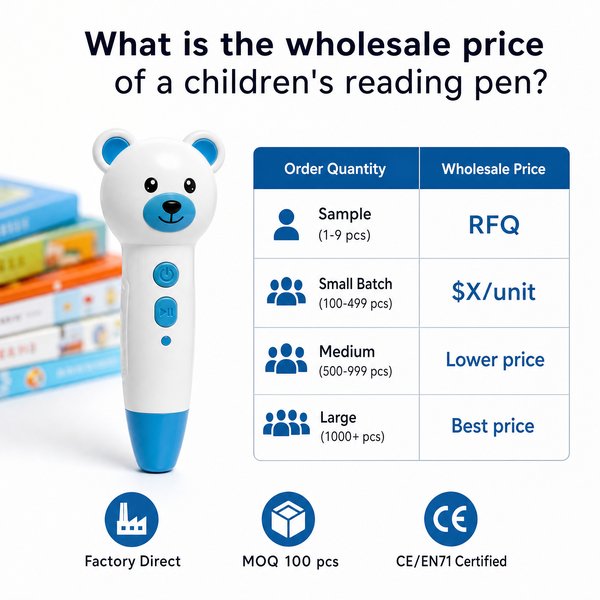
Children’s reading pens have revolutionized early learning by combining technology and tactile reading experience. For businesses sourcing these educational tools, understanding the wholesale pricing factors is crucial. In this article, we explore the wholesale price range of children’s OID reading pens, what influences their cost, and how you can make informed purchasing decisions for your educational toy business.
Understanding the Wholesale Price Range
The wholesale price of a children’s reading pen generally varies between USD 6 and 30 per unit FOB (Free On Board) factory in Shenzhen, China. This wide price range depends on several key factors including internal storage capacity, OID generation technology, certification status, customization level, and order quantity.
Here is a breakdown of typical price bands based on storage and certification for standard OEM units:
| Storage Capacity | OID Generation | Certification Status | Approximate Price Range (USD) | MOQ (Minimum Order Quantity) |
|---|---|---|---|---|
| 16GB | OID 2.0 | CE/FCC/RoHS Ready | $8 – $12 | 100 pcs |
| 32GB | OID 2.0 / 3.0 | CE/FCC/RoHS Ready | $10 – $16 | 100 pcs |
| 64GB | OID 3.0 | Fully Certified (CE, FCC, RoHS, EN71, ASTM, UN38.3) | $13 – $22 | 100–500 pcs |
| 64GB | OID 3.0 | Customized & Certified | $20 – $30 | 100 pcs (small MOQ) |
Key Product Features Impacting Wholesale Prices
To better understand how pricing is set, consider the following product attributes that influence the wholesale cost of children’s reading pens:
- Technology Type: These pens use OID (Optical Identification) technology, reading invisible dot patterns on specially printed books to play corresponding audio offline. No Bluetooth, Wi-Fi, or app required.
- Target Age Group: Designed for children aged 3 and above, ensuring safety and ease of use.
- Storage Capacity: Available in 16GB, 32GB, or 64GB, affecting how much audio content can be stored.
- Battery Life: Provides 8–12 hours of continuous playback with 2–3 hours recharge time via USB-C.
- Physical Controls: Includes 3.5mm headphone jack and volume control buttons for user convenience.
- Compatibility: Works exclusively with OID-coded books from the same brand or print mapping, ensuring seamless content integration.
- Customization Options: Manufacturers offer custom housing, audio content, and packaging for OEM buyers, usually with MOQs between 100 and 500 units.
- Certifications: Essential certifications for entering EU/US markets include CE, FCC, RoHS, EN71, ASTM, and UN38.3 (for batteries and transport safety).
OID Technology Generations: OID 2.0 vs OID 3.0
One of the biggest price determinants is the OID technology generation used in the pen. Understanding the differences between OID 2.0 and OID 3.0 can help you choose the right product for your market and budget.
OID 2.0
- Earlier generation technology with proven reliability.
- Lower unit cost, generally found in pens priced between $8–16.
- Compatible with a good range of OID-coded books.
- Limited to fewer simultaneous audio tracks and less precise dot recognition compared to OID 3.0.
OID 3.0
- Latest generation with improved dot recognition accuracy and speed.
- Supports higher storage (up to 64GB) and richer audio experience.
- Prices typically range from $13 to $30 depending on customization and certification.
- Better suited for premium markets requiring full certifications and advanced features.
Factors Influencing Wholesale Pricing Beyond Technology
Besides technology, several other factors impact wholesale pricing:
- Order Quantity: Larger orders reduce per-unit cost due to economies of scale. MOQ (minimum order quantity) can range from 100 to 500 units for OEM/custom orders.
- Certification Compliance: Obtaining certifications like CE, FCC, RoHS, EN71, ASTM, and UN38.3 can add to production cost but is essential for legal sales in many countries.
- Customization: Custom branding, packaging, and audio content creation increase unit cost but allow better market differentiation.
- Storage Capacity: Higher storage means more expensive memory chips and bigger firmware, impacting cost.
Market Outlook: Why Investing in Children’s Reading Pens Makes Sense
According to Grand View Research, the global educational toy market is projected to reach $34.5 billion by 2028, growing at a CAGR of 8.5%. This growth is driven by increasing awareness of early childhood education and rising disposable income worldwide.
Another industry report from Statista emphasizes that demand for screen-free, interactive learning tools like OID reading pens is gaining momentum among parents and educators, due to concerns over excessive screen time for young children.
Comparison Table: Toyvao Children’s Reading Pen vs Other Common Education Tools
| Product | Technology | Screen | Age Range | Average Wholesale Price (USD) | Connectivity | Customization Available |
|---|---|---|---|---|---|---|
| Toyvao Children’s OID Reading Pen | OID (Offline) | No screen | 3+ | $8–30 | Offline (no Wi-Fi/Bluetooth) | Yes |
| Talking Flash Card Machine | Audio Flash Cards | No |
