
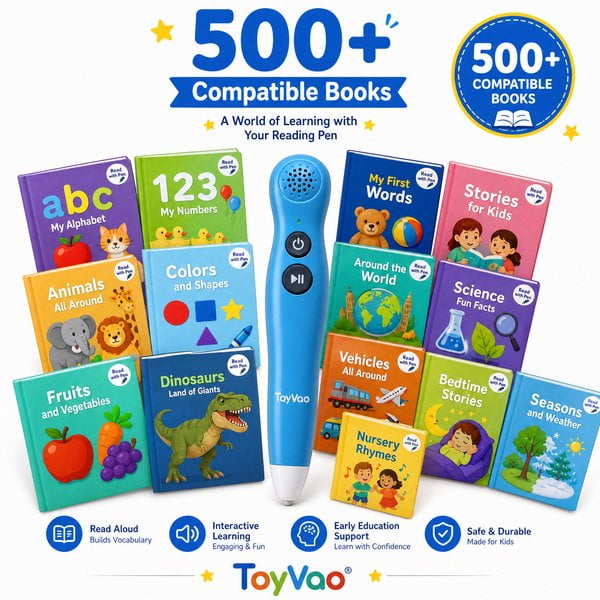
As an important tool for children’s learning, one of a reading pen’s core values lies in the library of compatible books it can offer. A rich, high-quality catalogue not only attracts users but also effectively supports children’s reading interest and learning development. So, how many compatible books should an ideal reading pen provide? This article explores the factors that influence this question and analyzes the market situation and user expectations.
Market Status and Key Products
Current reading pen products on the market, such as LeapFrog’s LeapReader system, offer “more than 150 interactive books and writing activities, audiobooks, music, etc., covering multiple reading levels” [1]. This indicates that leading brands recognize the importance of offering diverse content. However, many reading pen systems—such as LeapFrog Tag and VTech’s Bugsby reading system—typically require purchasing their “specifically designed books,” which are “mostly aimed at very young or early readers” [2]. One drawback of these closed systems is that they “work only with a limited number of books” [2], potentially restricting user choices across different reading stages.
Factors Affecting the Number of Compatible Books
The ideal number of compatible books for a reading pen is not a fixed value; it is influenced by multiple factors:
1. Target Audience and Learning Stage
- Preschool children and early readers: For very young children, a curated set of high-quality, engaging books in moderate quantity may be more important than an extensive library. These books should focus on foundational cognition, phonemic awareness, and early reading skills. Too many choices can be confusing.
- School-age children and children with learning disabilities: Older children or students with reading difficulties (such as dyslexia) need a broader range of reading materials to support learning and interest development. In such cases, a reading pen that is compatible with more diverse books—or that can scan any printed text and read it aloud—adds significant value [2].
2. Content Quality and Diversity
The number of books matters, but quality and diversity are the decisive factors for user experience. High-quality content should have the following characteristics:
- Professional narration: Human-read narration rather than synthetic speech provides a more natural and emotionally engaging reading experience [2].
- Interactivity: Beyond reading the text aloud, books should include interactive elements such as tappable icons for additional information or sound effects to enhance learning engagement [2].
- Content breadth: A range of topics, genres, and difficulty levels to meet children’s evolving interests and learning needs.
3. Openness and Expandability
The openness of a reading pen system determines its potential for content expansion. Some systems are closed and work only with specific branded books. Others may allow users to import audio or scan ordinary books, vastly broadening content sources. For example, some reading pens have storage capabilities—C Reader 2 has 5GB of memory, allowing storage of many recordings and scanned pages [3]—which gives users greater flexibility.
4. Economic Cost and Accessibility
The number of compatible books is also closely related to economic cost and accessibility. If each book requires an additional purchase at a high price, users may be discouraged despite a large catalogue. Therefore, offering reasonable pricing strategies, bundle sales or subscription services, and convenient purchase channels are important factors for improving user satisfaction.
Conclusion
Overall, the number of compatible books a reading pen should offer is not simply “the more the better.” It requires balancing quantity, quality, diversity, and openness. For children’s educational reading pens, an initial offering of a carefully curated book package covering core learning content—ranging from dozens to over a hundred titles—can meet early learning needs. At the same time, attention should be paid to continuous content updates and expansion, and to developing the capability to support more diverse books or scanning functions, so the device can adapt to the changing reading needs as children grow. The ultimate goal is to build a learning ecosystem that continuously stimulates children’s interest in reading and supports their holistic development.
References
[1] LeapFrog. LeapReader™ Reading and Writing System. Available at: https://store.leapfrog.com/en-us/store/p/leapreader-reading-and-writing-system/_/A-prod21301
[2] Reading Rockets. Where can I find more books to use with a reading pen? Available at: https://www.readingrockets.org/resources/expert-qa/where-can-i-find-more-books-use-reading-pen
[3] McMaster University Library. C Reader 2 – Reading Pen. Available at: https://library.mcmaster.ca/c-reader-2-reading-pen
