
1. Introduction
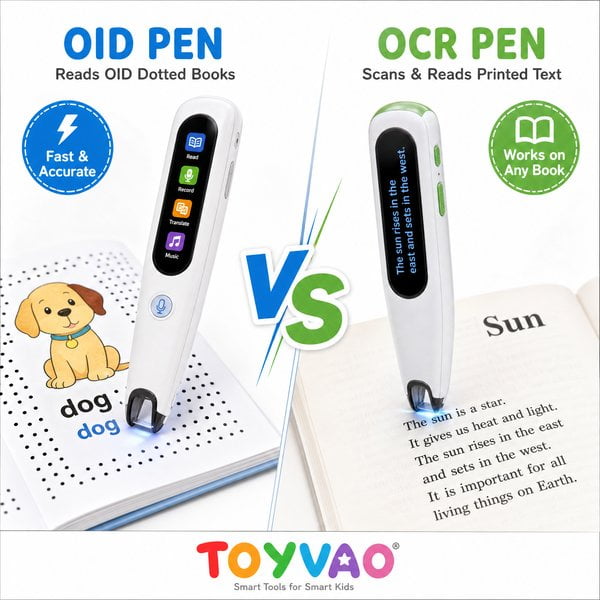
In today’s increasingly digital learning environment, talking pens are gaining popularity among parents and students as an auxiliary learning tool. By combining printed materials with interactive audio, they significantly enhance learning engagement and efficiency. The market currently offers two primary types of talking pens: the OID pen and the OCR scanning pen. Although both provide “point-and-read” functionality, they differ markedly in operating principles, application scenarios, and feature sets. This article explores the characteristics of both types to help you make an informed decision based on your specific needs.
2. OID Pen (Optical Identification Pen)
OID pen, or Optical Identification Pen, is a device that triggers audio content by recognizing special encoded patterns. It is typically used with dedicated OID-encoded books, whose pages contain microdot codes invisible to the naked eye [1].
How it works
The tip of an OID pen contains an optical sensor. When the tip touches a specific area on an OID-encoded page, the sensor reads the invisible dot-matrix code. These codes correspond to audio files pre-stored in the pen or downloaded via a connected device. The pen’s processor decodes the pattern and plays the associated speech, music, or sound effect, enabling the “point where you read” interactive experience [1].
Advantages
- Interactive audio feedback: OID pens deliver immediate, accurate audio feedback, making the learning process more vivid and engaging—especially suitable for children [1].
- Well-suited for young learners: Their simple and intuitive operation effectively increases interest and participation among preschool and early-primary children, aiding language initiation and story reading [1].
- Tightly integrated with specific content: Since content is pre-encoded and designed for the medium, OID pens can provide deep integration with specific textbooks or picture books and offer high-quality, tailored learning resources.
Disadvantages
- Requires special OID-encoded books/materials: A key limitation is that OID pens only recognize materials printed with OID codes. Users must purchase or obtain materials specifically created for OID pens [1].
- Limited to pre-programmed content: Functionality is constrained by pre-recorded and encoded content and cannot recognize ordinary books or arbitrary custom text.
Applications
OID pens are primarily used in early childhood education and for language learning tied to specific materials. Examples include children’s English point-reading textbooks, audio picture books, and interactive encyclopedias. By combining sound, images, and text, they create an immersive learning environment for children.
3. OCR Scanning Pen (Optical Character Recognition Scanning Pen)
OCR scanning pen, or Optical Character Recognition Scanning Pen, is a smart device that scans and recognizes printed text and converts it into editable digital text. It does not rely on special encoding; instead, it directly recognizes visible characters [2].
How it works
Like the OID pen, the OCR scanning pen’s tip contains an optical sensor, but its operating principle differs. When a user glides the OCR pen across printed text, the sensor captures an image of the text. Built-in OCR technology analyzes the image in real time, recognizes the characters, and converts them into digital text. This digital text can be stored, read aloud, translated, or transferred to other devices for editing [2].
Advantages
- Works with virtually any printed text: The OCR pen’s greatest advantage is its universality; it can scan ordinary books, newspapers, magazines, documents, and even printed text displayed on screens [2].
- Versatile features: Beyond basic text recognition and text-to-speech, many OCR pens include real-time translation, built-in dictionaries, text extraction, and data transfer, greatly expanding their use cases [2].
- Portable and convenient for students and professionals: Compact and easy to carry, OCR pens are ideal for students, language learners, and business users for quick reference, foreign language study, and document processing.
Disadvantages
- Recognition accuracy can suffer with low-quality text or complex layouts: OCR pens may show reduced accuracy for blurred fonts, complex formatting, handwriting, or unusual typefaces [2].
- Less interactive for specific learning content compared to OID pens: While OCR pens can read text aloud, they lack the deep content-bound interactivity of OID pens, such as tapping an illustration to trigger related sound effects or background music.
Applications
OCR scanning pens are widely used for language learning (vocabulary lookup, sentence translation), student study support (quick note capture, reading passages aloud), professional use (meeting notes, document organization), and as an assistive reading tool for visually impaired users. They help users efficiently access and process printed information.
4. OID Pen vs. OCR Scanning Pen: Comparative Analysis
To clarify the differences, the table below compares key characteristics of OID pens and OCR scanning pens:
| Feature | OID Pen (Optical Identification Pen) | OCR Scanning Pen (Optical Character Recognition Scanning Pen) |
|---|---|---|
| Operating principle | Recognizes invisible dot-matrix codes to trigger preset audio content [1] | Scans visible characters and converts them to digital text using OCR technology [2] |
| Compatibility | Limited to proprietary OID-encoded books/materials [1] | Compatible with virtually all printed text [2] |
| Interactivity | High interactivity with rich audio feedback and deep content linkage [1] | Text-to-speech, translation, and dictionary lookup; overall interactivity is comparatively lower [2] |
| Main use cases | Early childhood education, language initiation, learning with specific textbooks [1] | Language learning, text extraction, translation, assistive reading, document processing [2] |
| Strengths | Highly interactive, easy to use, ideal for young children, high-quality curated content [1] | Highly versatile, feature-rich (translation, dictionary), portable, efficient [2] |
| Limitations | Depends on proprietary materials; content is limited | Recognition accuracy depends on text quality; interactivity is relatively limited |
5. Which should I buy?
Your choice between an OID pen and an OCR scanning pen ultimately depends on your specific needs and use scenarios:
- If you are selecting a learning tool for young children, especially for language initiation, story reading, or use with specific textbooks, the OID pen is the preferable option. It provides stronger interactivity and an immersive experience, helping children learn through play.
- If you are a student, language learner, or a professional who needs to process large amounts of printed text, and you want to scan, read aloud, translate, or extract text from ordinary printed materials, then the OCR scanning pen will be your most useful tool. Its universality and multifunctionality can significantly boost your study and work efficiency.
- If you want the advantages of both, some products on the market attempt to combine both technologies, but they often emphasize one function over the other or come at a higher price. We recommend prioritizing your core requirements when making a choice.
6. Conclusion
Both OID pens and OCR scanning pens have their strengths and are excellent auxiliary tools for learning and work. OID pens stand out in children’s education due to their unique interactivity and targeted content; OCR scanning pens excel through broad compatibility and multifunctionality, making them valuable for students and professionals handling text information. Before purchasing, clearly define your primary use case and target users to select the talking pen that best suits your needs.
References
[1] What is a Talking Pen? How It Works (OID vs OCR Technology Guide). [https://www.reading-pen.com/blogs/what-is-a-talking-pen-and-how-does-it-work-a-beginner-s-guide.html](https://www.reading-pen.com/blogs/what-is-a-talking-pen-and-how-does-it-work-a-beginner-s-guide.html)
[2] OID Technology Reading Pen Guide: How to Choose Wisely. [https://electronics.alibaba.com/buyingguides/oid-reading-pen-guide-how-it-works-what-to-choose](https://electronics.alibaba.com/buyingguides/oid-reading-pen-guide-how-it-works-what-to-choose)
