
Introduction: Powering the Future of Learning
In the rapidly evolving landscape of educational technology, reading pens have emerged as indispensable tools for enhancing literacy and language acquisition. These innovative devices bring books to life, offering interactive learning experiences that captivate young minds. As a B2B buyer, distributor, or educational brand, selecting the right type of reading pen – specifically, choosing between rechargeable and battery-powered models – is a critical decision that impacts user experience, operational costs, and environmental footprint. Toyvao, a leading educational toy manufacturer based in Shenzhen, China, understands these nuances and is dedicated to providing high-quality, certified solutions tailored to your needs.
The Rise of Rechargeable Reading Pens
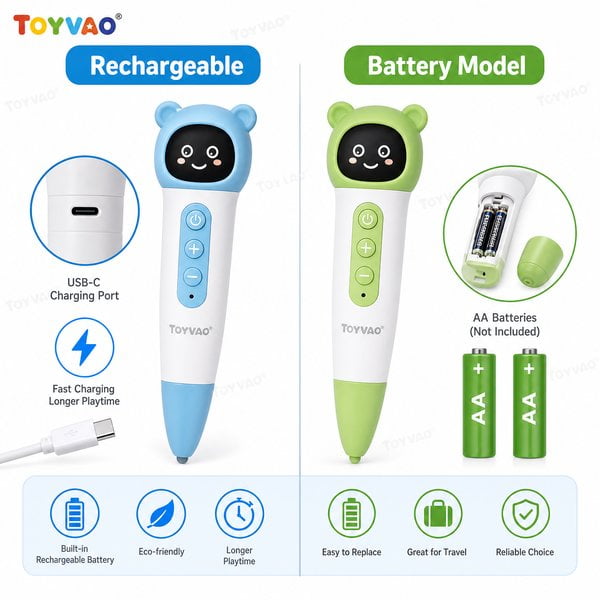
Rechargeable reading pens have gained significant traction due to their convenience and long-term cost-effectiveness. These pens typically feature built-in lithium-ion batteries that can be recharged via USB, eliminating the need for constant battery replacements. This design offers several compelling advantages for B2B applications:
- Environmental Sustainability: By reducing the consumption of disposable batteries, rechargeable pens contribute to a greener planet, aligning with corporate social responsibility initiatives.
- Cost Efficiency: Over the product’s lifecycle, the absence of recurring battery purchases translates into substantial savings for educational institutions and distributors.
- User Convenience: A simple USB charge ensures the pen is always ready for use, minimizing interruptions during learning sessions.
- Modern Appeal: Rechargeable devices are often perceived as more advanced and user-friendly, appealing to contemporary educational settings.
The Enduring Appeal of Battery-Powered Reading Pens
While rechargeable models offer distinct benefits, battery-powered reading pens continue to hold their ground, particularly in specific scenarios. These pens typically use standard AA or AAA batteries, offering a different set of advantages:
- Immediate Power Availability: In environments where charging infrastructure is limited or immediate use is paramount, swapping out depleted batteries for fresh ones provides instant power, eliminating downtime.
- Lower Initial Cost: Often, battery-powered models have a slightly lower upfront cost, which can be an attractive factor for budget-conscious buyers or large-scale deployments.
- Simplicity: For some users, the straightforward nature of replaceable batteries is preferred over managing charging cables and power adapters.
Key Considerations for B2B Buyers
When making a procurement decision, B2B buyers must weigh various factors to ensure the chosen reading pen aligns with their strategic goals and target market. Toyvao, with its expertise and commitment to quality, helps partners navigate these choices.
Cost Analysis: Initial vs. Long-Term
Evaluate not just the unit price, but the total cost of ownership. Rechargeable pens may have a higher initial cost but offer significant savings on batteries over time. Battery-powered pens might be cheaper upfront but incur ongoing expenses for disposable batteries.
Durability and Longevity
For educational environments, robustness is key. Consider the battery life cycles of rechargeable pens and the ease of battery replacement in battery-powered models. Toyvao ensures all its products, whether rechargeable or battery-powered, meet stringent quality standards for durability.
Environmental Impact
The ecological footprint of disposable batteries is a growing concern. Rechargeable options significantly reduce waste, making them a more environmentally responsible choice for institutions aiming for sustainability.
User Experience and Maintenance
Assess the ease of charging for rechargeable pens versus the simplicity of battery replacement. Consider the target age group and the available support infrastructure. Toyvao’s products are designed for intuitive use and minimal maintenance.
Toyvao’s Commitment to Quality and Innovation
As a trusted manufacturer, Toyvao prides itself on delivering reading pens that meet the highest international standards. All our products, including both rechargeable and battery-powered models, are certified with CE, FCC, EN71, and RoHS, ensuring safety, quality, and compliance. Our strict quality control processes guarantee reliable and durable educational tools for your customers.
Comparison Table: Rechargeable vs. Battery-Powered Reading Pens
| Feature | Rechargeable Reading Pen | Battery-Powered Reading Pen |
|---|---|---|
| Power Source | Built-in Lithium-ion battery | Disposable AA/AAA batteries |
| Charging Method | USB charging | Battery replacement |
| Environmental Impact | Lower (less waste) | Higher (disposable battery waste) |
| Long-Term Cost | Lower (no battery purchases) | Higher (recurring battery purchases) |
| Initial Cost | Potentially higher | Potentially lower |
| Convenience | Charge and use | Swap batteries for instant power |
| Downtime | Requires charging time | None (if spare batteries available) |
Conclusion & Call to Action
The choice between rechargeable and battery-powered reading pens ultimately depends on your specific business model, target market, and operational priorities. Both options offer unique advantages, and Toyvao is equipped to provide high-quality solutions for either preference. Our commitment to innovation, stringent quality control, and adherence to international certifications (CE, FCC, EN71, RoHS) make us the ideal partner for your educational product needs. Whether you are looking for wholesale opportunities, OEM, or ODM customization, Toyvao offers flexible and reliable manufacturing services.
Contact Toyvao today to discuss your requirements and discover how our advanced reading pen solutions can empower learning for children worldwide. Visit our official website: https://toyvao.com/contact/
