
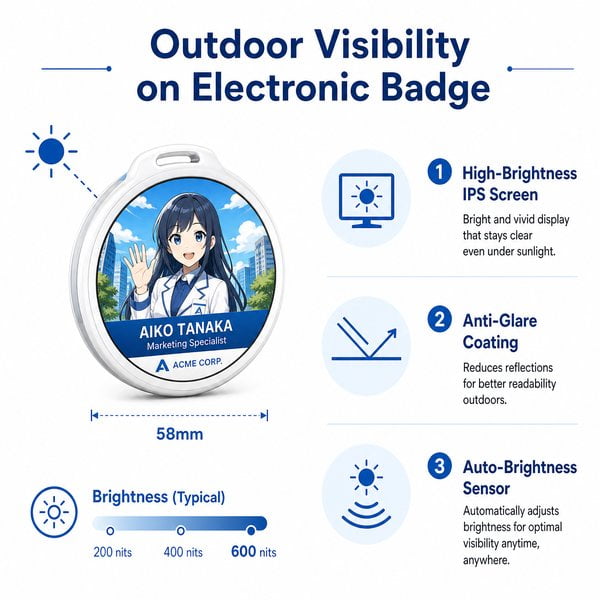
How to Set Up Outdoor Visibility on an Electronic Badge: A B2B Technical Sourcing Guide
Electronic anime badges (digital round badges) have become a staple in fan merchandise, event promotions, and collectible markets. However, outdoor deployment presents unique technical challenges—particularly regarding display visibility in bright sunlight, weather resistance, and power management. This comprehensive guide walks B2B buyers, importers, and event organizers through the critical specifications and sourcing considerations for maximizing outdoor visibility performance.
Understanding the Outdoor Visibility Challenge
Electronic badges designed for indoor use often fail in outdoor environments due to insufficient display brightness and poor contrast ratios. The global wearable display market is projected to reach $4.2 billion by 2030, with a CAGR of 18.4%, according to Grand View Research (2023). This growth is driving innovation in outdoor-capable badge technology, particularly for anime merchandise, promotional events, and festival activations.
When transitioning electronic badges outdoors, manufacturers and sourcing professionals must address:
- Display luminance (measured in nits or candelas per square meter)
- Viewing angles and contrast ratio degradation
- Ambient light rejection and anti-glare coatings
- Battery consumption under high-brightness operation
- Environmental sealing and IP ratings
Display Technology Selection for Outdoor Use
Brightness and Luminance Standards
The primary technical barrier to outdoor visibility is display brightness. Electronic badges typically use one of three display technologies:
| Display Type | Typical Brightness (nits) | Outdoor Viability | Power Consumption | Cost (OEM, per unit) |
|---|---|---|---|---|
| LCD (Passive) | 100-200 nits | Limited (direct sunlight only) | Low (50-150mA) | $2.50-$4.00 |
| E-ink / E-paper | 50-150 nits | Moderate (excellent in daylight, minimal power) | Very Low (5-10mA refresh) | $3.50-$6.00 |
| LED/OLED (Active) | 300-1000+ nits | Excellent (full sunlight readable) | High (200-500mA at full brightness) | $5.00-$12.00 |
| Transflective LCD | 150-300 nits | Good (hybrid reflective/backlit) | Medium (80-200mA) | $3.80-$7.50 |
Recommended Specifications for Outdoor Badges
For reliable outdoor visibility, Toyvao recommends the following baseline specifications:
- Minimum Brightness: 300 nits (candelas per square meter) for partial shade; 500+ nits for direct sunlight
- Contrast Ratio: At least 10:1 at 45-degree viewing angles
- Anti-glare Coating: Matte finish with 3-5% haze value to reduce reflections
- Refresh Rate: 30-60 Hz for smooth animation without flicker
- Color Gamut: sRGB or DCI-P3 for accurate anime character rendering
Environmental Protection and Durability
IP Rating Requirements
Outdoor deployment demands robust environmental sealing. Electronic badges should meet minimum IP54 rating (dust and water splash protection). For beach events or water-adjacent venues, IP67 or IP68 is recommended:
- IP54: Protected against dust ingress and water splashes from any direction
- IP67: Dust-tight; immersion up to 1 meter for 30 minutes
- IP68: Dust-tight; continuous immersion (submersible)
Achieving higher IP ratings increases manufacturing costs by 15-30% due to reinforced sealing gaskets, epoxy potting, and premium connector materials. Budget accordingly during the sourcing phase.
Temperature and Humidity Tolerance
Electronic badges must operate across expanded environmental ranges:
- Operating Temperature: -10°C to +50°C (outdoor seasonal variation)
- Storage Temperature: -20°C to +60°C
- Relative Humidity: 10-90% non-condensing
- UV Resistance: Polycarbonate or UV-stabilized resin housing to prevent color fading
Power Management for Extended Outdoor Operation
Outdoor venues often require 8-12+ hour operational windows. High-brightness displays consume significant battery power. Toyvao recommends:
Battery Capacity and Chemistry
- Lithium-Polymer (LiPo): 500-2000 mAh; excellent power density; ideal for badges requiring 6-10 hours outdoor use
- Lithium-Ion (Li-ion): 1000-3000 mAh; longer cycle life; recommended for reusable event merchandise
- Solar Hybrid: Integrate small-footprint solar cells (0.5-1 watt) for trickle charging during daytime events
Brightness Optimization Strategies
- Adaptive Brightness: Implement ambient light sensors (ALS) to automatically scale display brightness (reduces power consumption by 20-40%)
- Scheduled Dimming: Program lower brightness during low-traffic hours
- Pulse-Width Modulation (PWM): Use PWM controllers to fine-tune LED brightness without voltage regulation losses
- Low-Power Modes: Static display modes (non-animated) consume 60-70% less power than animated content
