
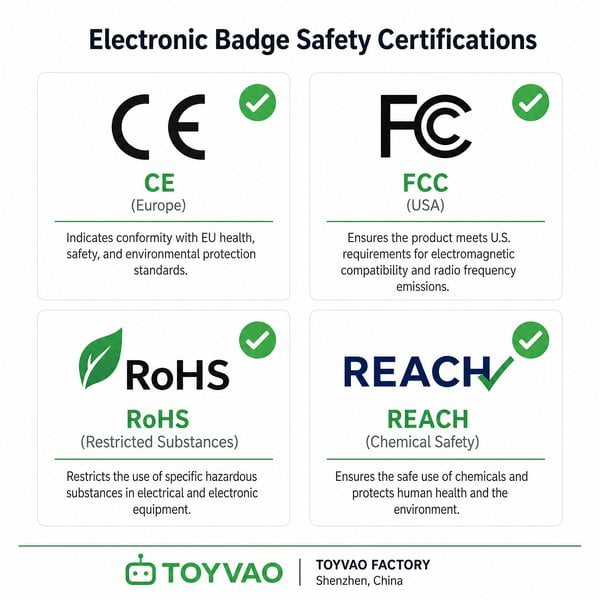
Are electronic badges safe? CE, FCC, and RoHS compliance explained
When sourcing electronic anime badges (电子吧唧) or digital round badges, safety and regulatory compliance are top concerns for B2B buyers. Electronic badges combine small PCBs, LEDs or LCDs, batteries, and sometimes wireless modules — each bringing specific regulatory requirements and risks. This guide explains the core standards (CE, FCC, RoHS), related battery and transport rules, practical sourcing checks, and how to manage compliance risk with Chinese manufacturers such as Toyvao in Shenzhen.
Why certifications matter for buyers
- Market access: CE (EU) and FCC (US) mark legal entry into major markets. Without them your badges may be blocked at ports or refused by distributors.
- Liability & recall risk: Non‑compliant electronics increase the chance of product failure, fire, or legal exposure. Retailers increasingly require documented test reports.
- Retailer acceptance: Many platforms and brick‑and‑mortar chains demand RoHS and battery safety evidence before listing products.
Market context: as wearable and novelty electronics volumes grow, regulatory scrutiny rises. For example, Grand View Research (2023) projects continued strong growth in the wearable electronics segment — signaling larger manufacture volumes and more oversight from regulators and retailers. Statista (2022) estimated global wearable device shipments reached roughly the high hundreds of millions of units annually, underscoring scale and the need for consistent compliance across suppliers.
What each regulation covers (quick summary)
| Regulation | Scope | Applies to | Typical documentation/tests |
|---|---|---|---|
| CE (EU) | Product safety & essential requirements under applicable directives (LVD, EMC, RED if wireless) | Products sold in EU/EEA | Technical File, EU Declaration of Conformity, EMC/LVD tests, RED tests for radio |
| FCC (US) | Radio and electromagnetic emissions (Part 15 for unlicensed devices) | Products sold in the USA | FCC test reports, FCC ID (for intentional radiators) or Supplier’s Declaration of Conformity |
| RoHS (EU/others) | Restriction of hazardous substances (Pb, Hg, Cd, Cr6+, PBB, PBDE, some phthalates) | Electronic products placed on EU market (also used by other markets) | Material declarations, test reports, supplier chain documentation |
| Battery rules | UN38.3 (transport), IEC 62133 (safety) | Lithium batteries included in devices | UN38.3 transport test report, IEC 62133 safety test, labeling |
Practical risks specific to electronic badges
- Battery hazards — most badges use coin or Li‑ion cells. Batteries require UN38.3 for shipping and often IEC 62133 for safety; many western retailers will insist on both.
- Radio modules — Bluetooth/NFC require RED (EU) and FCC (US) testing. Some modules are pre‑certified; if using modules, confirm module certificate covers final product integration.
- EMC/EMI — LEDs, motors (vibration), and switching circuits can cause emissions that fail EMC limits.
- Restricted substances — enamel paints, printed coatings, or solder may contain restricted materials under RoHS.
How to verify compliance when sourcing from Shenzhen (step-by-step)
- Request documentation up front: technical file, DoC (Declaration of Conformity), test reports (EMC, LVD, RED/FCC, RoHS, UN38.3, IEC 62133) and lab names (e.g., SGS, Intertek, TÜV). Do not accept generic “we are compliant” statements without files.
- Check test dates and scope: reports should be for the exact model or show equivalence for changes in enclosure, battery, antenna, or firmware.
- Talk battery: require UN38.3 and IEC 62133 reports and confirm supplier labeling for air transport. If your shipment is by air, carriers may refuse non‑compliant packs.
- Module integration: if supplier uses pre‑certified radio modules, ask for the module’s certificate and the module manufacturer’s integration guidance — some module certificates cover “plug‑and‑play,” others require re‑testing.
- Factory & QA controls: audit the PCB assembly, soldering processes, and BOM traceability. Ask for RoHS material declarations (MSDS) and sample XRF screening reports for heavy metals.
- Pre‑shipment validation: commission a third‑party lab to perform a pre‑compliance EMC/Radio check on a production sample before mass shipment.
- Contract terms: include indemnities for non‑compliance, penalties for recalls, and requirements for replacement/credit if test failures occur.
Typical timelines & costs (ballpark)
| Test / Certificate | Typical lead time | Approx. cost (USD) |
|---|---|---|
| RoHS testing / material screening | 1–3 weeks | $300–$1,000 per sample |
| EMC / Radio (pre‑compliance to full) | 2–6 weeks | $1,500–$8,000 depending on tests & lab |
| UN38.3 battery testing | 2–4 weeks | $1,000–$3,000 |
| IEC 62133 battery safety | 3–6 weeks | $2,000–$6,000 |
Note: costs vary by lab, sample count, and whether pre‑compliance reduces full test time. Using pre‑certified modules and compliant component suppliers can cut testing scope and cost.
Buyer checklist before placing a bulk order
- Obtain the full technical file and test reports for the product variant you will buy.
- Verify the battery supplier and request UN38.3 and IEC 62133 reports.
- Confirm radio module certificates and understand if additional testing is needed after final enclosure or antenna changes.
- Ask for RoHS material declarations and perform spot XRF testing on initial samples.
- Include pre‑shipment testing and contractual non‑compliance remedies.
FAQ
Q: Can an electronic badge be self‑declared for CE?
A: It depends. For simple low‑voltage, non‑radio devices you may self‑declare conformity by compiling a technical file and EU Declaration of Conformity. If the badge contains radio (Bluetooth/NFC), the Radio Equipment Directive (RED) applies and testing requirements are stricter; some cases may need a Notified Body.
Q: Do all badges need FCC certification?
A: If the badge emits radio frequency energy (Bluetooth, Wi‑Fi, NFC), it typically falls under FCC rules. Some fixed unintentional radiators can be covered by Supplier’s Declaration of Conformity (SDoC), but intentional radiators (Bluetooth) generally need FCC certification and an FCC ID.
Q: What about batteries in badges — are there special rules?
A: Yes. Lithium batteries require UN38.3 testing for transport and IEC 62133 for safety in many markets. Carriers and retailers often require both. Ensure proper labeling and documentation for shipment.
Q: How can I reduce compliance risk when sourcing from China?
A: Work with suppliers who provide full test reports from accredited labs (SGS, Intertek, TÜV). Use pre‑production samples for testing, audit factories, require BOM traceability and include compliance clauses in contracts.
Q: Are RoHS and REACH the same?
A: No. RoHS restricts certain hazardous substances in electrical/electronic equipment. REACH covers registration and restriction of chemicals across the EU. Both may be relevant; buyers should request RoHS declarations and check REACH SVHC lists for declared substances.
If you’d like help verifying reports, organizing pre‑compliance testing, or sourcing factory‑verified electronic anime badges from Shenzhen, contact Toyvao:
Email: sales@toyvao.com
WhatsApp: +86 186 8106 4480
