
Does a Reading Pen Need Special Books?
In the evolving landscape of educational technology, reading pens have emerged as powerful tools to enhance literacy and learning. A common question that arises for parents, educators, and distributors alike is: Does a reading pen need special books? The answer is nuanced, depending largely on the type and technology of the reading pen in question. While some reading pens are designed to work exclusively with specially encoded books, many modern devices, particularly those leveraging advanced Optical Character Recognition (OCR) technology, can read almost any printed text. This versatility makes them invaluable educational toys and learning aids, offering flexible solutions for diverse learning environments.
Understanding Reading Pen Technologies: How They Interact with Books
Reading pens, also known as talking pens or scanning pens, utilize various technologies to bring text to life. Understanding these underlying mechanisms is crucial to determine their compatibility with different types of books. Broadly, reading pens can be categorized into two main types based on their interaction with reading materials:
1. Pens Requiring Specially Encoded Books
Many early models and some current systems, especially those designed for younger children or specific educational programs, operate on proprietary technology that necessitates specially encoded books. These books often feature:
- Invisible Codes: Pages are printed with tiny, often invisible, dot patterns or codes that the pen’s optical sensor recognizes. Each code corresponds to specific audio files stored within the pen’s memory or linked via a companion app.
- Pre-recorded Audio: The audio content (words, sentences, sound effects, music) is pre-recorded and precisely matched to the text or images on the page. When the pen touches a specific area, it triggers the corresponding audio playback.
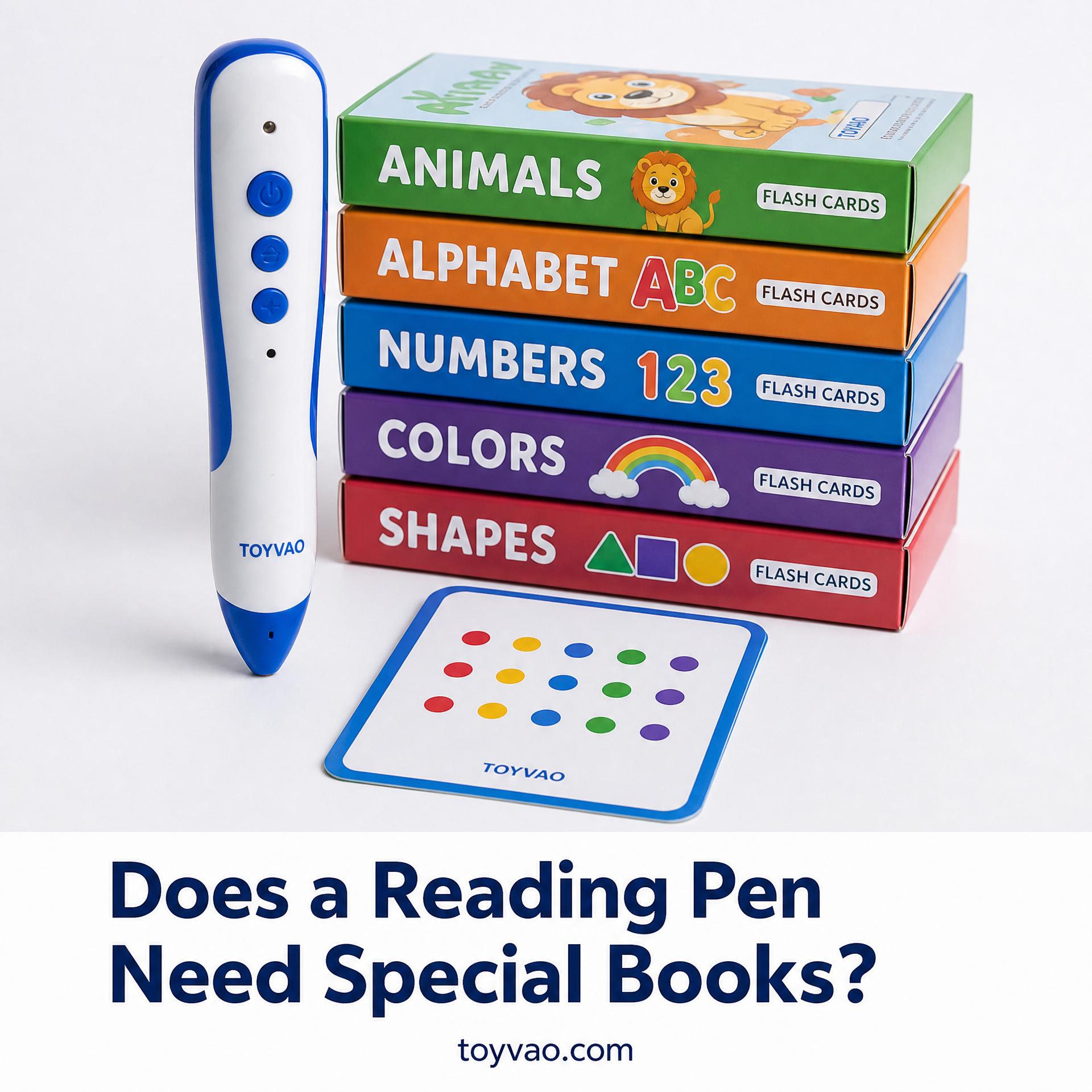
- System-Specific Content: These pens are typically part of a larger learning system, where the pen and books are designed to work together seamlessly. Examples include systems for learning foreign languages, early literacy, or specific subject matters. For instance, Toyvao’s talking flash cards, when paired with a compatible talking pen, offer an interactive learning experience where touching a card triggers pronunciation, definitions, or related facts.
The primary advantage of these systems is the rich, curated, and highly interactive content they offer. The audio is often professionally recorded, and the learning experience is structured to guide children through specific curricula. However, the limitation is clear: these pens are restricted to the publisher’s ecosystem of compatible books. If you wish to expand your child’s learning materials, you must purchase additional books from the same series or brand.
2. Pens with Optical Character Recognition (OCR) Technology
In contrast, a significant advancement in reading pen technology is the integration of Optical Character Recognition (OCR). These sophisticated devices are designed to scan and interpret printed text from virtually any source, making them far more versatile. Here’s how they typically work:
- Scanning Capability: The pen features a small scanner that captures an image of the text as it’s dragged across a line or word.
- Text-to-Speech Conversion: The OCR software within the pen converts the scanned image into digital text, which is then immediately synthesized into speech using a built-in text-to-speech (TTS) engine. This means the pen can read aloud any text it scans, regardless of whether the book is specially designed for it.
- Versatility: This type of reading pen does not require special books. It can be used with textbooks, novels, magazines, newspapers, and even handwritten notes (depending on the pen’s sophistication and handwriting clarity). This makes them incredibly flexible for students, professionals, and individuals with reading difficulties like dyslexia.
For instance, an OEM/ODM reading pen manufactured by companies like Toyvao can be equipped with advanced OCR capabilities, allowing brands to offer highly adaptable educational toys. These pens can be customized to support multiple languages, different accents, and various reading speeds, catering to a global market. The ability to read any printed material significantly broadens the scope of learning and accessibility, making them a powerful tool in modern education.
The Benefits of Versatile Reading Pens for Learning and Accessibility
The shift towards reading pens that don’t require special books offers numerous advantages, particularly in educational settings and for individuals seeking greater accessibility to printed materials. These benefits extend beyond mere convenience, impacting learning outcomes and fostering independence.
Enhanced Learning Experience
- Access to Diverse Materials: Students are no longer limited to a specific library of pre-encoded books. They can use their reading pen with any textbook, library book, or printed worksheet, making learning more dynamic and comprehensive. This is particularly beneficial for subjects requiring extensive reading from various sources.
- Improved Comprehension and Retention: By providing auditory feedback, reading pens help reinforce word recognition and pronunciation. This multi-sensory approach can significantly improve reading comprehension, especially for young learners or those with learning disabilities. The ability to hear words while seeing them can solidify understanding and aid memory retention.
- Language Acquisition: For children learning a second language, a talking pen that can read any text is an invaluable asset. It allows them to practice pronunciation and understand new vocabulary in context, transforming ordinary books into interactive language lessons. Toyvao’s expertise in OEM/ODM manufacturing means they can produce talking pens capable of supporting multiple languages, making them ideal for global educational markets.
Increased Accessibility and Independence
- Support for Dyslexia and Other Reading Difficulties: Reading pens are widely recognized as assistive technology for individuals with dyslexia, ADHD, and other reading challenges. By scanning text and converting it to speech, they reduce the cognitive load associated with decoding words, allowing users to focus on understanding the content. This fosters greater independence and confidence in reading.
- Portability and Convenience: Unlike bulky screen readers or specialized computer software, reading pens are compact and portable. Students can easily carry them to school, libraries, or home, ensuring consistent access to reading support wherever they go.
- Cost-Effectiveness: While initial investment in a high-quality reading pen might seem significant, its ability to work with any book eliminates the need to purchase expensive, specially formatted materials for every learning stage or subject. This makes them a more economical long-term solution for many families and educational institutions.
The Role of Toyvao in the Educational Toy Market
Toyvao, as a leading Shenzhen-based OEM/ODM manufacturer of electronic educational toys, plays a pivotal role in advancing the capabilities of reading pens and talking pens. Our focus on innovation ensures that our products, including learning card machines and talking flash cards, are not only engaging but also technologically advanced to meet the evolving needs of the global market.
We understand that the demand for versatile learning tools is growing. Therefore, our manufacturing processes are geared towards producing reading pens that offer broad compatibility, often incorporating advanced OCR technology. This allows our partners to offer products that are not limited to proprietary books, providing greater value and flexibility to end-users.
Comparing Reading Pen Types: Proprietary vs. OCR-Enabled
To further illustrate the differences and advantages, let’s compare the two main types of reading pens:
| Feature | Proprietary System Reading Pens | OCR-Enabled Reading Pens |
|---|---|---|
| Book Compatibility | Requires specially encoded books from the same system/publisher | Works with virtually any printed text (books, magazines, etc.) |
| Content Source | Pre-recorded audio embedded in specific books | Real-time text-to-speech conversion of scanned text |
| Flexibility | Limited to the ecosystem of compatible books | Highly flexible, adaptable to diverse reading materials |
| Cost (Books) | Potentially higher long-term cost due to proprietary book purchases | No additional cost for special books |
| Target Audience | Younger children, specific curriculum learning, language learning | Students (all ages), individuals with reading difficulties, language learners, professionals |
| Technology | Invisible codes, optical sensors, pre-loaded audio | Optical Character Recognition (OCR), Text-to-Speech (TTS) engine |
| Example | Toyvao’s talking flash cards with compatible pen (for specific content) | Advanced reading pen models capable of scanning any book |
This comparison highlights why OEM and ODM partners increasingly seek talking pen solutions that offer broader compatibility. The ability to use a single device across a wide range of materials significantly enhances its utility and appeal as an educational toy.
Conclusion
In conclusion, while some reading pens do require special books, the trend in educational toy development, particularly from OEM/ODM manufacturers like Toyvao, is towards more versatile devices. Modern talking pens equipped with OCR technology can read almost any printed text, offering unparalleled flexibility and accessibility. This advancement empowers learners of all ages and abilities, making reading more engaging, comprehensible, and independent. When considering a reading pen, it’s essential to evaluate its technological capabilities and compatibility to ensure it meets the diverse needs of its users.
Ready to Source Talking Pens & Reading Pens for Your Brand?
Toyvao is a Shenzhen-based OEM/ODM manufacturer specializing in electronic educational toys, including talking pens, reading pens, and talking flash cards. With 15+ years of experience and CE/FCC/EN71/ASTM certifications, we help global brands develop custom reading pen products from concept to shelf. – Email: sales@toyvao.com – WhatsApp: +86 186 8106 4480 – Website: https://toyvao.com
