
Introduction: Unlocking Literacy with Advanced Reading Pen Technology
In the rapidly evolving landscape of educational technology, reading pens have emerged as powerful tools for enhancing literacy and language acquisition. For B2B buyers—importers, distributors, brand owners, and educational institutions—understanding the precise capabilities of these devices is crucial for strategic sourcing and market positioning. A common inquiry revolves around their ability to recognize and articulate individual words. This guide delves into the core technologies that enable reading pens to perform this function, offering a data-driven perspective on their operational mechanisms and market implications.
The Core Technologies: OID vs. OCR in Word Recognition
Reading pens primarily leverage two distinct technologies for text recognition: Optical Identification (OID) and Optical Character Recognition (OCR). Each offers unique advantages and limitations, directly impacting a pen’s ability to read individual words effectively.
Optical Identification (OID) Technology: Precision and Speed
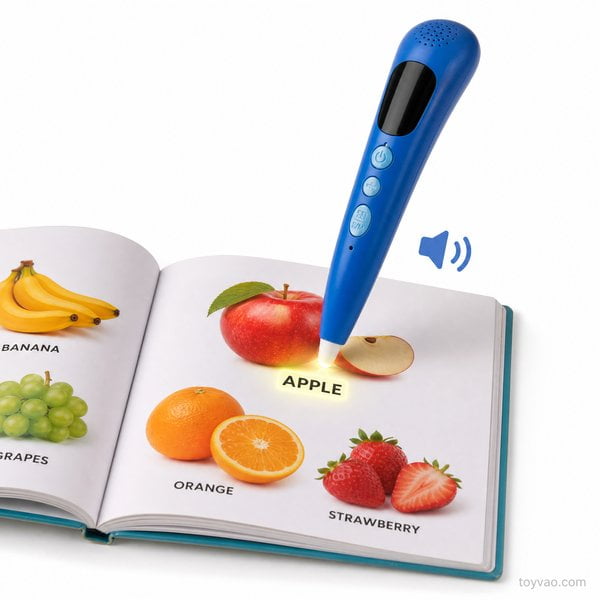
OID technology is foundational for many early learning reading pens. These pens interact with specially printed books that contain invisible micro-dot patterns beneath the text or images [1]. When the pen’s optical sensor touches a specific area, it reads these pre-encoded patterns, triggering instantaneous audio playback of the corresponding word, phrase, or sentence. This method ensures high precision and zero-latency audio feedback, making it ideal for young learners and structured educational content.
- Mechanism: Reads invisible micro-dots on specialized paper.
- Word Recognition: Pre-encoded audio linked to specific dot patterns allows for precise individual word pronunciation.
- Advantages: Instantaneous response, consistent audio quality, fully offline operation, durable hardware.
- Best For: Early language acquisition, phonics, interactive storybooks, and structured curricula where content is pre-coded.
Optical Character Recognition (OCR) Technology: Versatility and Real-time Scanning
OCR-based reading pens, often found in devices designed for older students or those with learning difficulties like dyslexia, utilize a tiny camera to scan visible text in real-time [2]. As the pen glides over a word, it captures the image of the characters, converts them into digital text, and then uses a text-to-speech (TTS) engine to vocalize the word. While highly versatile, OCR pens may introduce a slight latency compared to OID pens and require clear text for optimal performance.
- Mechanism: Scans visible printed text using a high-speed camera.
- Word Recognition: Converts scanned character images into digital text, then uses TTS for pronunciation.
- Advantages: Works with almost any printed material (books, newspapers), supports translation, aids independent reading.
- Best For: Dyslexia support, language learning with diverse materials, and situations requiring on-the-fly text scanning.
Can a Reading Pen Read Individual Words? The Definitive Answer
Yes, unequivocally, **reading pens are designed to read individual words**, among other textual units. The method and efficiency of this function depend heavily on the underlying technology:
- OID Pens: Excel at individual word recognition due to their pre-programmed nature. Each word in an OID-enabled book has a unique, invisible code that directly links to its audio pronunciation. This ensures that when a child taps a single word, only that word is spoken, providing clear auditory reinforcement for vocabulary building and phonics.
- OCR Pens: Also read individual words by scanning them and converting them to speech. Modern OCR pens, often enhanced with AI, aim for natural-sounding voices and improved accuracy in isolating and pronouncing single words from a line of text [3]. This capability is particularly beneficial for users who need to look up unfamiliar words or hear their pronunciation in context.
Both technologies support the granular reading of individual words, making reading pens invaluable tools for vocabulary development, pronunciation practice, and fostering reading independence.
Market Comparison: OID vs. OCR Reading Pen Solutions for B2B
For B2B buyers, selecting the right reading pen technology involves weighing factors such as target audience, content ecosystem, and desired functionality. The table below provides a comparative overview:
| Feature | OID Technology Reading Pens | OCR Technology Reading Pens |
|---|---|---|
| Primary Use Case | Early childhood education, structured learning programs, interactive books. | Assistive technology for dyslexia, language translation, general text scanning. |
| Word Recognition Mechanism | Reads invisible micro-dots linked to pre-recorded audio. | Scans visible text, converts to digital characters, then uses text-to-speech. |
| Content Compatibility | Requires specially printed, OID-coded books/materials. | Works with almost any printed text (books, newspapers, documents). |
| Response Time | Instantaneous (near zero latency). | Slight latency (1-2 seconds) due to real-time processing. |
| Offline Functionality | Fully offline. | Mostly offline; some advanced features (e.g., cloud translation) may require Wi-Fi. |
| Customization Potential (OEM/ODM) | High, especially with OEM-flexible OID III models for custom curricula and audio files [1]. | Moderate, primarily in software features, dictionaries, and TTS voices. |
| Typical B2B Application | Developing proprietary educational series, branded learning kits. | Providing assistive learning devices, multi-language support tools. |
The Toyvao Advantage: Partnering for Literacy Innovation
As a leading educational toy manufacturer based in Shenzhen, China, established in 2009, Toyvao specializes in OEM/ODM solutions for global brands, wholesalers, and retailers. Our expertise in OID technology ensures that our reading pens offer precise, reliable, and engaging individual word recognition capabilities, tailored to your specific market needs. We adhere to stringent international safety standards, including CE, FCC, EN71, and ASTM, guaranteeing product quality and compliance for global distribution.
Conclusion: Empowering Learners, Enhancing Brands
The ability of reading pens to accurately read individual words is a cornerstone of their educational value, facilitating vocabulary acquisition, pronunciation accuracy, and reading fluency. Whether through the instantaneous feedback of OID technology or the versatile scanning of OCR, these devices represent a significant advancement in accessible learning. For B2B partners, investing in high-quality reading pens means offering a product that genuinely empowers learners and strengthens your brand with innovative educational solutions.
Ready to Partner? Contact Toyvao Today
Ready to source high-quality reading pens for your brand? Contact Toyvao today at sales@toyvao.com or WhatsApp us at +86 186 8106 4480 for a custom quote and free sample.
