
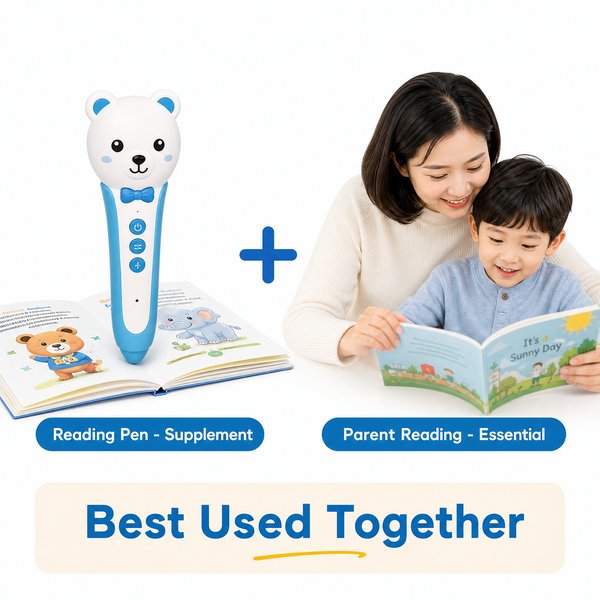
BLUF: No — a reading pen (including Toyvao’s OID children’s reading pen) should be treated as a high-quality supplemental tool, not a replacement for reading with parents. It reliably extends practice time, builds specific early literacy skills (phonemic awareness, vocabulary, listening comprehension), and supports classroom and special-needs use, but it cannot replicate the social, emotional and dialogic benefits of adult-child shared reading.
Quick decision framework: When it’s worth caring about / When you don’t need to overthink it
- When it’s worth caring about:
- You need consistent, repeatable audio models for independent practice (recommended sessions for ages 3–6: 15–30 minutes per session, up to 2 sessions/day).
- Your classroom or reading corner needs a low-maintenance, offline device with long battery life (8–12 hours) and quick USB‑C charging (2–3 hours).
- You must support multi-sensory learning for early readers, children with dyslexia or speech delay without introducing internet risks (Toyvao pen works OFFLINE; NO Bluetooth/NO Wi‑Fi/NO app required).
- You want factory-direct OEM/ODM with MOQ 100–500 pcs and full certifications (CE/FCC/RoHS/EN71/ASTM/UN38.3).
- When you don’t need to overthink it:
- You’re buying a device to occasionally entertain children — a reading pen is not a general tablet replacement and only works with OID-coded books from the same brand.
- You expect translation, general text scanning, or OCR of arbitrary printed material — this OID pen is NOT a translation pen, scanner pen, or OCR pen for general text.
- You need cloud analytics, remote updates or app-based content delivery — this product is intentionally offline for privacy and simplicity.
Core product facts (concise)
- Technology: OID invisible dot pattern — pen reads dots on special books and plays pre-recorded audio; works offline and requires OID-coded books from the same brand.
- Target age: Ages 3+
- Storage options: 16GB / 32GB / 64GB
- Battery: 8–12 hours use; charging 2–3 hours via USB‑C
- Audio: 3.5mm headphone jack; volume adjustment button
- Connectivity: NO Bluetooth, NO Wi‑Fi, NO app
- Limitations: Not a translation/scanning/OCR pen for arbitrary text
- Certifications: CE, FCC, RoHS, EN71, ASTM, UN38.3
- OEM/ODM MOQ: 100–500 pcs
Comparison: Parent reading vs. OID reading pen vs. Combined approach
| Feature / Outcome | Reading with Parents | Reading Pen (OID) | Combined Approach |
|---|---|---|---|
| Social interaction & bonding | High — conversation, emotional feedback, scaffolding | Low — audio models only, no social reciprocity | High — pen extends practice while parent provides interaction |
| Phonemic awareness & decoding practice | High when adult models phonics explicitly | High — consistent, repeatable audio models for phonics | Highest — adult-guided practice + extra repetition from pen |
| Availability / consistency | Variable (depends on caregiver time) | High — always available offline, long battery life (8–12h) | High |
| Privacy / network safety | High (no device risk) | High — device is offline (no Wi‑Fi/BT/app) | High |
| Content scope | Unlimited (any book) | Limited — only OID-coded books from same brand | Complimentary |
| Special-needs support (dyslexia, speech delay) | Very effective with trained strategies | Supportive — multi-sensory audio + tactile interaction reduces anxiety | Most effective |
| Cost per child | Minimal device cost, high time cost | Device/unit cost + coded books | Balanced investment |
How teachers and programs commonly use the reading pen
- Classroom reading corners and independent reading stations for 15–30 minute sessions.
- Phonics practice: point-and-read for isolated sounds/words, repeat-after-me drills.
- Bilingual learning: consistent pronunciation models for second-language vocabulary (note: not a translator).
- Small-group rotation: one pen per 3–6 children to increase exposure without replacing teacher-led instruction.
Recommended learning activities
- Point-and-read: child points to picture/word and listens to the audio cue.
- Repeat-after-me: child repeats words or sentences to practice pronunciation.
- Word hunting: give a list of target words and ask children to find and tap them in the book.
- Story sequencing: listen to audio segments and reorder picture cards to match story flow.
Special needs support — factual, non-medical benefits
- Dyslexia support: multi-sensory input (audio + visual + tactile tapping) can reduce reading anxiety, increase engagement, and build confidence during practice.
- Speech delay: clear, repeatable pronunciation models plus the ability to rehearse can reinforce speech patterns and provide audio reinforcement.
- Important: the pen supplements evidence-based instruction; it is not a medical device or standalone therapy.
Customer Feedback Synthesis (B2B style)
- Positive: “As a school procurement manager, I appreciate the offline design and CE/FCC certifications — low risk for classroom deployment.” — District Procurement Officer
- Positive: “The pens gave our phonics station structure; students love the repeat-after-me activity and usage is easy to manage.” — Primary School Headteacher
- Positive: “Factory direct pricing from Toyvao made the MOQ (100–500) workable for our chain; the 8–12h battery life is ideal for a full school day.” — Educational Retail Buyer
- Concern: “Books must be OID-coded from the same brand — extra cost and limits our existing library use.” — Bookstore Chain Category Manager
- Concern: “No Bluetooth or app means no remote content updates or analytics; that’s fine for privacy but limits after-sales scalability.” — Edtech Program Director
- Concern: “Not a translation or OCR pen; some staff expected broader functionality and had to be retrained on device scope.” — Curriculum Coordinator
FAQ
- Q: Can the pen read any printed book?
- A: No. The device uses OID invisible dot patterns printed on special OID-coded books from the same brand. It will not read arbitrary printed pages, and it is not an OCR or scanner pen.
- Q: Is the pen safe for classroom use with many children?
- A: Yes. The pen works offline (NO Wi‑Fi/NO Bluetooth/NO app), reducing network and privacy risk. It has CE/FCC/RoHS/EN71/ASTM/UN38.3 certifications, long battery life (8–12h), and a 3.5mm headphone jack for shared or individual listening.
- Q: Will the pen replace teachers or parents?
- A: No. It is designed as a supplemental tool to increase practice time, provide consistent audio models, and support multi-sensory learning. Adult-led interactions remain essential for dialogic reading, comprehension questions, and emotional support.
- Q: What are MOQ and customization options?
- A: Toyvao offers factory-direct OEM/ODM with MOQs typically between 100 and 500 pcs. Contact sales to discuss branding, storage options (16/32/64GB), and bundled OID book sets.
Practical buying checklist for B2B purchasers
- Decide use case: classroom rotation, independent practice, or supplemental home packs.
- Confirm book ecosystem: ensure availability of OID-coded titles you want to use.
- Choose storage capacity: 16/32/64GB depending on content library size.
- Plan deployment: ideally 1 pen per 3–6 children in rotation; supervise younger children.
- Verify certifications and warranty to meet procurement standards (CE/FCC/RoHS/EN71/ASTM/UN38.3).
Toyvao can provide factory-direct pricing, MOQ guidance, and sample units to trial in classrooms. For quotations, content bundling, or OEM/ODM discussions, contact Toyvao directly:
- WhatsApp: +86 186 8106 4480
- Email: sales@toyvao.com
- Website: https://toyvao.com
Conclusion: Use the reading pen to increase exposure, provide consistent audio models, and support special-needs practice — but keep parent/teacher reading at the center of early literacy for social, emotional and higher-order language development. Contact Toyvao to order samples, review certifications, or discuss custom branding and book bundles.
