
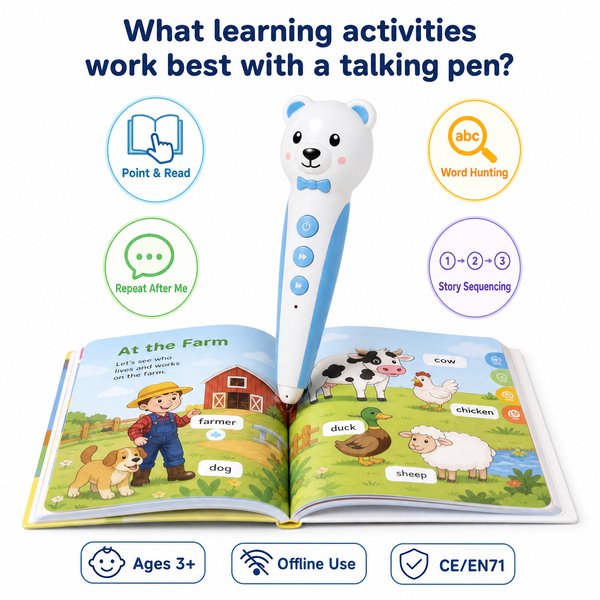
BLUF: Talking pens work best for structured, short, repeatable, multi-sensory early-literacy activities — point-and-read picture-word practice, phonics drills, repeat‑after‑me pronunciation, word-hunting games, and story-sequencing tasks. For children Ages 3+, use sessions of 15–30 minutes (max 2 sessions/day for Ages 3–6) to get measurable gains in phonemic awareness, vocabulary, listening comprehension and print awareness. Choose an OID-style offline pen when you want durability, no-network operation and book-level audio control; avoid it if you need general OCR, translation or open-text scanning.
When it’s worth caring about / When you don’t need to overthink it
Compatibility: OID-coded books vs open-text pens
When it’s worth caring about: If your curriculum or book supplier commits to a single interactive book ecosystem, or you want total offline reliability and low security risk, pick an OID pen that only reads invisible dot patterns on matched books.
When you don’t need to overthink it: If you need a quick listen-and-repeat toy for generic picture books, a simple audio-book player or read-aloud device may suffice — you don’t need the OID infrastructure.
Connectivity and privacy (No Bluetooth / No Wi‑Fi / No app)
When it’s worth caring about: For school deployments where network access is limited, devices must be COPPA/GDPR-friendly, or IT wants zero wireless endpoints in classrooms, the offline OID pen is ideal.
When you don’t need to overthink it: If you require remote analytics, firmware pushes, or content updates over Wi‑Fi, choose a different talking pen model that supports cloud services.
Classroom scale and procurement (MOQ, certifications)
When it’s worth caring about: If you’re a distributor or school district buying at scale, factory-direct OEM/ODM options and MOQs (100–500 pcs) matter; also confirm CE/FCC/RoHS/EN71/ASTM/UN38.3 certification.
When you don’t need to overthink it: For single‑classroom pilots or one-off gifts, small retail units are fine — you don’t need full OEM customization.
Special-needs support (dyslexia, speech delay)
When it’s worth caring about: If you want multi-sensory classroom tools that reduce reading anxiety and provide repeatable clear-model audio for practice, a talking pen supports those goals (as a supplemental tool).
When you don’t need to overthink it: If a child requires individualized clinical intervention, the talking pen is NOT a medical therapy — coordinate with specialists rather than relying solely on the device.
Concrete product facts (useful procurement checklist)
- Technology: OID interactive dots — works only with OID-coded books from the same brand.
- Storage options: 16GB / 32GB / 64GB (choose based on book library size and audio bitrate).
- Battery life: 8–12 hours typical. Charging: 2–3 hours via USB‑C.
- Connectivity: NO Bluetooth, NO Wi‑Fi, NO app required — fully offline.
- Ports & controls: 3.5mm headphone jack, volume adjustment button.
- Limitations: NOT a translation pen, NOT a scanner or general OCR pen — it plays pre-recorded audio only.
- Recommended daily use (Ages 3–6): 15–30 minutes per session, up to 2 sessions/day.
- MOQ for OEM/ODM: 100–500 pcs. Certifications: CE, FCC, RoHS, EN71, ASTM, UN38.3.
Activity comparison table — which activities map best to learner goals
| Activity | Best ages | Session length | How the talking pen is used | Primary literacy gains |
|---|---|---|---|---|
| Point-and-read (label practice) | 3–6 | 10–20 min | Child taps pictures/words to hear word and sentence audio | Vocabulary, print awareness |
| Repeat-after-me (pronunciation) | 3–8 | 15–25 min | Play model audio; child repeats; teacher monitors | Phonemic awareness, speech clarity |
| Phonics drills (sound families) | 4–7 | 10–20 min | Tap grapheme zones to hear phonemes, then blend | Decoding skills, letter-sound mapping |
| Word-hunting games | 4–9 | 15–30 min | Find and tap target words on a page for points | Fluency, sight-word recognition |
| Story sequencing | 3–8 | 15–30 min | Tap panels to hear scene audio; reorder cards/pages | Comprehension, narrative skills |
| Bilingual switching (preset tracks) | 3–10 | 15–30 min | Tap to play language A or B (must be encoded on book) | Vocabulary in two languages, listening comprehension |
How to design classroom activities that scale
- Reading corner rotation: 4–6 pens shared by groups of 4; each child gets a 15–20 minute point-and-read session.
- Independent station: Preloaded phonics book + headphones (3.5mm) for focused decoding practice.
- Guided small-group: Teacher listens while students repeat-after-me; use the pen’s audio levels to ensure clarity.
- Assessment-friendly task: Use a word-hunting checklist — students tap words and teachers record accuracy and fluency.
- Bilingual pair work: Pair fluent speakers with learners; use dual-language tracks in OID books to compare vocabulary.
Customer Feedback Synthesis
Positive:
- “Great for our early-years phonics corner — reliable offline playback and 10‑hour battery makes classroom rotation simple.”
- “Factory-direct pricing from Toyvao let us pilot 200 units with custom branding within our budget and timeline.”
- “Teachers loved the repeat-after-me tracks for speech practice — kids repeat until confident without screen time.”
Negative / Concerns:
- “Requires commitment to OID-coded books — switching suppliers meant extra cost for compatible titles.”
- “No Wi‑Fi or app means content updates are manual; we had to manage audio revisions on the manufacturer side.”
- “Not useful for scanning classroom worksheets or translating text — it’s a closed-system audio pen, not an OCR device.”
Dyslexia & speech-delay support (factual, non-medical)
- Multi-sensory pairing: Audio + visual + tactile tapping supports students who benefit from repeated, concrete input.
- Reduces performance pressure: Private, repeatable audio lowers reading anxiety and builds practice confidence in group settings.
- Clear pronunciation models: Repetition of model speech helps children with speech delay practice sounds and word forms.
- Note: The pen is a supportive educational tool — it is not a medical treatment. Coordinate with specialists for individualized therapy plans.
Quick procurement spec table (for order sheets)
| Spec | Options / Value |
|---|---|
| Technology | OID dot recognition (book-specific) |
| Storage | 16GB / 32GB / 64GB |
| Battery life | 8–12 hours |
| Charging | USB‑C, 2–3 hours |
| Audio output | Built‑in speaker + 3.5mm headphone jack |
| Connectivity | No Bluetooth / No Wi‑Fi / No app |
| MOQ (OEM/ODM) | 100–500 pcs |
| Certifications | CE, FCC, RoHS, EN71, ASTM, UN38.3 |
FAQ
- Q: Can this pen read any printed book or worksheet?
- A: No. OID pens read invisible dot patterns printed on specially encoded books. The device will not read generic printed pages, perform OCR, or translate arbitrary text.
- Q: Does the pen require Wi‑Fi, Bluetooth, or a smartphone app?
- A: No. This pen works fully offline — there is no Bluetooth, no Wi‑Fi and no app required. Content is pre-recorded and stored on the device (16/32/64GB options).
- Q: Is this appropriate for children with dyslexia or speech delays?
- A: The pen is a supportive, multi-sensory classroom tool that can reduce reading anxiety and provide clear audio models for practice. It is not a medical therapy; use it alongside specialist guidance and evidence-based interventions.
- Q: What are the order minimums and certification assurances?
- A: MOQ for OEM/ODM runs 100–500 pcs. Toyvao supplies devices with CE, FCC, RoHS, EN71, ASTM and UN38.3 certifications for battery transport.
Ready to procure or pilot an OID talking pen? For factory-direct pricing, customization (OEM/ODM) and sample requests contact Toyvao: WhatsApp +86 186 8106 4480, email sales@toyvao.com or visit https://toyvao.com.
