
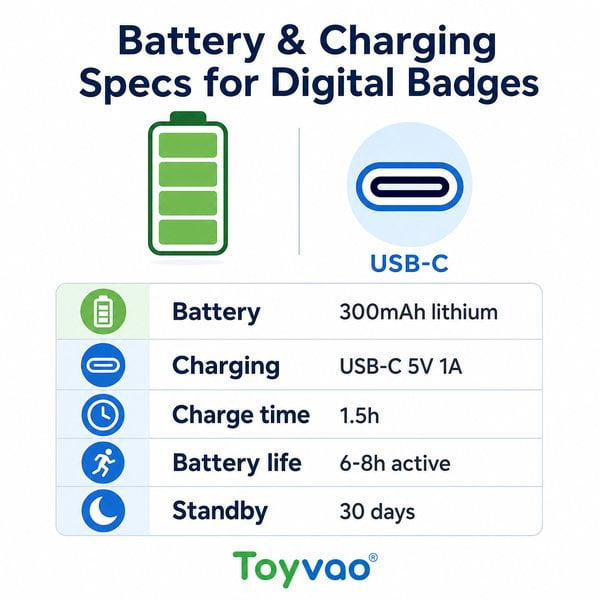
What battery and charging specs matter for digital badges?
When sourcing electronic anime badges (电子吧唧) or digital round badges, battery and charging decisions are central to product performance, safety, compliance, shipping, and user experience. Buyers and product managers must balance runtime, form factor, safety certifications, cost, and manufacturability. This guide covers the technical specs and commercial factors to evaluate when ordering badges from Shenzhen suppliers like Toyvao.
Why battery and charging matter for digital badges
- Runtime & UX: Battery capacity and average current draw determine how long animated LED panels, small OLED screens, or audio features run between charges.
- Safety & Compliance: Rechargeable cells require protection circuits and must meet UN38.3 / IEC 62133 for shipping and market access.
- Manufacturing & Cost: Cell type and pack assembly affect BOM cost, assembly complexity, and MOQ.
- Logistics: Lithium cells have regulated transport rules; coin cells behave differently from LiPo in air freight.
Key battery specs to specify in RFQs
- Battery type — Li-Po pouch (most common for thin badges), Li-ion cylindrical, rechargeable coin (LIR), or non-rechargeable coin (CR2032).
- Nominal voltage — single-cell lithium cells: 3.7 V nominal; coin cells 3.0 V.
- Capacity — specify mAh target (e.g., 250 mAh, 500 mAh). For thin 40–60 mm badges, typical ranges are 200–600 mAh.
- Max continuous discharge current — ensure it covers peak draw (LED matrix + driver + MCU + speakers if any).
- Charge algorithm — CC/CV charging for Li-ion/LiPo with proper termination (4.20 V ± 0.05 V).
- Recommended charging current (C-rate) — commonly 0.2C–0.5C for longevity; e.g., 500 mAh cell charged at 0.5C = 250 mA.
- Protection — integrated PCM/BMS for overcharge, over-discharge, short-circuit, and temperature monitoring.
- Cycle life & storage state — specify expected cycles at specified DoD and recommend storage charge (≈40% SOC for long shipments).
Charging hardware & interface choices
For badge-grade products the simplest reliable solutions are:
- Micro-USB or USB-C charging via a linear or switching charger IC (e.g., TP4056-class for 5V single-cell charging modules). USB-C can be used for orientation convenience but avoid PD negotiation for single-cell badges unless higher power is required.
- Integrated charging PCB with thermistor input for temperature-aware charge termination.
- Magnetic pogo-pin charging or proprietary docking for event badges — useful when waterproofing or thinness is needed.
Performance examples and how to calculate runtime
Estimate average current draw and divide battery capacity by draw. Example calculations used for supplier discussions:
- Badge with LED animation and Bluetooth: average draw ≈ 80–120 mA. A 500 mAh LiPo → runtime ≈ 4–6 hours.
- Simple LED-only badge: average draw ≈ 20–50 mA. A 250 mAh coin or pouch → runtime ≈ 5–12 hours.
- Charging time: Charge time ≈ Capacity (mAh) / charge current (mA) × 1.1 (inefficiency). E.g., 500 mAh at 250 mA ≈ 2.2 hours.
Safety, standards and shipping
- UN38.3 is required for air transport of lithium cells and packs. Confirm supplier provides test reports and proper packaging labels.
- IEC 62133 and UL 2054 / UL 1642 are commonly requested safety standards for rechargeable cells — require test reports where target markets demand them.
- CE and RoHS compliance for the finished badge; FCC for wireless-enabled badges (BLE, Wi-Fi).
- Labeling — battery capacity, nominal voltage, and disposal instructions are often required by retailers and distributors.
Quality checks to include in your SOW
- Incoming inspection of cell capacity, internal resistance, and voltage tolerance.
- Full charge/discharge cycle testing for batch validation (sample sizes defined by AQL).
- Thermal / short-circuit testing and verification of protection circuits.
- Shipping state-of-charge verification (ship at ~30–50% SOC for lithium cells).
Industry context
Smart and wearable devices are growing rapidly; battery supply and regulation follow. Grand View Research reports that the global wearable technology market is expanding at a doubledigit CAGR, driven by consumer interest in personal electronics and event merchandise — this growth increases demand for robust, small-format batteries suited to badges and pins. (Source: Grand View Research, 2023 market analysis.)
Similarly, Statista tracks strong growth in the lithium-ion battery market as electrification and portable electronics demand higher-capacity cells; buyers should expect tightening lead times and rising material scrutiny during peak seasons. (Source: Statista, lithium-ion battery market trends.)
Practical sourcing checklist (what to request from suppliers)
- Cell type and datasheet (voltage, capacity, dimensions, weight, IR).
- Protection board spec and charging IC model, including charge current and termination behavior.
- Test reports: UN38.3, IEC 62133, CE/RoHS, FCC (if wireless).
- Sample inspection plan: capacity tolerance, cycle test, thermal test.
- Shipping instructions and state-of-charge confirmation.
- MOQ, lead time, lifetime warranty terms and failure rate (ppm).
Specification comparison
| Spec | Li-Po pouch (typical badge) | Rechargeable coin (LIR2032) | Non-rechargeable coin (CR2032) | NiMH (small) |
|---|---|---|---|---|
| Nominal voltage | 3.7 V | 3.6–3.7 V | 3.0 V | 1.2 V per cell |
| Typical capacity (badge use) | 150–600 mAh | 40–90 mAh | 200–240 mAh (non-recharge) | 200–600 mAh |
| Form factor | Thin pouch — flexible | Small coin — thin | Small coin — thin | Bulkier cells |
| Rechargeable | Yes | Yes | No | Yes |
| Typical charging | CC/CV via USB charger IC | Specialized charger (low capacity) | — | NiMH charger (CC) |
| Shipping complexity | High (UN38.3) | Moderate (UN38.3 for rechargeable) | Low (non-lithium) | Moderate |
Negotiation tips
Ask suppliers for cell traceability, batch test data, and failure rates in ppm. For event badges, request custom low-cost PCBs with standard TP4056-class chargers (or integrated USB-C) and negotiate MOQ vs. price for custom capacities. If you require faster charging, specify a higher C-rate and confirm thermal mitigation on the badge enclosure.
Frequently Asked Questions
What battery capacity should I choose for a 50 mm animated badge?
For a 50 mm badge with animated LEDs and occasional Bluetooth, target 300–500 mAh. Expect 3–6 hours runtime depending on brightness and wireless use. Use the runtime formula: Capacity (mAh) ÷ Average draw (mA).
Do I need a protection circuit for a single-cell pouch battery?
Yes. Include a PCM/BMS to prevent overcharge, over-discharge and short circuit. Many badge suppliers integrate the protection board into the pack or the charging PCB.
What charging current is safe for badge batteries?
0.2C–0.5C is typical for longevity. For a 500 mAh cell, 100–250 mA charging current is safe. Faster charging is possible but will reduce cycle life and require thermal management.
Which certifications should I require from my supplier?
Request UN38.3 for transport, IEC 62133 for cell safety, CE/RoHS for finished units, and FCC for wireless variants. Ask for test reports and date-stamped certificates.
How should batteries be shipped for event orders?
Ship lithium batteries at ~30–50% SOC and follow IATA/ICAO packing instructions if by air. For large consumer shipments, consider sea freight for bulk lithium cells to reduce cost and paperwork.
Next steps / Contact Toyvao
For sample requests, detailed BOM reviews, or compliance documentation from a Shenzhen OEM experienced with event and novelty electronics, contact Toyvao:
- Email: sales@toyvao.com
- WhatsApp: +86 186 8106 4480
