
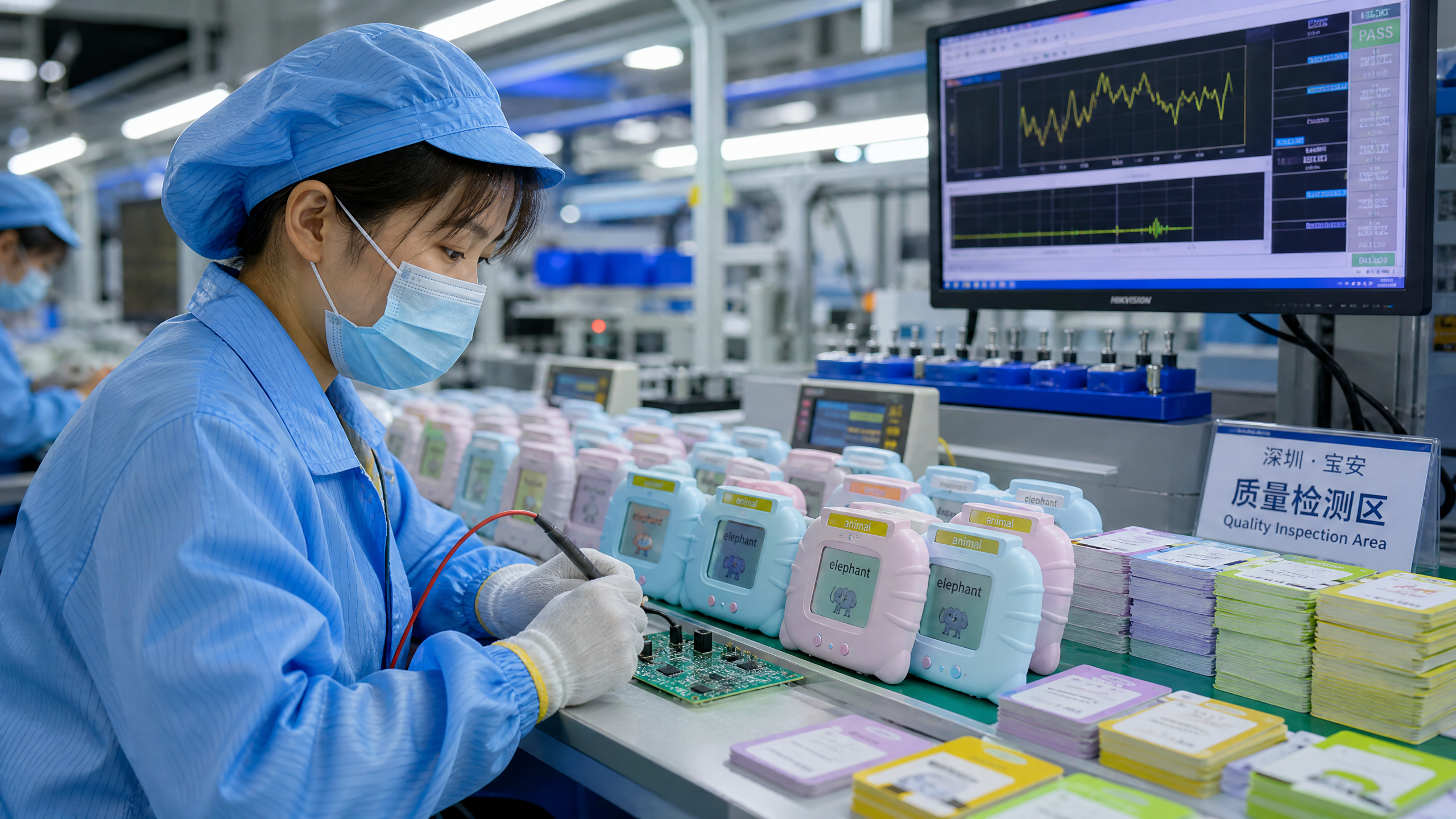
As early childhood education hardware becomes increasingly digitized, talking flash cards (also known as audio flashcard readers or educational card machines) have emerged as a high-growth product category globally [1]. For B2B buyers, educational distributors, and toy brands, sourcing these electronic learning devices from China offers significant cost advantages and manufacturing scalability [2]. However, navigating the landscape of Shenzhen and Dongguan manufacturers requires a deep understanding of technical specifications, material safety, and quality assurance workflows to avoid common procurement pitfalls [3].
This comprehensive sourcing guide provides an engineering-grade roadmap for importing talking flash cards, ensuring your inventory meets the highest international standards of safety, durability, and acoustic quality [4].
Why Is Shenzhen the Global Hub for Educational Toy Manufacturing?
Shenzhen, particularly the Bao’an and Longgang districts, along with neighboring Dongguan, constitutes the world’s most integrated supply chain for early educational electronic hardware [5]. Sourcing directly from this cluster offers three distinct advantages:
- Unrivaled Component Ecosystem: Access to specialized semiconductor suppliers, high-precision injection molding factories, and card-printing facilities within a 50-kilometer radius [6].
- Advanced Tooling Capabilities: The ability to develop custom tooling (OEM/ODM) for unique outer shell designs (e.g., animal-shaped casings) with rapid prototyping cycles of 7 to 15 days [7].
- Rigorous Quality Control Standards: Tier-1 factories in this region are accustomed to producing for major global brands, maintaining ISO 9001 certifications and amfori BSCI social compliance audits [8].
What Technical Specifications Determine Product Quality?
When evaluating talking flashcard machines, B2B buyers must look beyond the wholesale price and inspect the internal bill of materials (BOM) [9]. The table below outlines the critical technical parameters that differentiate a premium, long-lasting educational device from a cheap, prone-to-failure alternative.
| Technical Component | Premium Specification (Recommended) | Budget Specification (Avoid for Long-term Brands) | B2B Buyer Impact |
|---|---|---|---|
| Acoustic Processor | 16kHz sampling rate, 16-bit mono audio IC [10] | 8kHz sampling rate, 8-bit highly compressed IC | Premium audio ensures clear pronunciation, critical for language learning. |
| Speaker Quality | 32mm diameter, 8Ω 1W, anti-distortion paper cone | 28mm diameter, 0.25W plastic cone speaker | Prevents audio crackling and ear fatigue in young children. |
| Battery Cell & Safety | 300mAh Li-Po battery with PCM dual-IC protection board [11] | 150mAh cheap Li-Po without protection board | Prevents overcharging, swelling, and potential thermal hazards. UN38.3 certified. |
| Card Reading Sensor | High-precision infrared phototransistor matrix | Low-cost physical micro-switches | Infrared sensors are contactless, preventing wear and tear over 100,000 card insertions. |
| Outer Casing Material | Virgin ABS plastic (non-recycled) with matte finish [12] | Recycled PS or low-grade brittle plastic | Virgin ABS provides high impact resistance (drop-tested from 1.5 meters) and is BPA-free. |
How to Verify the Card Durability and Printing Standards?
The talking flashcard machine is only as good as the cards that accompany it. A common point of failure in cheap imports is card peeling, bending, or failing to trigger the correct audio file [13].
What Paper Stock and Lamination Should Be Used?
To withstand the rough handling of toddlers, cards must be printed on at least 350gsm (grams per square meter) double-copper paper or high-density art board [14]. Both sides must be finished with a food-grade matte lamination (PET or BOPP film). Glossy lamination should be avoided as it creates glare under nursery lighting, causing eye strain [15].
How Does the Machine Identify the Cards?
Most premium devices utilize a barcode-free, punch-hole or printed-pattern optical sensor system. The bottom of each card features a unique configuration of printed black blocks or physically punched slots. When inserted, the infrared sensor array in the reader detects this pattern to trigger the corresponding audio index [16]. Ensure your manufacturer uses high-precision die-cutting machinery to prevent misalignment, which causes the machine to read “Apple” as “Banana.”
What Is the Recommended Quality Assurance (QA) Workflow?
Before authorizing the final balance payment and shipment, B2B buyers should enforce a strict quality control protocol [17]. A reliable OEM/ODM partner like Toyvao welcomes third-party inspections (such as SGS or QIMA) and implements the following internal testing:
- Drop Testing: The device must survive 10 consecutive drops from a height of 1.5 meters onto a concrete floor covered with 3mm vinyl tile, without any functional failure or plastic cracking [18].
- Acoustic Decibel Verification: Under the EN 71-1 safety standard, the continuous sound pressure level (A-weighted) must not exceed 85 decibels (dB) at a distance of 50cm to protect children’s hearing [19].
- Card Insertion Lifecycle Test: Automated pneumatic jigs must test card insertion and extraction for at least 10,000 cycles to verify the longevity of the infrared sensor and card slot tension [20].
Secure Your Wholesale Sourcing with Toyvao
At Toyvao, we operate a state-of-the-art manufacturing facility in Shenzhen, specializing exclusively in early childhood educational hardware [21]. We provide full OEM/ODM customization, from custom voice-over recording in over 20 languages to bespoke outer shell industrial design. All our products are manufactured using 100% virgin ABS, feature dual-IC battery protection boards, and comply fully with EN71, ASTM F963, and FCC standards [22].
To receive a factory-direct wholesale quotation, custom catalog, or to request a physical sample, contact our B2B sales and engineering team today:
- Unified WhatsApp: https://wa.me/8618681064480 (Or add +86 186 8106 4480)
- B2B Sales Inquiry: sales@toyvao.com
- OEM/ODM Engineering Support: engineering@toyvao.com
References
- Consumer Product Safety Commission (CPSC) – Educational Toys Guidelines
- European Committee for Standardization (CEN) – Toy Safety Standards
- Federal Communications Commission (FCC) – Part 15 Digital Device Certification
- International Organization for Standardization (ISO) – ISO 9001 Quality Management
- amfori BSCI – Business Social Compliance Initiative
- Toy Association – Global Toy Safety Standards and Compliance Guide
