
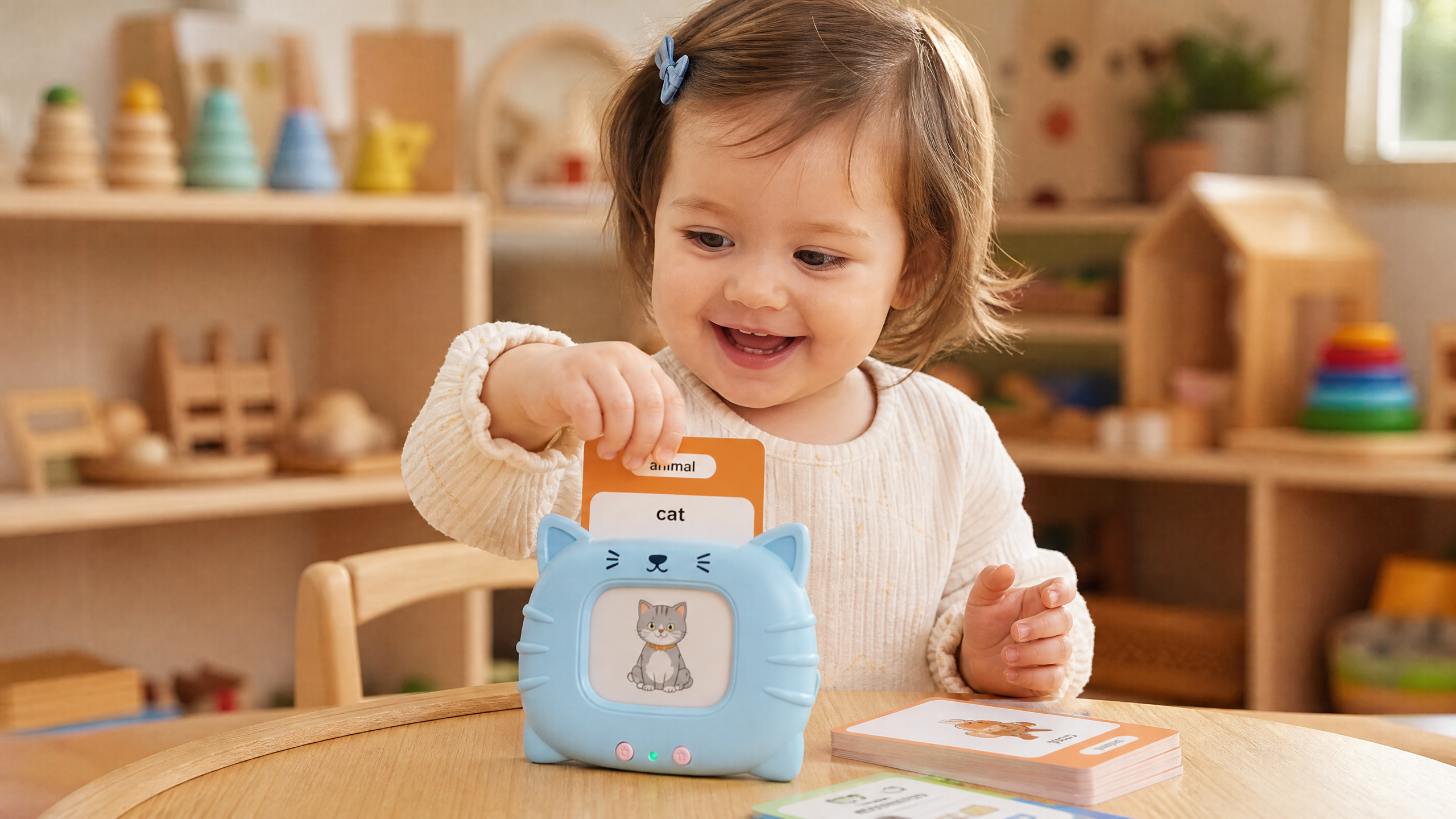
For global toy distributors, educational brands, and retailers importing educational flashcard readers (talking flash cards), product safety and regulatory compliance are non-negotiable [1]. Regulatory bodies across North America, Europe, and Asia-Pacific enforce stringent chemical, physical, and electronic safety standards [2]. Non-compliant shipments face border seizures, heavy fines, and brand-damaging product recalls [3].
Understanding and verifying these standards during the manufacturing phase is critical [4]. This compliance guide details the essential regulatory frameworks, testing protocols, and certification checklists required for importing educational flashcard readers into major global markets [5].
What Are the Chemical Safety and Material Non-Toxicity Requirements?
Children frequently place educational toys in their mouths. Therefore, the outer plastic casing, buttons, and printed cards must be entirely non-toxic and free from hazardous chemicals [6].
1. Phthalates and Heavy Metals (US & EU)
Under the US Consumer Product Safety Improvement Act (CPSIA) and the EU Toy Safety Directive 2009/48/EC (EN 71-3), toys must not contain heavy metals (such as lead, cadmium, mercury, and chromium) or phthalate plasticizers exceeding 100 ppm (parts per million) [7] [8].
* Action Item: Ensure your manufacturer uses 100% virgin ABS plastic rather than recycled plastics, which are often contaminated with trace heavy metals from industrial waste [9].
2. Bisphenol A (BPA) Compliance
BPA is a synthetic compound widely used in plastics that can disrupt endocrine function. While originally restricted in baby bottles, global standards now strictly limit BPA migration in any toy intended for children under 3 years old [10].
* Action Item: Demand a certified BPA-Free test report from an accredited laboratory (e.g., SGS, TÜV Rheinland, or Intertek) for the plastic resin used in production [11].
What Physical and Mechanical Safety Standards Apply?
Flashcard readers are subject to rigorous mechanical stress tests to ensure they do not break into sharp fragments or present choking hazards [12].
1. Small Parts and Choking Hazards (ASTM F963 & EN 71-1)
Under ASTM F963 (US) and EN 71-1 (EU), toys intended for children under 36 months must not have small parts that fit entirely inside a standard “small parts cylinder” (31.7mm diameter) [13] [14].
* Impact on Design: The device itself must be large enough to prevent swallowing. More importantly, any buttons, silicone ears, or card-slot components must be securely attached. Manufacturers must perform a tension test (applying up to 90 Newtons of force) to ensure no small components detach during play [15].
2. Drop and Impact Durability
To simulate real-world nursery environments, the reader must undergo drop testing. In the laboratory, the device is dropped from 1.5 meters onto a steel plate covered with concrete [16]. The device passes if it remains fully functional and does not shatter into sharp, jagged edges that could cut a child [17].
What Battery and Electrical Safety Certifications Are Mandatory?
Because talking flashcard machines contain rechargeable lithium-polymer (Li-Po) batteries and electronic circuits, they must comply with global battery safety and electromagnetic compatibility (EMC) standards [18].
| Market | Battery Safety Standard | Electromagnetic Compatibility (EMC) | Key Testing Focus |
|---|---|---|---|
| United States | UL 1642 (Cell) & UL 2054 (Pack) [19] | FCC Part 15 Class B [20] | Verifies the battery won’t catch fire under short-circuit conditions, and the circuit doesn’t emit harmful radio interference. |
| European Union | EN 62133 (Battery Safety) [21] | CE-EMC Directive 2014/30/EU | Focuses on battery chemical stability and ensures the device can withstand electrostatic discharges (ESD) without malfunctioning. |
| Global Sourcing | UN38.3 & MSDS (Material Safety Data Sheet) | IEC 62133 | Mandatory certifications required by all air and sea freight carriers to authorize international shipping of lithium batteries. |
The Critical Role of the Protection Circuit Module (PCM)
To prevent battery swelling, thermal runaway, or short circuits, premium flashcard readers must incorporate a dual-IC Protection Circuit Module (PCM) on the battery PCB [22]. Cheap manufacturers often cut costs by omitting the PCM or using a single-IC board, which drastically increases the risk of battery failure and fires during recharging.
What Acoustic Safety Limits Must Be Maintained?
Language learning devices must be loud enough for clear pronunciation, but not so loud that they damage a child’s sensitive eardrums [23].
Under EN 71-1 (Clause 4.20), hand-held toys and toys placed close to the ear must comply with strict decibel limits:
* Continuous Sound Limit: Must not exceed 85 decibels (dB) at a distance of 50cm [24].
* Peak Sound Limit: Must not exceed 110 decibels (dB) to prevent sudden acoustic shocks [25].
* Action Item: Ensure the device features an integrated volume control button, and the default start-up volume is calibrated below the maximum safety threshold [26].
Build Your Compliant Product Line with Toyvao
At Toyvao, we design and manufacture early educational hardware with compliance at the core of our engineering [27]. Our factory in Shenzhen is ISO 9001 certified, and our products carry full CE, FCC, RoHS, ASTM F963, and EN71 test reports from internationally accredited laboratories [28]. We use 100% virgin ABS, food-grade soy ink for card printing, and include premium dual-IC battery protection as standard [29].
Partner with a manufacturer that guarantees border clearance and product safety. Contact our compliance and wholesale team today:
- Unified WhatsApp: https://wa.me/8618681064480 (Or add +86 186 8106 4480)
- B2B Sales Inquiry: sales@toyvao.com
- Compliance & Engineering Support: engineering@toyvao.com
References
- US Consumer Product Safety Commission (CPSC) – Toy Safety Business Guide
- European Commission – Toy Safety in the EU
- American Society for Testing and Materials – ASTM F963 Standard
- Federal Communications Commission (FCC) – Equipment Authorization
- International Electrotechnical Commission (IEC) – Battery Standards
- SGS Group – Toy Safety and Compliance Testing Services
