
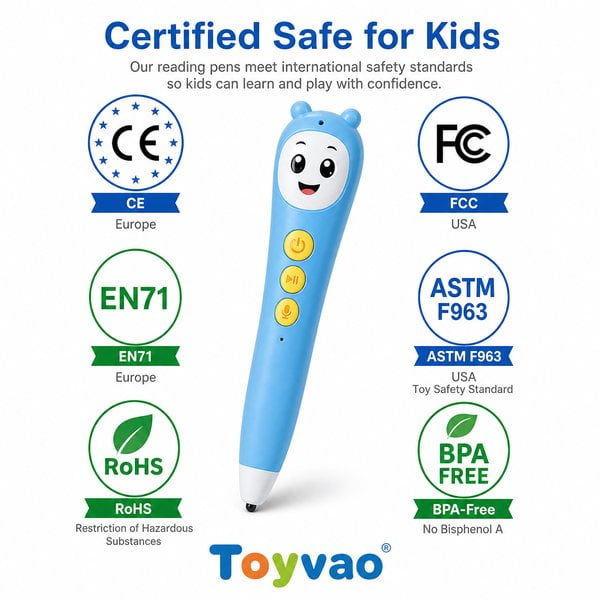
As an innovative learning tool, children’s reading pens are favored by parents and educational institutions worldwide. Through interactive learning, they help children improve reading ability and language skills. However, because they are targeted directly at children, the safety of reading pens is of paramount importance. To ensure product quality and children’s health, manufacturers must comply with stringent international toy safety certification standards. This article provides a detailed overview of the toy safety certifications a reading pen should have in the major global markets (United States, European Union, United Kingdom, and China).
Overview of Major International Market Safety Certifications
1. United States: ASTM F963 and CPSIA
In the United States, children’s reading pens must comply with regulations from the U.S. Consumer Product Safety Commission (CPSC), the most important of which are the Consumer Product Safety Improvement Act (CPSIA) and the mandatory toy safety standard ASTM F963. ASTM F963 covers a wide range of toy safety requirements, including:
- Mechanical and physical performance: preventing small parts from detaching and causing choking hazards, avoiding sharp edges and protrusions that could cause injury, and ensuring structural stability.
- Chemical safety: restricting levels of harmful substances such as lead and phthalates to ensure materials are non-toxic.
- Flammability: requirements for the flame resistance of certain materials.
- Electrical safety: for electronic toys such as reading pens, compliance with the electrical safety requirements of 16 C.F.R. Part 1505 is required to prevent risks like electric shock and overheating.
- Labeling requirements: clear indication of age recommendations, warning information, and manufacturer details.
In addition, manufacturers must have testing performed by CPSC-accepted third-party laboratories and issue a Children’s Product Certificate (CPC) to demonstrate conformity with all applicable regulations.
2. European Union: Toy Safety Regulation (EU) 2025/2509 and the EN 71 Series
The EU’s toy safety standards are among the strictest globally. The EU has issued the new Toy Safety Regulation (EU) 2025/2509, which replaces the previous Directive 2009/48/EC and establishes a transition period until August 1, 2030. All toys sold on the EU market must bear the CE mark and be accompanied by an EU Declaration of Conformity.
Core standards include:
- The EN 71 series: a comprehensive set of toy safety standards covering:
* EN 71-1: mechanical and physical properties, including small parts, sharp edges, cord length, folding mechanisms, etc.
* EN 71-2: flammability, ensuring toy materials are not easily combustible.
* EN 71-3: migration of certain elements, limiting the migration of heavy metals such as lead, cadmium, mercury and certain organic compounds — critical for the plastic housings and inks of reading pens.
- EN IEC 62115: a safety standard specifically for electrically operated toys, applicable to reading pens with electrical components to ensure electrical safety and to prevent risks such as electric shock, overheating, and battery hazards.
- Chemical safety: the new regulation expands the list of prohibited and restricted substances, including endocrine disruptors, skin sensitizers, respiratory sensitizers, PFAS and certain bisphenols.
- Digital Product Passport (DPP): in the future, all toys sold in the EU will be required to carry a digital product passport providing safety and compliance information via data carriers such as QR codes.
- Connected toys: reading pens with connectivity features must undergo assessment of cybersecurity and data privacy risks.
3. United Kingdom: Toys (Safety) Regulations 2011 and UKCA Mark
After Brexit, the UK’s toy safety regime is primarily governed by the Toys (Safety) Regulations 2011, which retain much of the content of the EU toy safety directive. Toys sold in Great Britain must bear the UKCA mark, though CE markings may still be accepted during transition periods. Northern Ireland continues to follow the EU CE marking requirements.
Although the Product Regulation and Metrology Act 2025 (PRAM) lays groundwork for future product safety legislation, toy manufacturers must currently ensure compliance with existing regulations and monitor potential future regulatory divergences.
4. China: GB 6675 and CCC Certification
In China, toys must comply with the mandatory national standards of the GB 6675 series (parts 1–4) and obtain China Compulsory Certification (CCC) for products within the scope. The GB 6675 series covers:
- GB 6675.1: general safety requirements for toys.
- GB 6675.2: mechanical and physical properties.
- GB 6675.3: flammability.
- GB 6675.4: migration of certain elements.
As an electronic toy, reading pens must also meet applicable national electrical safety standards. CCC certification is a mandatory market access requirement in China, ensuring products meet national safety and quality standards throughout design, production, and sale.
Safety Considerations Specific to Reading Pens
Beyond the general toy safety standards above, reading pens as electronic products require special attention to the following aspects:
- Electrical safety: safety of batteries (especially button cells), quality of charging ports and cables, design to prevent short circuits and overheating. Battery compartments should be child-resistant and carry clear warning labels.
- Chemical substances: housing materials, internal circuit boards, and inks (if touchable inks or coatings are involved) must comply with hazardous substance limits, particularly heavy metals and phthalates.
- Small parts and choking hazards: caps, buttons, or other detachable parts must be large enough to avoid ingestion and choking. This is especially critical for products intended for children under three years old.
- Acoustic safety: if the reading pen emits sound, volume levels must be controlled to safe ranges to avoid hearing damage.
- Data privacy and cybersecurity: reading pens with connectivity or data storage features must protect user data — especially children’s data — and comply with relevant regulations such as GDPR (EU) or COPPA (US).
- Durability: the product should withstand routine drops and impacts typical of children’s use without breaking into hazardous components.
Importance for Manufacturers and Consumers
For manufacturers, obtaining these safety certifications is not only a passport to international markets but also a demonstration of corporate social responsibility. Strict compliance with safety standards helps to:
- Reduce risk: minimize the likelihood of product recalls, fines, and legal actions.
- Build brand reputation: demonstrate product safety and reliability to consumers, strengthening brand trust.
- Expand market share: meeting international standards facilitates global distribution.
For consumers, choosing reading pens that have passed rigorous safety certifications means providing a safer, more reassuring learning environment for children and effectively avoiding potential health and safety hazards.
Conclusion
Toy safety certification for children’s reading pens is a complex but critical aspect. Manufacturers must thoroughly understand the specific regulations and standards of their target markets, and integrate safety requirements across product design, material selection, manufacturing processes, testing, and labeling. Only by doing so can reading pens deliver educational benefits while maximizing protection for children’s health and safety, and earn recognition and trust in the global market.
