
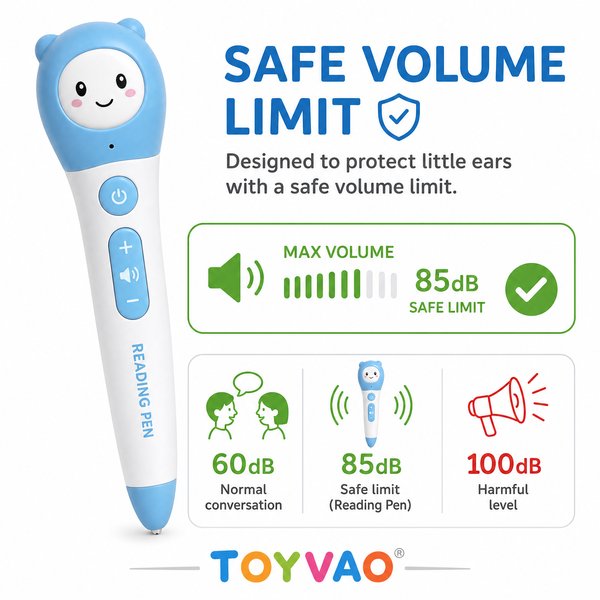
With advances in technology, reading pens have become a popular tool for children’s learning. However, many parents may wonder: do reading pens have a safe volume limit? How can parents ensure their child’s hearing is not harmed while using a reading pen? This article will examine the volume safety issues of reading pens in depth and provide related recommendations.
Vulnerability of Children’s Hearing Health
Children’s auditory systems are still developing and are far less tolerant of noise than adults. Prolonged exposure to high-decibel sounds—even those emitted by seemingly harmless toys—can cause permanent damage to a child’s hearing. Therefore, when selecting any sound-emitting product for children, including reading pens, the safety of its volume is critical.
International and Domestic Safe Volume Standards
There are corresponding international and domestic standards and recommendations regarding volume limits for children’s toys:
- General recommendation: Many audiology experts and organizations recommend that sounds to which children are exposed for extended periods should not exceed 85 decibels (dB). Exposure above this level, even for short durations, can cause hearing damage. For example, continuous exposure at 85 dB for eight hours may lead to hearing impairment, while sounds at 100 dB can cause harm within just a few minutes.
- China’s national standard: According to China’s new national standard for children’s toys, the volume limit for sound-emitting toys is typically 65 decibels. This standard aims to provide greater protection for children’s hearing.
- Other references: Studies indicate that sounds below 40 decibels have no adverse effects on children, while noise levels exceeding 70 decibels may potentially damage a child’s auditory system.
It is worth noting that some electronic devices, such as smartphones and tablets, can reach 100 to 112 decibels at maximum volume, far exceeding safe ranges for children’s hearing; therefore special attention to volume control is required when using these devices.
Volume Safety Design of Reading Pens
Reputable reading pen manufacturers typically take children’s hearing protection into account and incorporate volume safety mechanisms into product designs:
- Volume limiting module: Many reading pens have built-in volume limiting modules to ensure their maximum volume does not exceed safe ranges for children’s hearing. This means that no matter how the child adjusts the volume, it cannot reach harmful levels.
- Low default power-on volume: Some reading pens default to a lower volume when powered on to avoid sudden high-decibel sound that could startle or harm a child’s ears.
- Stepped volume control and safe-volume settings: Some products offer stepped volume controls and allow parents to set a “safe volume” to ensure children cannot accidentally increase the volume during regular use.
- Headphone safety: If a reading pen supports headphones, it is recommended to use child-specific headphones with built-in volume limits; such headphones typically cap maximum volume at safe levels such as 75/85/94 decibels.
How Can Parents Ensure Safe Use of Reading Pens?
In addition to choosing reading pens that meet safety standards, parents should take measures in daily use to protect their children’s hearing:
- Choose reputable brands: Purchase reading pens with clear volume safety markings that comply with national or international safety standards.
- Check product documentation: Read the product manual carefully to understand the reading pen’s volume range and safety settings.
- Regularly check the volume: Even if the reading pen has volume limits, periodically check that the volume is appropriate during use and avoid prolonged use at high volumes.
- Limit usage time: Even at safe volume levels, prolonged use of reading pens can cause auditory fatigue. It is advisable to limit usage time so children’s ears can rest.
- Use the proper environment: Using the reading pen in a quiet environment prevents children from raising the volume to hear content more clearly.
Conclusion
As a children’s learning tool, the volume safety of reading pens is an issue parents should not overlook. By selecting products with built-in safe-volume designs and combining them with proper guidance and usage habits, parents can effectively protect children’s hearing—allowing them to enjoy learning while preserving a healthy auditory future.
