
BLUF (Bottom-Line-Up-Front)
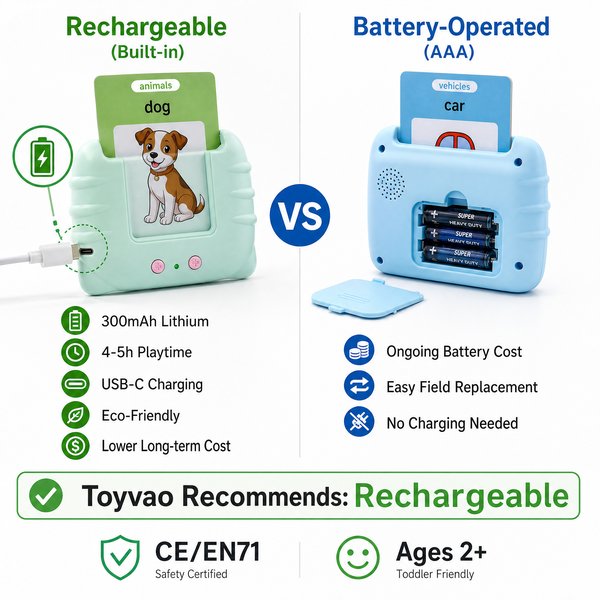
The core difference is operational convenience and total cost of ownership: rechargeable flash card machines use a built-in lithium battery (typical Toyvao spec: 300mAh, 4–5 hours continuous play, USB charging) and deliver better customer experience, lower ongoing costs and higher perceived value for e-commerce, while battery-operated models use replaceable AAA cells—cheaper to make and easier to service but higher lifetime cost, more waste, and lower perceived quality.
When it’s worth caring about / When you don’t need to overthink it
1) When battery type matters: daily classroom use vs occasional home use
- When it’s worth caring about: If you sell to preschools, daycare centers, or high-usage households where the device runs several hours per day, choose rechargeable (300mAh, 4–5 hours) for predictable runtime and easy USB charging.
- When you don’t need to overthink it: For low-frequency gift purchases or parties where the device will be used briefly, AAA battery models are acceptable and lower upfront cost.
2) When safety, shipping and compliance matter
- When it’s worth caring about: If you ship globally (Amazon FBA, cross-border ecommerce) check lithium battery shipping rules and certifications (CE/EN71, RoHS recommended). A built-in rechargeable battery is better packaged and reduces loose-battery hazards if the design complies with regulations.
- When you don’t need to overthink it: Local retail channels where customers can easily buy replacement AAA cells and returns are in-person.
3) When buyer perception and e-commerce conversion matter
- When it’s worth caring about: For Amazon/Shopify listings where perceived value and unboxing matter, rechargeable machines convert better because they arrive ready-to-use and feel premium. They’re lightweight, easy to bundle (extra cards), and have higher AOV potential.
- When you don’t need to overthink it: Bulk institutional sales where price-per-unit dominates and buyers expect to handle power supply themselves.
4) When ESL/audio quality matters
- When it’s worth caring about: For ESL and bilingual products, prioritize native-speaker recorded audio (not robotic TTS). Whether rechargeable or battery-operated, audio quality and human recordings determine educational effectiveness.
- When you don’t need to overthink it: If cards are novelty toys (sounds or animal noises) rather than language learning, battery type is less critical.
5) When durability and child-safety matter
- When it’s worth caring about: For younger age groups (2–5 years) pick robust materials: drop-resistant ABS plastic for the unit and thick cards (300g+ copperplate paper) to withstand handling. Built-in batteries avoid loose battery compartments which can be a safety risk.
- When you don’t need to overthink it: Older kids and low-wear environments where device is rarely dropped.
Side-by-side comparison
| Attribute | Rechargeable (built-in Li‑ion) | Battery-operated (replaceable AAA) |
|---|---|---|
| Power source | Built-in rechargeable lithium battery (typical: 300mAh) | 3× AAA or similar (user-replaceable) |
| Typical playtime | 4–5 hours continuous (per full charge) | Depends on battery quality; fresh alkalines 6–12 hours |
| Charging/Refueling | USB charging — easy, no consumables | Replace batteries — ongoing consumables |
| Upfront cost | Moderate — slightly higher BOM cost, higher perceived value | Lower — cheaper BOM, lower perceived value |
| Lifetime operating cost | Lower — no repeat battery purchases | Higher — recurring battery purchases |
| Shipping / compliance | Requires lithium battery handling rules; usually OK with proper labeling and documentation | Simpler shipping; no lithium battery paperwork |
| Safety | Safer (no loose battery doors) if designed to standard | Risk of child access to batteries if compartment not secured |
| Ideal channels | Amazon/Shopify premium listings, branded retail, educational catalogs | Value retail, discount channels, mass-market toys |
| Best for | High-usage classrooms, frequent learners, ESL learners needing ready-to-play units | Low-use gifting, price-sensitive institutional orders |
Practical trade-offs retailers and procurement teams care about
- Return rates and first-impression: Rechargeable units lower negative reviews about “no batteries included” and improve first‑use satisfaction.
- SKU bundling: Rechargeable machines are easier to sell as one SKU with card packs or curriculum bundles; battery models often need “batteries not included” messaging which can reduce conversion.
- Warranty & after-sales: Factory support (Toyvao offers a 1-year factory warranty and responsive after-sales) mitigates concerns for rechargeable models related to battery life.
- Environmental/sustainability: Rechargeable reduces single-use battery waste—useful for schools and eco-conscious buyers.
Customer Feedback Synthesis (B2B buyer style)
- “Our preschool buyers loved that the unit arrives charged — deployment was immediate. Rechargeable is a selling point on Amazon.” — Regional distributor
- “The thick 300g cards and ABS housing held up to daily classroom use. We had far fewer returns than our old AAA model.” — Educational supplier
- “Rechargeable model increased AOV after we bundled extra card packs — customers perceived better value.” — Shopify store owner
- “Concern: cross-border shipping required a bit more paperwork because of the lithium cell — manageable but needs planning.” — International procurement manager
- “Some clients worry about long-term battery degradation; we mitigate this with a clear warranty and replacement policy.” — School district purchasing officer
- “For ultra-low-cost giveaways we sometimes still choose AAA units — cheaper per unit for promotional bundles.” — Promotional products buyer
Checklist for buying teams
- Confirm battery spec: built-in Li‑ion ~300mAh with 4–5 hours runtime if you want ready-to-play units.
- Ask for native-speaker recorded audio files if selling to ESL markets — recordings beat TTS for language acquisition.
- Verify material specs: drop-resistant ABS housing and card stock of 300g+ copperplate for longevity.
- Get compliance documentation: CE, EN71, RoHS where applicable, and lithium battery shipping docs for rechargeables.
- Negotiate bundling: extra card packs increase AOV and make rechargeable units more attractive online.
FAQ
- Q: How long does the rechargeable battery last and can it be replaced?
- A: Typical Toyvao rechargeable units use a 300mAh lithium battery delivering about 4–5 hours continuous play per charge. Built-in batteries are usually not user-replaceable on low-cost devices; plan warranty/replacement policy accordingly. Toyvao provides a 1-year factory warranty and after-sales support.
- Q: Are there shipping or regulatory issues with rechargeable models?
- A: Yes — devices with built-in lithium batteries require proper labeling and documentation for air transport (IATA/ICAO rules). Work with your supplier to obtain the required test reports and shipping declarations. AAA battery models typically avoid those specific lithium regulations.
- Q: For ESL markets, is audio quality tied to battery choice?
- A: Audio quality depends on recordings and speaker hardware, not battery type. However, rechargeable units arriving charged improve first-use experience for language learners. Always request native-speaker recorded audio (not robotic TTS) and sample clips before bulk purchase.
- Q: Which SKU is better for Amazon/Shopify—rechargeable or battery-operated?
- A: Rechargeable is generally better for direct-to-consumer channels: higher perceived value, ready-to-use, fewer first-day complaints, and easier to upsell with card bundles. Battery-operated SKUs can still work well in price-sensitive categories or bulk B2B promo orders.
Bottom-line recommendation
For most B2B channels targeting preschools, parents, and ecommerce shoppers, rechargeable flash card machines with a 300mAh lithium battery (4–5 hours playtime), thick cards (300g+), and native-speaker audio provide the best balance of user experience, lower lifetime cost, and higher conversion. Reserve battery-operated models for ultra-price-sensitive or one-off promotional use.
Contact Toyvao (factory-direct solution)
If you want factory-direct pricing, sample units, or compliance docs, contact Toyvao for the Talking Flash Card Machine. Toyvao offers a 1-year factory warranty and responsive after-sales support. WhatsApp: +86 186 8106 4480. Email: sales@toyvao.com. Website: https://toyvao.com
