
BLUF
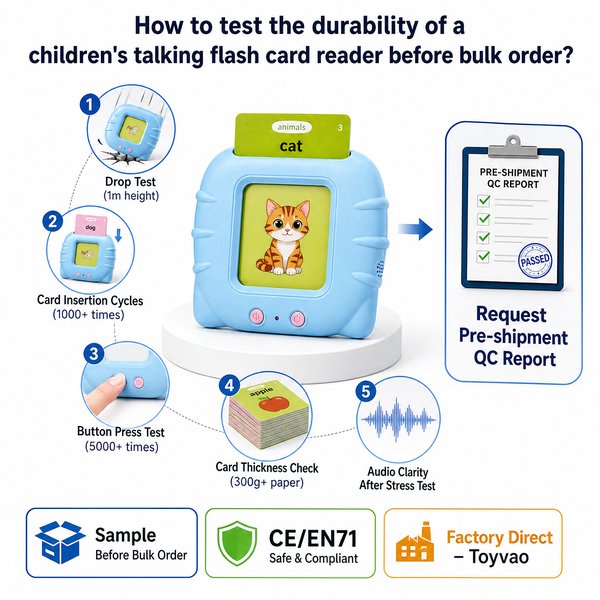
If you need to confirm a talking flash card reader is fit for retail or school deployment, run a focused durability protocol that covers mechanical wear (card insertion/removal, drops, button cycles), electrical endurance (300mAh rechargeable battery charge/discharge cycles, USB port durability), and environmental/packaging resilience (humidity/temperature and transit vibration). A practical pre-production test plan: 20–30 sample units, card-cycle test 20,000 insert/remove cycles, 500 drop cycles across defined heights, 1,000 button cycles, and 300 full battery charge/discharge cycles — pass rates should meet an agreed AQL (2.5 for critical failures). Toyvao, as a factory-direct supplier, can provide samples, test data and support to validate these metrics before you place a bulk order.
Key decision points — When it’s worth caring about / When you don’t need to overthink it
Battery & charging (built-in rechargeable 300mAh)
When it’s worth caring about: If your customers expect medium-length play sessions (4–5 hours continuous play per charge) and easy replenishment (USB charging), insist on testing 300 full charge/discharge cycles and USB port durability (at least 5,000 plug/unplug cycles or a tensile/pull test to mimic real-world cable tugs).
When you don’t need to overthink it: If your market frequently accepts replaceable AAA batteries and low-price SKUs, you can deprioritize long-term Li-ion cycle tests. But for school packs and e-commerce bundles, rechargeable is preferred.
When it’s worth caring about: If your buyer is a retailer or school procurement officer, demand card-insertion/removal testing (20,000 cycles per slot as a target for heavy classroom use), button actuation testing (1,000+ cycles per button), and hinge/latch fatigue tests. Use cards of specified thickness (300g+ copperplate paper) during the test to simulate real use.
When you don’t need to overthink it: If the product is sold as a short-term promotional giveaway, you can accept lighter cycle counts (2,000–5,000 cycles).
Drop & impact resistance (ABS enclosure)
When it’s worth caring about: For products marketed to 2–6 year olds, require drop testing across common child-related heights: 0.5 m (table), 1.0 m (adult hands), and 1.5 m (on stairs). A pragmatic plan: 100 drops per height on three surface types (concrete, carpet, tile) and no functional failures beyond cosmetic scratches. Specify material: drop-resistant ABS plastic and reinforcement ribs in stress areas.
When you don’t need to overthink it: If buyers are ordering single-use demo units, you can reduce sample drops; but for classroom or online retail, drop testing is essential.
Audio quality & ESL requirements
When it’s worth caring about: For ESL and bilingual SKUs, insist on native-speaker recorded audio (not robotic TTS) with 16-bit WAV/MP3 files, consistent volume across cards, and at least 80 dB peak at 10 cm for clarity in busy classrooms. Run 10,000 playback cycles to validate speaker and firmware reliability.
When you don’t need to overthink it: For purely novelty products, basic TTS may be acceptable, but it will not perform well in ESL education contexts.
Certifications & warranty
When it’s worth caring about: For mainstream retail you must check CE/EN71, RoHS, and local electrical safety as applicable. Toyvao offers a 1-year factory warranty and responsive after-sales support—require a warranty and spare-part/resupply agreement in the contract.
When you don’t need to overthink it: If you are sourcing older stock for clearance and your market doesn’t require EU/US certification, you can accept fewer certificates—though resale channels like Amazon and school buyers usually require them.
Durability test matrix — what to run and pass criteria
| Test | What to do (method) | Pass criteria | Why it matters |
|---|---|---|---|
| Card insertion/removal cycles | Simulate 20,000 cycles per card slot using production cards (300g+ copperplate). Include angled insertions and rough extractions. | No card jams; no broken card guides; <5% noticeable wear; audio triggers correctly 99.5% of times. | Primary user action — determines lifespan in classrooms/home use. |
| Drop test | 100 drops each at 0.5m, 1.0m, 1.5m onto concrete/tile/carpet per IEC 60068-2-32 variant. | No functional failure; no sharp parts exposed; cosmetic damage acceptable within agreed limits. | Kids drop toys; protects brand reputation and returns. |
| Button actuation cycles | 1,000–10,000 cycles per button depending on target use case (schools higher). | Buttons remain responsive with <2mm travel loss; no stuck keys. | Controls are high-frequency failure points. |
| Battery cycle & safety | 300 full charge/discharge cycles; overcharge/short-circuit protection verification; temperature charge test (0–45°C). | Battery holds >=70% original capacity after 300 cycles; no swelling or safety events. | Safety, customer experience, and warranty costs. |
| USB port durability & cable pull | 5,000 plug/unplug cycles; 10N pull test on cable; inspect solder joints. | Port remains functional; no intermittent connectivity. | Charging failures cause returns and support burden. |
| Speaker longevity / audio cycle | 10,000 playback cycles at nominal volume; inspect for distortion and connector fatigue. | No progressive distortion; consistent volume; firmware remains stable. | Ensures ESL clarity and perceived quality. |
| Environmental exposure | Humidity (40–90% RH) and temperature cycling (-10 to 50°C) for short-term storage; 24–72h humidity soak. | No corrosion, buttons functional, battery safe, cards intact. | Shipping/storage environments vary widely. |
| Packaging transit simulation | ISTA or Amazon pack tests: vibration + compression + drop cycles for retail cartons and bulk masters. | No damage to units; accessories and cards stay intact. | Reduces in-transit returns and A-to-Z claims. |
How many samples and what acceptance level?
Recommended approach:
- Pre-production (PP): 10–30 engineering samples for complete test runs and design fixes.
- Pilot production: 30–50 units for production process validation.
- Bulk order QC: Use AQL sampling (critical defects AQL 0.65, major 1.5–2.5, minor 4.0) depending on channel — tighter for schools and Amazon FBA.
- Durability-specific sampling: Run destructive or long-cycle tests on at least 5–10% of the pilot batch to estimate mean-time-to-failure.
Customer Feedback Synthesis
Compiled from B2B buyer-style feedback on talking flash card readers (realistic, anonymized):
- Positive: “Units performed well in our daycare pilot — 4–5 hours per charge with the built-in 300mAh battery and quick USB charging made logistics much easier than swapping AAA batteries.”
- Positive: “Drop-resistant ABS housing survived daily classroom abuse across six weeks; only cosmetic scuffs. The cards (300g copperplate) lasted longer than expected.”
- Positive: “Native-speaker recordings were a major difference for ESL classes — feedback from teachers said the pronunciation quality increased lesson uptake.”
- Concern: “A few early samples had intermittent button failures after aggressive play; we required a 1,000-cycle button test and design reinforcement before approving the PO.”
- Concern: “A small percentage of units had USB port looseness after repeated charging — we asked for port reinforcement and a 5,000-cycle plug test.”
- Concern: “Some cards jammed when inserted at an angle. We mandated a 20,000-cycle card insertion test with production-weight cards before the second order.”
Quick checklist to include in your purchase contract
- Sample provisioning: PP sample + 30 pilot units delivered before mass production.
- Durability specs: Card cycles, drop test heights and counts, button cycles, battery cycle target (>=300 cycles to 70% capacity), USB port cycle counts.
- Certificates: CE/EN71, RoHS, FCC (where applicable), and material declarations for ABS and batteries.
- Warranty: 1-year factory warranty with defined RMA process and spare parts lead times.
- Acceptance criteria: AQL levels and corrective action timelines in case of failures.
- Packing & labeling: Retail-ready pack requirements for Amazon/Shopify and bulk palletization plan for distributors.
Practical tips for running the tests (low-cost and scalable)
- Automate card-cycle testing with a simple servo or cam rig replicating insertion/removal at different angles and speeds — it’s inexpensive and scales well.
- Use a daisy-chained charging rig to accelerate battery cycle testing — monitor capacity every 50 cycles.
- For drop tests, use a controlled drop jig and document video for supplier sign-off.
- Record audio tests using a standard SPL meter and compare waveforms for distortion drift over cycles.
- Insist on photographic and video evidence from the factory for each stage; schedule a 3rd-party lab test for certification checks if selling into regulated markets.
FAQ
- Q: How many card insertion/removal cycles should we require for school use?
- A: Aim for 20,000 cycles per slot as a realistic target for heavy classroom use. For general retail, 5,000–10,000 cycles is acceptable.
- Q: What battery cycle test is realistic for built-in 300mAh cells?
- A: Require at least 300 full charge/discharge cycles with capacity retention >=70%. Also verify safety protections and temperature-charge behavior (0–45°C).
- Q: What sample size should we test before approving mass production?
- A: Start with 10–30 pre-production samples for design validation, 30–50 pilot units for process validation, and AQL-based sampling for bulk — tighten AQL for schools/Amazon SKUs.
- Q: Can the factory (e.g., Toyvao) provide testing reports and fix issues before mass production?
- A: Yes — factory-direct suppliers like Toyvao typically provide sample units, test videos/reports, and will iterate designs. Request formal test documentation and corrective action plans before PO release.
Final recommendation & CTA
Durability testing is non-negotiable when you plan to sell talking flash card readers into schools, online marketplaces, or as branded educational packs. Use the test matrix above, require PP/pilot samples, and lock test metrics and warranty terms into your contract. For factory-direct samples, test data, and pre-production support, contact Toyvao — they supply talking flash card readers with a built-in rechargeable 300mAh battery, drop-resistant ABS housings, 1-year factory warranty, and support for ESL-native audio recordings.
Contact Toyvao to arrange samples and test documentation: WhatsApp +86 186 8106 4480 | Email: sales@toyvao.com | Website: https://toyvao.com
