
What Certifications Do You Need to Sell Reading Pens in Europe?
Bottom Line Up Front (BLUF)
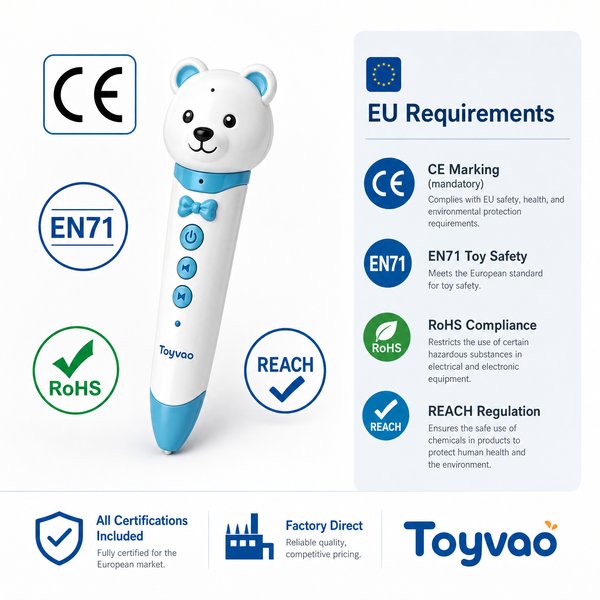
To legally sell a children’s reading pen, like Toyvao’s bear-shaped offline OID reading pen, in the European market, you must ensure your product is fully compliant with the European Union’s stringent safety and environmental regulations. This primarily means obtaining the CE mark under the Toy Safety Directive 2009/48/EC, backed by compliance with the harmonized EN71 series standards (at minimum EN71-1, EN71-2, and EN71-3).
Moreover, compliance with additional directives such as RoHS (Restriction of Hazardous Substances), REACH (Registration, Evaluation, Authorization and Restriction of Chemicals) focusing on SVHCs (Substances of Very High Concern), WEEE (Waste Electrical and Electronic Equipment Directive), and the Battery Directive will be necessary. If you ship your products by air containing lithium batteries, you must also meet UN38.3 testing requirements. Depending on your pen’s electronic features, EMC (Electromagnetic Compatibility) evidence might also be required.
Always maintain a comprehensive technical file and a signed EU Declaration of Conformity as proof of compliance for enforcement authorities and customers.
Key Product Facts About Toyvao’s Children’s OID Reading Pen
- Technology: Offline Optical Identification (OID) technology that functions only with OID-coded books, ensuring screen-free, safe learning.
- Hardware Specifications: Available with 16GB, 32GB, or 64GB storage options, providing 8–12 hours of continuous battery life and 2–3 hours USB-C fast charging.
- Connectivity: Equipped with a 3.5mm headphone jack and volume control, but no Bluetooth or Wi-Fi, enhancing child safety by limiting external connections.
- Customization: Minimum order quantities (MOQ) range from 100–500 pieces. Custom housing, audio content, and packaging options are available directly from Toyvao’s Shenzhen factory.
- Book Printing: Requires CMYK + K printing for invisible OID dots. Audio files must be precisely mapped to dot codes to synchronize reading content.
Essential Certifications and When They Matter
CE Marking & Toy Safety Directive (EN71 Series)
When to prioritize: Always. Any device marketed as a toy for children under 14 must comply with the Toy Safety Directive (2009/48/EC). This includes:
- EN71-1: Mechanical and physical properties — ensures the pen is safe from choking hazards or sharp edges.
- EN71-2: Flammability requirements — guarantees the materials used are flame-resistant.
- EN71-3: Migration of certain elements — limits toxic heavy metals like lead, cadmium, mercury, and arsenic.
Additional parts of EN71 may apply depending on specific features, such as EN71-9 for organic chemical compounds.
RoHS Compliance
Ensures restriction on hazardous substances such as lead, mercury, and cadmium in electrical and electronic equipment. For reading pens containing batteries and circuitry, RoHS compliance is mandatory.
REACH & SVHC Awareness
Manufacturers must be aware of and disclose any Substances of Very High Concern (SVHCs) present above threshold levels in their products. This is crucial for transparency and consumer safety.
WEEE & Battery Directive
These directives regulate the labeling and end-of-life disposal of electronic toys and batteries. You must provide proper recycling information and comply with eco-design requirements.
EMC Testing
If your reading pen includes electronic components that could emit electromagnetic interference, Electromagnetic Compatibility (EMC) testing is necessary to ensure the device does not disrupt other electronics.
UN38.3 Lithium Battery Testing
For air transport of lithium-ion batteries used in reading pens, UN38.3 certification ensures safety during shipping.
Comparison Table: Key Certifications for Children’s Reading Pens in Europe
| Certification/Directive | Purpose | Applicable Products | Mandatory/Optional | Typical Testing Requirements |
|---|---|---|---|---|
| CE Mark (Toy Safety Directive 2009/48/EC) | Ensures toy safety including mechanical, chemical, and physical risks | All toys and children’s reading pens under 14 years | Mandatory | EN71 series testing (EN71-1, EN71-2, EN71-3) |
| RoHS Directive | Restricts hazardous substances in electronics | Electronic components in reading pens | Mandatory | Material composition analysis |
| REACH SVHC | Monitors presence of Substances of Very High Concern | All materials used in the pen and packaging | Mandatory (disclosure) | Material safety data sheets and compliance checks |
| WEEE & Battery Directive | Manages disposal and recycling of electronics and batteries | Electronic toys with batteries | Mandatory | Proper labeling and recycling info |
| EMC Directive | Ensures electromagnetic compatibility | Devices with electronic circuits emitting signals | Conditional | EMC interference testing |
| UN38.3 | Certifies lithium battery safety for air transport | Battery-powered reading pens shipped by air | Mandatory (if air shipment) | Battery transport safety tests |
Why Compliance Matters: Market Trends and Consumer Trust
According to Grand View Research, the global educational toy market is expected to reach $34.5 billion by 2028 with a CAGR of 7.5% from 2021 to 2028. Europe represents a significant portion of this market, driven by increasing parental demand for safe, educational, and screen-free toys like reading pens and flash card machines.
Furthermore, the European Commission enforces strict toy safety laws to protect children, meaning non-compliant products risk recalls, fines, or bans, harming brand reputation.
Practical Tips for Manufacturers and Importers
- Start Compliance Early: Integrate product testing during your R&D phase to avoid costly redesigns.
- Maintain Detailed Technical Files:
