
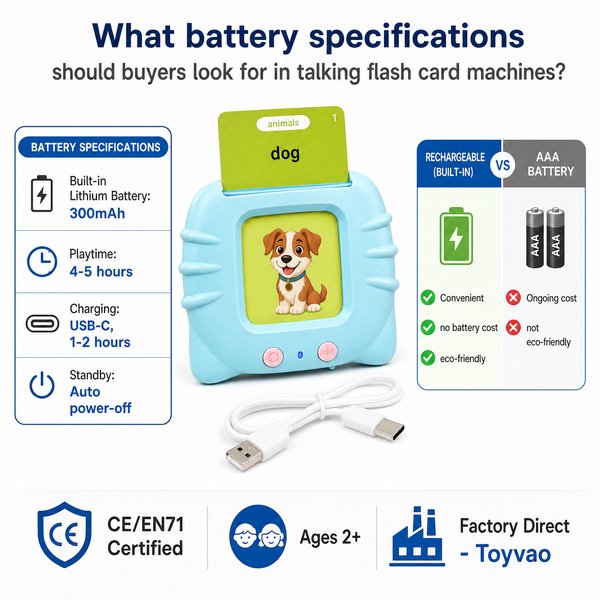
BLUF — What battery specs matter for talking flash card machines?
Bottom line: choose a built-in rechargeable lithium battery around 250–400mAh (Toyvao uses a typical 300mAh cell) with USB charging, 4–5 hours continuous play, short recharge time (<2.5 hours), and the right safety certifications (CE/EN71 and RoHS). That specification gives the best balance of classroom/demo usability, shipping/logistics advantages, and long-term customer satisfaction versus older AAA or user-replaceable designs.
Why this matters for B2B buyers
- Rechargeable 300mAh class batteries deliver 4–5 hours of continuous play — enough for multiple demo sessions, small classroom rotations, or extended retail display time without frequent recharging.
- Built-in rechargeable batteries simplify packaging and reduce shipping weight and returns (no loose cells, no customer confusion about batteries), increasing e-commerce conversion on Amazon/Shopify and lowering fulfillment costs.
- Safety and certification (CE/EN71, RoHS) are critical for procurement and for fast customs clearance in many markets.
Decision checklist — When it’s worth caring about / When you don’t need to overthink it
Battery type: built-in rechargeable lithium vs replaceable AAA
When it’s worth caring about: You sell on Amazon/Shopify, need low shipping weight, want fewer returns, or target parents who prefer screen-free, plug-and-play toys. Built-in Lithium (300mAh class) reduces SKUs, avoids loose-battery incidents, and offers consistent audio performance.
When you don’t need to overthink it: You are supplying very low-cost giveaway items where unit cost must be minimal and customers expect to provide their own AAA cells (rare in premium or curated retail).
Capacity & runtime (mAh and hours)
When it’s worth caring about: If you sell into preschools, daycare centers, or demo-heavy retail environments, aim for 4+ hours continuous play; that generally maps to 250–400mAh for small single-speaker devices.
When you don’t need to overthink it: For promotional items or short-play gift-bag inclusions where 1–2 hours usage is acceptable.
Charging method and time
When it’s worth caring about: USB charging (micro-USB or USB-C) with charging time under 2.5 hours is superior for school IT staff and parents; keeps accessories standardized and reduces lost charging cables issues.
When you don’t need to overthink it: If the product is sold strictly as disposable/short-term use or included in product demo bundles where charging can be handled centrally.
Replaceability and repair
When it’s worth caring about: For institutional buyers who expect long lifecycle and repairability, confirm whether the battery is replaceable or the unit is supported under warranty. Toyvao offers a 1-year factory warranty and responsive after-sales support — helpful for education buyers.
When you don’t need to overthink it: Retailers offering low-cost, mass-market units where replacement batteries would be impractical.
Safety certifications and transport
When it’s worth caring about: For cross-border shipments, customs, and school procurement, insist on CE/EN71 and RoHS compliance and proper UN transport declarations for lithium batteries (most small built-in cells fall under exempted categories but verify with supplier documentation).
When you don’t need to overthink it: Selling within a single market that does not require explicit certification documentation (rare for institutional buyers).
Concrete specification summary
- Battery type: Built-in rechargeable lithium polymer or lithium-ion
- Typical capacity: 250–400mAh (Toyvao: ~300mAh)
- Expected playtime: 4–5 hours continuous
- Charging: USB charging (micro-USB or USB-C), charge time <2.5 hours
- Safety: CE/EN71, RoHS; check for MSDS/UN documentation if shipping by air
- Warranty & support: 1-year factory warranty recommended (Toyvao provides this)
Quick comparison: Rechargeable built-in Li vs AAA vs NiMH (practical B2B view)
| Spec / Use case | Built-in Li (300mAh typical) | Replaceable AAA (alkaline) | Internal NiMH (user-replaceable) |
|---|---|---|---|
| Runtime | 4–5 hours | 2–4 hours (varies with brand) | 3–5 hours |
| Charging | USB on-device (fast, convenient) | No; requires external batteries | May need external charger unless device charges cells |
| Logistics / packaging | Lower weight, simpler packaging, no loose batteries | Higher shipping weight, batteries often excluded for air freight | Moderate complexity; some restrictions apply |
| Customer experience | Plug-and-play; consistent performance | Customers must buy/replace cells; variable experience | Good if supported; may confuse end-users |
| Suitability for schools/retail | Best — preferred for demos, displays, and e-commerce | OK for low-cost items only | Acceptable if warranty/replacement policy is clear |
Operational considerations for bulk buyers
- Turnkey readiness: Units with built-in Li and USB charging reduce post-receipt setup for distribution centers or brick-and-mortar stores.
- Replacement policy: Confirm whether spare parts or replacement batteries are available through the manufacturer — Toyvao provides 1-year factory warranty and responsive after-sales support for factory-direct partners.
- Packaging & labeling: Ensure manufacturer provides battery-related labeling (battery type/wh/disposal) to satisfy local regulations and Amazon packaging guidelines.
Customer feedback synthesis (B2B buyer quotes)
- Positive: “The rechargeable units arrived demo-ready — no batteries to install, which cut our shelf prep time by half.”
- Positive: “300mAh battery performance matched the spec — about 4 hours during classroom rotations, excellent for our preschool customers.”
- Positive: “USB charging and CE paperwork made customs clearance and Amazon FBA setup straightforward.”
- Concern: “Some buyers expected replaceable batteries for field repairs — we had to document warranty repair pathways clearly.”
- Concern: “A few units had intermittent charging port fit issues; QA check before bulk shipping is essential.”
- Concern: “For heavy school deployments we’d prefer higher-capacity variants (500mAh+) — check for optional SKU upgrades.”
FAQ
- Q: How long does a 300mAh battery typically last in real-world use?
- A: Expect roughly 4–5 hours of continuous audio playback for a single-speaker talking flash card machine with a 300mAh built-in battery. Actual runtime depends on volume level and audio codec efficiency.
- Q: Are the batteries user-replaceable?
- A: Most modern talking flash card machines with built-in lithium batteries are not user-replaceable to preserve compactness and waterproofing. For institutional buyers, confirm the manufacturer’s service policy — Toyvao offers a 1-year factory warranty and responsive after-sales support for repairs and replacements.
- Q: What charging interface should I require?
- A: USB charging (preferably USB-C where available) is recommended for compatibility with common chargers and power banks. Aim for a full charge time under 2.5 hours for operational convenience.
- Q: What safety certifications matter for procurement?
- A: Request CE and EN71 toy safety compliance and RoHS environmental compliance. For cross-border shipments, ask for MSDS and battery transport guidance — most small built-in lithium cells fall under exempted categories but documentation is required for air freight.
Bottom-line recommendations for buyers
- Default to built-in rechargeable lithium (~300mAh) with USB charging for most retail, e-commerce, and school use-cases.
- Require CE/EN71 and RoHS documentation for procurement files and customs.
- Ask suppliers about optional higher-capacity SKUs if you plan heavy institutional deployment or long unattended demo displays.
- Negotiate a 1-year warranty and clear RMA process — Toyvao offers factory direct support and warranty for buyers.
Ready to evaluate factory-direct samples or ask about custom battery options? Contact Toyvao for specifications, sample orders, and partner pricing — WhatsApp: +86 186 8106 4480, Email: sales@toyvao.com, Website: https://toyvao.com.
