
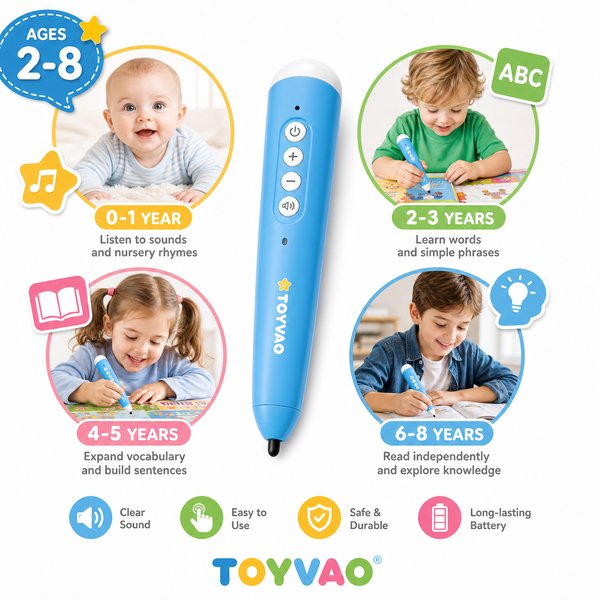
As an innovative educational tool, the reading pen has garnered increasing attention from parents in recent years. By combining audio and visual stimulation, it helps children learn through interactive engagement. However, many parents have questions about the appropriate age for using a reading pen. This article explores the suitability, benefits, and purchasing considerations of reading pens across different age groups to help you make an informed choice for children.
Suitable Age Range for Reading Pens
Reading pens are suitable for a wide age range and are generally recommended for children from 0 to around 12 years old, although usage methods and focal points differ by age group [2].
0–3 years: Language Initiation and Parent‑Child Interaction
For infants and toddlers aged 0–3 years, reading pens primarily serve as tools for language initiation. Even a 6‑month‑old baby can begin to be exposed to a reading pen under parental supervision [1]. At this stage, a reading pen can:
- Open the door to language learning: Through sound-enabled picture books and flashcards, children are exposed to rich vocabulary and simple sentences, stimulating interest in language [2].
- Develop phonological awareness and listening skills: Providing correct, clear speech helps establish phonological patterns and imitation ability [1].
- Strengthen parent‑child bonding: The ideal use of a reading pen is as an aid with parental involvement—shared reading enhances parent‑child interaction [1].
- Function as a music player: When paired with musical picture books or sound cards, the pen can be used as a music player to let ears become familiar with language rhythms first [1].
Purchase recommendations: At this stage choose materials with bright colors, simple illustrations, and content focused on nursery rhymes, stories, and basic cognition. The pen itself should be made of durable, non‑toxic, BPA‑free materials, be sturdy and drop‑resistant, and easy for infants to grasp [3].
3–6 years: Preschool Education and Interest Development
Children aged 3–6 enter the preschool stage, where reading pens can support foundational learning and foster interest in study [2].
- Support preschool education: Assist learning of pinyin, Chinese characters, English, and other basics; clear and accurate pronunciation helps children listen and repeat [2].
- Increase learning engagement: Many reading pens include interactive games and stories to make learning more vivid and enjoyable [2].
- Foster independent reading habits: As cognitive ability increases, children can begin to enjoy independent reading and the interactive effects of the pen [1].
Purchase recommendations: At this stage select materials with richer content covering a wider range of subjects such as bilingual (Chinese and English), mathematics, everyday knowledge, and basic science. The pen should offer good sound quality and sensitivity; some products also provide recording features to enhance personalization [1] [3].
6–12 years: Advanced Learning and Reading Support
For school‑age children aged 6–12, reading pens can serve as effective aids for more in‑depth learning and reading support [2].
- Address reading challenges: Help children deal with unfamiliar characters and difficult passages, improving reading efficiency and comprehension [2].
- Assist English learning: Provide standard pronunciation and example sentences to help children better master English [2].
- Improve learning independence: For children with reading difficulties (e.g., dyslexia), reading pens can significantly enhance reading independence and confidence [4].
Purchase recommendations: At this stage consider materials that integrate with extracurricular books and classical poetry. Sound quality and sensitivity remain important, and you may consider pens with built‑in dictionary functions to allow children to look up new words quickly [4].
Key Factors When Choosing a Reading Pen
Regardless of the child’s age, consider the following key factors when selecting a reading pen:
- Educational content and scalability: Are the learning materials diverse, plentiful, and regularly updated? Do they cover multiple age groups and subjects? [1] [3]
- Age‑appropriateness and safety: Check the manufacturer’s recommended age range, ensure materials are safe and non‑toxic, and that the design is easy to grasp and durable [3].
- Interactivity and features: Beyond narration, does the device offer music playback, interactive games, recording, and other features? [3]
- Sound quality and sensitivity: High sound quality protects children’s hearing; clear and accurate pronunciation aids language acquisition; high sensitivity enhances user experience and prevents frustration [1].
- Battery life and charging method: Choose a product with long battery life and convenient charging options [3].
Conclusion
Reading pens are versatile learning tools that can accompany a child’s development from infancy through primary school. The key is to select a reading pen and accompanying materials that match the child’s age, learning needs, and interests, and to encourage active parental involvement in shared reading. When used correctly, reading pens can effectively stimulate learning interest, cultivate good reading habits, and lay a solid foundation for language and cognitive development.
References
- [What is a reading pen? At what age can it be used? | Recommended reading pens for young children – Mr. Little Feet Step by Step] (https://mrlittlefeet.store/blogs/kidsread-talking-pen/readingpenguide)
- [Which age groups are reading pens suitable for – Baidu Aicai Procurement] (https://b2bwiki.baidu.com/article/d1j765hh2jdivaogadpg)
- [2026 Parents’ Guide: How to Choose the Right Reading Pen for Toddlers – Joybuy] (https://www.joybuy.co.uk/blog/talking-pen-for-toddlers-guide/ltpNdAnm)
- [Using a reader pen at different ages – C-Pen] (https://cpen.com/insights/using-a-reader-pen-at-different-ages)
