
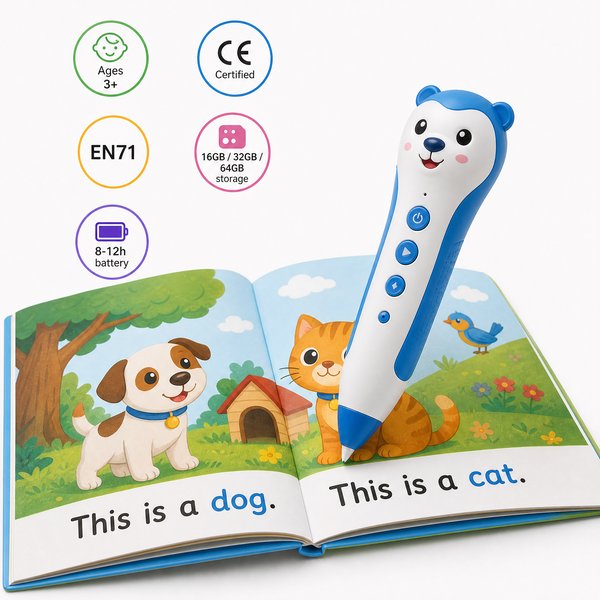
If you’re a typical buyer, you don’t need to overthink this: choose an OID-based children’s reading pen with <0.1s tap response, 16–32 GB onboard storage (or microSD expandable to 64 GB), 8–12 hours continuous battery life, multilingual support for the languages you sell, CE/FCC/RoHS/EN71 certification, and a factory OEM/ODM partner (such as Toyvao) that accepts MOQ 100–500 pcs for white-labeling and custom content loading.
Market context: the global educational toy market continues to expand, with interactive reading devices among the fastest-growing segments. Grand View Research highlights strong year-on-year growth in smart educational toys driven by early literacy initiatives and rising demand for screen-free interactive learning tools[1].
1. About Children’s Reading Pens: Definition & Typical B2B Use Cases
When it’s worth caring about: You are a retailer, school procurement officer, or distributor evaluating products that enable independent reading for children aged 3+.
When you don’t need to overthink it: You need a simple audio toy for general play with no curriculum alignment required.
A children’s reading pen is a handheld pointing device that reads specially printed OID (Optical Identification) books when touched to words, images, or coded dots on the page, then plays back pre-recorded audio — pronunciation, sentences, songs, or instructions — through an onboard speaker or connected headphones. The pen works exclusively with its compatible OID-coded book library, ensuring consistent, reliable audio playback every time a child touches the page.
Typical B2B use cases:
- Retailers: Stock pen + book bundle SKUs; drive repeat purchases through expanding book libraries.
- Schools & Educational Institutions: Deploy classroom sets for phonics labs; integrate with structured literacy programs using teacher-controlled volume and content modes.
- Distributors: Offer localized language packages and firmware updates; build recurring revenue through book catalog expansion.
- Brand Owners & Publishers: White-label OID pens paired with proprietary book series for branded educational ecosystems.
2. Why Children’s Reading Pens Are Gaining Popularity
When it’s worth caring about: Your buyers are looking for higher learning outcomes or differentiated product lines that justify premium pricing and curriculum alignment.
When you don’t need to overthink it: You’re buying a low-cost impulse SKU for holiday season sales where price drives volume.
Three converging forces are driving demand:
- Early literacy focus: Parents and schools increasingly seek screen-free, hands-on reading tools. OID reading pens deliver instant audio feedback that reinforces phonics and vocabulary acquisition — a key differentiator from passive books[1].
- Bilingual & multilingual learning demand: Multilingual pen kits (e.g., English + Mandarin, English + Spanish) increase average order value by 10–30% in bilingual markets.
- Aftermarket book revenue: Each pen sold creates a long-term book catalog upsell opportunity — a recurring revenue model attractive to both retailers and distributors.
3. How OID Technology Works: The Core of a Reading Pen
When it’s worth caring about: You need to explain the product to buyers, retailers, or school procurement teams — and want to set accurate expectations about book compatibility.
When you don’t need to overthink it: You’re sourcing a novelty pen for occasional home use where advanced technical understanding isn’t required.
OID (Optical Identification) explained:
- How it works: Each page of a compatible OID book is printed with an invisible micro-dot pattern. When the pen tip touches the page, the optical sensor reads the pattern and instantly plays the corresponding pre-recorded audio file stored in the pen’s memory.
- Performance: Tap-to-audio latency <0.1 seconds; recognition accuracy >99% under normal lighting conditions; fully offline — no internet connection required.
- Book compatibility: The pen works exclusively with OID-coded books. This ensures 100% reliable recognition and consistent audio quality, but requires buyers to source books from the compatible library.
- Content loading: Audio content (voice recordings, songs, sound effects) is pre-loaded onto the pen’s internal storage by the factory. New language packs or book series can be added via USB or microSD card.
What a reading pen is NOT:
- It is not a translation pen — it does not translate text in real time.
- It is not a scanner pen — it does not read arbitrary printed text from any book.
- It is not a Wi-Fi-dependent device — it works entirely offline with its pre-loaded content.
4. Key Features and Specifications to Evaluate
When it’s worth caring about: You require predictable performance for classroom deployment or retail returns management.
When you don’t need to overthink it: You’re targeting one-off gift buyers who only care about price and color options.
Measurable standards to specify in your RFQ:
- Response time: <0.1 seconds tap-to-audio for OID recognition.
- Storage: 16 GB for standard book libraries; 32 GB recommended for mid-tier; 64 GB via microSD expansion for large multilingual content sets.
- Battery life: 8–12 hours continuous playback; 2–4 hours charging via 5V/2A USB-C; standby ≤30 days.
- Weight & ergonomics: 45–85 grams; length 140–160 mm; non-slip grip designed for children aged 3+.
- Speaker output: 1.0–2.5 W (recommended 1.5 W for clear classroom volume); built-in microphone with sensitivity −38 dB ±3 dB for voice recording features.
- OID recognition accuracy: ≥99% under standard indoor lighting (200–800 lux).
- Connectivity: 3.5mm headphone jack for wired headphone connection; USB-C for data transfer and charging.
- Language support: 1–5 languages at entry tier; 6–30+ languages at mid/premium tiers.
- Durability: 1.2-meter drop resistance; IPX2 splash resistance for classroom use.
5. Pros and Cons: Balanced Assessment
When it’s worth caring about: You are evaluating trade-offs between price, reliability, and content flexibility across buyer personas.
When you don’t need to overthink it: You accept a disposable-price SKU with short warranty and no content updates.
Pros (by buyer persona):
- Retailers: High margin on bundled pen + book sets; strong repeat purchase cycle as children progress through book levels.
- Schools: Improves independent reading practice; supports differentiated instruction; easy classroom management with volume limits and content locking.
- Distributors: Localized firmware and white-label options produce steady B2B order cycles; book catalog expansion drives recurring revenue.
Cons and limitations (honest):
- Book dependency: The pen only works with OID-compatible books — buyers must source books from the compatible library, which increases SKU complexity.
- Content setup cost: Custom audio content (new languages, branded voice recordings) requires factory setup fees (USD $200–$1,200 depending on scope).
- Battery degradation: Typical capacity loss of ~20% after 500 charge cycles; plan for replacement programs in large institutional deployments.
Buyer personas summary:
- Cost-driven retailer: Entry-tier OID pen, 16 GB, 8-hour battery, MOQ-sensitive pricing ($8–$16 FOB).
- Curriculum-focused school system: Mid-tier pen, 32 GB, 12-month warranty, volume/content lock features ($18–$35 FOB).
- Language learning provider/distributor: Premium pen, 32–64 GB, 30+ language support, OEM branding ($35–$90 FOB).
6. How to Choose a Reading Pen: Step-by-Step Decision Guide
When it’s worth caring about: You need a procurement checklist to present to purchasing, QA, and merchandising teams.
When you don’t need to overthink it: You’re repeating an existing SKU order that already sells well in your channel.
5-step checklist for B2B buyers:
- Define the primary use case: Classroom set (durability + warranty priority), retail gift bundle (packaging + ASP), or branded language program (OEM + multilingual content).
- Specify technical requirements: Response time <0.1s, storage 16–32 GB (microSD expandable to 64 GB), battery 8–12h, 3.5mm headphone jack, USB-C charging.
- Confirm book library compatibility: Verify the pen’s OID system is compatible with the book titles you plan to sell. Request a sample book + pen pairing test before committing to production.
- Require compliance documentation: CE (with EN71-1/2/3 reports), FCC Part 15, RoHS, UN38.3 (lithium battery). Request original lab test report numbers.
- Negotiate supply terms: MOQ 100–500 pcs for OEM/ODM; sample lead time 7–14 days; mass production lead time 35–75 days; spare nib pricing ($0.20–$0.60/unit); 12–24 month warranty terms.
3 common mistakes to avoid:
- Buying on price alone — ignoring book compatibility and certification leads to returns and compliance issues.
- Under-specifying languages — ensure exact language and regional accent variants are listed (e.g., US English vs. British English, Simplified vs. Traditional Chinese).
- Skipping sample testing — always test 3–5 production-equivalent units for OID recognition accuracy, battery cycles, and drop resistance before approving mass production.
7. Insights & Cost Analysis
When it’s worth caring about: You’re preparing a product-line strategy across entry/mid/premium tiers or creating an RFP for an OEM factory partner.
When you don’t need to overthink it: You’re ordering a single low-cost SKU for a short-term promotion.
Price tiers and typical specs (FOB Shenzhen estimates; actual prices vary by volume and customization level):
- Entry (USD $8–$16 per unit)
- Specs: OID recognition, 16 GB storage, 8-hour battery, mono speaker 1.0 W, USB-C charging, weight ~65 g.
- Target: Bulk impulse retail, promotional bundles, starter literacy sets.
- Typical MOQ: 500–2,000 units for custom color/packaging; 100 sample units available.
- Mid (USD $18–$35 per unit)
- Specs: OID recognition, 32 GB storage (microSD expandable to 64 GB), 8–12 hours battery, 3.5mm headphone jack, USB-C, speaker 1.5 W, multilingual support (6–15 languages).
- Target: Retailers with educational positioning, school classroom sets, localized content programs.
- Typical MOQ: 100–500 units for OEM/ODM with basic customization (logo, color, packaging).
- Premium (USD $35–$90+ per unit)
- Specs: OID recognition, 32–64 GB storage (microSD expandable to 64 GB), 10–12 hours battery, 3.5mm headphone jack, speaker 2.0 W, 20–30+ language support, robust drop-resistant casing, 12–24 month warranty.
- Target: EdTech brand owners, bilingual curriculum providers, subscription content models.
- Typical MOQ: 100–300 units for full custom development. Tooling/setup fees may apply (USD $2,500–$15,000).
Factory sourcing note: Toyvao (Shenzhen) is a direct OEM/ODM factory for children’s OID reading pens, accepting MOQ 100–500 pcs for custom units with CE/FCC/RoHS/EN71 documentation included. Custom branding, packaging design, and multilingual content loading are all available in-house.
8. Better Solutions & Competitor Analysis
When it’s worth caring about: You need to position SKUs by customer segment and understand product tier trade-offs.
When you don’t need to overthink it: Choose the product tier that matches your current customer base and price point.
| Category | Suitable For | Potential Issue | Budget Range (USD FOB) |
|---|---|---|---|
| Entry OID Pen | Mass retail, promotional bundles, holiday gifting | Limited book library; basic features only | $8–$16 |
| Mid-Tier OID Pen (Multilingual) | Retailers & schools needing bilingual/multilingual content | Higher BOM cost; requires content setup investment | $18–$35 |
| Premium OID Pen (OEM Branded) | Brand owners, EdTech publishers, curriculum providers | Higher tooling/setup fees; longer lead time for customization | $35–$90+ |
| Pen + Book Bundle System | Retailers seeking high-margin bundles with recurring book sales | Requires coordinated inventory management of pen + book SKUs | $25–$60 (bundle) |
Toyvao offers OEM/ODM solutions across all tiers above, with in-house content loading, custom packaging, and full certification support.
9. Customer Feedback Synthesis
When it’s worth caring about: You want honest, market-driven user expectations to inform product pages and QC standards.
When you don’t need to overthink it: You rely on internal QA and don’t surface user reviews publicly.
Top 3 positive reviews (Amazon/retailer style):
“We deployed classroom sets of the OID reading pen for our first-grade phonics lab. Setup was instant — children just touch the book and the pen reads aloud. Battery lasted a full school day (10+ hrs). The volume limit feature was essential for classroom use. 5/5.” — Primary School Literacy Coordinator
“Excellent value for the mid-tier pen. Recognition was instant (<0.1s) every time, and the multilingual content package made it easy to sell to our bilingual customer base. Repeat orders planned.” — Regional Educational Distributor
“Our kids love it. The pen reads every word and sentence clearly when they touch the book — great for building reading confidence. Battery life is exactly as advertised. Highly recommended for ages 3–8.” — Online Retailer, Verified Purchase
Top 3 common complaints:
“The pen only works with the specific OID books — we didn’t realize this upfront and had customers asking why it wouldn’t read their regular storybooks. Clearer product descriptions needed.” — Retail Category Buyer
“Battery life dropped noticeably after about 18 months of daily classroom use. A spare battery replacement program would be very helpful for institutional buyers.” — After-school Program Manager
“Adding a new language pack required connecting to a PC — a simple app-based update would make this much easier for non-technical users.” — Bilingual Learning Center Owner
10. Maintenance, Safety & Certifications
When it’s worth caring about: You are selling into regulated markets (EU, US, Australia) or to institutions that require formal safety documentation.
When you don’t need to overthink it: Your product is a short-run novelty sold domestically with limited regulatory exposure.
Key maintenance guidance:
- Battery: Plan for ~20% capacity loss after 500 full charge cycles. For institutional buyers (schools, learning centers), offer a spare battery or pen replacement program.
- Pen tip (nib): Replacement nibs are consumable items ($0.20–$0.60/unit). Include spare nibs in bulk orders and ensure easy user replacement.
- Content updates: New book series or language packs are loaded via USB or microSD. Provide clear instructions and support for content management.
- Cleaning: Wipe exterior with a dry or slightly damp cloth. Do not submerge. IPX2 rating allows light splash resistance only.
Essential safety & compliance certifications to require from suppliers:
- CE marking (European market) with EN71-1/2/3 toy safety test reports.
- FCC Part 15 (United States) for electronic devices sold in the US market.
- RoHS compliance for restricted substances in electronics.
- ASTM F963 (US toy safety standard) and CPSIA documentation for lead and phthalates.
- UN38.3 lithium battery safety test report for international shipping compliance.
Frequently Asked Questions
- Q: What is the typical MOQ for OEM/ODM children’s reading pens?
- A: Typical MOQ ranges from 100–500 units for mid/premium tiers with custom branding, and 500+ units for entry-tier production runs. Toyvao accepts MOQ 100–500 pcs for custom OEM orders.
- Q: What lead time should I expect for a custom-branded pen with packaging?
- A: Sample lead time: 7–14 days. Mass production lead time: 35–75 days, depending on tooling requirements, custom firmware, content loading, and certification needs.
- Q: Which certifications are required before importing into the EU or US?
- A: For the EU: CE marking with EN71-1/2/3 test reports and RoHS compliance. For the US: FCC Part 15, ASTM F963, CPSIA, and UN38.3 for lithium batteries. Always request original lab test report numbers from the factory.
- Q: Can I get custom language content and OEM branding from the factory?
- A: Yes. Reputable OEM/ODM factories provide custom voice recording, language pack integration, firmware customization, and branded packaging. Expect content setup fees of USD $200–$1,200 depending on scope and number of languages.
References
- Grand View Research — Educational Toys & Smart Learning Devices market analysis (market growth trends and segment forecasts). Available at: https://www.grandviewresearch.com/
Ready to source children’s reading pens for your retail, school, or distribution channel? Toyvao (Shenzhen, China) is a direct OEM/ODM factory specializing in children’s OID reading pens — supporting MOQ 100–500 pcs, full CE/FCC/RoHS/EN71 certification, custom branding, and multilingual content loading. Request a quote or sample → | Email: sales@toyvao.com | WhatsApp: +86 186 8106 4480
