
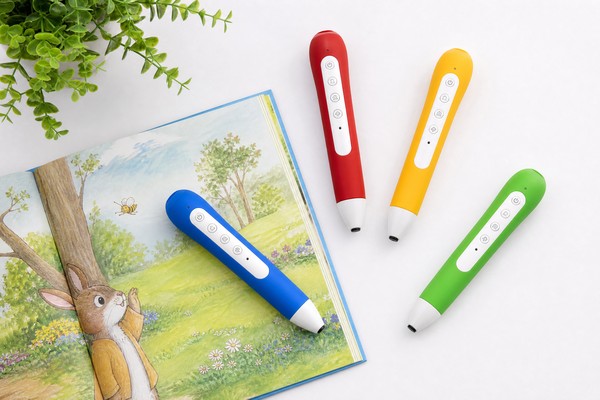
Executive Summary
This guide explains how to plan, budget, contract, produce, test and localize audio content for Picture Book Reading Pens (also called Story Pens, Talking Book Pens, OID Reading Pens). It focuses on three commercial priorities: narration quality, rights clearance, and localization. It provides technical specifications, production workflows, cost benchmarks, legal terms to request or grant, QA procedures and integration requirements for pen firmware and hardware.
Target reader: product managers, sourcing managers, content directors, and procurement teams working with OEM/ODM pen suppliers, audio studios, localization vendors and voice talent agencies.
Key takeaways:
– Use professional human narration for core story content where brand/educational quality matters; use TTS selectively for low-cost or very large catalog applications.
– Master audio as WAV 48 kHz / 24-bit mono, then deliver optimized files (e.g., MP3/AAC mono at 32–96 kbps) for pen firmware depending on storage and playback performance.
– Secure both text adaptation rights and audio master rights in writing. Favor “work-for-hire” or perpetual, worldwide, sublicensable audio rights to avoid future royalty or territory constraints.
– Plan 4–8 weeks per language for end-to-end production (casting, recording, editing, QC, firmware integration), shorter if using TTS.
– Typical all-in cost per 30-page book, single language, professional human narration and postproduction: $1,200–$6,000. TTS workflows can cut content cost to <$500 per title, but require licensing and careful QA for child-friendly prosody.
– For localization, budget translation ($0.08–$0.20/word), voice talent ($200–$1,500 per book), and cultural adaptation (20–40% additional effort).
What Is Picture Book Reading Pen and Who Uses It
Picture Book Reading Pens are handheld devices that play pre-recorded audio when children tap hotspots on printed picture books. Typical use cases:
– Early literacy learning: read-along narration, phonics, word highlighting
– Language learning: bilingual editions, vocabulary modules
– Storytelling and entertainment: narrative audio, character voices, sound effects
– Institutional customers: schools, early childhood centers, retail bundling with books
Key stakeholders in the supply chain:
– Publishers and content owners: provide text/content IP and editorial direction
– OEM/ODM hardware suppliers: implement audio playback engine, storage, mapping logic, power and safety compliance
– Content producers and audio studios: casting, recording, editing, mixing, mastering
– Localization vendors: translation, voice casting in target language, cultural adaptation
– Voice talent and agencies: professional narrators, character actors
– QA teams and integrators: file packaging, manifest generation, device testing
Operational constraints that shape production choices:
– Storage on pen devices ranges from 128 MB to 8 GB (typical mid-range 512 MB–2 GB), so file size and codec choice drive audio bitrate and length allocation.
– On-device CPU and firmware govern supported codecs (MP3, AAC, WAV) and simultaneous playback features (stereo, effects).
– Trigger latency must remain low (<50–150 ms from tap to playback start) to preserve tactile-audio experience.
Why Demand Is Growing
Market drivers for higher-quality audio and broader localization:
– Rising global demand for bilingual educational products and early literacy tools in emerging markets.
– Retail and institutional buyers expect native-quality narration and culturally appropriate content — basic TTS is insufficient for premium brands and classroom use.
– OEMs differentiate hardware by the richness of audio experience (characterization, sound design) and by breadth of language support.
– Mobile-first parental behavior: consumers compare pen audio to streaming audiobooks and expect similar production quality.
– Education standards (phonics, read-along synchronization) push buyers toward content with precise timing and phoneme-level alignment.
Commercial implications:
– Buyers choose higher-quality content when per-unit economics allow (a pen bundled with a title or when units sold exceed content amortization threshold).
– Localization is often required for market entry — failing to budget for adaptation leads to missed sales or poor reception.
Key Technology Differences
Audio capture and delivery choices materially affect perceived quality, file size and integration complexity. These are the key technical dimensions.
Recording and master formats
– Recommended master: WAV PCM, 48 kHz sample rate, 24-bit, mono. Rationale: preserves headroom for processing and resampling; 48 kHz is standard for multimedia and DVD/video workflows.
– For archival deliverables you can also accept 96 kHz/24-bit; but masters should be delivered uncompressed WAV.
– For narration-only content where storage is constrained, 44.1 kHz/24-bit is acceptable.
On-device playback formats and bitrates
– Preferred pen playback formats: MP3 (MPEG-1/2 Layer III) or AAC (LC/AAC-LC). AAC gives better quality at low bitrates.
– Typical bitrate targets for mono narration in kids devices:
– High quality: 64–96 kbps VBR (mono). Use when storage allows and you want documentary-grade clarity.
– Standard quality: 32–48 kbps CBR or VBR (mono). Balanced size/quality for many pens.
– Budget/legacy devices: 16–32 kbps (may be audible compression artifacts; avoid for primary narration).
– Speech-optimized codecs: Opus at 24–48 kbps provides high-quality speech at small sizes, but firmware support is limited; only use if OEM supports Opus.
Channel configuration
– Mono is recommended for primary narration – halves file size vs stereo and simplifies alignment.
– Use stereo only if spatial effects or binaural sound are core to the product and hardware supports it.
Loudness and peak standards
– Loudness target for narration: -18 LUFS integrated (±2 LU). Set true-peak limit to -1 dBTP to avoid inter-sample clipping when encoded to lossy formats.
– Apply consistent metadata and loudness normalization across all files to prevent level jumps when users switch pages or languages.
Timing and synchronization
– Read-along word-level sync requires time-aligned transcripts. Forced-alignment tools (e.g., Montreal Forced Aligner, Gentle) can generate timestamps per token. Expect manual correction effort: 10–40 minutes per 1,000 words depending on complexity and accuracy targets.
– For tap-triggered hotspots, generate a manifest mapping hotspot ID to audio file and optional start offset in milliseconds.
Speech technologies
– Human narration: best naturalness and emotional range. Casting and direction critical for child engagement.
– TTS (neural voices): increasingly natural, cost-effective for large catalogs. Choose neural TTS with child-appropriate prosody; budget licensing for commercial use and confirm long-term usage rights.
– Hybrid: human narration for primary stories; TTS for extra vocabulary, translations, or real-time features.
Automation and tooling
– Use batch audio processing tools for resampling, normalization, loudness adjustment and codec export (SoX, FFmpeg).
– Use CI/CD style content pipelines where possible: incoming master WAVs > loudness check > codec conversion > manifest generation > package sign-off.
Key Features and Specifications to Evaluate
When contracting production or evaluating vendors, validate the following specific deliverables and specs.
Audio and deliverables
– Master files: WAV PCM 48 kHz / 24-bit / mono; individual track per chapter/page; file names with unique IDs.
– Final files for pen: MP3 (MPEG-1 Layer III) mono, 48 kbps VBR (or AAC LC 48 kbps mono) unless pen firmware requires different codec/bitrate.
– Loudness: integrated -18 LUFS ±2; true peak -1 dBTP.
– File naming: canonical format [TitleID][LanguageCode][HotspotID]_[Segment].wav (e.g., TBP123_en_US_HP05.wav).
– Manifest: JSON or XML mapping hotspot IDs to file names, duration (ms), language code, and CRC/hash for integrity checks.
– Timecodes for read-along: word-level or phrase-level time stamps in CSV/JSON with token indexes and ms offsets.
Voice talent and session specs
– Voice sample requirements: 30–60 second dry reads in target voice and style, with sample lines that reflect page-level pacing and child-directed tone.
– Studio session specs: ISO booth, condenser or shotgun mic (Neumann U87, Sennheiser MKH416, or equivalent), preamp, recording chain with <= -12 dBFS peak target; record at 48k/24-bit.
– Direction: 1 producer/director for every 1–3 narrators; script markups for emphasis, pauses, character voices.
Editing and postproduction
– Editor deliverables: cleaned takes, de-clicked, de-plosive processed, consistent EQ curve, light compression for intelligibility (ratio 2:1–4:1), de-esser as needed.
– Don’t apply extreme dynamic range compression – children’s content should preserve expressiveness.
– Version control: provide both pre-mix (raw edits) and final mix masters.
Localization and translation
– Translation deliverables: adapted script (not literal) with notes for timing and hotspot constraints; target reading length within ±10% of original if read-along or interface timing matters.
– Localization QA: linguistic review, in-context audio review on device, and cultural sensitivity review.
Rights and legal
– Rights granted must include: master audio rights in perpetuity, worldwide, sublicensable, for use in devices, software, retail, education and marketing. Clarify whether voice talent needs to waive or assign moral rights.
– If third-party music or sound effects are used, secure synchronization rights and master use rights for those elements as well.
Testing and QA
– Device testing: check latency, hot-spot mapping, file integrity, multi-language switching, firmware interactions and memory footprint.
– Listen tests on target device speaker and on headphones that children will use.
– Acceptance criteria: audition checklist, bug ticketing process, and sign-off gates.
Pros and Cons
Pros of professional production and full rights clearance
– High engagement and perceived product value (better conversions and customer retention).
– Avoids future legal exposure and revenue interruptions.
– Easier international expansion with licensed and localized audio.
– Better educational outcomes when narration matches pedagogical intent.
Cons and trade-offs
– Higher upfront costs and longer timelines versus TTS or minimal production.
– Complexity of rights negotiation, especially with accepted industry talent or unionized performers.
– Storage and firmware constraints increase production complexity (need for codec optimization and manifesting).
– Localization multiplies cost per language; poor localization harms brand.
Pros of TTS and hybrid models
– Rapid scale across large catalogs and many languages with predictable costs.
– Easy updates and on-device dynamic generation where supported.
Cons of TTS
– Current neural TTS, while improved, may lack natural childlike expressiveness, timing nuance, and emotional variation necessary for premium children’s content.
– License restrictions and possible unanticipated commercial use limits; careful review required.
Step-by-Step Decision Guide
Use this operational checklist to move from concept to delivered content.
Project scoping (0–1 week)
– Define list of titles, pages per title, average audio length per page, and target languages.
– Confirm pen hardware constraints: storage (MB), supported codecs, CPU limits, maximum file count per filesystem, latency budget.
– Decision: human narration vs TTS vs hybrid based on budget and quality targets.
Rights and legal (1–2 weeks, parallel)
– Confirm text rights with publisher/author: adaptation rights, derivative rights, and audio rights.
– Draft or request clauses: work-for-hire language, perpetual worldwide master rights, sublicensing, and a moral rights waiver from talent where local law allows.
– Engage legal counsel for union talent or complex publishing agreements.
Budgeting and vendor selection (1–3 weeks)
– Obtain quotes for casting, studio time, editing, translation, and QA.
– Benchmarks:
– Casting and talent fees: $200–$1,500 per title per language (depends on talent standing and usage).
– Studio recording: $50–$250 per hour; typical 30-page book may need 1–6 hours of recording.
– Editing/mixing: $100–$800 per title.
– Translation: $0.08–$0.20 per source word.
– QA and device integration: $200–$1,000 per title.
– Select vendors with prior pen/device experience and request sample deliverables and manifests.
Pre-production and casting (1–2 weeks)
– Provide talent briefs: age target, tone, pacing (words per minute: 100–130 for preschool, 120–160 for early readers), character notes.
– Request dry reads and short sample reads matching your script style.
– Approve final cast and schedule sessions.
Recording and direction (1–3 weeks)
– Book studio time and remote direction if required.
– Produce RAW masters: take-level WAV 48k/24-bit, capture multiple takes per page (prefer 2–4 usable takes).
– Ensure director enforces timing, pausing, and correct pronunciations for proper read-along alignment.
Editing, mixing and localization (1–4 weeks)
– Editor assembles per-page files, performs noise removal, EQ, compression and loudness normalization.
– For localization: translators provide adapted scripts, record new sessions and follow identical postproduction specs.
– Forced-alignment and manual QA for read-along sync; annotate word-level timestamps if required.
Delivery, packaging and integration (1–2 weeks)
– Vendor provides final file set (masters + pen-ready files), manifest JSON/XML, checksums, and QA reports.
– Integrate into firmware or content manager; perform device-level testing for mapping, latency, and playback.
User acceptance and production sign-off (1 week)
– Perform end-to-end QA on representative sample of devices.
– Issue punch-list for defects, correct and retest until acceptance.
Recommended timeline summary
– Human narration, single language, full QA: 4–8 weeks.
– TTS-only production per language: 3–7 days to 2 weeks (depending on translation and approvals).
Pricing and Cost Analysis
Below are practical cost benchmarks. Use these to build budgets and compare vendor proposals.
Typical cost components per book (single language, 30 pages, approximate)
– Casting and voice talent: $200–$1,500 (non-union talent on the low end; established child/character actors on the high end).
– Studio/recording time: $150–$600 (2–4 hours at $75–$150/hr).
– Editing/postproduction: $200–$800 (depends on complexity; includes noise reduction and mastering).
– Read-along alignment (word-level timestamps): $200–$600 (manual correction effort).
– Translation (per language): $150–$800 (assuming 2,000–5,000 words at $0.08–$0.20/word).
– Localization QA / device testing: $150–$600.
– Licensing / rights fees (if buying pre-existing audio or talent with residuals): $0–$5,000+ depending on talent and scope.
Total per title (single language, professional human workflow): $1,200–$6,000.
TTS cost scenario (single language)
– TTS runtime/licensing: $0–$500 one-time or monthly subscription depending on vendor and usage terms.
– Post-TTS editing and prosody tuning: $100–$400.
– Translation: same as above.
– QA and device testing: $100–$300.
Total per title (TTS): $200–$1,200.
Cost per unit amortization
– If content costs $2,500 and expected device sales are 10,000 units, content cost contribution per unit = $0.25.
– If sales are 1,000 units, cost per unit = $2.50.
– Use conservative sales forecasts and factor in multi-language versions.
Negotiation levers
– Buy content rights in bundles (multiple titles) to obtain volume discounts.
– Request staged payments: partial on casting, partial on delivery, final on device sign-off.
– Require detailed deliverables list and acceptance criteria in contract.
Union vs non-union talent
– Unionized talent or SAG-AFTRA governed sessions typically increase costs and require residuals/usage reporting. Expect 2–5x cost inflation over equivalent non-union rates and additional paperwork.
– If union talent is mandatory for brand recognition, account for residual terms and mandatory notices.
Competitive Landscape
Types of suppliers and what they offer
- Full-service children’s audio studios
- Offer casting, direction, recording, editing, localization and device packaging.
- Strengths: single point of responsibility, experience with read-along and pedagogical narration.
-
Typical clients: publishers, education brands.
-
Voice talent agencies and marketplaces
- Example platforms: Voices marketplaces, regional agencies.
-
Strengths: extensive talent pools, audition management. Usually require separate postproduction vendors.
-
Localization houses
- Offer translation, transcreation and voice casting in markets. Many operate with local studios.
-
Strengths: cultural adaptation and regional QA. Weakness: may not integrate technical packaging for pen devices.
-
TTS providers and vendors
- Major cloud vendors: Amazon Polly (Neural), Google Cloud Text-to-Speech (WaveNet), Microsoft Azure Neural TTS, independent TTS specialists that can customize prosody.
- Strengths: cost-effective scaling to many languages, fast iteration.
-
Weakness: prosody for children’s literature still variable; are limited by license terms.
-
Audio postproduction freelancers and boutiques
- Cost efficient for smaller runs; may lack device integration experience.
Selection advice
– For enterprise and retail-scale projects, prefer full-service studios with demonstrated pen/device integration references.
– For volume catalogs where cost is primary, use TTS partners with human post-editing and strict QA.
– Always request test deliverables integrated on your target pen hardware before final sign-off.
What Buyers Say
Common feedback and empirical findings from buyers in the category:
Quality vs cost trade-offs
– Buyers report that poor narration or heavy TTS artifacts significantly reduce product value in retail channels.
– Many buyers move to hybrid models: human narration for flagship titles and TTS for supplementary or multi-language expansions.
Rights problems
– Buyers who purchased only limited audio rights later faced restrictions when launching in new markets or on companion apps. Buyers advise insisting on perpetual, worldwide, sublicensable audio master rights.
Localization issues
– Straight translation often fails — buyers mandate transcreation to match syllable counts and cadence for read-along synchronization.
– Right-to-left languages and languages with longer words require special layout planning for hotspot mapping and timing.
Technical integration pain points
– Firmware limitations (unsupported codecs, maximum filenames, file count limits) often surface late. Best practice: provide hardware spec and constraints to content vendors before production.
QA and firmware testing
– Buyers emphasize the importance of device-level QA; audio that passes studio checks can still fail on-device because of codec implementation differences or speaker response.
Turnaround expectations
– Buyers expect a 4–8 week turnaround; compressed timelines often increase costs or lower quality.
Safety, Maintenance and Compliance
Regulatory and safety areas to address when producing content for children’s hardware.
Audio safety and listening levels
– Target playback levels and offer parental volume limits. Recommended maximum long-term listening level: 85 dB(A) (consistent with common public health guidance for children’s listening safety). Implement device-level volume limiting and provide documentation.
– Verify that firmware does not allow user override above the safe threshold without explicit parental action.
Product safety and hardware compliance
– Ensure device-level regulatory compliance: CE (EU), FCC (USA, Part 15 for unintentional radiators), RoHS, REACH. If the pen contains a Li-ion battery, ensure UN38.3 testing and packaging compliance for air transport.
– If device supports wireless (Bluetooth/Wi-Fi), ensure appropriate certifications (Bluetooth SIG, IEC/EN radio standards).
Privacy and data protection
– Many jurisdictions have special protections for children’s personal data (COPPA in the USA; GDPR with special rules for minors in EU). If the pen collects data (usage, voice recordings, personalization), implement:
– Parental consent flows
– Data minimization and purpose limitation
– Clear retention and deletion policies
– Secure storage and transmission (TLS, at-rest encryption)
– Prefer offline-only designs where possible to reduce regulatory burden.
Content safety and age-appropriateness
– Implement editorial checks for age-appropriate language, absence of adult themes, and cultural sensitivity.
– For music and SFX, confirm licensing terms and ensure content contains no problematic lyrics.
Talent safety and contracts
– For child actors, adhere to local labor laws: work permits, limited session lengths, required welfare measures and guardian presence.
– Include voice care and vocal warm-up guidelines for talent to prevent strain; cap continuous recording blocks to safe durations (e.g., max 2 hours recording per day with breaks).
Accessibility and inclusive practice
– Consider inclusive casting (diverse voices, accents) and provide alternative content files for children with different needs (slower pacing, larger pauses).
Auditability and record-keeping
– Maintain metadata, contracts, session logs and proof of rights clearance for 5–10 years (or longer as required) to support audits from rights holders or regulators.
Frequently Asked Questions
What format should I demand for masters and final files?
– Masters: WAV PCM 48 kHz / 24-bit / mono. Final pen files: MP3 mono (32–96 kbps) or AAC mono as per hardware; set integrated loudness to -18 LUFS and true-peak -1 dBTP.
How do I secure audio rights to avoid future fees?
– Require master recording rights as “work-for-hire” or obtain an exclusive perpetual worldwide license, transferable and sublicensable, covering use in devices, software, marketing and resale. Require talent to waive moral rights where allowed and secure a signed assignment or license from each performer.
Is TTS acceptable for children’s story narration?
– TTS is acceptable for supplemental content, vocabulary lists and low-cost market entries. For primary storytelling and brand-level products, professional human narration or a curated hybrid approach is recommended for emotional nuance and engagement.
What are realistic timelines?
– Human narration and full QA per language: 4–8 weeks. TTS and translation: 3 days–2 weeks. Multi-language projects scale linearly with number of target languages plus coordination overhead.
How much should I budget for localization?
– Translation: $0.08–$0.20/word. Voice talent and recording per language: $400–$2,500 per book depending on talent and studio time. QA and integration per language: $150–$800.
What to include in the manifest for device integration?
– Hotspot ID, file name, language code (ISO 639-1 or 639-3), segment duration (ms), offset (ms if part of larger file), checksum (SHA-256), and any metadata tags (title, author, copyright).
Should I use union talent?
– Use union talent when brand recognition or star power matters or when your market requires union representation. Expect higher fees and administrative overhead. For large catalogs on tight budgets, non-union talent with clear license assignments is common.
How to ensure read-along sync accuracy?
– Use forced-alignment tools for initial timestamps and plan for manual correction. Allocate 10–40 minutes per 1,000 words for correction time in production schedules.
What loudness standard to follow?
– Use -18 LUFS integrated for narration. Adjust for music and SFX mixes while maintaining intelligibility. Normalize final deliverables.
Contact Toyvao
For consultation on sourcing, production management, localization planning, vendor selection and contract templates for Picture Book Reading Pens, contact Toyvao’s content sourcing team:
- Email: sales@toyvao.com
- Corporate site: https://www.toyvao.com
- Sourcing inquiries: sourcing@toyvao.com
- Phone (APAC hours): +86 571 8XX-XXXXXX (ask for Content & Audio Production)
Provide in your initial email:
– Title list with page counts and expected run time per page
– Target languages and markets
– Hardware constraints (storage, supported codecs, manifest requirements)
– Expected volumes and timeline
Toyvao can provide sample SOW templates, rights assignment language, vendor shortlists and project-managed pilots for one or multiple titles.
