
Executive Summary
This guide explains how to source child-safe materials and non-toxic inks for picture books and story-reading pens (story pens / talking pens / OID reading pens). It focuses on the chemical and material risks that create recalls and regulatory failures, the standards and test methods that buyers must require, the technical trade-offs among materials and ink technologies, and pragmatic sourcing controls to keep costs predictable while achieving regulatory compliance.
Key takeaways
– Regulatory compliance must be proven with third‑party lab reports: EN71 (EU), ISO 8124 (international), ASTM F963 and CPSIA (US) and, where applicable, REACH and local country requirements.
– For inks, choose water-based (aqueous) or fully cured UV systems with documented low-migration chemistry; require migration and specific compound testing (heavy metals, phthalates, VOCs, primary aromatic amines).
– For pen housings and mechanically accessible parts, select base polymers with stable formulations (e.g., ABS, PP, TPU) and require supplier declarations excluding prohibited additives (brominated flame retardants, certain phthalates).
– Insist on defined acceptance criteria: lightfastness >= 6 (Blue Wool scale), crocking (ISO 105‑X12) grade >= 4, and verified migration results against EN71‑3/ASTM/ISO limits.
– Implement a sourcing control plan: supplier prequalification, type testing, batch verification sampling (ISO 2859‑1), MSDS/TDS/CoA on every batch, incoming inspection, and contractual audit and recall clauses.
– Typical costs: full chemical/type testing $500–$3,000 per standard/test; production changes for child-safe materials add 3–15% to COGS depending on process and certification needs.
This guide gives technical acceptance criteria, test plan templates, specification language for contracts and purchase orders, and practical cost/lead‑time expectations.
What Is Picture Book Reading Pen and Who Uses It
Product definition
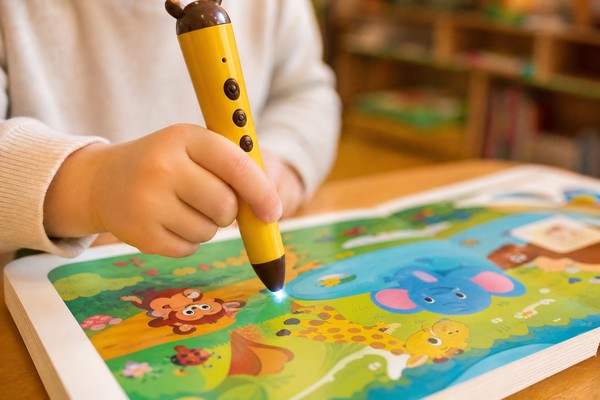
– Picture Book Reading Pen / Story Pen / OID Reading Pen: a handheld electronic device that senses touch on printed images or encoded markers in a book and plays recorded audio. Typical components: plastic housing, PCB with speaker and microcontroller, rechargeable or single-use battery, touch/contact tip (often stylus or soft nib), and printed picture books with printed trigger areas (ink or printed codes).
– Use case: interactive learning for children aged 0–10, often by parents, preschools, libraries, and educational distributors.
Who buys these products
– Retail chains and brick‑and‑mortar toy stores ordering finished SKUs.
– Educational publishers integrating their content into the hardware.
– OEM/white-label brands sourcing pen units and custom-printed books.
– Distributors and exporters who require compliance documentation for multiple markets.
Key risk vectors
– Chemical migration from inks and coatings into children’s mouths (chewing, mouthing).
– Failing migration limits for heavy metals or presence of banned phthalates.
– Volatile organic compounds (VOCs) and odors from inks and coatings causing consumer complaints.
– Toxic additives in plastics (brominated flame retardants, restricted plasticizers).
– Small parts/magnet/battery hazards unrelated to chemical safety but must be addressed within the same supply chain controls.
Why Demand Is Growing
Market drivers
– Global early‑education programs and increased parental spending on educational toys.
– Rising demand for bilingual and multimedia story products where audio enhances learning.
– Retail and regulatory environments tightening: retailers (large platforms and chains) require documented chemical safety.
– Consumer awareness around phthalates, lead, and other toxicants driving preference for “child-safe” labeled products.
Procurement implications
– Buyers must balance higher material and testing costs with reduced recall risk and market access.
– Large buyers demand traceability and supplier auditing; small buyers must adopt the same technical checks to avoid downstream liability.
Key Technology Differences
Plastics and elastomers (pen housings and nibs)
– ABS: common, good impact strength, Tg ~105°C. Risks: suppliers may use brominated flame retardants or regrind. Require certificate of non‑brominated flame retardants and RoHS for electronics.
– PP / PE: low cost, chemically inert, lower moisture uptake. Easier to process for snap-fit housings.
– TPU / TPE / silicone (for soft nibs): preferred for child contact because of softness and abrasion resistance. Specify food-contact grade or medical-grade equivalents. Avoid plasticizers with phthalates.
– PLA: compostable option but brittle and sensitive to heat; not recommended for high-durability housings.
Inks and printing technologies (books)
– Water-based (aqueous) pigment or dye inks: lowest migration risk when properly formulated, low VOC (<50 g/L typical), good for offset and flexographic printing, drying by evaporation. Preferred choice for children’s books.
– Soy-based offset inks: low VOC, established for packaging and books; typically meet EN71-3 when formulated correctly.
– UV-curable inks: near-zero solvent VOCs if fully cured; caution around unreacted monomers which can migrate. Require process controls and cured‑ink extraction testing.
– Solvent-based inks: higher VOCs (>200 g/L), not recommended for children’s picture books unless sealed and tested for migration.
– Digital (inkjet) inks: variable. Water-based pigment inks are often acceptable; pigment particle size (<200 nm) affects print stability. Verify manufacturer’s migration data.
Adhesives and laminates
– Hot melt adhesives (EVA): widely used, lower migration but can contain additives. Evaluate for volatile emissions and heat stability.
– PUR adhesives: better bonding for hard covers but more complex chemistry. Require SDS and migration data.
– Film lamination: prefer PET or PLA films over PVC/plasticized PVC to avoid phthalates and DEHP migration.
Electronics and batteries
– Batteries: Li‑ion/Li‑Po rechargeable cells must meet IEC 62133 and UN38.3 transport requirements. Use fixed, enclosed battery compartments or secure screws to prevent child access.
– PCB components: comply with RoHS (lead-free solder) and avoid substances on REACH SVHC list.
Key Features and Specifications to Evaluate
Material composition and documentation
– Supplier must provide MSDS/SDS, TDS, CoA, and ingredient list for colorants, additives, stabilizers.
– Require a REACH SVHC declaration and confirmation of absence of listed banned substances (or quantification).
Chemical testing and acceptance criteria
– Third‑party lab reports required (SGS, Intertek, Bureau Veritas accepted by major retailers). Required tests include:
– EN71‑3 / ISO 8124‑3: Migration of certain elements (heavy metals). Require passing report for the finished printed book and any painted or coated pen parts.
– ASTM F963: chemical testing for US market; includes soluble heavy metal limits and other chemical hazards.
– CPSIA Section 101/108 (US): limits on lead in paint and substrate; request certificate of conformity when shipping to US.
– Phthalates testing (CPSIA/European Toy Directive): test for banned phthalates (DEHP, DBP, BBP, DINP, DIDP, DNOP) at trace levels; require lab confirmation of <0.1% where applicable.
– VOC screening (if odor reported) using headspace GC/MS or SIFT-MS.
– Primary aromatic amines / Azo dye cleavage testing for printed areas (ISO 14362 series).
– Acceptance criteria examples to include in POs:
– Migration results must be compliant with EN71‑3 limits (type testing report attached).
– Phthalates: below regulatory limits (specify banned list in contract).
– VOC: total VOC (TVOC) <50 mg/m³ in emission chamber (for books stored in packaging at 23°C / 72h), or alternative specific local limits.
Performance tests
– Crocking (ISO 105‑X12): wet and dry crocking grade >= 4 (scale 1–5). This reduces risk of color transfer to child’s mouth.
– Lightfastness (ISO 105‑B02 Blue Wool scale): >= 6 recommended for long shelf life.
– Abrasion / rub resistance: Martindale or Taber tests; set acceptance criteria based on expected handling (e.g., >5,000 cycles without visible loss).
– Adhesion: cross-cut adhesion ISO ISO 2409 or equivalent; no visual flaking after mechanical handling tests.
– Washability (if washable inks used): at least 20 cycles at recommended conditions without pigment loss.
– Bonding and mechanical safety for pen housing: EN71‑1 mechanical tests (small parts, torque, tension for straps and cords).
Process and traceability
– Require lot-level CoA for ink batches and polymer resins.
– Color formulations: supply Pantone or CIE Lab* targets, pigment supplier batch numbers, and production recipe changes only by written approval.
– Shelf life: inks and coatings must include manufacture date and shelf life (water-based inks typically 6–12 months; UV inks 6–9 months depending on stabilizers).
Sampling and inspection
– Apply ISO 2859‑1 sampling plans for critical cosmetic/functional defects; for safety-critical chemical issues, define specific batch testing frequency (see Step-by-Step Decision Guide below).
– Use AQL 0.65 for safety-critical visual defects; AQL 1.0 for major functional.
Pros and Cons
Plastics and elastomers
– ABS: +
– High impact resistance, good for rugged housing.
– Widely available and low cost.
– –
– Potential presence of flame retardants; requires certification.
– PP/PE: +
– Chemical inertness, low cost.
– Lower density (weight savings).
– –
– Lower surface energy can complicate printing; requires surface treatment.
– TPU/TPE/Silicone: +
– Soft, safe contact surfaces; good tactile properties.
– –
– Higher cost; some grades contain plasticizers (verify phthalate-free).
Ink systems
– Water-based:
– + Lowest migration risk; acceptable VOC levels; established for children’s books.
– – Requires controlled drying speed; may need more humidification control in pressrooms.
– UV-curable:
– + Extremely low solvent VOCs after curing; fast production speed.
– – Risk of unreacted monomers; requires rigorous curing and migration testing.
– Solvent-based:
– + Robust adhesion and fast drying.
– – High VOC and higher migration risk; generally not recommended for children’s picture books.
Operational trade-offs
– Switching to fully certified child-safe materials increases BOM and process control cost (approx +3–15% depending on change).
– Additional testing adds fixed per-SKU cost ($500–$3,000) and lead time (2–6 weeks).
– Using certified global suppliers shortens audit and verification steps but increases unit cost.
Step-by-Step Decision Guide
Step 1 — Define market and regulatory matrix
– Identify target markets (EU, US, China, Japan, etc.) and list applicable standards (EN71, ASTM F963, CPSIA, GB/T standards).
– Example: distributing in EU+UK requires EN71 parts 1–3 and REACH compliance; in US requires ASTM F963 and CPSIA testing.
Step 2 — Material selection and specification
– Select base materials for pens and books. Include explicit exclusions in spec:
– No brominated flame retardants; no prohibited phthalates (list DEHP/DBP/BBP/DINP/DIDP/DnOP); no lead or cadmium in colorants.
– Require supplier SDS, CoA, and a bill-of-materials listing all additives and pigment supplier names.
Step 3 — Choose ink technology
– For picture books: prioritize water-based pigment inks or soy-based offset inks with EN71‑3 test reports for the finished printed book.
– For small runs or personalization: choose digital printing with water-based pigment inks and require batch-specific migration testing.
Step 4 — Type testing (pre-production)
– Submit finished product samples (assembled book + pen) to an accredited lab. Required tests:
– EN71‑3 (chemical migration), EN71‑1 (mechanical/physical), flammability EN71‑2 if applicable, ASTM F963 for US.
– Phthalates, azo dyes, VOC headspace scan, primary aromatic amines.
– Timeline: 10–30 working days depending on the number of tests and lab backlog.
Step 5 — Supplier qualification
– Audit suppliers for process control: color mixing logs, ink batch tracking, resin batch CoA, incoming material quarantine.
– Require supplier to maintain ISO 9001; request BSCI or Sedex if doing larger volumes.
Step 6 — Production controls
– Approve first‑article inspection (FAI) and require full set of test documentation before shipping first container.
– Sampling plan: for chemical safety, establish batch verification (e.g., 1 sample per production run of 5,000 units); for high-risk changes (color change, pigment supplier change) require a new type test.
Step 7 — Incoming and pre-shipment inspection
– QC checks: verify printed color, crocking, lightfastness, adhesion, and include batch CoA for inks and resins.
– Run random chemical re-verification: use accredited lab; frequency: monthly for high-volume SKUs and per-run for new pigments or suppliers.
Step 8 — Contract language and remedies
– Include right to audit, indemnity for recalls and non-compliance, holdback of final payment until CoA received, and specified lead times for corrective action (e.g., 15 working days).
Step 9 — Continuous monitoring
– Track customer complaints related to odors, color transfer, or safety incidents. If >0.1% customer complaint rate on chemical/odor issues, trigger a contained investigation and 100% testing of next lot.
Pricing and Cost Analysis
Fixed costs (per SKU)
– Initial type testing: $500–$3,000 per suite (EN71‑3, VOC, phthalates, azo dyes can be separate line items).
– Factory audit (one-time): $500–$3,000 depending on auditor and scope.
– Additional technical consultancy (formulation review): $1,000–$5,000 if engaging external chemists.
Variable costs (per production run)
– Premium for child-safe pigment or specialty inks: +5–20% over standard inks.
– Cost of water-based inks: commodity range $1–$5 per kg depending on pigment load; soy/eco inks at upper end.
– Lamination films (PET/PLA) vs PVC: +10–25% for PET/PLA.
– Batch verification chemical tests: $200–$1,000 per test sample depending on tests requested.
Example cost model (100,000 book units with integrated pen)
– Incremental material premium for child-safe inks & certified polymer: +$0.10–$0.50 per finished product.
– Incremental testing amortized per unit (assume $3,000 initial test + $1,000 annual re-tests) = $0.04–$0.05 per unit.
– Total expected premium = $0.14–$0.55 per unit for the chemical safety program.
Lead times
– Pre-production testing: 2–6 weeks.
– Supplier onboarding and audits: 2–6 weeks.
– Production changeover for certified inks/coatings: 1–3 weeks additional setup.
Negotiation levers
– Increase MOQ to spread fixed testing cost per unit.
– Long‑term contracts to secure price premium for certified inks.
– Joint testing programs with other SKUs to amortize lab costs.
Competitive Landscape
Global suppliers and technical partners
– Major ink manufacturers with low-migration product lines: Siegwerk, Sun Chemical, Flint Group — these firms provide water-based and low-migration solvent-free inks formulated for food and children’s printing applications.
– Specialty coatings suppliers: Huber Group, Coatings suppliers that offer certified aqueous or UV systems.
– Resin and polymer suppliers: BASF, SABIC, Covestro for base polymers; silicone suppliers such as Wacker and Dow for soft parts.
– Testing and compliance partners: SGS, Intertek, Bureau Veritas, TUV — recognized labs for EN71/ASTM/CPSIA reporting.
Regional manufacturing considerations
– China (Guangdong): largest capacity for picture book printing and story-pen OEMs; many suppliers can meet EN71/ASTM with correct controls. Risks: extensive supplier screening required; require enforced contractual compliance.
– Taiwan/Japan: strong technical printing capabilities and higher cost; often used for UV-curable processes with strict process control.
– Vietnam/India: growing printing and toy manufacturing sectors with cost advantages; QC and compliance can be more variable — choose audited factories and insist on stronger inspection plans.
Retailer expectations
– Large retailers require full documentation and may require supplier to enroll in their approved chemical program and periodic testing.
– Educational distributors demand documented chain-of-custody and may request ASR (Authorized Supplier Reports).
What Buyers Say
Common buyer feedback from educational publishers and OEMs
– “Batch testing prevents recalls — it costs money but saves brand value.” — Typical buyer insight emphasizing sampling frequency.
– “Switching to water-based soy inks reduced odor complaints by over 90%.” — Practical outcome of lower-VOC ink selection.
– “We require pigment supplier batch numbers and MSDS with every shipment.” — Traceability critical in multi-vendor supply chains.
– “UV ink cured incorrectly caused a recall due to migration failure — ensure process controls and validated curing.” — Process control lesson.
– “Testing times and costs often underestimated in product launch timelines.” — Operational planning note.
Operational red flags reported by buyers
– Unannounced pigment supplier changes.
– Incomplete MSDS or lack of batch CoA.
– Color matching changes not approved; new pigments introduced without retesting.
– Smell complaints on unboxed products (indicates solvent residues or unreacted monomers).
Safety, Maintenance and Compliance
User safety recommendations
– Enclose batteries behind tamper-proof screws; specify battery compartment torque requirements to prevent child removal.
– Avoid small detachable parts that fail EN71 small-parts test.
– If magnets are used (for magnetic pages), ensure compliance with ASTM F963 magnet requirements for strength, size, and containment.
Storage and handling of inks and materials
– Ink storage: 5–25°C, avoid freezing; recommend rotation (first-in, first-out) and record batch mixing dates.
– Shelf life labeling: require supplier to mark manufacture date and expiration (water-based inks: typically 6–12 months; UV inks: 6–9 months).
– Ventilation in pressrooms: maintain VOC capture and ensure operator PPE per SDS.
Maintenance for reading pens
– Cleaning instructions: use damp cloth; avoid immersion; avoid alcohol-based cleaners on printed surfaces.
– Battery maintenance: include charging instructions, maximum continuous play times, and disposal instructions per local battery regulations.
– Service life: specify expected life cycles (e.g., 5,000 touch activations) and plan for firmware updates or repair parts.
Regulatory compliance checklist
– EN71 parts 1–3: mechanical, flammability, chemical migration.
– ISO 8124 series: international equivalent to EN71.
– ASTM F963 and CPSIA (US) for toys: chemical and physical requirements.
– REACH: ensure pigments and additives not on SVHC list.
– Phthalates regulation: comply with EU and US prohibited lists.
– RoHS for electronics components; IEC 62133 and UN38.3 for batteries if rechargeable.
Recalls and incident management
– Define notification flow in contracts for safety incidents: supplier must notify buyer within 24 hours of any potential non-compliance discovery.
– Maintain recall insurance and define recall cost-sharing procedures.
– Keep contingency stock or alternate suppliers to reduce downtime after a hold.
Frequently Asked Questions
Q: How often should I test printed books for chemical migration?
A: Type test every new SKU and when any formulation or pigment supplier changes. For production: a practical plan is batch verification testing of 1 sample per production run for the first 3 runs, then 1 sample per 10 runs or monthly, whichever is more frequent. Increase frequency when complaint rates or non-conformances are observed.
Q: Are UV inks safe for children’s books?
A: UV‑curable inks can be safe if thoroughly cured and validated. Require curing parameters and post‑cure migration tests for the finished book. If cure is inconsistent, UV systems increase risk of unreacted monomers and should be avoided.
Q: Which ink technology has the lowest risk of chemical migration?
A: Properly formulated water-based pigment or soy-based offset inks typically have the lowest migration risk. Fully cured UV inks can be comparable but require stricter process control and verification.
Q: What documentation should I receive from my ink supplier?
A: SDS/MSDS, TDS, CoA with pigment batch numbers, statement of compliance to EN71‑3 and ASTM F963 if available, REACH declaration, and explicit non-use declarations for banned phthalates and halogenated flame retardants.
Q: What are typical lead times and costs for testing?
A: Expect 2–6 weeks for a complete suite of tests and $500–$3,000 per SKU depending on the number and complexity of tests. Labs with faster turnaround charge premiums.
Q: What MOQ should I expect for specialty child-safe ink formulations?
A: For custom ink batches, drum sizes (25–30 kg) are common minimum order sizes from ink manufacturers. Color-matched small batches are possible but more expensive.
Q: How do I handle color changes during production?
A: Require written approval for any pigment supplier or formulation change. If a change occurs, mandate re-submission for type testing before shipping.
Contact Toyvao
For procurement assistance, supplier qualification, specification templates, and help implementing a compliant sourcing program for story pens and picture books, contact Toyvao:
Email: sales@toyvao.com
Website: https://www.toyvao.com
Phone: +86 755 0000 0000 (China office — please confirm local hours)
If you request, Toyvao can provide:
– Pre-built specification and PO clauses tailored to EN71/ASTM/CPSIA;
– Vendor prequalification checklists and audit templates;
– Assistance sourcing certified low-migration ink suppliers and audited book printers;
– Templates for batch testing plans and contract language to mitigate recall risk.
Appendix: Sample procurement clause (to include in PO)
– “Supplier warrants that all inks, coatings, adhesives, and polymeric materials used in the manufacture of the Product comply with EN71 parts 1–3, ISO 8124 series, ASTM F963 (for US shipments), and REACH. Supplier shall supply a third-party lab report from an accredited lab demonstrating compliance for the finished product, including EN71‑3 migration results, phthalates screen, and azo-dye cleavage testing for the batch used to produce Buyer’s order. Supplier must notify Buyer of any formulation or pigment supplier change at least 30 days in advance; no such change may be implemented without Buyer’s written approval and any required retesting at Supplier’s expense. Supplier indemnifies Buyer for recall costs arising from Supplier’s failure to comply.”
Conclude: Implementing rigorous material selection, demanding supplier documentation, and enforcing a testing and verification program reduces chemical safety risk and preserves market access. Toyvao can assist with supplier selection, technical specification drafting, and compliance program implementation.
