
Executive Summary
This guide analyzes the practical and economic trade-offs between single-speaker and dual-speaker designs in Picture Book Reading Pens (story pens, talking book pens, OID reading pens) with a focus on classroom use. It translates acoustic and electrical specifications into purchasing criteria and total-cost-of-ownership (TCO) implications for schools, school districts, and institutional buyers.
Key conclusions:
– For small-group classroom use (5–12 children, 1–3 meters), a well-engineered single-speaker design with optimized driver, enclosure and DSP will meet requirements for clarity, speech intelligibility, battery life and durability at the lowest cost.
– For whole-class listening, richer sound effects, stereo separation, or higher sound-pressure-level (SPL) requirements, dual-speaker configurations provide measurable benefits: up to +3–6 dB SPL gain, improved stereo imaging for spatialized audio, and redundancy for durability. These benefits come at an incremental BOM cost typically between $0.80 and $4.00 per unit (depending on scale and parts choices).
– Decision factors should prioritize speech intelligibility (frequency range, distortion, SNR), classroom noise environment (ambient dBA), required coverage radius, battery life, robustness (IP rating, material strength), and regulatory compliance (EN 71/EN 62133/FCC/RoHS).
– Targeted specification ranges for classroom story pens: voice-centric frequency response 300 Hz–8 kHz; sensitivity 85–95 dB SPL @1 W/1 m (or equivalent at operating voltage); THD <5% at typical operating SPL; continuous output 0.5–3 W RMS per channel depending on driver size and intended coverage.
This document provides explicit technical criteria, a step-by-step decision guide, BOM and pricing benchmarks, safety and compliance checks, and procurement recommendations for B2B buyers sourcing reading pens for classrooms.
What Is Picture Book Reading Pen and Who Uses It
Product definition:
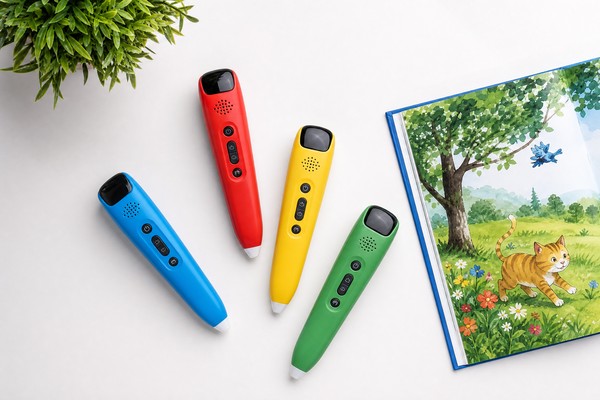
A Picture Book Reading Pen (also called Story Pen, Talking Book Pen, OID Reading Pen) is a handheld electronic device that plays prerecorded audio when the pen tip contacts or scans designated areas of an illustrated book. The device contains at minimum: a contact/optical sensor, microcontroller or SoC, flash memory for audio assets, audio amplifier and speaker, power source (rechargeable battery), and an enclosure shaped for handheld operation.
Primary classroom users and use cases:
– Early years teachers (preschool, kindergarten): shared group listening, teacher-led sessions, listening corners.
– Primary school classrooms (Grades 1–3): independent reading stations, literacy interventions, EAL/ESL support.
– Special education settings: individualized audio prompts, multi-sensory learning for students with learning differences.
– Libraries and afterschool programs: durable shared devices for storytime.
Buyer profiles:
– School districts and procurement departments: purchase in batches of 50–5,000 units, prioritize durability, unit cost and warranty.
– Educational product resellers and distributors: require OEM/ODM options, custom branding, content-loading services.
– NGOs and public education initiatives: emphasize low-cost, rugged, long-battery-life devices with basic audio capability.
Operational constraints in classrooms:
– Ambient noise: typical classrooms range 45–70 dBA during instruction; effective audio must overcome noise without exceeding safe listening thresholds for children.
– Group sizes: buying decisions must consider whether the pen will be used by individuals, small groups (3–8 children), or the whole class (20–30).
– Supervision level and wear-and-tear: devices must survive drops (0.5–1.2 m), repeated handling and charging cycles.
Why Demand Is Growing
Drivers of rising demand for story pens in classrooms:
– Literacy initiatives: evidence-based strategies emphasize repeated listening and multi-sensory engagement for early reading skills. Audio-enabled books support phonological awareness and vocabulary acquisition.
– Scalable, low-training technology: teachers can deploy pens quickly without complex AV setups; pens reduce need for large speaker systems or tablets per student.
– Cost pressure on tablets: compared with 1:1 tablet deployments, pens offer a low-cost way to deliver rich audio content and interactive reading experiences.
– Localization and multilingual needs: pens enable quick swapping of language tracks (e.g., English, Spanish, Mandarin), useful in multilingual classrooms.
– Durability and hygiene: compared to shared headphones, single integrated speaker reduces shared contact points and simplifies sanitization.
Market dynamics:
– Unit volumes in education procurement typically fall into the 50–10,000 range per order; as orders scale, OEMs can offer incremental feature sets (Bluetooth streaming, larger batteries, dual speakers) with modest price differentials.
– Supply-side improvements: low-cost MEMS and micro-speaker drivers, efficient Class-D amplifiers, and compact SoCs (Bluetooth + audio) have reduced the incremental BOM cost of adding a second speaker or higher output.
Key Technology Differences
This section translates engineering differences between single- and dual-speaker story pens into functional outcomes for classroom use.
Speaker driver size and type:
– Small handheld pens typically use moving-coil micro-speakers (6–28 mm diameter), or micro full-range drivers. Driver diameter strongly affects SPL capability and low-frequency response.
– Common ranges: 8–12 mm (compact, low cost), 13–20 mm (balanced), 25–40 mm (larger housings for higher output).
– Dual-speaker designs often pair two identical drivers for out-of-phase cancellation control or for left/right stereo; they may also use one mid/woofer + one tweeter arrangement in larger housings (rare in pen form).
Amplification and channels:
– Single-speaker: one amplifier channel (0.5–3 W RMS). Efficient Class-D amps are standard (e.g., 1 W–3 W chips) with 1–2 cell Li-ion battery supply.
– Dual-speaker: either two amplifier channels (stereo) or a bridged mono configuration to increase output into a single combined load. Stereo designs require stereo-capable audio file management and source material.
Acoustic architecture:
– Enclosure coupling: speaker placement relative to the book surface matters. Front-firing drivers with reflective baffles create directional sound; down-firing or side-firing drivers can improve dispersion in crowded settings.
– Ports and acoustic vents influence bass extension and perceived loudness. Small portable enclosures have limited low-frequency response; DSP-based EQ is used to maximize midrange clarity.
– Stereo separation: physical separation of drivers and baffle design determine achievable stereo image. Pen-form factors limit separation; in practice, true stereo imaging is modest unless used with multiple pens or paired pens.
DSP and signal processing:
– Voice-optimized EQ emphasizes 300 Hz–3 kHz band for intelligibility. Bandwidth beyond 8–10 kHz improves sibilance and naturalness but is less critical for comprehension.
– Dynamic range compression and AGC (automatic gain control) can improve perceived loudness in noisy rooms but must be tuned to avoid clipping and over-compression.
– Limiting and peak protection prevent damage and control max SPL for safety.
Connectivity and codecs:
– Local playback: WAV/MP3/Opus files stored in internal flash; codec choice impacts storage needs. Opus offers better low-bitrate speech quality but requires more CPU.
– Bluetooth streaming (optional): allows teacher devices to broadcast audio; Bluetooth Low Energy or classic A2DP options will affect latency and power consumption. SoC choices: nRF52-series (BLE + limited audio), Realtek/Qualcomm (A2DP).
– File management: USB mass storage mode, SD card, or OTA content updates via Bluetooth.
Power and battery management:
– Single-speaker models often target 500–1,200 mAh Li-ion batteries for 6–12 hours of intermittent playback at conservative SPLs.
– Dual-speaker models or higher-output designs require larger cells (1,200–2,500 mAh) to sustain similar battery life.
– Charging: USB-C with 5 V/1–2 A charging is standard; battery protection per IEC 62133 is mandatory for Li-ion cells.
Mechanical durability and ergonomics:
– Housing materials: ABS, PC, or TPE overmolds for grip. Impact resistance tested to 0.5–1.2 m drop heights for education-focused devices.
– Exchangeability: user-replaceable batteries and speaker modules ease maintenance but add manufacturing complexity.
Key Features and Specifications to Evaluate
This is a concise checklist with target spec ranges and testing notes for procurement teams evaluating story pens for classroom use.
Acoustic and electrical specifications
– Frequency response (preferred for speech): 300 Hz–8 kHz (min); extended top-end up to 12–16 kHz desirable for clarity.
– Sensitivity: 85–95 dB SPL @1 W/1 m (or measured at standard test distance relevant to device; manufacturers often quote @0.5 m).
– Maximum SPL (continuous): design so that normal operation does not exceed 85–90 dB(A) at 0.2–0.5 m. Implement software limiting for transients.
– Output power:
– Single-speaker classroom pen: 0.5–2.0 W RMS
– Dual-speaker pen (higher output): 1.0–3.0 W RMS per channel (or combined bridged mono output)
– THD (total harmonic distortion): <5% at typical operating levels (1 kHz tone) for intelligible voice reproduction.
– SNR (signal-to-noise ratio): >70 dB preferred to avoid hiss in quiet rooms.
– Stereo separation (for dual-speaker): >15–20 dB mid-band if stereo imaging is a requirement.
Driver and enclosure
– Driver diameter choices: 8–12 mm (compact), 13–20 mm (balance), 25–40 mm (higher output, larger pen).
– Enclosure IP rating: IPX0–IPX4 common; specify IPX4 or higher if frequent exposure to spills or washable features are needed.
– Impact rating: pass 0.5 m drop on concrete for standard units; 1.0 m+ for ruggedized models.
Power and runtime
– Battery type: Li-ion or Li-Po cell with protection circuit; IEC 62133 compliance.
– Typical battery capacities and run times:
– 600–900 mAh → 6–10 hours low-to-moderate use
– 1,200–2,500 mAh → 10–20 hours depending on SPL and duty cycle
– Standby power: <10 mA preferred to conserve battery when not in use.
Connectivity and content handling
– Onboard storage: 8–32 GB recommended depending on audio compression and content scope (MP3 @96–128 kbps for speech).
– Interfaces: USB-C (data + charging), optional microSD slot.
– Content management: bulk flashing services, USB bulk copy, or OTA updates via Bluetooth.
Durability and serviceability
– Expected lifecycle: 2–4 years typical under school use. Replaceable speakers or battery recommended for long-term TCO.
– Warranty: 12–24 months standard; specify extended warranty or repair rates for larger contracts.
Compliance and safety
– Electrical and battery: CE, FCC, RoHS, IEC 62133/UN38.3 for Li-ion cells.
– Toy standards (if marketed as toys): EN 71-1/EN 71-3 (Europe), ASTM F963 (US) where applicable.
– Acoustic safety: internal limits or software to cap output; documentation of measured SPLs at specified distances.
Manufacturing and supply chain
– MOQ and lead times: typical consumer-electronics OEMs accept MOQs of 1,000–5,000 units; ODMs in China may accept smaller MOQs at higher unit costs.
– MOQ impact on features: Bluetooth, dual-speaker, custom housing and branding may add to lead-time and minimum order sizes.
Testing and acceptance criteria
– Factory audio test: measure SPL, distortion, frequency response, and channel balance (for dual-speaker) per unit or sample-based lot testing.
– Mechanical test: drop, button-actuation cycles, and connector durability tests.
– Battery test: cycle life (≥300 cycles to 80% capacity), vendor certification.
Pros and Cons
Direct comparison of single- vs dual-speaker configurations with measurable outcomes.
Single-speaker configurations
Pros
– Lower BOM and assembly cost: savings on driver, amplifier channel, PCB routing and calibration.
– Simpler firmware and content requirements: mono content management reduces complexity.
– Lower power consumption: one amp channel and one driver typically extend battery life for the same battery capacity.
– Smaller or slimmer form factor possible: easier to design pen-shaped housings and lighter units for small hands.
– Easier compliance testing and QC: fewer audio channels to validate.
Cons
– Limited SPL and coverage for larger groups or noisier classrooms; may require higher-powered single driver which increases cost and size.
– No stereo imaging: less immersive sound effects and limited ability to present spatialized audio.
– Single point of failure: speaker damage renders unit silent unless repairable.
Dual-speaker configurations
Pros
– Higher achievable SPL: two drivers can deliver 3–6 dB greater output (depending on placement and phasing), useful for larger groups or ambient noise.
– Stereo/panned effects: enables spatialized audio and more engaging soundscapes when content is mixed for stereo, or when two pens are used in pairs.
– Redundancy: if one driver fails, unit may still produce audio albeit with reduced output.
– Improved perceived fidelity: with proper DSP and enclosure, two drivers can better cover mid/high bands and produce a fuller sound.
Cons
– Higher BOM and manufacturing cost: additional driver, amplifier channel, larger PCB and power consumption.
– Increased complexity: firmware must support stereo content or bridged mono; testing and content production costs rise.
– Form-factor constraints: to achieve stereo separation you need lateral spacing or larger housings; in pen-shaped devices effective separation is limited.
– Battery drain: two drivers / amplifier channels reduce runtime unless battery capacity is increased, which adds weight and cost.
Practical trade-offs
– If primary requirement is speech intelligibility in small to moderate groups, single-speaker is the cost-optimized choice.
– If use cases include whole-class listening without external amplification, or if content relies on stereo cues for pedagogy, dual-speaker designs deliver measurable benefits but increase unit cost and complexity.
Step-by-Step Decision Guide
This checklist converts classroom requirements into a procurement decision with scoring to choose single or dual speaker designs.
Step 1 — Define primary use case and target group size
– Individual/small group (1–8 children): single speaker preferred.
– Medium group (9–15 children): single speaker with higher-output driver or dual speaker if noise/coverage problems exist.
– Whole class (16–30+ children): dual-speaker or external paired pen systems recommended.
Step 2 — Measure classroom acoustic environment
– Record daytime ambient noise (dBA) at typical usage location. Use a smartphone dB app as a rough indicator; seek lab measurements if within 5 dB of threshold.
– Target perception margin: desired speech SPL at listener positions = ambient dBA + 10–15 dB to ensure intelligibility.
– If ambient is 60 dBA and you need 75 dBA at 2–3 m, choose designs capable of sustained output matching that requirement.
Step 3 — Specify required SPL and coverage radius
– Define measurement distance (0.5 m, 1 m, 2 m). SPL specs must reference distance.
– Required continuous output example: 75–80 dBA at 1 m for small groups; 80–85 dBA at 2–3 m for larger groups.
Step 4 — Evaluate content format and pedagogy
– Mono speech recordings: single speaker sufficient.
– Stereo-rich audio with panning: dual speakers provide value.
– If content will frequently be streamed by a teacher device, ensure Bluetooth A2DP support and low-latency options.
Step 5 — Define battery life target and duty cycle
– Estimate average daily playback minutes per device and desired days between charges.
– Use power budget: example, a single-speaker pen consuming 0.8–1.2 W average may run 8–12 hours on a 1,000 mAh battery; a dual-speaker design may require 1,800–2,500 mAh for similar runtime.
Step 6 — Durability and maintenance policy
– If devices are shared across classes or high-turnover settings, require replaceable speakers/batteries, reinforced housings, and at least 12–24 months warranty with defined RMA terms.
Step 7 — Cost/benefit scoring
– Build a simple matrix and assign weights to criteria: speech intelligibility (30%), coverage (25%), battery life (15%), durability (15%), cost (15%).
– Score single and dual options on each criterion and compute weighted totals to determine fit.
Step 8 — Procurement test batch
– Order small pilot lot (20–100 units) of shortlisted models for classroom trials. Insist on:
– Factory measurement reports for SPL, THD, frequency response.
– Sample destructive and lifecycle tests.
– Content-loading and firmware update procedure documentation.
Step 9 — Scale sourcing
– Use pilot data to finalize specs. Negotiate MOQ, lead time, and penalties for out-of-spec deliveries.
– Include spare parts (speakers, batteries) in initial order to reduce downtime.
Pricing and Cost Analysis
This section provides benchmark BOM and unit pricing estimates to inform procurement negotiations and TCO modeling. All numbers are approximate and intended as procurement guidelines. Prices vary by component quality, supplier geography, and order volume.
Typical BOM cost breakdown (single-speaker, 5,000–20,000 MOQ)
– Speaker driver (8–20 mm): $0.20–$1.20
– Amplifier IC (Class-D single channel): $0.40–$1.00
– SoC/microcontroller (audio playback): $1.20–$3.50 (higher for Bluetooth-capable SoCs)
– Flash memory (8–16 GB): $0.70–$1.50
– Battery (600–1,200 mAh Li-ion): $1.00–$2.50
– Enclosure and mechanical parts: $0.50–$1.50
– PCB & passive components: $0.40–$1.20
– Assembly & test: $0.50–$1.50
– Packaging and documentation: $0.15–$0.60
Estimated FOB unit cost: $4.15–$13.00
Incremental BOM cost to move to dual-speaker
– Second speaker driver: +$0.20–$1.20
– Second amplifier channel or stereo amp: +$0.40–$1.50
– Additional PCB real estate and routing: +$0.10–$0.50
– Increased battery capacity (to maintain runtime): +$0.50–$2.00
– Firmware and testing overhead: +$0.10–$0.40
Estimated incremental cost: $1.30–$5.60
Retail and institutional price tiers (indicative)
– Basic single-speaker EDU pen (mass-market): $8–$18 retail; institutional unit price often $5–$12 depending on volume.
– Mid-tier single-speaker with robust case and larger battery: $18–$35 retail; institutional unit price $12–$22.
– Dual-speaker or higher-output EDU pen: $25–$60 retail; institutional price $18–$40.
– Premium packages (content licensing, custom branding, management portal): incremental $3–$12 per unit plus possible SaaS fees.
Total Cost of Ownership (TCO) factors
– Maintenance and replacements: plan for 5–15% annual replacement depending on usage intensity.
– Content costs: budgeting for audio production, localization, and updates—expect $0.5–$5.0 per hour of produced audio depending on language and talent.
– Training and deployment: initial teacher training and device management can add to first-year costs.
– Spare parts and repair: keep 5–10% of unit count in spare batteries and spare speaker modules for 2–4 year deployments.
Negotiation levers
– MOQ and lead time: higher MOQs reduce per-unit costs; negotiate staggered deliveries to manage inventory.
– Component alternates: specify acceptable alternatives for key chips to avoid single-supplier price exposure.
– Warranty and RMA terms: include clear SLAs for repair turnaround, replacement coverage for drop and water damage if required.
Competitive Landscape
Supplier categories and capabilities
- Low-cost generic OEMs (mainland China)
- Strengths: lowest unit costs, high-volume production capacity, fast prototyping.
-
Weaknesses: variable QC, limited IP protection, customization may require high MOQs.
-
Mid-tier educational electronics suppliers
- Strengths: product design for education use (rugged housings, user-friendly interface), reasonable QC processes, content-loading services.
-
Weaknesses: higher price than generic OEMs; may still require moderate MOQs.
-
Premium/Branded educational manufacturers (global)
- Strengths: strong content partnerships, certified to educational standards, extended warranties and support, established service channels.
-
Weaknesses: significantly higher unit cost, longer lead times for custom hardware.
-
ODM with integrated content and cloud management
- Strengths: turnkey solutions (hardware + content + device management), good for large-scale deployments and subscription models.
- Weaknesses: vendor lock-in, potentially higher recurring costs.
Component supplier landscape
– Speaker drivers: multiple factories in Zhejiang and Guangdong provinces produce micro-speakers in the 8–40 mm range.
– Amplifier ICs: Texas Instruments, STMicroelectronics, Maxim, and smaller Chinese vendors provide Class-D amps at different price/performance points.
– SoC/MCU: Nordic (nRF series), Realtek, Actions Semiconductor, and various Chinese SoCs target different connectivity and audio needs.
– Battery suppliers: established cell makers supply IEC 62133-certified cells; choose reputable vendors to avoid safety liabilities.
Content production and licensing partners
– Local audio studios specializing in children’s voice talent and localization.
– Educational publishers licensing book content; negotiations should include usage rights for audio playback and any digital distribution.
Market positioning considerations
– Price-sensitive buyers will favor single-speaker models with proven durability.
– Buyers prioritizing engagement and high-fidelity audio for immersive content should consider dual-speaker or paired-device solutions, but must budget for higher costs and content requirements.
What Buyers Say
Synthesized feedback from school procurement managers, teachers, and resellers after pilots and deployments.
Positive feedback trends
– Teachers value simplicity: devices that “just work” with minimal setup and dependable audio levels.
– Battery life and charging logistics are critical: units that last multiple class sessions without requiring constant charging are favored.
– Rugged designs and warranty support reduce administrative overhead for IT/maintenance teams.
Common complaints and failure points
– Volume and intelligibility: low-cost single-speaker devices sometimes fail in noisy classroom contexts; speech becomes muddy at long distances.
– Charging infrastructure: chargers and cables are often lost or failed; centralized charging trays and labeled cables recommended.
– Content management: updating audio en masse is a pain point; buyers want bulk-flash or OTA provisioning.
– Durability: cheap speaker grills and brittle plastics fail under repeated drops; buyers request reinforced housings and serviceable components.
User preferences on speaker configuration
– Small-group users (teachers for reading corners) prefer compact, lightweight single-speaker pens.
– Whole-class pilots frequently reported that single-speaker pens required repetition or louder volumes; dual-speaker pens were judged better for whole-class but at a higher price.
– Stereo content was described as “nice-to-have” but not mission-critical for early literacy; teachers prioritize clarity over immersive sound.
Service and supplier expectations
– Clear QA documentation, factory test records, and reasonable RMA turnaround are consistently ranked as important to buyers.
– Buyers prefer suppliers offering spare parts kits, user manuals that include basic audio calibration guidance, and simple content-upload workflows.
Safety, Maintenance and Compliance
Regulatory and safety checklist for procurement and acceptance testing.
Electrical and battery safety
– Batteries: require IEC 62133 compliance for rechargeable cells. Shipping must comply with UN38.3 for air transport of lithium batteries.
– Charging: choose chargers and cables meeting applicable regional standards (CE for EU, FCC for US) and incorporate overcharge and thermal protection circuits.
– EMC: ensure devices pass EMC testing for interference (EN 55032/55035 or FCC part 15 as applicable).
Toy and child-safety regulations
– If marketed as a toy: EN 71 series (mechanical/physical properties EN71-1, flammability EN71-2, and migration of harmful elements EN71-3) in Europe; ASTM F963 in the US.
– Surface coatings and plastics must comply with RoHS and local chemical content restrictions (e.g., phthalates bans).
Acoustic safety and hearing protection
– Set maximum output levels and document measured SPL at specified distances. Recommended design practice:
– Implement software limiters to restrict continuous output to below 85–90 dB(A) measured at 0.2–0.5 m depending on local regulation and exposure assumptions.
– Provide user documentation on recommended maximum volume settings and safe listening practices.
– Consider hearing-sensitive users and those with special needs; provide content mixing and teacher controls to manage levels.
Mechanical and environmental
– Enclosures should pass drop tests from at least 0.5 m; education-grade units should target 1.0 m.
– For washable or spill-resistant units, seek at least IPX4 rating; fully waterproof (IP67) requires different sealing and serviceability trade-offs.
Maintenance best practices
– Establish charging stations with labeled ports to reduce cable loss and damage.
– Maintain an inventory of spare speakers and batteries equal to 5–10% of deployed units to minimize downtime.
– Schedule firmware updates and content pushes during off-hours; prefer OTA mechanisms when available.
– Provide teachers with simple troubleshooting guides: reset procedures, battery status LEDs, and contact RMA instructions.
Documentation and traceability
– Require suppliers to provide batch-level QC reports for audio performance, battery cells certificates, and materials safety data sheets (MSDS) for plastics and finishes.
– Keep a documented test protocol and acceptance criteria for SPL, frequency response, battery capacity, drop testing results, and EMC certificates.
Frequently Asked Questions
Q: Do I need a dual-speaker pen to improve clarity for my class?
A: Not necessarily. For most classroom contexts where speech intelligibility is key, a single-speaker pen engineered with a high-sensitivity driver, voice-optimized EQ and efficient amplification will be sufficient for small to medium groups. Dual speakers mainly benefit coverage radius, perceived loudness, and stereo effects.
Q: How do I compare SPL claims from suppliers?
A: Ensure SPL specs include test distance and measurement conditions (e.g., 1 W input, measured at 0.5 m). Prefer suppliers that provide full frequency-response curves, THD figures at specified SPL levels and sample measurement reports under IEC or ANSI standards.
Q: What battery capacity should I specify?
A: Work from your duty cycle. For typical school day usage (30–90 minutes per device daily), a 600–1,200 mAh battery will suffice for single-speaker models. For dual-speaker or whole-class heavy use, specify 1,500–2,500 mAh cells.
Q: Are stereo files necessary?
A: Not for basic reading content. Stereo is valuable when content includes directional sound effects or spatial cues used pedagogically. Mono files are smaller, cheaper to produce, and simplify device management.
Q: What SLA terms should I demand?
A: Minimum 12-month warranty with defined RMA procedures and turnaround times (e.g., 15–30 business days). For large deployments, request spare-unit pools and on-site repair options.
Q: How much does adding a second speaker increase cost?
A: Incremental BOM impact typically ranges from $1.30 to $5.60 per unit depending on driver quality, amplifier choice, and battery needs. Final unit price impact will also include higher shipping and potentially increased warranty reserves.
Q: How should I manage content localization and updates?
A: Negotiate content-loading services with your supplier or select a pen that supports USB mass-flashers or OTA updates. Budget for production costs of voice talent and localization per language track.
Q: What environmental or disposal rules apply?
A: Li-ion batteries and electronic components are subject to e-waste regulations. Provide end-of-life recycling instructions and consider buy-back or recycling programs if required by local law.
Contact Toyvao
For procurement support, technical specifications review, pilot coordination, and sourcing multiple OEM/ODM options, contact Toyvao:
- Email: sourcing@toyvao.com
- Website: https://www.toyvao.com/sourcing
- Supply chain services: request a sourcing dossier including BOM alternatives, factory QC checklists, and sample pilot plan.
Provide your target order volume, required delivery timeline, classroom use case (group size, ambient noise), and any mandatory regulatory or content requirements. Toyvao will return a tailored supplier shortlist, estimated landed cost, and recommended acceptance-test protocol within 3–5 business days.
