
Executive Summary
This guide explains the US regulatory requirements that matter for Picture Book Reading Pens (also called Story Pens, Talking Book Pens, OID Reading Pens) intended for children. It focuses on the three regulatory pillars buyers and manufacturers must manage: FCC radio and electromagnetic requirements, the Consumer Product Safety Improvement Act (CPSIA) obligations for children’s products (third‑party testing, lead/phthalates, tracking labels, certifications), and ASTM toy‑safety rules (primarily ASTM F963). It also covers related battery and transport standards (UN38.3, IEC/UL 62133), button/coin‑cell hazards, COPPA/data privacy when pens connect to apps, and practical supply‑chain controls.
Key takeaways:
– Classify the pen early: Is it a purely audio, passive OID pen with no RF, or an active device with Bluetooth/Wi‑Fi or microphone/recorder? RF presence changes the compliance pathway and cost materially.
– Mandatory CPSIA obligations apply to all products marketed as children’s products in the US: third‑party testing from a CPSC‑accepted lab, a Children’s Product Certificate (CPC), and permanent tracking information on product or packaging.
– ASTM F963 (toy safety) governs mechanical hazards, small parts, battery enclosures, flammability and chemical limits; follow it as the practical standard the CPSC enforces.
– FCC compliance is required for any device with digital circuitry or RF emissions. Use pre‑certified radio modules to reduce FCC cost and time.
– Batteries are a frequent failure and recall root cause—design compartments, cell chemistry, and shipping documentation to meet IEC/UL 62133, UN38.3 and CPSC guidance on button/coin cells.
– Plan for combined testing costs: expect $2k–$10k per SKU for CPSIA/ASTM chemistry and mechanical testing; FCC certification for intentional radiators commonly runs $8k–$25k; battery transport and safety tests another $2k–$10k. Factor recurring production testing and lab sampling.
This guide gives the technical differences, compliance steps, testing and labeling specifics, cost ranges, and a practical decision flow buyers can use when sourcing story pens for the US market.
What Is Picture Book Reading Pen and Who Uses It
Product definition
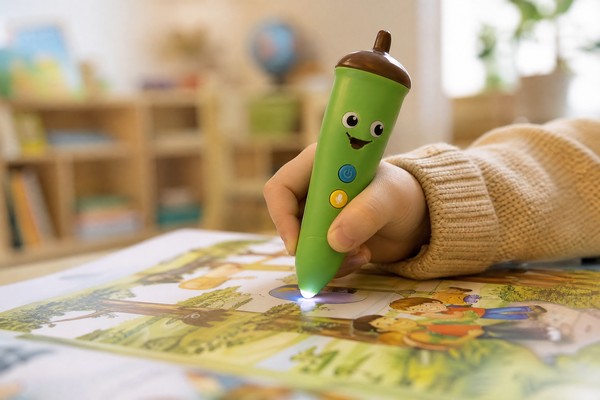
– Story Pens / Picture Book Reading Pens: handheld electronic pens that produce spoken audio (narration, sounds, music) when their tip or sensor is tapped on specially printed picture books or storyboards.
– Common internal components: microcontroller, flash memory (audio files), DAC/audio codec, loudspeaker (0.5W–2W typical), microphone (optional), battery (Li‑ion, LiPo, NiMH, or AA/AAA), optical sensor or infrared/reflective reader for printed markers (OID/dot pattern or barcode), and possibly RF modules (Bluetooth LE 4.0/5.0, Wi‑Fi 802.11 b/g/n).
– Variants:
– Passive OID-only pens: no wireless connectivity; read encoded pattern on paper to play local audio.
– Connected pens: Bluetooth or Wi‑Fi capable; synchronize with apps, stream or download audio, or collect usage data.
– Recording pens: include microphone and storage for voice recording/playback.
– RFID/NFC‑enabled pens: read embedded tags in books.
Primary users and buyers
– Publishers (children’s book and educational content publishers).
– Toy brands and private‑label manufacturers (mass‑market and specialty).
– Educational institutions and early‑learning centers (bulk purchases).
– Distributors and retailers (online and brick‑and‑mortar).
– ODM/contract electronics manufacturers (suppliers that design and build the devices).
End‑users
– Children from newborn to 8–9 years, but age‑grading typically targets 0–3 and 3–8 categories; age grading dictates applicable mechanical and small‑parts tests.
Why Demand Is Growing
Several structural and market drivers explain growth for story pens in the US:
– Early literacy emphasis: education policy and parental investment in pre‑K literacy tools support demand for interactive audio story products that reinforce vocabulary and phonics.
– Hybrid digital‑physical learning preference: parents and educators prefer devices that combine tactile books with digital audio rather than screen‑based learning, due to concerns about screen time.
– Globalized content and bilingual education: story pens make it practical to supply multilingual audio without reprinting books; useful for Spanish/English dual‑language households.
– Evolving price points and feature sets: sub‑$20 basic pens and mid‑range ($30–$80) connected pens widen the addressable market.
– Supply chain maturity: established ODMs in Asia can deliver complete solutions with OID printing and pre‑loaded audio content, lowering barriers to entry for publishers.
Implication for buyers
– Increased competition among suppliers reduces lead times but increases regulatory scrutiny; retailers and platforms (Amazon, Walmart) require documentation of CPSIA compliance and lab reports before listing children’s electronic toys.
– Buyers must align product features (connectivity, battery type, recording capability) with compliance cost and timelines.
Key Technology Differences
Hardware architecture
– Microcontroller vs embedded Linux:
– Low‑cost pens use MCUs (ARM Cortex‑M0/M3/M4) with onboard flash for audio. No exposed OS; simpler certification for emissions.
– High‑end pens that support complex user interfaces or multiple codecs may run embedded Linux on ARM A‑class SoCs to support higher audio sampling rates, streaming, and OTA firmware updates.
Audio sampling and memory
– Audio sampling rates: 8 kHz (telephony quality), 16 kHz (voice clarity), 44.1 kHz (music‑grade). Choose sampling rate per content quality requirement; higher rates increase memory needs.
– Typical on‑board flash: 8 MB–64 MB for pre‑recorded content; 128 MB–32 GB if the pen stores large libraries or supports user recordings.
Sensors and identification
– OID/dot‑pattern optical readers: pen reads an invisible printed pattern and maps coordinates to audio files. Requires precise printing and registration; no RF.
– Barcode/QR readers: lower cost but require visible codes and precise placement.
– RFID/NFC tags: read distance is limited; useful for embedded tags in thicker board books.
Connectivity
– No RF: simpler path—comply with CPSIA/ASTM and EMC for unintentional emissions.
– Bluetooth LE (BLE): requires FCC Part 15 certification for intentional radiators. Use pre‑certified modules (Grants/Listing) to limit testing to module integration or perform modular approval and then final product approval for spurious emissions and antenna‑port evaluation.
– Wi‑Fi: higher FCC testing cost; also introduces more stringent security/privacy obligations if collecting data.
– USB/OTG: devices exposing USB may be treated as computing devices by FCC (digital circuitry emissions testing) and ASTM for accessible ports.
Batteries and charging
– Primary vs rechargeable:
– Disposable (AA/AAA): mechanical design must prevent swallowing of batteries in products for under‑3 use; compartments must be secured.
– Rechargeable lithium‑ion/lithium polymer: require compliance with IEC/UL 62133 for cell safety and UN38.3 for transport. Charging circuitry must include overcharge, short‑circuit and thermal protections.
– Charging interfaces: micro‑USB legacy, USB‑C increasingly common; follow current electrical safety/EMC rules.
Firmware and security
– Firmware update path: OTA (over BLE or Wi‑Fi) requires secure boot/DFU and integrity checks.
– Data collection: pens that store or transmit usage data or audio involving children invoke COPPA obligations (see Safety, Maintenance and Compliance).
Key Features and Specifications to Evaluate
Regulatory and safety‑driven product requirements
– Age grading: define intended age range (e.g., 0–3, 3–6, 6–8). Tests and mechanical requirements vary by age group.
– Small parts: ASTM F963 small‑parts cylinder test; devices or detaching components intended for children under 3 must pass small‑parts checks.
– Button/coin batteries: battery compartments for products intended for children under 8 must be secured with a tool (screw) or be otherwise inaccessible; labeling and use of child‑resistant packaging required per CPSC guidance.
– Lead and heavy metals: CPSIA mandates third‑party testing for lead content and other banned elements in accessible materials. For paint/coating, current enforcement targets limits in the low parts per million (ppm) range; verify with a CPSC‑accepted lab for current numeric thresholds (typically 100 ppm or less depending on the test and year of enforcement).
– Phthalates: six phthalates (DEHP, DBP, BBP, DINP, DIDP, DnOP) are restricted at concentrations above 0.1% (1,000 ppm) in children’s toys/childcare articles.
Electrical and EMC specifications
– FCC requirements:
– Unintentional radiators (digital circuits) must meet FCC Part 15 Subpart B radiated and conducted emissions limits and the ANSI C63.4 measurement procedure.
– Intentional radiators (Bluetooth/Wi‑Fi) must meet Part 15 Subpart C rules; certification through a Telecommunication Certification Body (TCB) is typically required. Use pre‑certified modules (modular approval) to reduce cost and simplify integration.
– EMC/ESD immunity and surge: design for ESD contact ±4 kV and air ±8 kV; surge concerns smaller but relevant if external power or USB charging is present.
Mechanical and acoustic specs
– Speaker output: typical loudspeaker 0.5W–2W; acoustic output level should be limited to safe levels for children (follow ANSI/ASA S12.10 or local guidance): many buyers target ≤85 dB(A) at 0.5 m as a design target for continuous exposure. Include user volume limiters and warnings.
– Tip design and materials: pens must have no sharp points or protrusions, and the tip must withstand drop and torque tests per ASTM F963.
Software and privacy
– COPPA/data security: pens that collect or transmit personal data on children under 13 must implement parental notice/consent and data protection measures. Apps associated with pens must include a clear privacy policy and parental controls.
– OTA updates: require cryptographic signing and rollback prevention to prevent compromise.
Supply‑chain traceability
– CPSIA tracking label requirements: include manufacturer/importer name, location, phone number or website, the date of manufacture (month/year), batch/lot or run number, and detailed description of the product. Must be permanently affixed to product or packaging where feasible.
Pros and Cons
Pros
– High engagement: physical/digital hybrid format tends to increase parent/child interaction relative to screen‑only apps.
– Differentiated product: content bundling and language features can create strong SKU differentiation.
– Lower returns on content: once audio is produced it can be reused across SKUs with minor localization.
– Scalable hardware: using pre‑certified modules and off‑the‑shelf SOCs speeds time‑to‑market.
Cons / Compliance pain points
– Multi‑discipline testing: device spans electronic emissions (FCC), chemical testing (CPSIA/ASTM), battery safety and transport testing—coordination across several labs and schedules.
– Batteries: Lithium batteries add testing and shipping complications and are a leading source of recalls if design is inadequate (overheating, short circuit, button battery ingestion).
– Data/privacy exposure: connected pens require COPPA compliance and secure firmware, increasing development and legal costs.
– Tradeoffs between feature and cost: adding Bluetooth/Wi‑Fi bumps certification costs by an order of magnitude and adds recurring testing and labeling obligations.
– Labeling and documentation: CPCs, tracking labels, lab reports, and record retention create administrative overhead and must be maintained for each SKU and production lot.
Step-by-Step Decision Guide
Step 1 — Define product class and age grade
– Decide age grading (e.g., 0–3 vs 3–8). If under‑3, design to stricter mechanical & small parts limits and button/coin battery access rules.
– Identify whether the pen will have RF connectivity, microphones, or recording.
Step 2 — Choose hardware strategy
– If no connectivity is needed, favor a simple MCU architecture, sealed battery compartments, and no microphone.
– If Bluetooth/Wi‑Fi is required, select pre‑certified radio modules with documented FCC grants (modular approvals) and documented antenna specifications. Confirm module integration guide and required testing scope.
Step 3 — Chemical and mechanical design controls
– Specify materials with restricted substances declarations (RSL) from suppliers covering lead, phthalates, and heavy metals.
– Design battery compartments with child‑resistant screws or require a tool to open; implement tip retention and small‑part retention features.
– Implement acoustic limits and test to intended dB targets.
Step 4 — Select test labs and pre‑production testing
– Engage a CPSC‑accepted third‑party lab for CPSIA testing (lead, phthalates, other ASTM F963 chemical tests).
– For mechanical and battery tests, choose labs experienced in ASTM F963 and UN38.3/IEC 62133 testing.
– For devices with digital circuitry or RF, appoint an accredited EMC lab for FCC Part 15 testing and certification; ensure they can submit to a TCB if certification is needed.
Step 5 — Pre‑production verification
– Run a small pilot production run and test representative samples for full compliance scope: mechanical, chemical, battery, EMC, and radio spurious emissions.
– If using a pre‑certified module, perform “integration” tests: antenna pattern check, spurious emissions due to enclosure, and any required platform tests noted in module grant.
Step 6 — Documentation and certification
– Obtain lab test reports and issue a Children’s Product Certificate (CPC) that references the test reports and lists all applicable rules and standards.
– Prepare the CPSIA tracking information for product and packaging.
– For FCC-certified devices, mark the product with the FCC ID and include required user manual statements.
Step 7 — Production quality controls
– Implement incoming inspection for raw materials and components, including battery supplier certificates and random chemical screening.
– Establish a sampling plan for periodic production testing (often 1%–5% of production lots depending on supplier reliability and risk).
Step 8 — Post‑market monitoring and corrective action
– Track customer complaints and incidents; have an incident triage process linked to supply‑chain corrective action.
– Keep documentation updated for each lot in case of audits or retailer requests.
Decision shortcuts
– If you want to minimize certification cost/time: avoid RF; use AA/AAA batteries if age allows; use pre‑verified components; and select suppliers with existing CPSC/ASTM test history.
– If connectivity is essential: contract with an ODM experienced in FCC modular integration, and budget for higher testing and legal costs.
Pricing and Cost Analysis
Typical cost components and approximate ranges (ballpark estimates to plan budgets; actual quotes will vary by supplier and lab):
Bill of Materials (per unit, typical ranges)
– Low‑end MCU pen (no RF, basic speaker): $3–$8 BOM.
– Mid‑range pen (better speaker, OID sensor, rechargeable cell, basic MCU): $8–$18 BOM.
– Connected pen (BLE module, higher‑capacity battery, better audio components): $15–$40 BOM.
One‑time compliance testing and certification (per SKU)
– CPSIA third‑party testing (lead, phthalates, soluble heavy metals, full ASTM F963 chemical panel): $1,000–$5,000 depending on sample count and scope.
– ASTM F963 mechanical testing (battery tests, small part, flammability, drop tests): $1,000–$4,000.
– FCC testing:
– Unintentional radiator (digital emissions): $2,000–$8,000.
– Intentional radiator (Bluetooth/Wi‑Fi) with certification: $8,000–$25,000 including lab testing and TCB fees; using a fully pre‑certified module can reduce this to $2,000–$6,000 for final verification.
– Battery testing:
– IEC/UL 62133 (cell and pack safety testing): $2,000–$6,000.
– UN38.3 transport testing (required for air/sea transport of lithium cells): $2,000–$8,000.
– COPPA/legal review and privacy policy drafting (if app collects child data): $1,000–$5,000 depending on counsel and complexity.
Recurring and indirect costs
– Production QC and sample testing per lot: $300–$1,500 per lot sample.
– Labeling and documentation management; CPC maintenance and retesting after design changes.
– Recall insurance, registration services, and potential cost of regulatory remediation if non‑compliance is found.
Cost tradeoffs
– Pre‑certified radio modules increase unit BOM slightly but reduce FCC certification costs and time to market substantially.
– Using alkaline replaceable batteries can avoid UN38.3 costs but may increase warranty/returns due to battery life and lack of sealed charging safety.
Return on compliance investment
– Non‑compliance risks include retailer delisting, regulatory fines, forced recalls (recall costs often exceed $500k for a mid‑sized recall), reputational damage, and shipment holds at US ports.
– Proper compliance reduces these risks and speeds onboarding to large retailers that require documentation as part of vendor approval.
Competitive Landscape
Ecosystem categories
– OEM/Brand owners: Established children’s electronic brands and education publishers who either design in‑house or work with ODMs.
– ODM contract manufacturers: Electronics manufacturers in Asia that can deliver combined hardware, firmware, and book printing (OID) turnkey solutions.
– Module suppliers: Bluetooth/Wi‑Fi module vendors that offer FCC modular approvals and integration guides (using these modules reduces certification cost).
– Test labs and TCBs: Accredited labs for CPSIA/ASTM testing and telecommunications certification bodies for FCC grants.
– Content providers: Audio production houses and localization vendors for multi‑language audio production.
Supplier selection criteria
– Regulatory track record: suppliers with prior US toy certifications, sample CPSC/CPC history, and audit trails.
– Component sourcing stability: long‑lead components (speakers, battery cells, BLE modules) must have multiple approved sources.
– Documentation discipline: suppliers that consistently provide C of C, TDS/MSDS, ROHS declarations, and batch tracking.
Market dynamics
– Many toy buyers source devices from China ODMs; regional suppliers in SE Asia and Eastern Europe exist for smaller volumes and faster tooling turnaround.
– Large retailers increasingly require not only compliance documentation but also electronic submission of certificates and lab reports to vendor portals.
Differentiation strategies
– Brands focusing on safe, no‑RF, robust battery designs can enter market with lower compliance overhead and appeal to conservative buyers.
– Feature differentiation through higher audio quality (44.1 kHz), broad language libraries, or durable industrial design can command higher price points but increase BOM and testing.
What Buyers Say
Common buyer requirements and lessons learned from procurement professionals:
– “Pre‑certified modules save us $10k–$15k and 3–6 months on FCC approvals.” — Preference for integration of modular radios and documented antenna specs.
– “Battery safety failures are the #1 cause of recalls; insist on IEC 62133 and UN38.3 test certificates from the cell supplier.” — Buyers require supplier documentation and periodic retesting.
– “Third‑party lab reports must match the SKU exactly; cosmetic differences or a different PCB revision triggers new testing.” — Rigid demand for matching lab sample to production SKU.
– “Retailers and marketplaces demand CPCs and CPSIA test reports before listing; no exceptions.” — Buyers prioritize suppliers that can provide full paperwork.
– “We insist on COPPA-compliant apps and data minimization if the pen pairs to a mobile app.” — Privacy concerns lead buyers to block products with poor data practices.
Operational preferences
– Suppliers that include a compliance pack with CIF shipment (CPC, test reports, supplier declarations, material certificates, battery certificates, UN38.3) accelerate retailer onboarding.
– Buyers often require a warranty and incident response SLA with the manufacturer.
Safety, Maintenance and Compliance
Safety design and labeling requirements
– Battery compartments: use secured screws or tool‑required access for button/coin batteries and for devices intended for young children. Label with battery ingestion warnings.
– Acoustic safety: limit sustained sound pressure; include user instructions for safe listening durations and distance.
– Chemical safety: all accessible materials should be validated against CPSIA/ASTM chemical panels; maintain material certificates and supplier declarations.
– Small parts and mechanical hazards: design to pass ASTM F963 drop, torque, and tension tests that simulate child use.
Maintenance guidance for end‑users
– Provide clear user manual instructions on battery insertion, charging procedures, and avoidance of exposure to moisture.
– For rechargeable devices, include charging times, recommended chargers, and end‑of‑life battery recycling guidance.
Regulatory compliance maintenance
– Record retention: keep test reports, CPCs, certificates of conformity, and supplier declarations for the lifetime of the product in the market; CPSC may request documentation after incidents.
– Change control: any change in BOM, supplier, PCB layout, enclosure, antenna, or battery chemistry requires reassessment and usually partial re‑testing.
– Post‑market surveillance: maintain a process to collect incidents, customer complaints, and execute corrective action including voluntary recall procedures if necessary.
Privacy and data protections (if connected)
– COPPA checklist: obtain verifiable parental consent prior to collecting personal information from users under 13; provide a clear, accessible privacy policy; limit data collection and retention to necessary purposes.
– Security controls: use TLS/HTTPS for communications, enforce secure pairing procedures, authenticate OTA firmware updates, and limit PII collected by server APIs.
– App store requirements: mobile apps tied to products must follow Google Play and Apple App Store privacy rules (declaration of data collection and age restrictions).
Logistics and transport
– Lithium battery transport: comply with IATA/IMDG packaging, labeling, and documentation. UN38.3 test report required for shipments containing lithium cells.
– Imports: CBP and CPSC enforcement at port can result in Detention Without Physical Examination (DWPE) if documentation is missing.
Frequently Asked Questions
What specific CPSIA tests are required for story pens?
– A typical test package includes lead content (total lead in substrate and lead in paint/coating), phthalates screening for the six regulated phthalates, and the relevant ASTM F963 soluble heavy metals panel. Mechanical tests per ASTM F963 (small parts, battery compartment, drop tests) are also required. Work with a CPSC‑accepted lab to define the exact panel for your age grade.
Do I need FCC approval if the pen has no Bluetooth or Wi‑Fi?
– Even without RF, digital circuitry in pens often requires EMC testing to FCC Part 15 (unintentional radiator) to demonstrate emissions are within limits. If the product uses no radiating digital electronics and only passive components, verification may be simpler, but most MCU‑based pens will be subject to testing.
Can I use a pre‑certified Bluetooth module to avoid full FCC certification?
– Yes. Using a pre‑certified modular radio can reduce testing and certification burden, but you still must verify that integration (antenna placement, enclosure, power supply) does not create additional spurious emissions. Follow the module manufacturer’s integration and labeling requirements.
What about button/coin batteries?
– Button/coin batteries are high‑risk. If the battery is accessible to children under 8, the compartment must be secured with a tool (screw), and the product must include ingestion warnings. Design to avoid small parts detaching and have clear battery disposal instructions.
How often must I test during production?
– There is no fixed federal frequency, but buyers commonly require periodic lot testing. A typical approach: initial pre‑production full testing, then random sample tests on each production lot for the first several runs, shifting to quarterly or risk‑based frequency once supplier reliability is established.
What happens if my product fails a test after production?
– Coordinate immediately with your supplier, quarantine affected lots, notify stakeholders (retailer, distributor), and work with your lab to understand failure cause. For chemical failures, determine material substitution or supplier remediation; for electrical or battery failures, stop shipments, and consider recall insurance and corrective actions.
How does COPPA affect connected pens?
– COPPA applies when apps or cloud services collect personal information from children under 13. You must provide parental notice, obtain verifiable parental consent for certain data, and limit data collection/retention. Work with legal counsel to implement compliant flows and privacy policy.
Contact Toyvao
For regulatory guidance, supplier sourcing, or to request a compliance readiness assessment for Story Pens intended for the US market, contact Toyvao’s compliance team:
- Website: https://toyvao.com/compliance
- Email: compliance@toyvao.com
- Sales / sourcing inquiries: sourcing@toyvao.com
Provide the following when contacting Toyvao for an assessment:
– Product specification sheet (components, battery type, presence of RF, microphone/recorder).
– Target age grade.
– Bill of materials or preliminary BOM.
– Any prior test reports or supplier declarations.
Toyvao will respond with a compliance requirements checklist, recommended test plan, estimated testing timelines and cost ranges, and a supplier audit checklist tailored to your product configuration.
