
Receiving a “FAIL” report from a third-party testing laboratory is a B2B importer’s worst nightmare. It means production stops, launch dates are missed, and additional costs accrue for redesign and re-testing. Understanding the most common reasons why electronic educational toys like talking flash cards fail certification is crucial for preventing these costly setbacks.
What Are the Most Common Causes of Certification Failure?
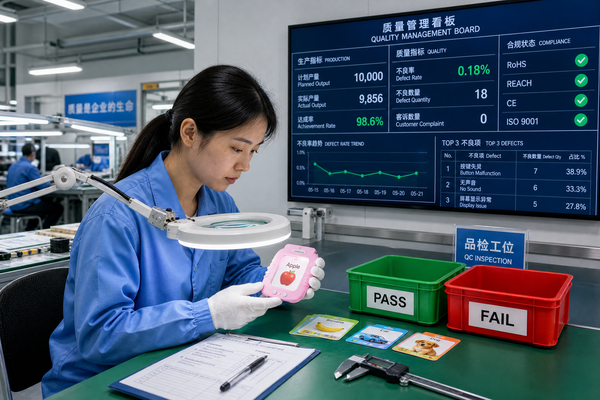
While talking flash cards seem simple, they are complex products combining plastics, electronics, and printed materials, all of which must meet stringent safety standards for children. According to industry data and guidelines from the Toy Association, failures typically fall into three categories [1].
- Chemical Failures (Phthalates and Heavy Metals): This is the most common and often the most expensive failure to fix. Toys must pass strict limits for lead and phthalates under CPSIA (US) and REACH (EU). Failures usually occur because a factory used a cheaper, non-compliant plasticizer in the housing, or the ink used to print the flashcards contained trace amounts of heavy metals.
- Physical and Mechanical Hazards (Small Parts): Toys intended for children under 3 years old must not contain or generate “small parts” that pose a choking hazard. If a talking flash card machine shatters during a drop test, and a piece of plastic or a small button breaks off and fits inside the “small parts cylinder,” it fails.
- Acoustic Hazards (Excessive Volume): The World Health Organization (WHO) and pediatricians warn about the risk of hearing damage from loud toys [2]. Standards like ASTM F963 and EN71-1 have strict decibel limits for toys that emit sound. If the factory uses a cheap, uncalibrated speaker or fails to design a proper acoustic enclosure, the toy will fail the acoustic test.
Common Failure Points and Prevention Strategies
| Failure Type | Root Cause | Prevention Strategy |
|---|---|---|
| Chemical (Lead/Phthalates) | Non-compliant inks or cheap plastic resins | Mandate raw material testing; use only trusted, certified suppliers |
| Mechanical (Small Parts) | Brittle plastic; weak sonic welding; poor structural design | Use high-impact ABS plastic; reinforce internal screw posts; conduct pre-testing |
| Acoustic (Too Loud) | Uncalibrated speaker; lack of volume control | Specify decibel limits in the BOM; design acoustic dampening into the housing |
| Electronic (EMC) | Poor PCB layout causing electromagnetic interference | Ensure experienced electronic engineers design the PCB layout |
How Toyvao Prevents Certification Failures
At Toyvao, we believe that preventing a failure is infinitely cheaper than fixing one. We have implemented a rigorous quality management system designed to guarantee compliance on the first test.
We maintain a strict “Approved Vendor List” (AVL) for all raw materials. Every batch of plastic, ink, and electronic components we receive must be accompanied by a valid compliance certificate before it enters our assembly line. Our acoustic engineers carefully calibrate the speakers in our talking flash cards to ensure clear pronunciation without exceeding safe decibel levels for toddlers. By controlling the supply chain and engineering process tightly, Toyvao ensures that your products pass third-party testing smoothly, allowing you to launch on time and on budget.
References
[1] The Toy Association. “Safety & Compliance.”
[2] World Health Organization (WHO). “Deafness and hearing loss.”
[3] U.S. Consumer Product Safety Commission (CPSC). “Small Parts for Toys and Children’s Products.”
Don’t let compliance failures delay your product launch. Partner with Toyvao today!
Email: sales@toyvao.com | WhatsApp: +86 186 8106 4480
