
A common and costly mistake in OEM/ODM manufacturing is treating compliance testing as an afterthought—something to be handled only after the product is fully assembled. When a finished talking flash card machine fails a drop test or a chemical analysis, the buyer must pay to re-engineer the product, re-cut the molds, and re-test, causing massive delays. To avoid this, B2B buyers must integrate certification planning into the earliest stages of product development.
Why Is “Design for Compliance” Critical?
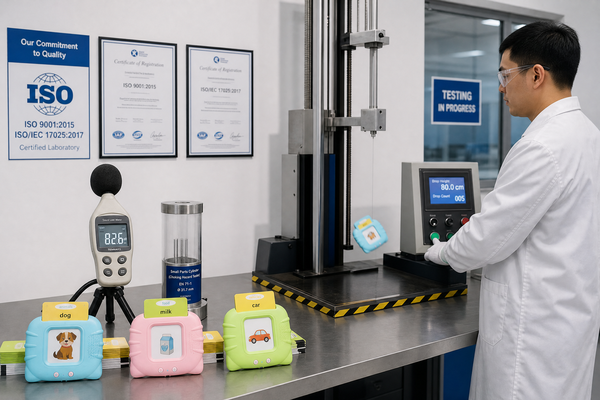
“Design for Compliance” (DfC) means engineering the product from the ground up to meet all regulatory standards of your target market. This proactive approach saves time and money.
For example, the American Academy of Pediatrics (AAP) emphasizes the dangers of button batteries if swallowed by young children [1]. Therefore, safety standards like ASTM F963 (US) and EN62115 (EU) require battery compartments to be secured with a screw or require two independent movements to open. If your design team creates a sleek, snap-on battery cover without a screw, the product will fail certification. Fixing this after the steel injection molds are made can cost thousands of dollars and delay the launch by months.
What Are the Steps to Integrate Testing into Development?
A robust DfC workflow involves collaboration between your design team, your manufacturing partner, and your chosen testing laboratory.
- Define Target Markets and Standards Early: Before sketching the first concept, clearly define where the product will be sold (e.g., US, EU, Japan). Identify all applicable standards (CPSIA, CE, ST, etc.) and share these requirements with your factory.
- Material Pre-Selection: Work with your factory to select plastics, inks, and electronic components that already have compliance histories. For example, ensure the PCB supplier uses RoHS-compliant solder and the plastic supplier provides REACH-compliant ABS.
- Pre-Testing Prototypes: Do not wait for mass production to test the product. Send 3D-printed prototypes or “first-off-tool” samples to the lab for preliminary physical and mechanical testing (e.g., drop tests, tension tests for small parts).
- Final Certification on Golden Samples: Official certification testing should be conducted on the “Golden Samples”—the first batch of products made using the final mass-production molds and materials.
The “Design for Compliance” Workflow
| Development Phase | Compliance Action | Risk Mitigated |
|---|---|---|
| Concept & Design | Identify target markets & required standards (e.g., ASTM, EN71) | Prevents fundamental design flaws (e.g., unsafe battery doors) |
| Engineering & BOM | Select pre-certified materials (RoHS, REACH) | Reduces risk of chemical test failures (lead, phthalates) |
| Prototyping | Conduct preliminary physical/mechanical tests | Avoids expensive mold modifications later |
| Golden Sample | Submit for official third-party certification | Ensures customs clearance and legal sale |
How Toyvao Engineers for Global Compliance
At Toyvao, “Design for Compliance” is embedded in our DNA. We know that a brilliant educational toy is useless if it cannot legally enter your target market.
When you bring your OEM/ODM talking flash card project to Toyvao, our engineering team immediately reviews your design against the latest CPSC and CE regulations. We proactively suggest modifications—such as adjusting the acoustic cavity to meet decibel limits for toddlers, or reinforcing the card slot to pass durability tests. By identifying and resolving potential compliance issues during the CAD phase, we save our B2B partners time, money, and stress, ensuring a smooth path to market.
References
[1] American Academy of Pediatrics (AAP). “Button Battery Injuries in Children.”
[2] U.S. Consumer Product Safety Commission (CPSC). “Children’s Toys.”
[3] The Toy Association. “Toy Safety Standards.”
Looking for a factory that understands global toy compliance? Contact Toyvao today!
Email: sales@toyvao.com | WhatsApp: +86 186 8106 4480
