
The demand for specialized educational toys is growing rapidly as parents and educators seek effective tools to support neurodivergent children. For B2B buyers, educational brands, and healthcare distributors, understanding the therapeutic value of these products is crucial. Talking flash cards have emerged as a highly effective, non-screen-based intervention tool. As a leading manufacturer in Shenzhen, Toyvao designs talking flash card machines with specific acoustic and tactile features that cater to the unique needs of children with autism spectrum disorder (ASD) and speech delays.
Why Are Screen-Free Audio Devices Preferred for Neurodivergent Children?
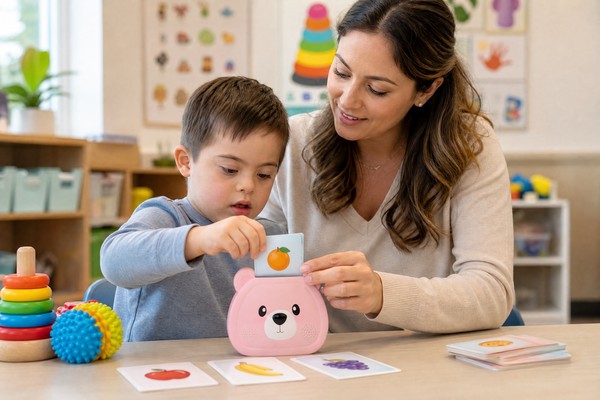
Children with autism and speech delays often experience sensory overload when exposed to the rapid visual stimuli and blue light emitted by tablets and smartphones. The World Health Organization (WHO) and pediatric experts recommend limiting screen time for early childhood development, particularly for neurodivergent children who may be prone to hyper-focusing on digital screens [1].
Talking flash cards provide a screen-free alternative that isolates the learning stimulus. By requiring the physical action of inserting a card to produce a corresponding sound, these devices create a direct, predictable cause-and-effect loop. This predictability is highly comforting for children with ASD and encourages repetitive practice without the overstimulation associated with digital screens.
How Do Talking Flash Cards Facilitate Expressive Language Development?
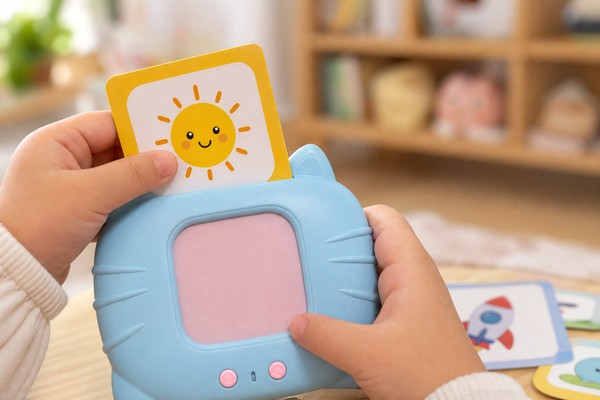
For children with speech delays, the primary goal of intervention is to encourage expressive language—moving from understanding words (receptive language) to vocalizing them. Talking flash cards are designed to support this transition through several mechanisms:
- Clear, Isolated Audio Prompts: High-quality talking flash card machines utilize a 16kHz sampling rate and 16-bit mono audio to deliver crisp, distortion-free pronunciation. This clarity is essential for children who are learning to mimic phonetic sounds [2].
- Repetition Without Frustration: Children with speech delays often require dozens of repetitions to master a single word. A talking flash card machine provides consistent, patient audio feedback every time the card is inserted, allowing the child to practice independently without feeling pressured by a human instructor.
- Multisensory Engagement: The process involves visual recognition (the picture on the card), tactile engagement (holding and inserting the card), and auditory processing (hearing the word). This multisensory approach strengthens neural pathways associated with language acquisition [3].
What Features Should B2B Buyers Look For in Therapeutic Flash Card Machines?
When sourcing talking flash cards intended for therapeutic or special education markets, buyers must prioritize specific design elements that ensure safety, durability, and effectiveness. The following table outlines the key specifications to consider:
| Feature | Standard Toy Specification | Therapeutic/Special Ed Specification |
|---|---|---|
| Audio Quality | 8kHz (Standard Voice) | 16kHz, 16-bit Mono (High-Fidelity) |
| Volume Control | Fixed or >85dB | Adjustable, strictly capped at 85dB (EN71/ASTM compliant) |
| Material Durability | Standard Cardstock | Tear-resistant, waterproof laminated cards |
| Device Housing | Standard ABS Plastic | Food-grade ABS/Silicone, drop-resistant |
| Battery Safety | Basic Li-ion | Li-Po with PCM dual-IC protection (UN38.3/MSDS) |
How Can Brands Customize Content for Special Education Needs?
As an OEM/ODM manufacturer, Toyvao works with educational brands to customize the content of talking flash cards. For the special education market, standard vocabulary (e.g., “apple,” “dog”) is often insufficient.
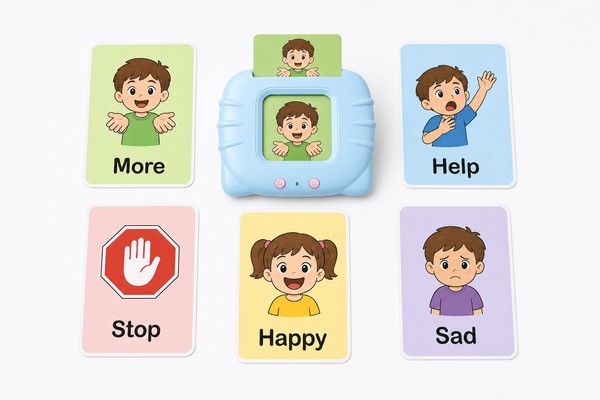
Brands can develop custom card sets focusing on functional communication and emotional regulation. This includes “Core Vocabulary” cards (e.g., “more,” “help,” “stop”) and “Emotion” cards (e.g., “happy,” “frustrated”). By partnering with speech-language pathologists (SLPs) to curate the audio and visual content, brands can create highly specialized products that command a premium in the healthcare and educational sectors.
Why Partner with Toyvao for Specialized Educational Electronics?
Creating products for vulnerable populations requires a manufacturing partner committed to uncompromising quality and safety. Toyvao’s engineering team ensures that every talking flash card machine meets stringent international acoustic standards, preventing auditory damage while delivering crystal-clear pronunciation. Our factory implements rigorous quality control, including drop tests and battery safety checks, ensuring the final product is durable enough for daily therapeutic use.
Interested in developing a specialized line of talking flash cards for the special education market? Contact Toyvao’s engineering team today.
Email: sales@toyvao.com
WhatsApp: https://wa.me/8618681064480
Display Phone: +86 186 8106 4480
References
[1] World Health Organization (WHO). (2019). Guidelines on physical activity, sedentary behaviour and sleep for children under 5 years of age.
[2] American Speech-Language-Hearing Association (ASHA). (2023). Technology in Speech-Language Pathology.
[3] American Academy of Pediatrics (AAP). (2022). Sensory Integration and Language Development in Autism Spectrum Disorder.
相关文章 (Related Articles):
有用资源 (Useful Resources):
