
Executive Summary
Picture book reading pens (also called story pens, talking book pens, or OID reading pens) combine simple mechanical hardware (plastic mouldings, speaker, battery) with embedded electronics (MCU, audio storage, audio codec/DAC) and media (pre-recorded audio, printed book with touch points). For B2B buyers placing large orders, the primary supply-chain risks are long and volatile semiconductor lead times, bottlenecks in speaker and battery supply, tooling and moulding iteration delays, and logistics disruption for finished goods and printed books.
This guide maps typical lead times and cost drivers, identifies the components that most frequently create single-point failures, and gives actionable mitigations: standardize on a small set of commodity ICs and memory sizes, dual-source critical items (MCU, flash, Li-ion cells, speaker), maintain component safety stock based on calculated reorder points, use modular designs to enable last-minute substitutions, and specify contractual delivery remedies and capacity commitments. Also covered are alternatives such as TF/microSD architectures, NFC tag-based systems versus integrated audio, localised content production timing, and nearshoring options for assembly.
Expect the following ranges in a normal (non-crisis) sourcing environment:
– Commodity MCU lead times: 8–20 weeks for mid/low-end parts; 4–8 weeks if using high-volume commodity lines or alternative vendors.
– Audio flash memory (NOR/NAND): 6–16 weeks depending on density and package.
– Speakers: 4–12 weeks for 8–13 mm units; longer for custom drivers.
– Batteries (Li-ion/LiPo): 4–10 weeks with certification steps adding time.
– Injection mould tooling: 20–60 days for first samples; mould cost typically USD 2,000–12,000 per cavity depending on complexity and material.
– PCB fabrication and SMT: 10–30 days, influenced by layer count, via types, and SMT capacity.
– Sea freight lead time China → US/EU: 30–45 days; air freight 3–7 days.
This document provides specifications to evaluate, step-by-step decision guidance, pricing considerations, mitigations for component shortages, compliance requirements relevant to children’s products, and operational controls buyers should require of suppliers.
What Is Picture Book Reading Pen and Who Uses It
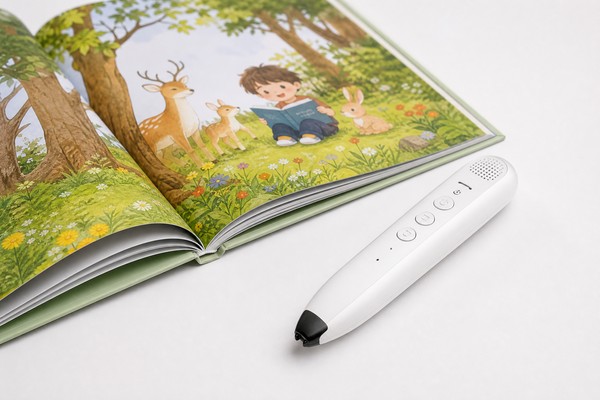
A Picture Book Reading Pen is a handheld device that produces audio when its tip or stylus touches marked illustrations, icons, or printed OID (Optical Identification) tags in a book. Typical variants:
– Passive audio pen: reads printed OID codes and plays audio from internal flash.
– NFC-based pen: reads NFC tags embedded in pages and plays corresponding audio.
– Bluetooth-enabled pen: streams audio from an external source (phone/app) or receives updates wirelessly.
– TF/microSD pen: audio stored on removable card for easy content update.
– Hybrid designs: combine internal flash for primary languages and TF/NFC for expansion.
Primary users and buyers:
– Toy and educational product wholesalers and retailers.
– Publishers of children’s books (interactive editions).
– Private label manufacturers and importers.
– Educational institutions procuring classroom kits.
– NGOs and literacy programs ordering for distribution.
Key production and supply-chain characteristics:
– High levels of customization (book artwork, recorded narration, local languages).
– Low unit BOM cost but comparatively high fixed costs (tooling, NRE, content production).
– Need for functional testing (audio sync, tap accuracy) and child-safety compliance.
– Order patterns: mix of repeat orders (books) and frequent design refreshes (new titles/voices).
Why Demand Is Growing
Demand drivers for reading pens include:
– Curriculum and literacy programs that value multimodal learning for early readers.
– Publishers seeking differentiated, value-added products to offset digital disruption.
– Internationalization: rapid growth in non-English markets where audio support aids language learning.
– Low-cost embedded audio solutions lowering per-unit retail prices, expanding market reach.
– Consumer preference for tactile, screen-free children’s learning tools.
Supply-chain implications:
– Growing unit volumes encourage consolidation on specific component families, but increased SKU variety (languages, book formats) increases supply complexity.
– Content localization amplifies lead times because recording, QA, and integration must be scheduled for each market.
– Seasonal demand peaks (Q3–Q4 for holiday season) create capacity competition for mould shops, SMT lines, and logistics, making lead-time certainty crucial.
Key Technology Differences
Understanding the technology stack helps prioritize risk:
Audio storage and playback architecture
– Internal Flash (SPI NOR or SPI NAND) — audio stored onboard, simple BOM, secure but requires flash availability; common densities: 8–64 MB for compressed audio.
– TF/microSD — large, removable storage; flexibility for localization and updates; risks: microSD supply, connector durability.
– Streaming over Bluetooth — reduces on-device storage needs, increases BOM (BT module, antenna), and introduces regulatory testing complexity (FCC/CE) and power consumption concerns.
MCU and Audio Processing
– Single-chip solutions (MCU + audio codec) reduce part count and cost but increase risk if the specific part has long lead times.
– Discrete MCU + DAC approach is more flexible for component substitution but increases BOM complexity.
– Common MCU families: ARM Cortex-M0/M3 variants, PIC microcontrollers, and specialty audio SoCs from suppliers like Actions, Nuvoton, or custom SoC vendors in China.
Touch/Optical detection
– OID optical recognition (simple line-of-sight codes) — low-cost IR/optical sensor; firmware calibrations needed per print variance.
– NFC-based — reliable tag-to-audio mapping but higher per-book cost (NFC tag cost and embedding).
– Capacitive/resistive touch — sometimes used for button-based pens but not for reading-specific functionality.
Power
– Primary alkaline battery designs: lower certification burden, simpler logistics but higher recurring costs and user-hosted batteries.
– Rechargeable Li-ion/LiPo: compact, better UX, but require UN38.3 testing, IEC/UL battery certifications, and increase lead times and supply constraints.
Connectivity and update path
– USB programming vs OTA/Bluetooth — affects warranty repair model, field-updatability, and the ability to push last-minute content fixes or language packs.
Mechanical and manufacturing
– Injection moulded housings with custom artwork, printed sleeves, and metal spring contacts for batteries. Tooling iterations and tolerances affect fit-and-finish and functional reliability.
Key Features and Specifications to Evaluate
When qualifying suppliers and designs, specify measurable technical and manufacturing parameters:
Audio
– Storage capacity: specify MB and filesystem requirements (raw PCM vs compressed MP3/ADPCM).
– Playback quality: sample rate (8–22 kHz typical for voice), bit depth (8–16 bits), SNR target (≥60 dB preferred), distortion tolerance (<5% THD typical for speech).
– Speaker: diameter (8 mm to 13 mm typical), impedance (4–8 Ω), rated SPL at 0.1 W and 1 kHz; mounting and acoustic enclosure design.
Electronics
– MCU model and lead-time alternatives: list at least two cross-referenced alternative part numbers.
– Memory type: SPI NOR for code and small audio, SPI NAND or eMMC for larger audio sets.
– Power management: charging IC (if rechargeable), battery protection IC, overcurrent and temperature protection.
Mechanical
– Housing material (ABS/PC/TPR), flame retardant grade if required.
– Tip type and durability (wear cycles); specify expected life cycles (e.g., >100,000 taps).
– IP rating, if any (usually IPX0–IPX4 for splash resistance).
Battery
– Type (AA alkaline, NiMH, LiPo), nominal capacity (mAh), run-time targets (e.g., 8 hours continuous playback), charging time.
– Safety specs: IEC 62133 conformity; supplier to provide test certificates.
Testing and verification
– Burn-in: recommended >4 hours per finished device or 100% functional test including audio playback and touch detection.
– AQL and defect thresholds: propose AQL 1.5 for critical defects at inspection; specify functional test pass rate expectations.
Book and content
– OID printing tolerance: contrast and ink types compatible with optical sensors.
– NFC tag type and memory: NTAG213/215/216 depending on data needs; embedding method and durability.
– Localization schedule: recording lead time 2–6 weeks per language including QA.
Logistics and packaging
– Unit dimensions and cartonization (units per inner box / per master carton), preferred master carton weight (<20–25 kg for handling).
– Labeling requirements: country-specific warnings, CE/FCC marks, battery and disposal labeling.
Supply terms
– MOQ for electronics units (typical SMT runs: 1,000–5,000 units), injection moulding runs (often 1,000–5,000 per cavity).
– Sample policy: pre-production sample lead time 20–45 days.
Pros and Cons
Pros
– High perceived value at low BOM cost: audio adds experiential value without high materials expense.
– Modular possibilities (TF card, NFC) permit last-minute content localization.
– Established manufacturing base in Asia with experienced suppliers familiar with educational toys.
Cons / Risks
– Semiconductor market volatility makes MCUs and memory long lead-time items; shortages are common during global demand spikes.
– Battery and speaker supply are periodic bottlenecks, especially for non-standard sizes or higher QC expectations.
– Custom mould tooling introduces fixed costs and iteration delays; rework or new revisions are expensive and time-consuming.
– Content production (voice talent, rights) adds non-hardware lead time that is often underestimated.
– Child-safety compliance requires additional testing time and may cause shipments to be held up if documentation is incomplete.
Step-by-Step Decision Guide
- Map the BOM and identify critical single-source components
- Create a Component Criticality Matrix: classify each part as Critical (no substitute, long lead time), Important (replaceable with effort), or Commodity.
-
For critical items list at least two alternate part numbers and preferred cross-qualifications (pin, package, voltage).
-
Establish realistic lead-time baselines and order cycles
- Collect supplier lead-time confirmations (PLTs) for each critical component and for finished goods.
-
Use conservative lead times: PLT + 20% buffer for volatile components.
-
Calculate inventory policy and safety stock
- Use the reorder point (ROP) formula: ROP = Average demand during lead time + Safety Stock.
- Safety Stock (SS) example: SS = Z × σLT. For 95% service level, Z ≈ 1.65.
-
Example: Annual demand 100,000 units → weekly demand 1,923 units. Lead time 8 weeks → avg LT demand = 15,385. If weekly σ = 500, SS = 1.65 × sqrt(8) × 500 ≈ 2,335. ROP ≈ 17,720 units.
-
Negotiate procurement and contract terms
- Secure standing orders or capacity commitments for high-risk parts with penalties/price review clauses.
- Specify life-of-product agreements where practical for MCUs/SoCs.
-
Use consignment or vendor-managed inventory (VMI) for high-value components.
-
Implement multi-sourcing and qualification
- Qualify at least two suppliers for every critical item.
-
Run small initial orders (pilot lots) through the second supplier and include them in PCBA qualification tests.
-
Design for supply chain flexibility
- Use standard packaging and commodity ICs where possible (e.g., common MCU footprints).
- Modularize the audio system so that storage or wireless modules can be swapped with minimal firmware impact.
-
Standardize on common flash sizes (e.g., 16 MB, 32 MB, 64 MB) to reduce SKU proliferation.
-
Plan manufacturing and QA steps with timing buffers
- Allow 20–60 days for injection mould approval and pilot shots; schedule 2–3 mould correction cycles in the project plan.
-
Reserve SMT capacity during peak season with down payments or committed slots.
-
Synchronize content production with hardware schedule
- Lock down scripts and languages earlier than mechanical design sign-off.
-
Plan 2–6 weeks for recording, 1–2 weeks for audio QA and integration per language.
-
Logistics and contingency
- For time-critical launches, plan air freight for critical components or finished goods and sea freight for bulk replenishment.
-
Maintain a contingency budget for expedited tooling changes, firmware patches, or last-minute component substitutions.
-
Monitor and review
- Implement weekly BOM-availability reviews and a monthly supply-risk dashboard (stock cover in weeks, PLT variance, supplier on-time delivery).
- Institute supplier scorecards tied to delivery and quality KPIs.
Pricing and Cost Analysis
Cost drivers for a typical picture book reading pen can be divided into variable unit costs and fixed non-recurring engineering (NRE) costs.
Typical cost structure (order of magnitude for mid-volume orders, 5k–50k units):
– BOM (electronic components): USD 1.8–6.5 depending on complexity
– MCU/audio SoC: USD 0.40–3.50
– Flash: USD 0.08–1.20
– Speaker: USD 0.10–0.80
– Battery: USD 0.30–2.00 (LiPo higher than alkaline)
– PCB and SMT: USD 0.20–1.00
– Sensors, connectors, LEDs: USD 0.05–0.50
– Mechanical (housing, tooling amortization)
– Injection mould tooling: USD 2,000–12,000 per cavity; amortize over expected production volume (e.g., 10,000 units → USD 0.20–1.20/unit)
– Per-unit moulded part cost: USD 0.20–1.20 depending on complexity
– Assembly and testing: USD 0.30–1.50 (functional test increases cost)
– Packaging (retail box + inserts): USD 0.30–1.00
– Content production and localization: USD 200–2,000 per language per title for professional recording; amortize over units
– Certifications and testing (one-time): USD 2,000–8,000 per major certification (EN71, EMC, FCC) depending on lab and number of test items
– Freight and duties: variable; sea freight & duties often add 5–15% of FOB cost
Pricing examples by complexity
– Basic offline pen (internal flash, no BT, alkaline): Unit ex-factory approx USD 3.0–6.0 at 10k MOQ.
– Mid-tier pen (rechargeable, better speaker, 32 MB flash): USD 6.5–12.0 per unit at 10–20k.
– High-end (Bluetooth, rechargeable, robust enclosure, multi-language content): USD 12–25+.
Cost management levers
– Volume discounts: electronic components and PCBs scale; secure tiered pricing in contracts.
– Standardize flash and MCU choices across titles to consolidate buy.
– Push content costs downstream by offering TF-card-based variants where publishers provide cards locally.
– Use simpler packaging for non-retail educational orders to save USD 0.30–0.50 per unit.
Logistics and landed cost considerations
– Use FOB pricing for supplier negotiation; calculate landed cost using:
Landed cost = FOB unit price + inland freight to port + ocean freight + insurance + customs duty + handling fees + local VAT (if reclaimable) + last-mile distribution.
– For seasonal launches, build in expedited freight costs (air cargo can add USD 2–10 per unit depending on weight/volume).
Competitive Landscape
Manufacturing geography
– China remains the dominant region for design, tooling, and high-volume assembly for this product category, with mature ecosystem for toy-grade injection moulding, speaker suppliers, and low-cost electronics.
– Taiwan specializes in higher-quality PCB and semiconductors; some audio SoC vendors originate here.
– Vietnam and the Philippines are emerging assembly bases for toy assembly and packaging as buyers diversify manufacturing away from China; capacity and supplier ecosystems are more limited, especially for tooling and small-batch electronics.
Key supplier types
– Full-service OEMs: provide moulding, SMT, content integration, testing, packaging, and can handle logistics—higher unit cost, lower buyer overhead.
– PCB/EMS providers: focus on board fabrication and assembly; buyer needs separate moulding/assembly partners.
– Component distributors: authorized vs independent; authorized distributors mitigate counterfeit risk but often have higher prices and limited stock; independent brokers may have stock but higher risk.
– Specialist audio SoC vendors in China/Taiwan: offer integrated MCU+audio solutions; these can reduce BOM but increase single-source risks.
Market dynamics
– OEMs with in-house tooling and content studios offer faster time-to-market but command price premiums.
– Many buyers use private-label models: content produced by publishers is integrated by OEMs who maintain content codecs and OID printing standards.
– Consolidation risk: if multiple buyers use the same SoC or speaker vendor, that vendor’s capacity constraints cause simultaneous cross-customer shortages.
What Buyers Say
Common procurement feedback from buyers in this category:
– “Semiconductor lead times are the single largest cause of delayed shipments.” Buyers report MCUs and memory being allocated to larger consumer electronics first.
– “Audio integration issues surface late.” Late-stage problems such as poor alignment between OID printing contrast and optical sensor calibration cause rework and delay.
– “Manufacturing quotes vary widely due to unaccounted testing.” Some suppliers quote low assembly costs but omit 100% functional testing and burn-in, which buyers later add as change orders.
– “Tooling changes are expensive and slow.” Iterations on moulds due to tolerance or cosmetic issues typically cost USD 1k–5k per change and add 1–3 weeks each.
– “Content localization schedules are often underestimated.” Voice recording, approvals, and re-records due to creative changes add weeks and sometimes require re-mastering audio packages.
These insights suggest buyers must budget for conservative schedules, insist on clear functional test scopes, and require supplier commitments for sensor testing vis-à-vis printed OID samples.
Safety, Maintenance and Compliance
Regulatory standards and testing
– Toy safety (EU): EN 71 series — mechanical/physical (EN 71-1), flammability (EN 71-2), migration of certain elements (EN 71-3). Test time 1–3 weeks; allow for retests.
– Toy electrical safety: EN 62115 (electrical toys) — applies to battery/rechargeable devices.
– EMC and radio: CE (EMC Directive 2014/30/EU), and where wireless is used, RED (2014/53/EU) for radio equipment. FCC Part 15 for US radio equipment approvals.
– Batteries: UN38.3 for transport; IEC 62133 for cell safety; UL certifications for the US market where required.
– US consumer product safety: CPSIA (lead, phthalate limits), and ASTM F963 (toy safety standard).
– Chemical controls: RoHS (lead, mercury, cadmium), REACH SVHC declarations for EU.
Maintenance and operational guidance
– Batteries: specify safe charging profile (charging current, termination), provide battery protection ICs, and include user warnings in packaging. For Li-ion, plan for cell aging and specify expected cycle life (e.g., 300–500 cycles) and storage requirements.
– Speaker care: provide recommended usage levels and caps to reduce distortion and prevent mechanical failure.
– Firmware updates: plan update mechanism and associated security for Bluetooth-capable devices.
Documentation and supplier deliverables
– Supplier must provide test reports and declarations of conformity (DoC) for applicable standards.
– For batteries, obtain manufacturer batch certificates, UN38.3 test report, and IEC/UL test report when applicable.
– Provide detailed product labels: CE/FCC marks (where applicable), battery disposal icons, age grading, choking hazard warnings.
– Responsible sourcing: require supplier to provide RoHS and REACH compliance documentation and complete material declarations (BOM Level) for traceability.
Quality controls and service life
– Require suppliers to run 100% functional testing with audio playback check, sensor accuracy check, battery charging/discharging test and at least 4–8 hours burn-in for batches.
– Define warranty terms and return rates thresholds; typical toy warranty 6–12 months, but buyer obligations for replacement and repair must be contractually agreed.
Frequently Asked Questions
Q: Which components most often cause order delays?
A: MCUs/SoCs and flash memory are the highest risk items due to global semiconductor demand. Batteries and small speakers are next, especially for custom sizes or higher QC grades. Injection mould corrections and printing issues on book artwork also frequently delay shipments.
Q: How much safety stock should we hold for critical components?
A: Use a statistical approach: Safety Stock = Z × σLT. For example, for an 8-week lead time and weekly demand variance σ of 500 units, for 95% service level SS ≈ 2,335 units. Apply this per critical component, not only at finished-goods level.
Q: Is it better to design with internal flash or microSD?
A: Internal flash simplifies the BOM and secures content; microSD provides maximum flexibility for localization and field updates but adds cost and mechanical durability considerations. Choose internal flash for high-volume, unchanging titles; use microSD for multi-language, variable content or for titles where publisher wants control over content updates.
Q: How long does certification typically add to the project timeline?
A: Testing durations vary by lab workload and number of standards. Allow 2–6 weeks for a complete EN71/EMC/FCC test cycle; more if re-tests are required. Factor certifications into the critical path early.
Q: Can we reduce risk by nearshoring?
A: Nearshoring (e.g., Vietnam) reduces geopolitical concentration risk but can increase unit cost and reduce access to certain sub-suppliers (specialty ICs, mould shops). Nearshoring is beneficial for assembly, packaging, and final testing but critical electronic components will typically still come from established global distributors.
Q: What contractual terms should we prioritize with suppliers?
A: Prioritize lead time commitments, penalty clauses for late delivery, minimum guaranteed capacity during peak seasons, clear change control procedures for engineering revisions, and requirements for component traceability and test documentation.
Q: How do we manage content production and avoid a content-related delay?
A: Lock scripts and artwork early, use parallel tracks (mechanical development and content recording concurrently where possible), set firm sign-off gates, and budget for localization buffer (2–6 weeks per language). Use modular audio packaging to swap files without firmware changes.
Contact Toyvao
For supplier introductions, BOM risk audits, or tailored sourcing strategies for picture book reading pens—contact Toyvao’s procurement team to request an assessment, sample supplier lists, and customizable supply-chain mitigation worksheets. Email: sourcing@toyvao.com.
