
Executive Summary
This guide provides a practical, line-item costing and price-estimation template for OEM/ODM Picture Book Reading Pens (also called Story Pens, Talking Book Pens, or OID Reading Pens). It converts engineering and sourcing inputs—BOM, tooling, assembly, testing, packaging, certifications, logistics—into a reproducible per-unit landed cost and target wholesale price. It includes typical component specifications, realistic unit-cost ranges for 2024–2026 manufacturing environments, non-recurring engineering (NRE) and tooling amortization methods, factory testing and quality provisions, shipping and duty considerations, and margin models for contract manufacturers and brand owners.
Use this guide to:
– Build a defensible per-unit cost model for proposals and RFQs.
– Compare OEM (build-to-print) vs ODM (turnkey) pricing impacts.
– Estimate NRE/tooling amortization across expected volumes.
– Calculate landed cost under major Incoterms (FOB, CIF, DDP).
– Allocate budgets for safety testing, firmware, and content licensing.
Assumptions used in examples:
– Target volume 10,000 units (MOQs commonly 3,000–20,000).
– Unit retail target range $25–$60 depending on features.
– Manufacturing base primarily China with alternatives in Vietnam/Taiwan for specific capabilities.
What Is Picture Book Reading Pen and Who Uses It
Product definition
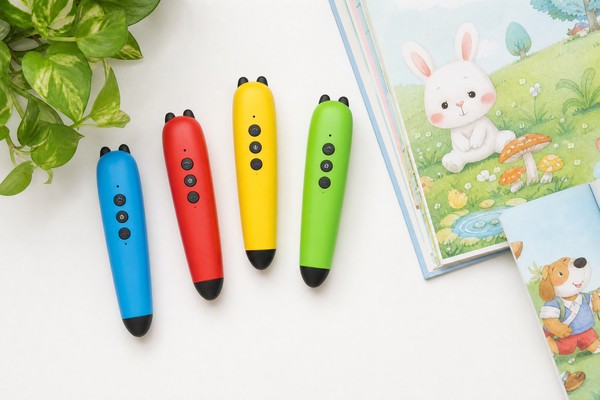
– A Picture Book Reading Pen is a handheld, battery-powered device that plays pre-recorded audio or TTS narration when its tip taps images or embedded OID markers in specially produced books. Common terms: OID Reading Pen, Story Pen, Talking Book Pen, Audio Pen.
– Typical functionality: play narration, repeat sentences, read words, play songs, volume control, offline playback, Bluetooth/Wi‑Fi for updates, USB connectivity for charging/data, simple buttons/LEDs, internal speaker and sometimes a headphone jack.
Primary users and buyers
– End users: toddlers to early readers (ages 2–8), parents and educators seeking literacy aids, special education programs.
– B2B buyers: educational publishers, toy brands, retail chains, private-label vendors, distributors, and e-learning content providers.
– Procurement buyers: sourcing managers, product managers, category managers at publishers or consumer electronics brands looking to contract OEM or ODM production.
Use cases affecting cost
– Low-cost storytelling pen for mass-market retail vs premium multi-language pen for educational programs — different BOM, packaging, and certification needs.
– Content licensing and formatting required for publishers (audio production, multi-language files).
– Integration with app platforms or cloud services increases firmware complexity and costs (OTA, Bluetooth LE).
Why Demand Is Growing
Market drivers
– Early literacy investment: growing emphasis on interactive learning for pre-K and primary grades.
– Hybrid content models: publishers want physical books plus digital audio without screens.
– Globalization: demand for multi-language pens for international distribution and multicultural education.
– Special needs applications: aids for dyslexia, auditory learning, and visual impairment localization.
Commercial drivers
– Lower component costs for microcontrollers, flash memory, and small speakers enable feature-rich units at lower price points.
– Advances in OID marker technology and printing make book production scalable.
– Increasing interest from educational publishers and retail private labels for low-R&D turnkey solutions.
Regulatory and product safety trends
– Stricter child-safety compliance and chemical restrictions increase compliance costs, but also raise barriers to low-quality competitors.
Implication for buyers
– Buyers must balance marginal feature improvements (Bluetooth, larger storage, richer audio) against sharp cost increases (battery chemistry, radios, certification).
– Cost transparency (BOM + process overhead + logistic + compliance) is critical to prevent margin erosion.
Key Technology Differences
OID / Optical ID vs RFID vs QR-based mapping
– OID (printed micro-pattern or invisible ink): low-cost, no electronics in book, works offline; requires pen tip optical sensor and decoding MCU logic. Reliability depends on print quality and paper stock.
– RFID/NFC tags: higher per-book cost (tags), require NFC reader in pen, advantages for robust mapping and security.
– QR or barcode scanning: cheaper for adult-targeted products; less suitable for continuous flow reading with children.
Audio engine and storage
– Pre-recorded audio files (MP3/ADPCM/PCM) vs TTS:
– Pre-recorded: better voice quality, predictable file sizes, licensing costs per voice/locale.
– TTS: more flexible for dynamic content; requires higher-performance MCU or dedicated TTS chip and more RAM/flash.
– Storage: onboard NOR/NAND flash vs SD/microSD slot. Typical sizes:
– Baseline: 32–128 MB flash for single-book sets.
– Mid-range: 256–512 MB for multi-book/multi-language.
– High-end: 1–4 GB for rich multimedia.
Connectivity
– No connectivity: simplest, lowest cost, easier compliance.
– Bluetooth LE: supports headphones/app pairing; adds BOM cost ($0.8–$3 incremental), RF testing.
– Wi‑Fi: rare due to power and certification costs.
MCU and audio codec
– MCU performance selection drives cost: simple 32-bit MCU with integrated audio codec ($1–$4) vs application processors ($4–$12).
– DAC/SR divider and low-power modes affect battery life.
Power and batteries
– Alkaline/AA/AAA: low compliance overhead; simple battery holder.
– Rechargeable Li-ion/Li-Po: higher BOM ($1–$4 depending capacity), charging IC and micro-USB/Type-C, UN38.3 lithium battery shipping rules, need for protection circuits.
Mechanical tip and sensing
– Optical lens or IR sensor integrated in tip; housing must provide replaceable nibs in some designs.
– Tip durability and water resistance requirements affect material selection and cost.
Firmware and content tools
– Proprietary firmware, audio packaging tools, book authoring tools, and content management systems (CMS) are significant intangible assets for ODMs.
Key Features and Specifications to Evaluate
Required hardware specs (minimum vs recommended)
– Speaker: 0.5W–2W 8Ω, diameter 28–40 mm recommended for clear voice playback.
– Microcontroller: Cortex-M0/M3 with hardware codec for baseline; recommended: 48–120 MHz, 256 KB RAM, 1–4 MB flash for moderate features.
– Audio storage: baseline 64 MB (sufficient for 1–2 short books). Recommended 256–512 MB for multi-language packages. Use eMMC or SPI NAND for >1 GB.
– Battery: AAA x2 (alkaline) or LiPo 500–1200 mAh for rechargeable versions; target run-time 6–15 hours depending on duty cycle.
– Tip sensor: optical camera/photodiode array with onboard decoding; sensitivity and sampling rates determine accuracy.
– Buttons and UI: minimal 3–5 buttons + LED indicators; consider capacitive touch for premium models.
– Connectivity: optional BLE 5.0 module for OTA and pairing.
– USB: Type-C recommended for future-proofing (charging and data).
– Housing: ABS+PC UV stabilized, flame-retardant grade meeting EN71 material safety.
Testing and quality thresholds
– Functional accuracy: tap-recognition rate >99% under specified light/paper conditions.
– Audio quality: SNR >60 dB for recordings; speaker distortion <10% at nominal volume.
– Battery lifecycle: rechargeable cells >300 cycles at 80% capacity; disposable models specify shelf life.
– Drop test: survive 1.2 m drop to concrete six faces, no sharp edges, no small parts.
– Environmental: operate 0–40°C, store -20–60°C; humidity 20–80% non-condensing.
Manufacturing tolerances and assembly
– Injection molding tolerances typically ±0.2 mm for critical features; precision tip alignment critical for OID sensor accuracy.
– PCB assembly: 4–6 layer typical for EMI and stability; board dimensions and components density influence PCB cost.
Content and software
– Audio format: MP3 CBR 32–128 kbps or ADPCM for small footprint; per-book file sizes scale with quality.
– Content licensing: fee per title or per-unit royalty model—important for publishers.
– Authoring tools & CMS: pricing and support for publishers factor into TCO.
Pros and Cons
Pros of buying OEM/ODM Story Pens
– Turnkey supply: ODM handles design, tooling, content packaging, and production.
– Faster time-to-market when partnering with experienced vendors.
– Economies of scale for components and assembly at higher volumes.
– Predictable per-unit pricing once BOM and NRE are defined and amortized.
Cons and risks
– Upfront NRE and tooling costs can be substantial (mold: $5k–$80k; firmware/content development: $5k–$150k).
– Quality and compliance risk if supplier lacks child-safety experience.
– IP and content protection: secure storage and transfer of audio/content required.
– Battery shipping and international certification complexity for lithium models.
– Vendor lock-in and opaque BOMs if not negotiated contractually.
Step-by-Step Decision Guide
Step 1 — Define product tier and target retail price
– Low-cost model: basic OID, no connectivity, AAA batteries — target retail $25–$35.
– Mid-tier: rechargeable battery, 256–512 MB storage, BLE, better speaker — target retail $35–$55.
– Premium: app integration, TTS, >1 GB storage, high-quality speaker — $55+ retail.
Step 2 — Specify must-have features and compliance
– Mandate certifications: EN71, REACH, RoHS, CE, FCC, CPSIA (US) as applicable; if using Li-ion, UN38.3 and IEC 62133.
– Define battery chemistry and shipping constraints early.
Step 3 — Create bill-of-materials (BOM) baseline
– List components with targeted specs and acceptable suppliers.
– Establish alternate suppliers for long-lead items (MCU, RF modules, flash).
Step 4 — Estimate NRE and tooling
– Injection mold: single-cavity $5k–$25k; multi-cavity $20k–$80k depending on material, complexity.
– Testing fixtures: $1k–$10k.
– Firmware and app development: $5k–$150k depending on complexity.
Step 5 — Request detailed quotes (FOB) with MOQ and lead-times
– Ask factories for BOM breakout, unit assembly labor, testing hours, and per-unit packaging cost.
– Require sample charges and batch testing scope.
Step 6 — Calculate per-unit amortized tooling and NRE
– Amortize mold, fixture and firmware NRE over expected production volume (example formula below).
Step 7 — Add factory overheads and QA reserves
– Add factory overhead (8–12% of BOM) and QA/RMA reserve (1–3% of total COGS).
Step 8 — Add shipping, duties, insurance, and logistics
– Calculate FOB to port, freight (LCL/LCL or full container), duties by HS code, and inland logistics to distribution hub.
Step 9 — Set target margins and price tiers
– Typical wholesale margin to distributor: 25–40% on FOB/CIF price.
– Typical brand margin (keeps): 50–100% markup for retail price (MAP varies by retail channel).
Step 10 — Embedded safeguards in contract
– Specify AQL, testing protocols, supplier responsibility for defective rates, warranty, IP protections, and spare-part availability.
Practical formulas
– Amortized NRE per unit = Total NRE / Expected production units.
– Total unit COGS = BOM (material costs) + PCB assembly + assembly labor + per-unit tooling amortization + per-unit testing + per-unit packaging + QA reserve.
– Landed unit cost (DDP) = Total unit COGS + Freight per unit + Duties per unit + Insurance + Inland transport + Import handling.
– Suggested selling price = Landed unit cost / (1 – desired gross margin).
Pricing and Cost Analysis
Template line items to include (use this as your spreadsheet structure)
– Direct material costs (component-level BOM)
– PCB and PCBA cost (including stencil, solder paste)
– Battery cost and holder/charging module
– Speaker, mic, sensors, MCU, flash memory, RF module
– Enclosure parts, seals, tips, buttons
– Assembly labor (per unit)
– Functional testing, burn-in, acoustic test, EMC pretest
– Packaging (unit box, insert, manuals, UPC/label)
– Per-unit tooling and NRE amortization
– Factory overhead and profit margin
– QA/RMA reserve
– Freight and insurance to customer hub
– Duties and VAT (country-specific)
– Last-mile warehousing and fulfillment cost (if DDP)
Typical component cost ranges (2024–2026)
– MCU (32-bit, audio-capable): $1.50–$6.00
– Flash memory (SPI, 64–512 MB): $0.20–$2.50; 1–4 GB eMMC: $2–$6
– BLE module (optional): $0.80–$3.50
– Speaker (28–40 mm): $0.20–$2.00
– Microphone: $0.05–$0.30
– Battery (AAA alkaline x2): $0.10–$0.40; LiPo 500–1200 mAh: $0.8–$3.0
– Battery protection/charging IC + connector: $0.30–$1.50
– PCB (4-layer, SMT): $1.00–$4.00 depending size and components
– Optical sensor/tip assembly: $0.30–$3.00 depending on sophistication
– Casing (ABS/PC injection molded): $0.80–$3.00 (per piece) dependent on complexity and color
– Buttons/pads: $0.05–$0.40
– Packaging (unit box, manual): $0.50–$3.00
– Assembly labor and touch-up: $0.20–$1.20
– Testing per unit (functional + burn-in): $0.10–$1.00
– Labeling/traceability printing: $0.05–$0.40
Sample per-unit cost model for 10,000 units (mid-tier product, rechargeable, BLE)
– MCU: $3.00
– Flash 512 MB eMMC: $3.00
– BLE module: $1.50
– Speaker: $1.00
– Microphone: $0.10
– LiPo 800 mAh battery: $1.50
– Charger IC & Type-C: $0.80
– PCB + SMT: $2.50
– Optical sensor tip: $1.20
– Housing (injection molded, 2-color): $1.50
– Buttons/assembly parts: $0.40
– Assembly labor: $0.60
– Testing & burn-in: $0.60
– Packaging: $1.50
– QA/RMA reserve (2% of subtotal): $0.35
Subtotal materials & production = $19.05
Add amortized NRE and tooling:
– Injection molds (2 pieces) = $20,000 → amortization per unit = $2.00
– Test fixtures & jigs = $4,000 → amortization per unit = $0.40
– Firmware/app NRE = $30,000 → amortization per unit = $3.00
Amortized NRE & tooling per unit = $5.40
Factory overhead and profit margin (OEM typical): +10% = $2.45
FOB factory price per unit ≈ $26.90
Add logistics and landed costs:
– Freight (40ft container, 10k units at 300kg ctns) estimated $3.00 per unit (sea freight + container + port handling)
– Insurance & forwarder fees: $0.30
– Duties (US, HS code 9503 toys, 0–4% depending subheading) assume 3% of FOB: $0.81
– Local VAT/import handling and warehousing: $1.50
Landed cost (to US warehouse): $32.51 per unit
Pricing and margin targets
– Distributor wholesale target (keeps 25–35%): Price to distributor ≈ Landed cost / (1 – 0.30) = $46.44
– Retail RSP (keeps 45–60% margin to retailer): RSP ≈ Wholesale / (1 – 0.45) = $84.44 (note this is high; implies either reduce COGS or accept lower retailer margin)
– Reality: For mid-tier product, better retail target is $35–$70; you must optimize BOM or reduce NRE amortization via higher volumes or re-scoping features.
Sensitivity analysis recommendations
– Primary cost drivers: MCU, flash, battery, housing molds, NRE. Model scenarios for 5k / 10k / 50k volumes to see per-unit decreases.
– Component substitution example: Replace eMMC 512 MB ($3.00) with SPI 256 MB ($1.00) reduces per-unit cost by $2.00, improving margins directly.
– Move to AAA disposable batteries may decrease BOM by $0.5–$1.5 but reduces end-user value.
Competitive Landscape
Manufacturer types
– Specialized OEMs: small-to-medium factories focused on talking pens and educational toys. Strengths: domain expertise, lower NRE for common designs. Weaknesses: limited capacity and less vertical integration.
– Consumer electronics ODMs: larger factories with audio product capability. Strengths: scale, better supply chain, stricter QC and certifications. Weaknesses: higher MOQ and longer lead times.
– Contract manufacturers in Southeast Asia (Vietnam, Malaysia): competitive labor costs, trade benefits for some markets, but expertise in OID pens concentrates in China.
– Component suppliers and module providers: BLE modules, Flash suppliers, and turnkey sensor modules can accelerate development.
Geography and trade considerations
– China remains dominant for OID pen manufacturing and injection molding capabilities.
– Vietnam/Taiwan used for diversification and risk mitigation; may face longer ramp and supplier maturity issues.
– EU/US domestic assembly is uncommon due to labor cost but used for high-mix, low-volume custom work or to meet specific compliance chains.
Supplier selection factors
– Evidence of previous child-product manufacturing and certifications.
– Transparency: ability to provide BOM with branded component references.
– Testing capability: in-house EMC, acoustic, and mechanical testing facilities reduce iteration time and cost.
– IP protection: confidentiality, secure servers for content, watermarking and legal protections.
Benchmarks and price ranges (FOB, mid-2020s)
– Bare-bones OID pen (no battery, AAA, limited memory, simple speaker): FOB $6–$12 at 10k units.
– Mid-tier rechargeable with BLE and 512 MB flash: FOB $18–$30 at 10k units.
– Premium with app integration, high-end speaker, 4GB memory: FOB $30–$55 at 10k units.
What Buyers Say
Common buyer priorities
– Price transparency: buyers request full BOM breakdown and prefer branded components for predictability.
– Reliability: buyers report field failures often originate from poor battery protection, unreliable tip sensors, and cheap speakers.
– Content integration: publishers need easy-to-use authoring tools and strict mapping accuracy.
– Compliance: buyers insist on test reports and factory capabilities to produce compliant children’s products.
Frequently reported issues
– Hidden costs: buyers often encounter extra charges for testing, labeling, packaging artwork, dedicated fixtures, or shipping surcharges not captured in initial quotes.
– Quality variance: initial samples perform well, but mass production batches deviate due to PCB assembly settings, molding shrinkage affecting tip alignment, or supplier substitutions.
– Firmware bugs and OTA management: buyers without technical oversight get locked into vendors’ firmware roadmaps and incur post-release costs.
– Battery shipping surprises: using Li-ion batteries dramatically increases shipping complexity and cost (special packaging and documentation).
Mitigation best practices buyers use
– Insist on detailed BOM with CPN (component part numbers) and acceptable alternates.
– Include AQL and batch QC acceptance criteria in contracts; require pre-shipment inspections and sample retention.
– Request factory-level process control documentation (PPAP, FMEA, first article inspection).
– Negotiate escrow of firmware/source or ensure license terms cover future support.
Safety, Maintenance and Compliance
Essential regulatory framework for children’s products
– Europe: CE marking; EN71 (parts 1–3) for mechanical/flammability/chemical safety; REACH for chemical substances; RoHS for restricted substances.
– United States: ASTM F963 (toy safety standard), CPSIA (lead and phthalate limits), and CPSC tracking label requirements.
– Electromagnetic: EMC/EMI testing per regional requirements; FCC part 15 (US) for RF devices.
– Radio: Declaration of Conformity for Bluetooth modules; RED (Radio Equipment Directive) in EU.
– Batteries: IEC 62133 for rechargeable cells safety; UN38.3 for air/sea transport of Li-ion batteries.
– WEEE and EPR: packaging and waste directives vary by market.
Safety design best practices
– No small detachable parts accessible after reasonable force; comply with size requirements to prevent choking.
– Flame-retardant housings (UL94 V-0 preferred for some markets).
– Battery access: cover with screws for non-rechargeable batteries to prevent access by children.
– Use child-safe plastics with documented material certificates and lead-free pigments.
Testing and documentation
– Full test plan: mechanical (drop, torque), flammability, chemical migration, EMC, RF, battery safety, aging.
– Factory pre-compliance testing recommended before committing to large runs.
– Maintain a technical file with test reports, risk assessment, labels, user manual, and contact information for authorities.
Maintenance and after-sales policy
– Provide clear user instructions for battery replacement/charging and cleaning.
– RMA protocol: define defective rate thresholds, repair vs replacement policy, spare parts availability, and timeliness.
– Track serial numbers or batch codes for traceability.
Logistics constraints with batteries
– Li-ion batteries shipped with devices require special packing and documentation, increase air freight costs up to 10x compared to sea, and may complicate express shipments.
Frequently Asked Questions
What is the typical MOQ and lead time?
– MOQ: 3,000–5,000 units for ODMs; 1,000–3,000 possible for OEM build-to-print with higher per-unit price. Prototype runs often 200–500.
– Lead time: 8–16 weeks for standard production after tooling and components are available. Add 6–12 weeks for initial tool making and validation.
How should NRE be handled in contracts?
– NRE should be explicitly defined, with milestones and deliverables. Agree on amortization volumes and whether tooling remains the buyer’s property. Consider escrow or staged payments linked to milestones.
How much should I reserve for compliance testing?
– Budget $8,000–$25,000 for full EN71/ASTM/FCC/EMC/EMI testing; more for wireless certifications or advanced batteries. Additional pre-compliance testing in factory reduces rework costs.
What are realistic defect/RMA rates?
– Good factories: 0.5–1% initial defect rate post-AQL. Acceptable production targets for children’s electronics typically aim ≤1% defective. Negotiate warranty and defective return handling.
Should I pick OEM or ODM?
– OEM (build-to-print): best for buyers with IP and design control, lower NRE but higher per-unit if low volume.
– ODM: best for buyers needing turnkey solutions, lower initial design time, but ensure IP and firmware control clauses.
How to handle content licensing?
– Two models: license per-title (flat fee + per-unit royalty) or work-for-hire (one-time NRE). Clarify audio quality, metadata, and format standards in contracts.
Which Incoterm is preferred for buyers?
– FOB factory island is common; buyers should consider CIF/DDP to compare landed costs. DDP transfers more responsibility to supplier and typically increases per-unit price.
What HS code and duty rates apply?
– HS code example: 9503.00 (Tricycles, scooters; dolls; other toys), but classification depends on function. Duty rates for toys to US typically 0–4%. Consult customs broker for exact rates.
How do I reduce per-unit costs quickly?
– Increase order volume, redesign for fewer components, use lower-cost memory/storage, eliminate wireless, migrate to disposable batteries, simplify casing, reduce packaging.
Contact Toyvao
For support building an actionable BOM and quotation template tailored to your feature set and target volumes, or to get introductions to vetted OEM/ODM partners and QC service providers, contact Toyvao procurement advisory. Provide:
– Target feature list (connectivity, battery type, storage)
– Target volumes and timeline
– Market and target retail price
– Compliance target markets (US, EU, others)
Toyvao will provide an editable costing spreadsheet and supplier shortlist.
