
Executive Summary
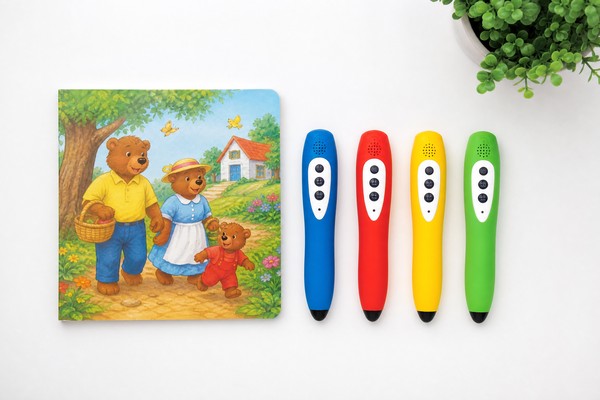
This guide helps procurement managers, clinical directors, special education coordinators, and school district buyers evaluate Picture Book Reading Pens (story pens, OID reading pens) for speech therapy and special needs use. Story pens are hand‑held audio devices that play recorded narration, prompts, or cues when the pen tip touches an encoded area on a printed page. For clinics and schools the device must do more than play stories: it must support assessment and practice workflows, be durable and sanitizable, protect child data, and integrate with education or therapy programs.
Key recommendations:
– Prioritize devices with phoneme/word-level playback control, adjustable playback speed (0.5–1.5x), repeat and loop modes, and clear human voice audio (≥ 85 dB SPL at 10 cm with < 3% THD).
– Require multi-user profile management, local and secure cloud storage options, and compliance with COPPA/FERPA/GDPR where applicable.
– Choose pens that use robust, repeatable identification tech—OID optical codes printed at 300–600 dpi or NFC tags for reusability—depending on your print and book lifecycle.
– For interactive therapy, select pens with on‑device speech recognition (ASR) that supports pediatric voices or cloud ASR with pediatric models and a measured word recognition rate ≥ 80% on target clinical populations.
– Expect unit prices: low end $10–30, mid $40–90, advanced $100–250. Include content production costs per title ($300–$5,000 depending on quality and localization), and SaaS/admin licensing $1–10 per user/month if analytics are required.
This document provides technology comparisons, feature and specification thresholds, procurement checklist, cost modeling, safety and compliance considerations, supplier evaluation criteria, and practical buyer feedback drawn from schools and therapy providers.
What Is Picture Book Reading Pen and Who Uses It
Definition
– A Picture Book Reading Pen (story pen / talking book pen / OID reading pen) is a handheld device that plays prerecorded or synthesized audio when its tip is touched to encoded locations (dots, patterns, NFC tags, QR targets) in a printed book or on a dedicated touch surface.
– Common names: OID pen (optical identification), talking pen, reading pen, story pen.
Primary user groups in the speech therapy / special needs context
– Speech-language pathologists (SLPs) in clinics and hospitals: for articulation practice, stimulation of language, and homework reinforcement.
– Special education teachers and classrooms (K–12): to support emergent literacy, vocabulary, sentence repetition, and independent practice.
– Early intervention teams and preschools: for parent coaching and multisensory learning.
– Assistive technology teams and occupational therapists: for augmentative support, fine motor practice, and sequencing tasks.
– School districts and therapy provider networks deploying shared assets across multiple users.
Typical use cases
– Receptive language development using narrated stories with targeted pause-and-repeat segments.
– Articulation drills: model → record and compare functions, and phoneme-level playback.
– Vocabulary building with picture-word pairing and multi-sensory prompts.
– Auditory discrimination and phonological awareness tasks using slowed playback and syllable segmentation.
– Home practice programs enabling carryover of clinic exercises.
Operational contexts
– Shared device pools across classrooms/clinics, requiring robust user profiles and content access control.
– One-to-one facilitation requiring accessibility features and customization per student.
– Offline environments (school districts with restricted internet) requiring local content and on‑device analytics.
Why Demand Is Growing
Clinical and educational drivers
– Evidence-based emphasis on increased practice intensity and frequency; devices enable daily, supervised independent practice without one-to-one clinician time.
– Rising diagnosis rates of speech and language disorders and of developmental disabilities (ASD prevalence estimates remain ~1–2% in school-aged populations depending on region), increasing demand for scalable therapy tools.
– Push for inclusive classrooms: teachers need tools that allow differentiated instruction and individualized scaffolds.
– Workforce shortages in SLPs and special educators: technology mitigates capacity limits by enabling paraprofessionals and parents to deliver structured practice.
Operational drivers
– Cost pressures: districts seek lower‑cost means to deliver evidence‑based practice outside scheduled therapy sessions.
– Remote and hybrid therapy: demand for devices that support asynchronous practice, remote monitoring, and teletherapy augmentation.
– Data-driven programs: need for tools that provide usage analytics, progress metrics, and documentation for IEPs (Individualized Education Programs).
Technology drivers
– Advances in TTS and ASR have increased usability for pediatric speech tasks.
– Printing and NFC tagging costs have fallen, making book-based interactive content cheaper to produce.
– Cloud platforms enable centralized content updates, usage analytics, and multi-site management.
Key Technology Differences
Overview
Selecting the right identification and audio architecture is a core technical decision. Three main technologies are used to trigger audio and interaction: OID optical codes, NFC/RFID tags, and camera/QR detection. Each has trade-offs for durability, cost, printing, reusability, and clinical suitability.
OID (Optical Identification) pens
– How it works: A coded dot/micro-pattern is printed on the page. The pen’s optical sensor reads the pattern and maps to audio stored on the pen or server.
– Strengths: Low unit cost for pens, no electronics embedded in books, high touch accuracy (typical hit rate > 99% with 300–600 dpi printing), offline operation.
– Weaknesses: Requires high-quality printing; opaque covers or glossy lamination can reduce read reliability. If book content changes, reprinting required.
– Use-case fit: Best when large quantities of custom printed materials are acceptable and offline operation is required.
NFC / RFID tags
– How it works: Passive NFC tags embedded/affixed to pages or stickers are queried by the pen’s NFC reader.
– Strengths: Robust read across paper types, reprogrammable tag options (NFC NTAG203/216), long-term durability, suitable for laminated or vinyl surfaces.
– Weaknesses: Higher per-book cost (tags $0.05–$0.40 each in bulk), requires physical integration (embedding tags), limited tag read range (< 4 cm), susceptible to magnetic interference in some setups.
– Use-case fit: Best for durable multi-year materials, library-type assets, or where reassigning content to tags is needed.
QR / camera-based systems
– How it works: Device camera scans printed QR or AR markers; backend maps marker ID to audio.
– Strengths: No special printing required beyond printed code, flexible mapping, can support high-resolution overlays and multimedia linking.
– Weaknesses: Slower interaction (camera autofocus latency 200–800 ms), requires sufficient ambient light, more power consumption, larger form factor needed for camera modules.
– Use-case fit: Projects where visual overlays and multimedia integration are prioritized and latency is acceptable.
Audio architecture: Pre-recorded human voice vs TTS vs hybrid
– Pre-recorded audio: Best naturalness and fine control of prosody; higher production cost ($300–$5,000 per title depending on narration length and localization). Static content unless re-recorded.
– Text-to-Speech (TTS): Scalable and editable, modern neural TTS offers very high naturalness. For therapy, need TTS with phoneme-level tagging, SSML support, and pediatric or neutral voices. On-device TTS requires higher compute/price; cloud TTS incurs privacy considerations.
– Hybrid: Pre-recorded key segments (e.g., model words) with TTS-generated scaffolds; reduces production costs while retaining natural models.
Speech recognition (ASR)
– On-device ASR: Lower latency and better privacy; limited by compute and model size; current small-footprint models may reach 70–85% WER (word error rate) on children’s speech.
– Cloud ASR: More accurate with larger models and pediatric training datasets; requires secure transmission (TLS), data retention policies, and possible compliance with COPPA/HIPAA/GDPR.
– Use in therapy: ASR should offer scored feedback (binary correctness, confidence scores, phoneme-level errors) and configurable sensitivity for atypical speech. Vendors should provide performance metrics on pediatric speech, with separate benchmarks for ages 3–5 and 6–12.
Connectivity
– Offline-only pens: Store audio on-device (internal flash 128–512 MB typical) and operate without network; good for privacy and low-infrastructure contexts.
– Bluetooth pens: Allow streaming, firmware updates, and connection to apps; battery impact must be considered.
– Wi‑Fi enabled pens: Support cloud sync and real-time analytics but increase cost and require network configuration and security management.
Key Features and Specifications to Evaluate
Hardware: physical, audio, and battery
– Tip technology and accuracy: OID read accuracy > 99% under recommended printing; NFC read success rate > 98% within 2–3 mm placement. Ask suppliers for read reliability tests at 3 printing/life-cycle stages.
– Ergonomics: pen length 120–150 mm, weight 40–80 g; rubberized non-slip grip and left/right handed design. Consider larger grips for fine motor issues (diameter 15–22 mm).
– Audio output: peak SPL ≥ 85 dB at 10 cm; frequency response 300–6,000 Hz for voice clarity; THD < 3% at typical listening levels. Include headphone jack (3.5 mm) and volume limiter (max 85 dB for children; configurable).
– Speaker specs: 0.5–2 W class, distortion measured. Prefer external ear/headphone compatibility for clinic environments.
– Battery: Li-Ion rechargeable; capacity 500–2,000 mAh depending on usage. Typical runtime 6–20 hours of intermittent use; standby months. Support USB-C charging and report charging time (e.g., 0–100% in 2–3 hours).
– Durability: drop-tested 1.2 m (tabletop to floor) for at least 100 cycles; IP rating if relevant (IPX4 splash resistant recommended for daily classroom use). Replaceable tips and spare parts availability.
Software and content
– Playback controls: play, pause, repeat single unit, play region loop, adjustable speed 0.5–2.0x in 0.1 increments, backward/forward skip (sentence/word), bookmarking, and section repeat.
– Phoneme-level playback: ability to tag phoneme/segment boundaries in content (SRGS/SSML or proprietary mapping).
– Recording & comparison: on-device recording of student responses with A/B compare playback and time-aligned visual or audio markers for clinicians.
– Multi-user profiles: per-user data isolation, up to hundreds of profiles on device or via cloud, ability to assign content to profiles.
– Analytics & reporting: session duration, number of repetitions, tasks completed, accuracy scores (if ASR used), export to CSV/PDF, IEP-friendly reporting format.
– Content management: Web-based CMS for uploading audio, mapping print codes, scheduling content, and batching updates. Support batch import of 100+ assets and localization workflows.
– Integration: APIs/SDK, LTI or xAPI (Tin Can) support for learning systems; SAML/SCIM for user provisioning in larger districts.
– Offline workflows: synchronization queue for offline usage; local storage limit (specify MB/GB). Confirm per-pen storage (e.g., 512 MB supports ~5 hours high-quality audio at 128 kbps).
Accessibility and clinical features
– Volume limiting (85 dB), clear male/female/pediatric voice options, high signal-to-noise (> 60 dB).
– Repetition and cueing levels: immediate repeat, delayed repeat, graduated fading.
– Pause points and scaffolds: clinician can insert pause points, prompts, and varying cue levels.
– Phoneme visualization: optional app with waveform and spectrogram for clinician use in therapy.
– Custom marker mapping: ability to define targets at word, syllable, or phoneme level.
Supply chain and manufacturing
– Minimum order quantities (MOQs) for custom branding: typically 500–1,000 units for OEM pens, less for white-label stock.
– Lead time: stock units 7–21 days; custom hardware 8–16 weeks including tooling and testing.
– Certifications: CE, FCC, RoHS typical. If classified as toy, EN71 compliance may apply. Battery standards: IEC 62133, UN38.3 for transport.
– Warranty: at least 12 months standard; 24 months preferred for institutional deployments. On-site repair options for large contracts.
Pros and Cons
Pros (clinics and schools)
– Scalable, low-cost way to increase practice frequency outside therapist sessions.
– Supports multimodal learning (audio + touch + print) which is effective for early literacy and language development.
– Can be used offline for privacy and in low-connectivity settings.
– Reduces clinician/admin workload when integrated with progress tracking; supports data collection for IEPs and billing documentation.
Cons / Limitations
– ASR accuracy on atypical pediatric speech remains imperfect; expect false negatives/positives, and validate on your target population before relying on automated scoring.
– OID-based systems require consistent high-quality printing; wear and lamination can degrade performance over time.
– Content updates can be expensive if relying solely on pre-recorded audio; hybrid TTS reduces cost but requires QA for clinical acceptability.
– Durable hardware is needed for school environments; cheaper units often have nib/wire/connector failures within 6–12 months.
– Regulatory ambiguity: if marketed with clinical claims, vendors may need medical device conformity; buyers should consult regulatory counsel.
Step-by-Step Decision Guide
Define clinical and operational requirements
– Scope the use: assessment only, therapy with feedback, homework reinforcement, classroom independent practice.
– Target users: ages (3–5, 6–12), diagnoses (phonological disorders, apraxia, ASD), co-morbid motor or sensory impairments.
– Environment: clinic (controlled), classroom (shared), home (parent supervised), rural/offline.
Prioritize features
– Mandatory: reliable touch-to-audio mapping, adjustable playback speed, human-quality audio, headphone jack, durable tip, 12+ months warranty.
– Important for clinics: on-device recording, phoneme-level playback, ASR scoring (with pediatric benchmark), multi-user profiles, user analytics export.
– Important for schools: multi-seat licencing, centralized content management, offline sync, easy sanitization, rugged housing.
Create an RFQ checklist
– Device hardware specs (weight, battery capacity, drop test results, charging type).
– Read technology (OID/NFC/QR) and read accuracy tests under classroom lighting and lamination conditions.
– Audio specs (SPL, distortion, headphone support).
– Software features (ASR specs, data retention policies, CMS capabilities, API).
– Certifications (CE/FCC/EN71/IEC 62133/UN38.3) and factory audit reports (SMETA/BSCI if required).
– Pricing tiers by quantity including replacement parts and sample unit price.
Pilot before large procurement
– Run a 4–8 week pilot with representative users (clinicians, teachers, students) across 3–5 sites.
– Pilot deliverables: device usage logs, clinician/teacher feedback, ASR accuracy report on 50–100 child utterances, content usability assessment, sanitization and durability notes.
– Define KPIs: increase in practice minutes per week, percent of tasks completed, ASR scoring accuracy, device fault rate < 2% during pilot.
Contract and rollout
– Negotiate warranty, spare parts, firmware update policy, training, and SLA for cloud services.
– Include acceptance criteria: read accuracy, battery performance, response latency (e.g., audio begins ≤ 200 ms after touch).
– Plan spare inventory based on usage: recommend spare part pool 10% of deployed units for initial 12 months (i.e., 5 spares per 50 units).
Training and implementation
– Provide 2–4 hours of clinician training, plus user guide and quick reference sheets.
– Create templates for IEP integration and parent-home practice protocols.
– Schedule firmware and content update windows to avoid disruption.
Pricing and Cost Analysis
Unit price bands (typical market ranges)
– Low-end basic pens (OID basic audio playback, 128 MB flash): $10–30 each; limited features and durability.
– Mid-range (better audio, recording, Bluetooth, 256–512 MB flash): $40–90 each.
– Advanced (ASR-capable, Wi‑Fi/Bluetooth, 512 MB–2 GB, CMS integration): $100–250 each.
Content production and printing
– Voice recording studio rates: $100–$400 per hour depending on locale and narrator quality. A 10–minute fully produced story with editing and tagging costs $300–$1,200.
– Localization (translation + re-record): 50–100% of base production cost per language.
– Printing with OID codes on paper: marginal cost per book typically +$0.05–$0.30 for printed OID micro-dots at scale (10k+). Laminating or hard-cover increases costs.
– NFC tags: $0.05–$0.40 each depending on type and order size; embedding increases assembly cost.
Software and service fees
– CMS/admin license: can be included or charged per-seat. Typical SaaS pricing $1–$10 per user/month for analytics and content management.
– Custom development (API, SCORM, LTI) $5k–$30k depending on integration complexity.
– Ongoing content updates: budget per title or per hour for content team; licensing models vary.
Total cost of ownership example (50-unit clinic deployment, 3-year period)
– Hardware: 50 mid-range pens at $75 = $3,750.
– Spares (10%): 5 units at $75 = $375.
– Content production: 10 custom therapy modules at $800 each = $8,000.
– CMS license: $5 per user/month for 10 clinicians over 36 months = $1,800.
– Support & warranty extension (optional): $1,000.
– Total 3-year cost = $14,925 → cost per student/session depends on utilization. If average 200 unique students/year and each receives 20 practice sessions/year, cost per session ≈ $1.18.
Negotiation levers
– Volume discounts on hardware and printing (5–25% at 500+ units).
– Bundled content discounts and multi-year SaaS commitments.
– Localized voice re-use rights and perpetual vs licensed content options.
Competitive Landscape
Supplier ecosystem
– Categories of suppliers:
– Large toy and education manufacturers offering turnkey pen+book packages.
– Chinese ODMs providing low-cost OEM pens and customization.
– Specialist edtech vendors that combine pens with cloud CMS, ASR, and analytics tailored to clinics and schools.
– Medical device integrators who can advise on regulatory pathways when therapeutic claims are made.
Selection criteria for suppliers
– Demonstrated experience serving schools/clinics: ask for reference customers and deployments of similar size.
– Content production capabilities: in-house studio vs recommended vendors; turnaround times 2–8 weeks.
– R&D and firmware support: roadmaps for ASR and security features, responsiveness to bug fixes.
– Quality systems: ISO 9001; for medical or regulated claims, ISO 13485 or evidence of regulatory counsel engagement.
– Factory audit and CSR: SMETA/BSCI reporting for procurement policies.
Market dynamics
– Many low-cost vendors supply basic OID pens; differentiation occurs at software, ASR, and data management levels.
– Consolidation trend: CMS/ASR vendors partner with hardware OEMs to offer complete solutions.
– Regional differences: EU buyers emphasize privacy and CE marking; US buyers emphasize FERPA/COPPA and classroom procurement rules.
What Buyers Say
Common procurement feedback from clinics and schools
– Positive: Devices increase independent practice time and engagement; students enjoy tactile interaction; teachers appreciate content that aligns directly with curriculum or IEP goals.
– Negative: Cheaper pens fail within 6–12 months due to tip wear or connector failures. OID reliability drops when schools laminate pages or use glossy covers without vendor guidance.
– ASR concerns: Many buyers report lower-than-expected ASR accuracy on young or disfluent speakers. Clinicians recommend pilots to establish realistic accuracy metrics for target populations.
– Data and integration: Buyers value easy export of reports in IEP-ready formats and single sign-on (SSO) support for district IT. Lack of APIs is a common complaint.
– Service: Warranty and spare parts are decisive. Long lead times for replacement or repair disrupt classroom schedules.
Direct buyer requests commonly surfaced
– Multi-user mode with parental access controls.
– Sanitizable housing (bleach-safe materials) and clear cleaning instructions.
– Localized voices and accents for students in bilingual programs.
– Pre- and post-testing modules and exportable proof-of-practice for billing and IEPs.
Safety, Maintenance and Compliance
Safety standards to require and verify
– Electrical & EMC: CE (EU), FCC (US), or regional equivalents.
– Toy safety where applicable: EN71 parts 1–3 (mechanical/physical, flammability, chemical) for devices marketed as toys.
– Battery safety: IEC 62133 compliance and UN38.3 for transport of lithium batteries.
– Materials: RoHS for hazardous substances; verify phthalate and heavy metal limits as per local regulations.
– If the device is used to diagnose or treat conditions and labeled as such, consult regulatory counsel for potential FDA (US) or MDR (EU) medical device requirements (21 CFR Part 820 / EU MDR).
Data protection and privacy
– COPPA (US): For any online data collection from children under 13, compliance is required. Vendors should provide parent consent mechanisms and data handling policies.
– FERPA (US): School deployments that involve student directory data should align with district FERPA policies and data-sharing agreements.
– GDPR (EU): Data controller/processor agreements, lawful basis for processing, and Data Protection Impact Assessments (DPIA) may be needed for special categories.
– HIPAA (US): If devices or cloud services store protected health information (PHI) within a clinical setting, vendor should be prepared to sign a Business Associate Agreement (BAA) and provide HIPAA-compliant infrastructure.
Maintenance best practices
– Sanitization: manufacturer-provided instructions. Prefer devices tolerant of alcohol wipes or diluted bleach; avoid immersion unless IP rating supports it.
– Daily: check tip integrity and wipe speaker grille and high-touch areas.
– Weekly: full charge/discharge cycle if devices are idle to maintain battery health.
– Annual: firmware update and audit of content and read mapping accuracy.
– Spare parts inventory: recommended 10% spare pens, 20% spare nibs for active shared deployments.
Disposal and recycling
– Follow e-waste regulations; provide take-back options for end-of-life lithium batteries and electronics.
– Request supplier end-of-life policies and recycling programs.
Frequently Asked Questions
Q: Which pen technology is best for schools with laminated books?
A: NFC tags or RFID are more robust for laminated or non-paper surfaces. OID requires matte unlaminated paper or microdot printing compatible with lamination. Always test a sample under expected lamination process.
Q: Can devices work offline?
A: Yes. Many pens operate entirely offline with on-device audio and recording. For analytics or ASR, connectivity is required; vendors typically support offline usage with deferred sync.
Q: How accurate is ASR for children?
A: On typical pediatric speech, cloud ASR tuned for children can achieve 80–90% word recognition in quiet conditions for age-appropriate utterances; accuracy drops for atypical articulation, background noise, or very young speakers. Require vendor-provided pediatric benchmarks on a comparable population before deployment.
Q: How long does content production take?
A: For pre-recorded professional narration: 1–4 weeks per title depending on length, revisions, and localization. Bulk projects and templated modules can be faster.
Q: Do pens pose infection control risks?
A: Shared devices are high-touch. Select models validated for wipe-down with hospital-grade disinfectants and supply a cleaning protocol. Consider assigning pens per student where feasible.
Q: Are these devices regulated as medical devices?
A: Typically they are not if used as educational or entertainment tools. If marketed with therapeutic claims (diagnosis, treatment), they may fall under medical device regulations (FDA, MDR). Buyers should confirm labeling and vendor claims and consult regulatory counsel.
Q: What warranty and support levels should I expect?
A: Institutional buyers should expect at least 12 months warranty, with options to extend to 24–36 months. SLA for replacements and firmware support should be included in contracts for deployments >100 units.
Contact Toyvao
For procurement assistance, RFQ templates, sample evaluation kits, and supplier matching for story pens and related content services, contact Toyvao’s institutional sourcing team via the Toyvao business inquiry forms on Toyvao.com or request an RFQ kit through the site. Provide: deployment size, desired technologies (OID/NFC/ASR), content requirements (number of titles, languages), pilot site locations, and preferred timelines to receive a detailed sourcing plan and sample cost estimate.
