
Executive Summary
This guide helps B2B buyers source, evaluate, and price accessory bundles for Picture Book Reading Pens (also called Story Pens, Talking Book Pens, OID Reading Pens). Accessories covered are charging docks, spare tips/nibs, carry and storage cases, and common replacement parts (batteries, speakers, OID/optical heads, PCBs, connectors). The document gives clear decision criteria, technical specifications, manufacturing and compliance requirements, pricing ranges, lead-time expectations, recommended bundle configurations for common buyer use cases (retail, schools, after‑school programs), and practical supply‑chain and warranty recommendations.
Buyers who will use this guide:
– Educational technology distributors and retailers
– School procurement officers and PTAs buying in bulk
– ODM/OEM product managers bundling reading pens for private label
– After-sales/repair centers and spare‑parts resellers
– Importers focused on children’s educational toys
Key takeaways:
– Accessory bundles materially affect product uptime, customer satisfaction, and TCO in institutional settings. Upfront accessory costs are typically 15–40% of the pen’s FOB unit cost depending on bundle depth.
– Minimum acceptable certifications: CE/EN71, RoHS, FCC (if wireless), and IEC 62133/UN38.3 for lithium batteries when applicable. U.S. market also requires CPSIA compliance for toys.
– Typical lead times: samples 1–3 weeks; production 4–8 weeks for standard accessories, 8–14 weeks when molds/custom housings are required.
– MOQ expectations: 100–500 for standard off‑the‑shelf accessories; 500–2,000 for custom-branded or molded parts.
This guide is a procurement instrument: use the step‑by‑step decision path and technical checklists to specify RFQs, evaluate samples, and operationalize spare‑parts inventory plans.
What Is Picture Book Reading Pen and Who Uses It
Definition and core function
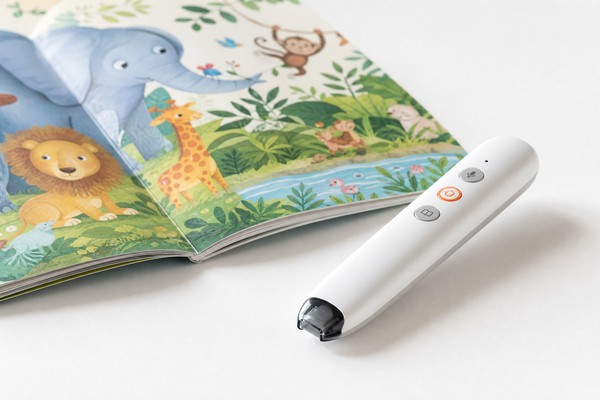
– A Picture Book Reading Pen is a handheld electronic reader that identifies printed codes or touch points on picture/storybooks and plays corresponding audio (narration, sound effects, language content). Technology variants include OID (Optical Identifier) pens that read dot/coded patterns, capacitive/touch pens that sense embedded conductive ink or printed targets, and audio‑trigger pens that use IR sensors or RFID in some implementations.
– Typical hardware: microcontroller, OID/optical sensor or touch sensor, small speaker (0.5–2.5 W depending on size), microphone (optional), flash memory (4–512 MB commonly), rechargeable battery (Li‑ion 3.7 V, 300–1,200 mAh), USB or USB‑C port for charging/data loading.
Primary users and buyer profiles
– Schools and preschool networks: purchase by classroom to support literacy and language programs. Buyers prioritize durability, simple charging/management, and low TCO.
– Retail chains and e‑commerce sellers: purchase retail-ready single‑unit bundles with branded carry case and charger for consumers.
– Libraries and community centers: need robust locks/secure carry cases, multi‑pen charging stations, and clear replacement parts availability.
– ODM/OEMs and private label brands: require components and accessory engineering to integrate with new pen models.
– Aftermarket and repair shops: buy spare tips, speakers, batteries, and PCB modules to service out-of-warranty units.
Operational context
– Institutional use often entails heavy cycles: tens of thousands of taps per month per pen depending on program size. Accessories that enable rapid charging, durable tips, and easy parts replacement reduce downtime and total ownership cost.
Why Demand Is Growing
Market drivers
– Growing investment in early literacy tools and digital‑analog hybrid learning aids. Governments and NGOs continue to fund programs that adopt reading pens in preschool and rural educational settings.
– Rising acceptance of tactile and multi‑sensory learning modalities; reading pens provide audio assistance for emergent readers and support multilingual content.
– Aftermarket demand: as pens proliferate in classrooms, the need for repairs, replacement tips, and institutional charging/management accessories rises.
Operational reasons for accessory adoption
– Battery lifetime and charging logistics: single pen batteries rarely sustain high institutional usage for a full day; multi‑slot charging docks, spare batteries, and power‑management accessories become necessary.
– Part wear: tips/nibs and speakers have finite life in heavy use. Spare parts reduce device obsolescence and extend usable lifetime.
– Asset management: carry cases, rigid trays, and charging stations reduce loss/theft and ease distribution across classrooms.
Regulatory and safety forces
– Stricter safety and transport rules for lithium batteries push buyers to invest in compliant battery replacements and charging docks that include overcharge protection and certified adapters.
Financial rationale
– Replacing a worn pen typically costs more than supplying spare tips and a battery swap. For institutional buyers, accessory bundles that reduce replacement rates by 20–40% drive lower TCO.
Key Technology Differences
Charging docks and stations
– Connector type: USB‑A charging with dedicated adapters vs USB‑C with PD capability. USB‑C is preferable for future‑proofing and faster charging (up to 9–18 W supported in some docks).
– Charging topology: single‑pen docks (passive charging) vs active smart docks with charge management and battery health monitoring. Active docks support timed charging cycles and may include temperature sensors.
– Slot count and current per slot: common multi‑slot docks are 4, 8 and 12‑slot. Typical per‑slot charge current: 500–1,000 mA (1×500 mA supports 300–500 mAh battery overnight; 1×1,000 mA needed for faster cycles).
– Communication: some docks use UART/USB bridging to update firmware/content during charging (important for schools that push content updates centrally).
Spare tips / nibs
– Materials: silicone, thermoplastic elastomer (TPE), polyoxymethylene (POM/Delrin), and conductive rubber for capacitive models.
– Fit and retention: press‑fit, threaded, or magnetic. Magnetic retention is faster to service; threaded is more secure for heavy use.
– Wear life: expected cycles vary widely—specify test protocol. Typical ranges: 20,000–100,000 touches depending on material and user profile.
– Tip geometry: rounded vs conical. Rounded tips reduce book surface wear; conical tips increase precision for small touch targets.
Carry cases and storage
– Materials: EVA foam inserts with molded PE shells, ballistic‑nylon soft cases, or PU/leather retail pouches.
– Capacity and fit: per‑pen compartments, cable pockets, and accessory trays. Institutional cases include lockable latches and mounting brackets.
– Shock protection rating: some cases use closed‑cell foam with 1–2 J drop protection; evaluate to your acceptance criteria for transport resilience.
Replacement parts
– Batteries: Li‑ion 3.7 V cells, capacity 300–1,200 mAh. Key specs: IEC 62133 compliance, cycle life 300–500 full cycles, internal protection circuit module (PCM) recommended.
– Speakers: 8–32 mm drivers, impedance 4–8 Ω, output 0.5–2 W. Replacement parts should match physical footprint and connector type.
– OID/optical modules: sensor modules with defined reading range (e.g., 1–8 mm), LED illumination wavelength (visible/NIR), and interface (I2C/UART).
– PCBs and connectors: custom PCBs must be cross‑referenced by firmware compatibility; spare micro‑USB/USB‑C ports are common failure points.
Content and firmware interfaces
– Storage and transfer: USB mass storage vs USB HID vs proprietary loader. Docks that also act as a content distribution hub should support bulk file transfer and batch flashing.
– Firmware update mechanisms: secure bootloader (recommended) and verified firmware signing for stable field updates.
Key Features and Specifications to Evaluate
Technical checklists for RFQs and sample evaluation
Charging docks
– Input power: specify 100–240 VAC adapter range for global use; output per dock as 5 V / total current e.g., 5 V @ 6 A for 8-slot at 750 mA/slot.
– Connector type per pen: USB‑C or proprietary pogo pins; pogo-pin arrays require precise mechanical tolerances (0.1 mm).
– Charge protocol: CC/CV for Li‑ion; include overvoltage, overcurrent, short‑circuit, and temperature cutoffs.
– Indicators and status: per‑slot LED (charging/ready), and possibly a multicolor indicator for fault states.
– Physical specs: material ABS/PC, dimension per slot, ventilation for heat dissipation; weight and stackability for storage.
– Certifications: CE, RoHS, FCC class B, and power adapter safety approvals (IEC/UL/CCC).
Spare tips / nibs
– Material spec (hardness, Shore A), tip diameter (2–6 mm typical), and mounting mechanism.
– Recommended tactile force and contact area to not damage printed codes (specify test values if available).
– Life testing: provide accelerated abrasion test data (e.g., 50,000 cycles at 0.5 N to simulate classroom use) and failure criteria.
– Packaging: bulk tray, sealed poly bag, or individually blistered for retail.
Carry and storage cases
– Internal foam cut dimensions, external dimensions, and weight.
– Lockability, stackability, and means of transport (handles, shoulder straps).
– Fire retardancy (depending on regulation) and material recyclability.
Replacement parts
– Battery spec: nominal voltage 3.7 V, capacity, PTC/PCM presence, cycle life, storage temperature range, and certificate list (IEC 62133, UN38.3).
– Speaker spec: diameter, magnet type, impedance, SPL at 1 W/0.5 m, and resonance frequency.
– Optical sensor spec: reading distance, illumination wavelength, eye‑safety (IEC 62471) if LED illumination used.
– PCB and firmware compatibility: BOM with component references and firmware version requirements.
Quality and durability tests to require
– Drop test: 1.2–1.5 m onto concrete, multiple faces, 10 cycles.
– Tip abrasion test: specified cycles at defined pressure and speed with recorded degradation.
– Battery cycle test: minimum 300 cycles to 80% capacity.
– Environmental: humidity 85% RH at 40 °C for 96 hours; low/high temp storage −20 °C to 60 °C.
– EMI/EMC: per FCC/CE class B.
Packaging and labeling
– Retail vs institutional packaging: retail boxed units should include clear user instructions, warranty card, and visible CE/FCC marks. Institutional bulk kits should include inventory labels and itemized packing list.
– Barcodes/labels with SKU, batch/lot number, manufacture date, and serial numbers for asset tracking.
Pros and Cons
Charging docks
Pros:
– Centralized charging reduces downtime and simplifies asset management.
– Smart docks can handle content updates and charge monitoring.
– Multi‑slot docks reduce per‑unit charger clutter and failure points.
Cons:
– Higher upfront cost; custom docks require tooling and longer lead times.
– Docks with batteries or advanced electronics increase shipping complexity and cost.
– Proprietary pogo-pin designs can limit cross‑compatibility with future pen revisions.
Spare tips
Pros:
– Lowest-cost way to extend field life; easy to replace in minutes.
– Reduces returns and customer dissatisfaction.
Cons:
– Incorrect tip hardness or geometry can damage book surfaces or reduce recognition accuracy.
– High-frequency replacement becomes a recurrent procurement cost to manage.
Carry cases
Pros:
– Reduce transport damage and loss; enable single‑kit distribution.
– Custom foam inserts allow mixing accessories in one kit.
Cons:
– Additional bulk and shipping weight.
– Custom molds significantly increase MOQ and lead time.
Replacement parts
Pros:
– Allow pen longevity and field repair; lowers lifecycle cost.
– Enables refurbishment programs and resale of used units.
Cons:
– Managing SKU proliferation increases logistical complexity.
– Some parts (custom PCB, OID head) may be single-sourced and vulnerable to obsolescence.
Step-by-Step Decision Guide
Define objectives
– Specify target user (retail consumer vs school vs library).
– Define expected daily use cycles per pen (e.g., heavy institutional: >1,000 touches/day).
– Set target lifecycle (e.g., 3 years in classroom environment).
Create a technical spec packet
– Pen model(s) and exact charging interface.
– Battery capacity and charging current limits.
– Physical dimensions for case inserts and dock slots.
– Firmware/loader requirements for docks if content distribution is needed.
Select accessory types and minimum acceptable specs
– For schools: choose multi‑slot active docks (4–12 slots), spare tip set (200% of pens), 1 spare battery per 5 pens, carry case for 20 pens.
– For retail: single‑pen wall adapter + USB‑C cable, branded EVA case, 10 spare tips per 100 retail units stocked at distributor.
– For repair centers: bulk packs of speakers, batteries, OID modules, and replacement PCBs; test stations for firmware flashing.
Issue RFQs with clear measurement and test criteria
– Provide drawings with dimensions and tolerance, electrical specs, and environmental tests.
– Request sample lead times and testing evidence (lab reports, in‑house test results).
Evaluate samples
– Run the specified life, drop, and charging tests. Verify firmware/loader compatibility and data‑transfer speed (MB/min) for batch updates.
– Check mechanical fit: tip retention force, dock pogo pin alignment, case foam tolerances.
Negotiate terms
– MOQ and pricing tiers: 500, 1,000, 5,000 units common thresholds.
– Warranty and RMA: 12 months for electronics typical; negotiate parts replacement windows.
– Spare parts lead time and guaranteed supply terms (e.g., 12 months post‑product EOL).
Plan inventory and spare‑parts strategy
– Keep at minimum: spare tips equal to 20–30% of active units; batteries equal to 5–10% of units; at least one spare PCB and speaker per 100 units.
– Setup reorder point based on lead time + safety stock (e.g., if lead time 8 weeks and daily failure rate 0.1%, reorder when stock covers 12 weeks).
Validate logistics and compliance
– If batteries are shipped, ensure supplier provides UN38.3 certification and proper packaging. For sea freight, verify IMDG code compliance.
– Confirm label requirements per destination market (WEEE, recycling, CE declarations).
Onboard supplier and build SOPs
– Create service manuals for pen disassembly and parts replacement.
– Standardize spare‑parts SKU naming and barcoding to simplify returns and repairs.
Pricing and Cost Analysis
Accessory cost ranges (FOB China estimates; adjust for other origins)
– Single‑slot passive dock (plastic, USB cable): $1.50–$4.00 each (MOQ 200–500).
– Multi‑slot active dock (4–12 slots, CC/CV, LEDs): $12–$45 per dock depending on slot count and electronics.
– Spare tip (standard silicone or POM): $0.02–$0.30 each depending on material and packaging.
– Retail EVA carry case: $1.50–$6.00 each depending on size and custom foam insert.
– Institutional hard case (molded PE with foam insert, 20‑pen): $18–$55 per case.
– Replacement battery (3.7 V Li‑ion 300–1,200 mAh, IEC 62133): $1.00–$4.00 each.
– Speaker driver (8–32 mm): $0.05–$0.80 each.
– OID/optical sensor module: $3.00–$15.00 each depending on integration and volume.
– Micro/USB‑C port assemblies: $0.10–$0.80 each.
Example cost build for a school bundle (per pen basis, FOB)
– Pen (base model): $12.00 (mid-range)
– Multi‑pen share of 8‑slot active dock (assume one dock per 8 pens; dock $30): $3.75 per pen
– Spare tips allocation (10 tips per pen at $0.10): $1.00 per pen
– Carry case (shared, 8 pens in 20‑pen case not realistic — assume bulk case per 20 pens $40 -> $2 per pen): $2.00
– Spare battery allocation (1 spare per 5 pens at $2.50): $0.50 per pen
Total accessory add: $7.25 → Package FOB per pen becomes $19.25
Wholesale & retail margins
– Typical B2B margin expectations: distributors aim for 20–40% gross margin; retail markups from FOB to consumer can be 2.0–3.0× depending on brand and channel.
– Example: FOB $19.25 → Distributor sells to retailer at $26–29 → MSRP $52–78 depending on brand positioning and bundling.
Cost levers to negotiate
– Increase order volume to step down unit costs (price breaks common at 500, 1,000, 5,000).
– Standardize on off‑the‑shelf docks and cases to avoid tooling charges.
– Reduce accessory variants—standardize tip materials and case sizes across pen SKUs.
Hidden costs to budget
– Battery shipping premium (air freight regs), additional lab testing fees for certifications per market, tooling for custom cases/docks, packaging artwork and UPC/GS1 license costs.
Competitive Landscape
Supplier types
– Full‑service electronics ODMs (Shenzhen/Dongguan): provide pen + accessory integration, firmware support, and often require larger MOQ (1,000+).
– Component shops (Yiwu, Ningbo): supply off‑the‑shelf accessories, lower MOQs (100–300), limited integration support.
– Mold and tooling specialists (Zhejiang, Guangdong): for custom cases and plastic parts — tooling costs $1,000–$12,000 depending on complexity.
– Aftermarket spare parts suppliers: specialize in batteries, speakers, and USB ports; useful for repair centers and long‑tail support.
Geographic hubs
– Guangdong (Shenzhen, Dongguan): electronics integration, advanced assembly, firmware support.
– Zhejiang (Ningbo, Yiwu): injection molding, accessory sourcing, trade shows for small components.
– Jiangsu/Shanghai: higher‑tier electronics assembly and quality control.
Channels to find suppliers
– B2B marketplaces: Alibaba, GlobalSources, Made‑in‑China for initial RFQs.
– Trade shows: Canton Fair, Global Sources Electronics shows for direct factory meetings and sample reviews.
– Local agents: for complex RFQs and on‑site audits; expect agent fees but reduce quality and logistics risk.
Competitor profile
– Established edu‑tech brands (e.g., companies offering proprietary reading pens) tend to integrate accessories tightly into product ecosystems; often source accessories from multiple suppliers.
– White‑label manufacturers focus on price and quick custom branding; buyers must manage testing and component longevity.
Risks and mitigations
– Single-source parts (custom OID sensor) create supply risk—negotiate multiple sources or buy long‑term stock.
– Design changes to pen may invalidate docks/pogo pin footprints—lock in accessory compatibility before product launch.
– Counterfeit and non‑compliant batteries—require batch testing and certificates from recognized labs.
What Buyers Say
Common procurement feedback distilled from institutional and distributor purchasers
Durability and uptime matter most
– School buyers report that charging logistics and tip wear drive most complaints. Multi‑slot docks and spare nib programs significantly reduce device replacements.
Compatibility headaches
– Buyers frequently cite compatibility mismatches (e.g., pogo‑pin spacing, USB‑C orientation, firmware loader protocols) as the primary barrier to bundled accessory reuse across product generations.
After‑sales and spare parts availability
– The ability to source batteries, speakers, and OID modules 12–24 months post‑product launch is a top criterion. Buyers prefer suppliers offering guaranteed spare‑parts supply agreements.
Packaging and labeling
– Retailers want accessory bundles that are shelf‑ready with clear UPCs and tidy packaging. Schools prefer bulk kits with inventory lists and asset tags.
Price vs total cost tradeoff
– Buyers accept higher upfront accessory costs (e.g., active docks) when they reliably reduce replacements and labor for recharging and repair.
Warranty and RMA performance
– Speed of replacement parts delivery—48–72 hour turnaround for critical items—strongly influences supplier selection for institutional customers.
Safety, Maintenance and Compliance
Mandatory certifications and compliance
– Toy and child product safety: EN 71 series (Europe), ASTM F963 (U.S.), CPSIA for lead and phthalates limits.
– Electrical safety: CE (LVD) and applicable national safety marks; UL listing for chargers/adapters if selling in North America.
– Battery safety: IEC 62133 testing and UN38.3 certification for transport. For U.S./EU recycling and battery labeling, comply with local directives (Battery Directive in EU).
– EMC: FCC Part 15 (U.S.) and CE EMC testing for wireless/wired product interference.
– RoHS and REACH: required for EU market and commonly requested by large retailers.
Shipping and transport rules
– Li‑ion batteries shipped by air require UN certification and specific packing instructions (IATA DGR). Sea freight still requires IMDG compliance.
– For mixed shipments (pens and batteries), suppliers should segregate and declare batteries appropriately to avoid shipment delays.
Maintenance best practices
– Tips: clean with mild soap and water weekly for institutional devices. Avoid solvents that degrade printed book surfaces or tip materials.
– Batteries: avoid full discharge below 3.0 V; charge management to maintain 20–80% state of charge for storage where feasible. Rotate spares in stock annually to avoid aging.
– Speakers/ports: provide SOPs for inspecting and reseating connectors; schedule field checks every 3–6 months in heavy‑use settings.
Warranty and RMA policy recommendations
– Standard: 12 months on electronics and chargers; 3–6 months on consumables (tips).
– RMA SLA: supply replacement parts within 7–14 days for standard orders; 48–72 hours for critical institutional customers if stock is held locally.
– Spare part kit: recommend buyers hold a 3‑month spare kit at regional distribution centers.
Testing and documentation to request from suppliers
– Test reports for IEC 62133, UN38.3, EN71, RoHS, and EMC.
– QC protocol and incoming inspection sampling plan (AQL 2.5/4.0 recommended for electronics).
– Assembly and disassembly service manual with torque specs, connector part numbers, and BOM.
Frequently Asked Questions
What accessories are essential vs optional?
– Essential for institutional buyers: multi‑slot charging dock, spare tips, at least one spare battery per 5 pens, and a case/kit for transport. Optional: firmware‑capable docks, retail carry cases, and spare speaker/modules for low‑volume consumer channels.
How many spare tips/batteries should I stock?
– Rule of thumb: spare tips 20–30% of unit count for light use and 100% (1:1) for heavy classroom rotations. Spare batteries 5–10% for typical programs; 20% for multi‑shift use.
What are realistic lead times?
– Samples: 1–3 weeks. Production for standard accessories: 4–8 weeks. Custom molded cases or docks: add 4–8 weeks for tooling. Always add contingency for peak seasons: +2–4 weeks.
What MOQs should I expect?
– Off‑the‑shelf tips and simple cables: MOQs 100–300. Customized branded cases or molded docks: MOQs commonly 500–2,000 due to tooling and setup.
How do I ensure compatibility between pen and dock?
– Provide suppliers with exact mechanical drawings, pogo‑pin locations, insertion depth, and electrical charging specs (charging current and data lines). Request a mechanical fit sample before full production.
How are batteries shipped internationally?
– Follow IATA/IMDG rules. Many carriers require UN38.3 certifications and special documentation. Work with suppliers that provide compliant packaging and documentation to avoid air freight rejections.
What warranty terms are standard?
– Electronics: 12 months. Consumables such as tips: 3–6 months. For institutional contracts, negotiate extended support and parts availability clauses (24–36 months post‑EOL).
Can accessories be co‑branded?
– Yes. Co‑branding is standard but increases MOQ, tooling, and unit cost. Provide artwork and color specifications in Pantone and accept proof samples prior to mass runs.
How do I handle obsolescence risk?
– Lock in long‑term supply contracts or buy spares upfront. Request last‑time‑buy windows and 12–24 month parts supply guarantees in contracts.
Contact Toyvao
To request an RFQ, sample kit, or supplier evaluation, provide:
– Product model numbers and technical drawings for the pen(s)
– Target annual volume for accessories and expected order cadence
– Required certifications and target markets (e.g., EU/US/CN)
– Desired MOQ and target FOB price per accessory
– Any branding/artwork files (Pantone/AI/PDF)
Email: sales@toyvao.com
Request form: https://toyvao.com/contact
Include the list above in your initial message for fastest response. Toyvao will provide a sourcing plan, estimated FOB pricing, sample lead times, and a recommended spare‑parts stocking schedule within 3 business days of receiving a complete RFQ packet.
