
Executive Summary
This guide explains how to negotiate lead times and production schedules with manufacturers of Picture Book Reading Pens (also called Story Pens, Talking Book Pens, OID Reading Pens). It provides practical, actionable steps and contract language you can use to reduce risk, shorten time-to-market, and improve on-time delivery rates. Content covers the product specifics that drive timing (hardware components, firmware, book printing), typical lead-time benchmarks, critical bottlenecks, negotiation levers (MOQ, sample policy, staggered shipments, penalties and incentives), production control metrics (AQL, KPIs), cost implications of scheduling changes, and regulatory/testing timelines that must be integrated into schedules.
Key takeaways:
– Typical prototype-to-production timelines: prototype 2–6 weeks; tooling/mold 15–30 days; pilot run 7–14 days; mass production 30–90 days depending on complexity and MOQ.
– Main schedule drivers: SoC/MCU availability, speaker and battery lead times, PCB assembly & programming, firmware validation, and synchronized book printing/binding.
– Negotiation levers: break orders into staggered shipments, secure components with on-site POs, include penalties for late delivery and bonuses for early delivery, require BOM and component lead-time transparency, use conditional tooling amortization clauses.
– Typical contractual terms: 30% deposit / 70% balance before shipment or LC at sight; AQL 2.5/4.0; on-time delivery KPI >95%; defect rate <1% for first 3 shipments.
This guide uses specific numbers, industry norms, and legal / quality controls you can implement in RFQs, POs, and supplier agreements.
What Is Picture Book Reading Pen and Who Uses It
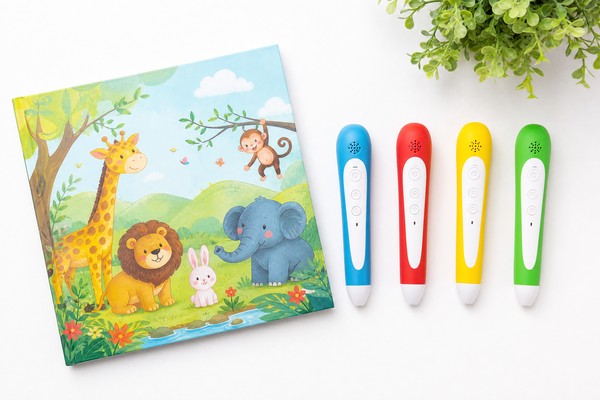
Picture Book Reading Pen: a handheld electronic reader that recognizes printed triggers on illustrated books (optical ID dots, printed OID codes, NFC tags, or QR points) and plays synchronized audio (pre-recorded narration, sound effects, or TTS). Typical components:
– Main MCU/SoC (ARM Cortex-M0/M3 class or specialized audio SoC)
– Flash memory (NOR/NAND, 8 MB–128 MB typical) or TF card up to 32 GB
– Audio DAC and amplifier; mono or stereo speaker (0.5–3W)
– Optical sensor or OID lens; alternative: NFC/RFID or computer-vision module
– Microphone for recording/voice interaction and firmware upgrades via USB/Bluetooth
– Battery: Li-ion (500–1500 mAh) or NiMH (not recommended for modern designs)
– Interface: micro-USB / USB-C for charging and data transfer; optional Bluetooth/Wi‑Fi
– Housing: ABS/PC; stylus tip with IR/optical pickup; child-safe clasp or lanyard
Who uses it:
– Educational publishers integrating audio with picture books
– Toy and educational product distributors and retailers
– Schools and kindergartens deploying digital learning resources
– Private-label brands seeking bundled book-pen solutions
– ODMs/OEMs building custom hardware for publishers
Use scenarios:
– Pre-recorded narration synchronized to illustrations (most common)
– Multi-language versions (one device supporting multiple language audio banks)
– Interactive learning: Q&A, vocabulary playback, songs, record-and-playback
Why Demand Is Growing
Market drivers with measurable impacts:
– Early childhood digital learning adoption: OECD and UNICEF reports indicate growing investment in early learning tech; global edtech market CAGR ~12% (past 5 years).
– Localization and multi-language education: publishers need low-cost ways to add audio in multiple languages without producing separate printed books. A single TF-card-based pen can host 5–20 language packs.
– Declining prices of MCUs and flash memory: unit BOM cost reductions (20–40% over 5 years) enable greater adoption by mid-market publishers.
– Content-driven differentiation: publishers can add audio to back-catalogue titles cost-effectively; incremental revenue generation per SKU typically justifies MOQ and tooling.
Quantitative signals:
– Typical publisher runs: 2,000–10,000 books per title in first print; pen+book bundle demand often follows 1:1 or 1:2 pen:book ordering in initial runs.
– Price points: retail pens range $20–60; white-label OEM cost to distributors typically $6–$35 depending on features and materials.
– Inventory sensitivity: publishers require short lead times during seasonal peaks (Q3–Q4) and often keep safety stock covering 8–16 weeks.
Operational consequences:
– Synchronizing book printing schedules (often 15–45 days for offset printing + binding) with electronics production is the main scheduling challenge.
– Content recording and localization timelines are often underestimated; voice recording and QA per language typically 1–3 weeks.
Key Technology Differences
Technology choices materially change lead times and schedule risk. Expect suppliers to quote varying timelines based on which approach you select.
Detection method
– Optical ID (OID) dots
– Pros: low cost, long-established in product category, offline operation, low power.
– Cons: book printing must include precise registration; printing alignment failures prolong QA and rework.
– Lead-time impact: requires coordination with book printer. Corrections require reprinting; typical buffer add 7–21 days.
- NFC/RFID
- Pros: no printed registration, can hold larger code sets, faster detection.
- Cons: per-book tag cost (USD 0.05–0.30 per tag), additional supplier for embedded tags, potential printing/binding alterations.
-
Lead-time impact: additional procurement for tags and changes in book binder process—add 10–30 days.
-
QR/barcode or machine vision
- Pros: flexible, can encode more info.
- Cons: higher compute, higher latency, increased firmware complexity.
- Lead-time impact: longer firmware development and field testing (add 2–6 weeks).
Audio source
– Pre-recorded WAV/MP3 per segment
– Pros: deterministic behavior, minimal CPU.
– Cons: storage needs increase with language and audio quality.
– Lead-time impact: content preparation and mapping typically 1–4 weeks per language.
- TTS (Text-to-Speech)
- Pros: eliminates massive audio recording for multiple languages.
- Cons: offline high-quality TTS requires powerful SoC and licensing; may need cloud fallback.
- Lead-time impact: firmware and licensing negotiations add 2–8 weeks.
Connectivity
– No wireless
– Lower BOM and regulatory burden; faster production.
– Bluetooth/Wi‑Fi
– Adds regulatory testing (FCC, CE RED), firmware complexity, and certification time—add 4–12 weeks.
Storage architecture
– Internal flash (8–128 MB): predictable, lower per-unit manufacturing cost; content must be flashed or burned in production.
– Flashing time in production: 10–60s per unit depending on data size and interface.
– TF card (microSD):
– Pros: easy content updates, faster initial production because preloaded cards can be inserted.
– Cons: logistics of preloading or procurement of high-quality microSD cards (lead times for cards during shortages 4–12 weeks).
Power and charging
– Built-in Li-ion batteries (500–1500 mAh) require UN38.3 battery testing and compliant packaging for transport, increasing schedule and cost.
– Replaceable AA/AAA: easier compliance but lower user experience and recurring cost for buyers.
Manufacturing and testing complexity
– SMT assembly, wave soldering, and functional test fixtures: require 7–21 days setup. Firmware burn-in and aging tests (recommended 48–72 hours at 40°C) add time but reduce field failures.
Each choice increases or reduces schedule risk. Select the technology stack first; then negotiate lead times against that stack.
Key Features and Specifications to Evaluate
Specifications that directly affect scheduling, production complexity, and supply risk. Get firm numbers for each.
Hardware
– MCU/SoC: model, supply chain lead time, package type. Typical families: ARM Cortex-M0/M3/M4, BES audio SoCs. Provide part numbers and vendor.
– Flash memory: size in MB; interface (SPI, NAND); manufacturer and lead times.
– Audio quality: sample rate (8 kHz–48 kHz), bit depth (8–16 bit), typical audio bitrate if compressed (MP3/VBR).
– Speaker driver: diameter (20–40 mm), impedance (4–8 Ω), power rating (0.5–3 W), SPL (dB at 0.5 m).
– Battery: chemistry, capacity (mAh), nominal voltage, charge protocol (CC/CV), expected runtime (hours of playback at defined volume), recharge cycles (500–1000).
– Sensor: OID sensor resolution, detection latency (ms), detection accuracy (% in field tests).
– Connectivity: USB type (micro-B/USB-C), support for USB mass storage, Bluetooth version if present.
Firmware & Content
– Firmware flashing method: over-the-air (Bluetooth), USB mass storage, or JTAG/SWD. Time per unit for flashing (seconds).
– Content format: audio file format (WAV/MP3), folder structure, naming conventions, maximum number of audio segments supported (10k–100k).
– Multi-language architecture: partitioning of memory, language switching mechanism.
Mechanical
– Housing material: ABS/PC grades, flame retardant? Thickness and IP rating.
– Stylus tip: replaceable, material, durability testing (number of taps before wear).
– Connector locations and tooling requirements for molds.
Production & QA
– MOQ: usual ranges 500–5,000 units per SKU for simple pens; complex units 2,000–10,000.
– Pilot run size: recommended 100–500 units for full validation.
– AQL levels: commonly AQL 2.5/4.0 for functional defects; cosmetic AQL 4.0/6.5.
– Burn-in: recommended 48–72 hours at elevated temperature and continuous playback.
– Functional test coverage: power, audio, OID detection, button life test (50k actuations), battery charge/discharge cycle test.
Regulatory & Safety
– Battery tests: UN38.3, IEC 62133 (for Li-ion), shipping restrictions.
– Toy safety: EN71-1/2/3, ASTM F963; chemical tests for heavy metals (EN71-3).
– EMC: FCC Part 15, CE EMC, RED for wireless modules.
Logistics & Packaging
– Unit dimensions and weight: include for freight calculation.
– Inner carton and master carton sizes, units per master carton.
– Packaging lead time and customization (printed boxes, manuals) typically 10–20 days.
Ask suppliers for exact numeric answers to these. Vague or missing numbers signal scheduling risk.
Pros and Cons
Pros of careful negotiation and schedule optimization
– Reduced stock-outs and reduced rush airfreight cost (air freight is 3–10x sea freight per kg).
– Faster time-to-market increases revenue for seasonal launches.
– Lower defects from agreed burn-in and testing procedures.
– Clear contractual remedies reduce disputes and expedite corrective action.
Cons / trade-offs
– Tighter penalties and shorter lead times may increase unit price (expedite fees 5–20%).
– Building buffer inventory increases carrying costs (typically 20–30% annual inventory carrying rate).
– Locking long-term supply or higher deposit mitigates lead-time risk but increases working capital tied up.
– Heavy customization (multiple languages, custom molds, RFID integration) lengthens lead times and increases risk of rework.
Specific supplier behavior to watch:
– Component shortages passed through as lead-time extensions; require early BOM lock.
– Suppliers may quote optimistic lead times under pressure; internal acceptance tests often extend timelines.
– Book printing errors are common schedule killers—plan for at least one reprint buffer in initial schedules.
Step-by-Step Decision Guide
This section gives a practical sequence to negotiate lead times and production schedules.
Define the target timeline and hard deadlines
– Back-calculate from your launch date. Example: Retail launch 2026-11-01. Work backward:
– Final shipment arrival (including customs and inland): 2026-10-01
– Factory ship date (FOB): 2026-09-20
– Production completion: 2026-09-10
– Mass production start: 2026-07-10 (60-day production window)
– Tooling ready / components on hand: 2026-06-20
– Pilot run & validation: 2026-05-20
– Firmware and content locked: 2026-04-30
– Sample approval: 2026-04-01
Map critical path items
– List tasks that cannot overlap: SoC lead time, mold completion, book printing, battery procurement, certification.
– Get supplier-provided lead-time breakdown for each item with part numbers.
Prepare your RFQ with required lead-time transparency
– Ask for itemized lead-time for: components, PCB assembly, speaker, battery, tooling, packaging, book printer, preloading content.
– Require suppliers to list long-lead parts and alternative part numbers.
– Require commitment to a component reservation plan (purchase order for key ICs upon PO).
Negotiate MOQ and pilot-run strategy
– Push to lower MOQ for first SKU (500–1,000) with premium or shared tooling amortization.
– If supplier insists on larger MOQ, negotiate staggered delivery: 20% pilot, 80% remainder within X weeks.
– Request 100–200 pilot units for functional and retail packaging validation.
Lock in content and firmware parallel to hardware
– Start content authoring, voice recording, and QA at least 8–12 weeks before first sample.
– Use a content delivery schedule (SOW) with milestones and penalties for late delivery from content vendors.
Agree production milestones and acceptance criteria
– Milestones: pre-production sample (PPS), first article inspection (FAI), pilot-run approval, mass production start, mid-run QC, final inspection.
– Acceptance criteria: AQL levels, test fixtures and checklists, battery performance thresholds (e.g., playback at 70 dB for 8 hours), OID detection accuracy >98% across 80% of book conditions.
Include penalties and incentives
– Penalty for late delivery: typically 0.5%–1% of order value per week up to 5% cap.
– Bonus for early delivery: 0.25%–0.5% per week, capped.
– Accelerated production fee: a fixed hourly or per-unit fee for rush production.
Use staged payments tied to milestones
– Example: 30% deposit on PO; 10% upon tooling completion; 20% upon pilot approval; 30% before shipment; 10% withheld for 30 days after delivery for QA holdback.
Demand BOM transparency and long-lead item reservations
– Require shared BOM with manufacturer to identify single-source parts and lead times.
– Negotiate partial payment to secure long-lead components on your behalf or require supplier to confirm reservations.
Set KPIs and reporting cadence
– KPIs: on-time delivery >95%, defect rate <1% for functional defects in first three lots, sample TAT 7–14 days.
– Weekly production updates with critical-path components, build progress (% complete), and issues.
– Monthly supplier review meetings for ongoing programs.
Agree change control and force majeure clauses
– Define change order process with lead-time impact assessment within 3 business days.
– Limit force majeure to events beyond reasonable control and require mitigation steps and notification timelines.
Plan for testing and certification
– Schedule third-party lab testing for toy safety and battery compliance 4–8 weeks concurrent with pilot run.
– Factor time for corrective actions from certification failures; plan for at least one 4-week iteration.
Plan for logistics and customs
– Confirm Incoterms (FOB vs CIF vs DDP). FOB gives you control of shipping; DDP removes risk but increases supplier handling time.
– Book freight early (sea freight booking lead time 7–14 days; air freight available faster but costly).
– If transporting Li-ion batteries, ensure compliant documentation and preferred shipping method; air shipments of battery-powered goods may be restricted.
Use inspection and QA gates
– Pre-shipment inspection (PSI) at AQL agreed level.
– Hire third-party inspection firm (SGS, Bureau Veritas) for first 3 shipments.
– Require supplier to make inspection reports available within 48 hours of inspection.
Escalation matrix
– Agree on contact points at supplier: account manager, production manager, QC manager, sourcing manager, and escalation to GM for unresolved issues.
Pricing and Cost Analysis
Understand the cost components to quantify the trade-offs of lead time negotiation.
Typical BOM cost breakdown (example mid-range pen, FOB China)
– SoC/MCU: $1.50–$5.00 (varies with audio and connectivity features)
– Flash memory/microSD: $0.20–$3.00
– Speaker: $0.30–$1.50
– Battery: $0.80–$3.50
– Optical sensor / OID module: $0.15–$1.00
– PCB and SMT assembly: $1.00–$3.50
– Housing & tooling amortization: $0.50–$3.00 (depends on amortization over MOQ)
– Firmware and content preloading: $0.20–$2.00
– Packaging & manual: $0.50–$2.00
– Testing & QA per unit: $0.10–$0.50
– Overhead, shipping, duties: $0.50–$2.00
Unit cost range by complexity:
– Basic offline OID pen: $6–$12 FOB
– Mid-range pen (multi-language, TF card, higher battery): $12–$22 FOB
– High-end (Bluetooth, Wi-Fi, premium acoustic): $22–$35+ FOB
Cost of shortening lead time
– Expedited component procurement (air freight for components): add 5–15% to BOM cost.
– Rush SMT or overtime hours: 10–25% surcharge.
– Air freight for finished goods: add 3–10x sea costs per kg. Example: sea freight $0.50/kg vs air freight $3–$7/kg.
– Penalty for rework or failed certification: variable; rerun tooling or reprint adds 10–40% to unit cost on that batch.
Cost of holding inventory vs expedited production
– Carrying cost assumption: 20–30% annual; cost per unit per month = unit cost * 0.02.
– Example: $12 unit, 3 months safety stock cost ≈ $0.72–$1.08 additional carrying cost.
– Use total landed cost model (unit cost + shipping + duties + carrying cost + QA) to compare options.
Pricing levers to negotiate
– Commit to larger annual volumes to achieve lower unit price and prioritized production slots.
– Agree on rolling forecast with minimum binding MOQ for each quarter.
– Offer advance payment to secure long-lead components at supplier cost.
Currency and escalation
– Fix currency and agree on price adjustment clause for raw-material escalation (Cap at ±5–8% or fixed formula using commodity indices).
Competitive Landscape
Global manufacturing footprint and supplier types:
China (Guangdong, Shenzhen, Dongguan)
– Largest concentration of pen manufacturers and assembly shops.
– Strength: broad supply chain, low unit costs, expertise in OID-based pens.
– Typical lead times: prototypes 2–4 weeks; mass production 30–60 days.
– Risks: capacity constraints during Chinese New Year and peak season, component allocation.
Vietnam
– Growing EMS presence; popular for partial assembly and full-box assembly to diversify risk.
– Strength: lower labor costs than some regions, easier compliance with certain trade agreements.
– Typical lead times: slightly longer setup for tooling if supplier is new to pen designs; mass production 45–90 days.
Taiwan / South Korea / Japan
– Specialty parts (acoustic engineering, advanced SoCs) and design houses; higher cost, shorter lead times for engineering support.
Eastern Europe
– Smaller volume, higher labor cost; used occasionally for European customization with shorter shipping.
Supplier types
– ODMs: supply full product and branding; shorter time to market if product already exists but limited flexibility on lead times for customization.
– EMS (Contract manufacturers): handle manufacturing with capability to source components; better for long-term programs.
– PCB contract shops: used when you need local quality control for critical electronics.
Market concentration
– A handful of Chinese OEMs control much of low-cost pen supply; large publishers often maintain preferred supplier lists and multi-sourcing to reduce risk.
How buyers use sourcing strategies
– Dual-sourcing: maintain primary and secondary suppliers in different regions to hedge lead-time risk.
– Strategic sourcing: negotiate long-term frameworks with price breaks and priority capacity.
– Local stocking: place inventory in regional warehouses to smooth seasonal spikes.
What Buyers Say
Common feedback from buyers working with pen manufacturers:
Positive
– Suppliers can deliver reliable hardware at low unit cost when BOM is stable.
– Off-the-shelf hardware solutions (reference designs) enable faster launches: 4–8 weeks for first shipment.
– TF-card preloading reduces production friction and simplifies content updates for multi-language SKUs.
Negative / recurring problems
– Component lead-time surprises: SoC and memory shortages can add 6–12 weeks unexpectedly.
– Book-printing alignment with OID codes fails more often than expected; lack of prepress coordination causes reprints.
– Underestimated firmware validation time; field issues with detection under real lighting conditions.
– Suppliers sometimes lack transparency on which components are constrained.
– QC on first shipments can be poor without enforced burn-in and third-party inspection.
Supplier selection red flags
– Reluctance to share BOM and long‑lead-item list.
– Unwillingness to accept staged deliveries, pilot runs, or third-party inspections.
– Vague or optimistic lead-time estimates without supporting data.
Best practices reported
– Buyers who lock long-lead parts early (via small prepayments) face fewer delays.
– Buyers who include book printers in weekly production calls prevent alignment errors.
– Using sample approvals with clear measurement criteria reduces disputes.
Safety, Maintenance and Compliance
Regulatory requirements are often the largest hidden timeline and cost item.
Toy safety
– EN71-1 (mechanical and physical), EN71-2 (flammability), EN71-3 (migration of certain elements/heavy metals).
– ASTM F963 for US market; includes mechanical, chemical, and labeling requirements.
– Age grading and choking hazard tests; small-part test for children under 3.
Battery compliance
– IEC 62133: safety requirements for batteries (Li-ion).
– UN38.3: required for air transport of lithium batteries. Testing and certification can take 2–6 weeks.
– Labeling and packaging requirements for transport.
Electromagnetic and radio
– FCC Part 15 for US if Bluetooth/Wi‑Fi used.
– CE (EMC and RED) for EU markets.
– Testing timeline: 2–6 weeks per certification body; failures require re-design and retesting (add 4–12 weeks).
Hazardous substance directives
– RoHS and REACH compliance for chemical restrictions common in EU.
– Heavy metal testing per EN71-3 may require material supplier traceability.
Maintenance considerations
– Battery replacement and lifecycle: specify replacement policy and accessible battery design if required.
– Firmware updates: how they will be delivered (USB, SD card, Bluetooth), update security, and field rollback procedures.
– Spare parts availability: speaker, stylus tips, batteries; commit to spare-part availability for X years (commonly 2–5 years).
Testing & documentation to require from suppliers
– Test reports for EN71/ASTM, IEC 62133, UN38.3, RoHS, and EMC.
– Full material declarations (MSDS) and traceability of plastic resin batches for EN71-3 chemical tests.
– Battery safety data sheets and transport declarations.
– A maintenance and disposal guidance document for end-users.
Schedule impact of testing
– Pre-certification testing should be scheduled after pilot run sample availability: allow 4–8 weeks minimum for primary certifications, plus buffer for corrective actions.
Frequently Asked Questions
What is a realistic lead time for a new pen SKU?
– Prototype: 2–6 weeks; tooling: 15–30 days; pilot run and pre-production testing: 2–4 weeks; mass production: 30–90 days. Total: typically 3–6 months from concept to shipment for a moderately complex pen.
How can I shorten the timeline without increasing risk?
– Use an existing reference design (ODM) rather than a full custom design.
– Preload content on TF cards and source pre-stamped cards from approved vendors.
– Lock the BOM early and commit to paying for long-lead components upfront.
– Stagger shipments and perform a small first run to validate book-electronics integration.
What should I ask in the RFQ to ensure transparent lead times?
– Break down lead time by component, PCB assembly, tooling, speaker, battery, book printing, and packaging.
– Provide part numbers and supplier names for key components.
– State required milestones and ask for sample TATs for PPS, FAI, and pilot.
How do I protect against supplier delays for long-term programs?
– Include priority capacity clauses in annual contracts with defined production windows and penalties for missed priorities.
– Maintain a secondary supplier and consider consignment or buffer inventory for key components.
– Negotiate rolling forecasts with binding minimums per quarter.
What penalties are standard for late delivery?
– Typical range: 0.5%–1% of order value per week, capped at 5–10%. Negotiate both penalties and early-delivery bonuses.
How do tooling costs interact with lead time negotiations?
– Tooling is often the schedule gate. Ask for tooling completion dates and require sign-off on mold trials within a set number of days.
– Negotiate amortization of tooling cost based on binding annual volume or agree that tooling is refundable if supplier misses key milestones.
When should I schedule certification testing?
– After pilot run and FAI (first article inspection), but before mass production ramp. This avoids rejecting a whole run for non-compliance. Allocate 4–8 weeks.
How should I handle content localization timing?
– Plan 1–3 weeks per language for recording, editing, and QA; simultaneous recording for multiple languages is recommended to meet tight schedules.
What inspection levels should I use?
– Functional AQL 2.5/4.0; cosmetic AQL 4.0/6.5. Use 100% functional testing on pilot runs.
Contact Toyvao
For supplier sourcing, RFQ templates, BOM review, and contract clause templates related to Picture Book Reading Pens, contact Toyvao’s commercial sourcing team at sourcing@toyvao.com. Provide your target launch date, required technical spec sheet, expected annual volumes, and preferred shipping Incoterms to receive a customized supplier shortlist and negotiation playbook.
